
Disclaimer: This article is for educational and informational purposes only. It does not constitute financial or investment advice. Trading forex and CFDs carries significant risk of loss. Past performance of any strategy — including backtests — does not guarantee future results. Never trade with money you cannot afford to lose.
What Is This Strategy?
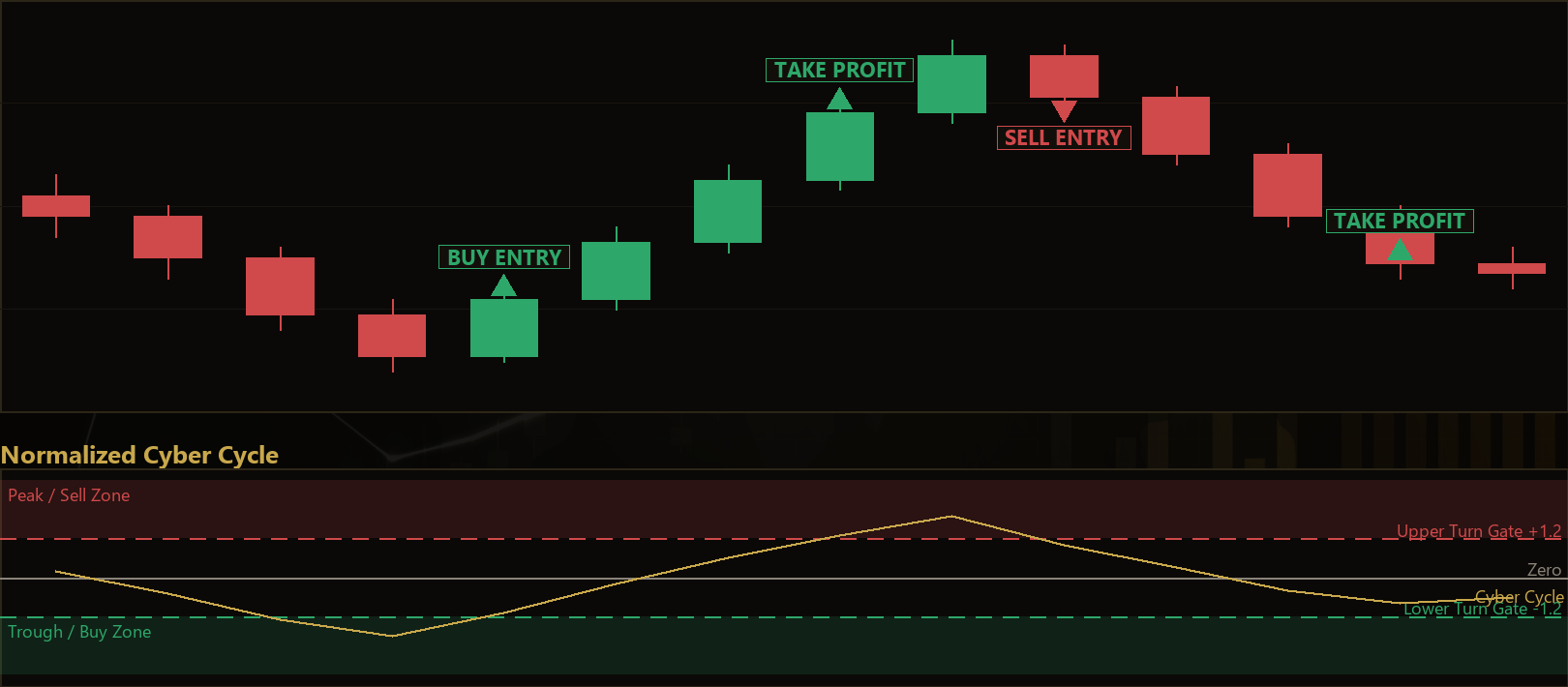
The Cyber Cycle Turn Reversal is a mean-reversion trading strategy built around John Ehlers' Cyber Cycle indicator — a low-lag recursive band-pass filter — applied as a counter-trend, turning-point tool on a single timeframe. Instead of chasing breakouts, it tries to identify the moment a short-term price cycle stops falling and begins to roll back up (or stops rising and rolls over), then trades against that recent extreme. In plain terms, it is a "fade the exhaustion" approach that waits for a confirmed turn rather than guessing where a move will end.
The core idea comes from a common way of modeling short-horizon markets: price action can be thought of as a dominant cycle riding on top of a slower trend, plus random noise. Ehlers' Cyber Cycle is designed to isolate that oscillating cyclic component with very little delay. Because the raw filter output grows and shrinks with price and volatility, the strategy normalizes it by the rolling standard deviation of its own recent values. This turns the signal into a scale-free oscillator — essentially a z-score (a measure of how far a value sits from its recent average, expressed in standard deviations) — so the same threshold settings behave consistently across symbols and volatility regimes.
As a learning tool, this strategy is best suited to traders who want to study oscillator-based mean reversion, digital signal-processing filters in trading, and the difference between reacting to an extreme versus waiting for a confirmed reversal. It is designed for liquid, ranging or rotational markets rather than strong one-directional trends. It is not a "set and forget" system, and it is presented here as a strategy analysis — a way to understand how cycle filters and confirmation logic combine — not as a profit opportunity.
How It Works
The strategy processes only completed bars. On each new bar it recomputes the Cyber Cycle across a rolling buffer of recent candles, normalizes it, and then inspects the three most recent values to detect a confirmed turn.
Building the signal:
- Median price — Each bar is reduced to its median price,
(High + Low) / 2, which is smoother than using the close alone. - 4-bar smoothing (FIR filter) — A weighted average of the last four median prices removes high-frequency jitter before the cycle math runs.
- Cyber Cycle (2-pole recursion) — A recursive filter isolates the oscillating component that swings around zero. Its speed is set by the
Alphaparameter. - Normalization — The raw cycle is divided by the population standard deviation of its last
NormPeriodvalues, producing a scale-free oscillator (roughly a z-score).
Entry conditions — the strategy signals a trade only on a confirmed turn beyond the threshold:
- Long signal: the normalized cycle formed a confirmed trough below
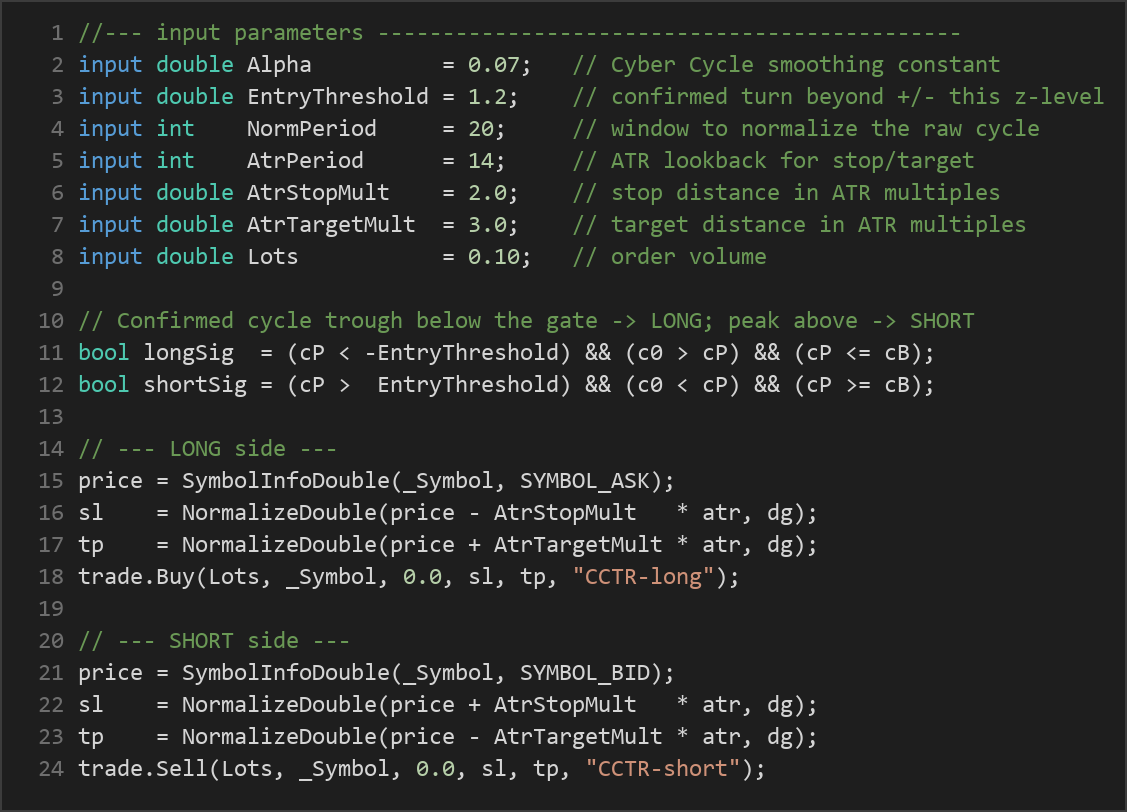
-EntryThreshold. Concretely, the pivot bar's value was below the negative threshold, the value one bar earlier was still falling or flat, and the newest value has ticked back up. This says the cyclic component was oversold and has started rolling up — the strategy goes long. - Short signal: the mirror image — a confirmed peak above
+EntryThreshold, where the cycle was overbought and has started rolling down — the strategy goes short. - Requiring the turn to be confirmed (an actual up-tick after the low, not merely "below the band") is what separates this from blindly catching a still-falling market.
Position handling and exits:
- Opposite-signal flip — If a long signal appears while a short position is open, the strategy closes the short first, then opens the long (and vice-versa). It avoids stacking duplicate positions on the same side.
- Stop-loss — Placed at
AtrStopMult × ATRaway from entry. ATR (Average True Range) measures recent volatility, so the stop automatically widens in fast markets and tightens in quiet ones. The ATR here is computed by hand from bar OHLC as a simple mean of true ranges. - Take-profit — Placed at
AtrTargetMult × ATRfrom entry. With the defaults (stop 2× ATR, target 3× ATR), the target sits farther away than the stop, giving a reward-to-risk ratio of roughly 1.5:1 on each trade before costs.
Because every calculation uses the primary symbol and the primary timeframe, the strategy simply runs on whatever chart timeframe you attach it to.
Strategy Parameters
| Parameter | Default | Min | Max | Description |
|---|---|---|---|---|
| Alpha | 0.07 | 0.02 | 0.20 | Cyber Cycle smoothing constant. Smaller values produce a longer, smoother cycle; larger values make it faster and more reactive. |
| EntryThreshold | 1.2 | 0.5 | 2.5 | The z-level a confirmed turn must occur beyond. Higher values demand a more extreme oscillator reading before a trade, producing fewer but more selective signals. |
| NormPeriod | 20 | 10 | 60 | Lookback window used to normalize the raw cycle into a scale-free oscillator (standard-deviation window). |
| AtrPeriod | 14 | 7 | 30 | Number of completed bars used to compute ATR for the volatility-scaled stop and target. |
| AtrStopMult | 2.0 | 1.0 | 4.0 | Stop-loss distance as a multiple of ATR. Larger values give the trade more room but risk more per position. |
| AtrTargetMult | 3.0 | 1.0 | 6.0 | Take-profit distance as a multiple of ATR. Sets the reward side of the trade relative to the ATR stop. |
| Lots | 0.10 | 0.01 | 1.0 | Order volume (position size) in lots for each trade. |
Recommended Chart Settings
This strategy was designed with liquid, rotational markets in mind — for example EUR/USD on the M15 to H1 timeframes. These conditions tend to produce the clean, repeating cyclic swings that a band-pass filter is built to capture, and the tight spreads of a major pair keep transaction costs from overwhelming mean-reversion edges.
You can attach the EA to other symbols and timeframes because it adapts to whatever chart it runs on, but be aware that behavior changes significantly across instruments and market regimes. Strongly trending markets, low-liquidity pairs, and very short timeframes (where noise and spread dominate) are the least favorable environments for a counter-trend cycle strategy. Results will vary across different market conditions, and any settings should be studied on a demo account before drawing conclusions.
How to Install on MetaTrader 5
- Download the .ex5 file from the link below
- Copy it to your MT5
MQL5\Expertsfolder - Restart MetaTrader 5 or refresh the Navigator panel
- Drag the EA onto a chart matching the recommended symbol and timeframe
- Configure the input parameters and enable Algo Trading
What to Consider Before Using This EA
Strengths of the approach. The Cyber Cycle is a genuinely low-lag filter, which means turning points are flagged closer to when they actually happen than with a lagging moving-average oscillator. Normalizing the output into a z-score makes the EntryThreshold behave consistently across volatility regimes, and the confirmation requirement (waiting for the cycle to actually turn) helps avoid entering while price is still accelerating against you. Volatility-scaled stops and targets adapt position risk to current market conditions rather than using fixed pip distances.
Known limitations. Every mean-reversion strategy shares one core weakness: it assumes moves will revert, and in a sustained trend they may not. A cycle filter can repeatedly signal "overbought" as a strong trend keeps climbing, producing a run of losing counter-trend trades. The band-pass math also introduces some ringing and can mistake a regime shift for another cycle swing. Parameters like Alpha and NormPeriod interact in non-obvious ways, so a setting that looks clean on one period may behave very differently on another — a reminder that curve-fitting to past data is a real risk.
Where it may underperform. Expect the weakest behavior in strong directional trends, during major news-driven expansions, on illiquid symbols with wide spreads, and on very fast timeframes where noise dominates the cyclic signal. This EA is a study tool for understanding filter-based reversion logic — it is not a guarantee of any particular outcome, and it should be evaluated critically rather than trusted blindly.
Risk Management Tips
Sound risk management matters more than any single indicator. Consider these general principles:
- Risk a small, fixed fraction per trade. A common guideline is to risk no more than 1–2% of account equity on any single position. Size your
Lotsso that the distance to the ATR-based stop represents that fraction — not the other way around. - Understand and expect drawdown. Even a well-designed strategy goes through losing streaks. Know the maximum drawdown you are willing to tolerate before you begin, and stop if it is reached.
- Test on a demo account first. Run the EA on a demo or a small account across varied market conditions before committing real capital, so you understand how it behaves in trends, ranges, and news events.
- Account for costs. Spread, commission, and slippage erode mean-reversion edges quickly, especially on shorter timeframes. Factor them into any evaluation.
- Never over-leverage. Leverage magnifies losses as much as gains. Keep total exposure modest, and avoid running multiple correlated strategies that can all lose at once.
- Keep records and review. Track your trades and periodically review whether the strategy is still behaving as expected under current conditions.
Risk Warning
Trading foreign exchange, CFDs, and other leveraged financial instruments involves substantial risk of loss and is not suitable for all investors. The strategies and tools discussed on this page are provided for educational purposes only and do not constitute financial advice, investment recommendations, or solicitation to trade. Always consult a qualified financial adviser before making trading decisions. Past backtest performance is not indicative of future results.
Downloads
- Expert Advisor: CyberCycleTurnReversal.ex5 (49 downloads)
- Source Code: CyberCycleTurnReversal.mq5 (58 downloads)
- Documentation: CyberCycleTurnReversal.pdf (53 downloads)