Disclaimer: This article is for educational and informational purposes only. It does not constitute financial or investment advice. Trading forex and CFDs carries significant risk of loss. Past performance of any strategy — including backtests — does not guarantee future results. Never trade with money you cannot afford to lose.
What Is This Strategy?
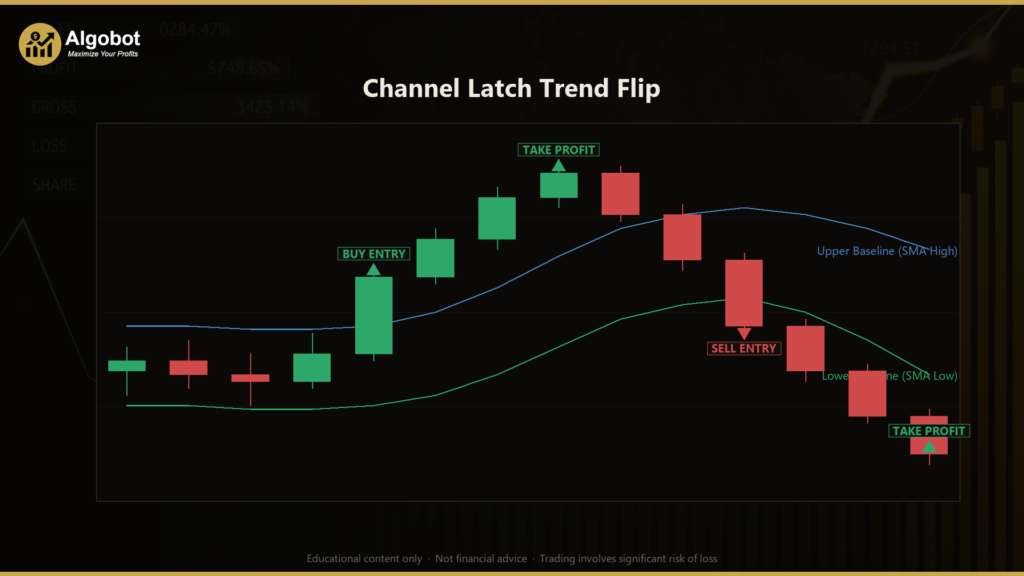
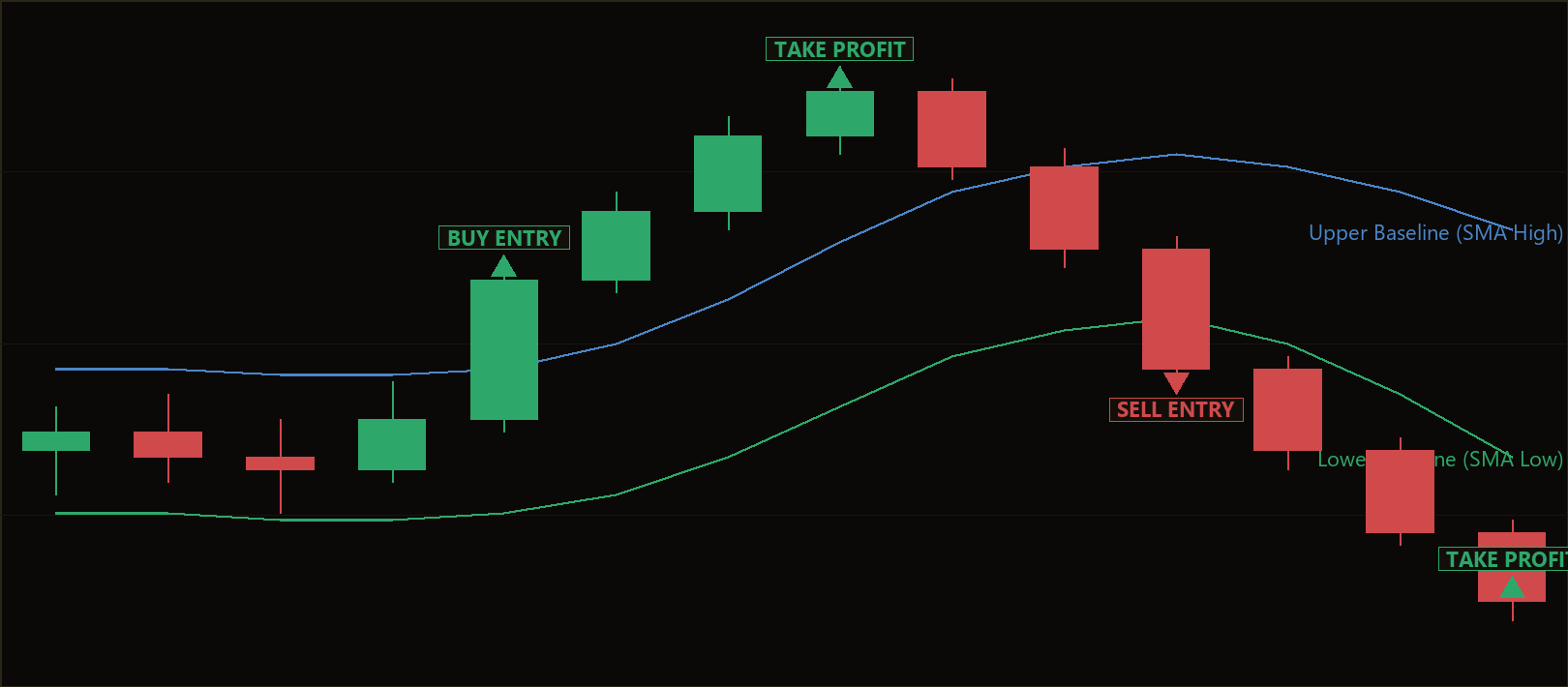
The Channel Latch Trend Flip is a trend-following strategy built around a two-line price channel and a single "latched" regime bit — a technique from the SSL-channel (Semaphore Signal Level) family of indicators. Instead of chasing every wiggle in price, it draws two moving-average baselines — one from recent highs and one from recent lows — and only recognizes a change of trend when price closes clean outside that envelope. This closing-price hysteresis is the heart of the method: it is designed to keep the system quiet during sideways ranges and to speak up only when a genuine regime change appears.
In plain terms, a latch is a memory switch. It flips to an "up" state when a candle closes above the upper baseline, flips to a "down" state when a candle closes below the lower baseline, and simply holds its last value whenever price is stuck between the two lines. Because the switch cannot change while price chops inside the channel, the strategy avoids many of the whipsaw entries that plague naive breakout systems. On top of the latch, three independent confirmation gates — a trend-slope filter, a decisive-break filter, and a candle-body filter — must all agree before any trade is placed.
This strategy is best understood as a learning tool for traders who want to study how hysteresis, multi-gate confirmation, and structural exits work together in a single, readable system. It was tuned with liquid forex majors such as EUR/USD or GBP/USD on higher timeframes in mind, but the logic is timeframe-agnostic. It is not a shortcut to results; it is a clean, transparent example of how a rules-based trend filter can be constructed and studied.
How It Works
The strategy evaluates its rules once per completed candle, so signals do not repaint mid-bar. Here is the full logic in plain English.
The channel and the latch:
- Upper baseline (
upBase) is a Simple Moving Average (SMA) of recent highs overChannelPeriodbars — think of it as a rolling resistance line. - Lower baseline (
dnBase) is an SMA of recent lows over the same period — a rolling support line. - The latch flips to +1 (up-regime) only when a candle closes above
upBase, and to −1 (down-regime) only when a candle closes belowdnBase. Between the two lines it holds its previous value. A fresh flip therefore signals that price has genuinely left the recent high/low envelope.
The three confirmation gates — a flip is ignored unless all three agree:
- Slope regime gate: A slow Exponential Moving Average (EMA) of closing prices over
TrendPeriodbars must be sloping in the same direction as the flip. The slope is measured by comparing the EMA now against the EMASlopeLookbackbars ago. This blocks counter-trend flips. - Decisive break gate: The flip candle must close beyond its baseline by at least
BreakAtrMult× ATR. ATR (Average True Range) measures recent volatility, so this converts a marginal poke over the line into a volatility-scaled requirement. Weak, shallow breaks are rejected. - With-trend body gate: The flip candle itself must close in the trade direction — a bullish body (close above open) for longs, a bearish body for shorts.
Entry signals (a single position at a time, symmetric long/short):
- The strategy signals a long when the latch flips up, the EMA slopes up, the break is decisive, and the candle body is bullish. It buys at the ask.
- The strategy signals a short when the latch flips down, the EMA slopes down, the break is decisive, and the candle body is bearish. It sells at the bid.
Exit and risk logic:
- ATR stop-loss: Placed at
SlAtrMult× ATR away from entry, so the risk distance adapts to current volatility. - ATR take-profit: Placed at
TpAtrMult× ATR away from entry in the profit direction. - Breakeven ratchet: Once price moves
BreakevenAtr× ATR in the trade's favour, the stop is pulled up to the entry price so an open winner is not allowed to turn back into a loss. - Regime-change exit: If the latch flips to the opposite state while a trade is open, the position is closed immediately — and the system may stop-and-reverse into the new regime on the same bar. This means losses can be bounded by structure, not only by the fixed stop.
Strategy Parameters
| Parameter | Default | Min | Max | Description |
|---|---|---|---|---|
| ChannelPeriod | 20 | 8 | 60 | Lookback for the high/low SMA baselines that form the latch channel. |
| TrendPeriod | 100 | 30 | 250 | Period of the slow EMA that defines the tradable trend regime. |
| SlopeLookback | 5 | 2 | 20 | Number of bars back used to measure the slow EMA's slope. |
| BreakAtrMult | 0.25 | 0.00 | 1.50 | Decisive-break margin; the flip close must clear its baseline by this × ATR. |
| AtrPeriod | 14 | 7 | 28 | Period of the ATR used for break margin, stops, targets, and breakeven. |
| SlAtrMult | 1.50 | 0.50 | 4.00 | Stop-loss distance as a multiple of ATR. |
| TpAtrMult | 2.50 | 0.50 | 6.00 | Take-profit distance as a multiple of ATR. |
| BreakevenAtr | 1.00 | 0.00 | 3.00 | Move stop to entry after price runs this × ATR in favour (0 disables it). |
| Lots | 0.10 | 0.01 | 1.00 | Fixed trade size in lots. |
| Magic | 4713 | 0 | 9,999,999 | Unique identifier so the EA manages only its own trades. |

Recommended Chart Settings
This strategy was designed with liquid forex majors in mind, such as EUR/USD or GBP/USD, on higher timeframes in the H1 to H4 range, where trend regimes tend to be cleaner and channel breaks are less frequent but more meaningful. The logic itself is timeframe-agnostic, so you are free to study it on other symbols and periods. Bear in mind that a longer timeframe generates fewer signals with more room per trade, while a shorter one generates more signals with more noise. Results and behaviour will vary considerably across different instruments, brokers, spreads, and market conditions, so treat any single configuration as a starting point for your own study rather than a finished answer.
How to Install on MetaTrader 5
- Download the .ex5 file from the link below.
- Copy it to your MT5
MQL5\Expertsfolder. - Restart MetaTrader 5 or refresh the Navigator panel.
- Drag the EA onto a chart matching the recommended symbol and timeframe.
- Configure the input parameters and enable Algo Trading.
What to Consider Before Using This EA
The clearest strength of the Channel Latch Trend Flip is its restraint. The hysteresis band means the latch cannot flip while price chops inside the channel, so the system is engineered to sit out ranges rather than trade them. Stacking three independent gates on top of every flip — slope, decisive break, and candle body — further filters marginal signals, and the structural regime-change exit gives the strategy a way to leave a trade before the fixed stop is hit. These are sound, well-understood ideas for reducing whipsaw.
The limitations are the natural cost of that design. Like all trend-following and breakout logic, it can suffer during choppy, low-volatility, or strongly mean-reverting conditions, where price repeatedly pokes just past a baseline and then reverses — producing a cluster of small losing flips. The multiple filters that reduce false signals also introduce lag, so entries arrive after a move is already underway and some of the cleanest early move is missed. Because only one position is held at a time, the strategy can also miss opportunities while it is committed elsewhere. A fixed lot size does not scale risk to account equity, and performance is sensitive to spread and slippage, especially on lower timeframes. As with any EA, forward behaviour can differ markedly from any historical study. Treat it as a framework to learn from and test rigorously, not as a plug-and-play solution.
Risk Management Tips
Sound risk management matters far more than any single entry rule. Consider these general principles as you study this or any strategy:
- Risk a small, fixed fraction per trade — many educational sources suggest no more than 1–2% of account equity on any single position — and size your lots accordingly rather than leaving them fixed.
- Always test on a demo account first. Run the strategy in a risk-free simulated environment until you thoroughly understand how it behaves across trending and ranging markets.
- Understand drawdown. Even a well-designed trend system will string together losing trades during unfavourable regimes; know in advance how large a drawdown you are willing to tolerate.
- Account for costs. Spread, commission, and slippage all erode results, particularly on shorter timeframes — include them in any testing.
- Never risk money you cannot afford to lose, and avoid over-leveraging, which magnifies both gains and losses.
Risk Warning
Trading foreign exchange, CFDs, and other leveraged financial instruments involves substantial risk of loss and is not suitable for all investors. The strategies and tools discussed on this page are provided for educational purposes only and do not constitute financial advice, investment recommendations, or solicitation to trade. Always consult a qualified financial adviser before making trading decisions. Past backtest performance is not indicative of future results.
Downloads
- Expert Advisor: ChannelLatchTrendFlip.ex5 (45 downloads)
- Source Code: ChannelLatchTrendFlip.mq5 (44 downloads)
- Documentation: ChannelLatchTrendFlip.pdf (46 downloads)