Disclaimer: This article is for educational and informational purposes only. It does not constitute financial or investment advice. Trading forex and CFDs carries significant risk of loss. Past performance of any strategy — including backtests — does not guarantee future results. Never trade with money you cannot afford to lose.
What Is This Strategy?
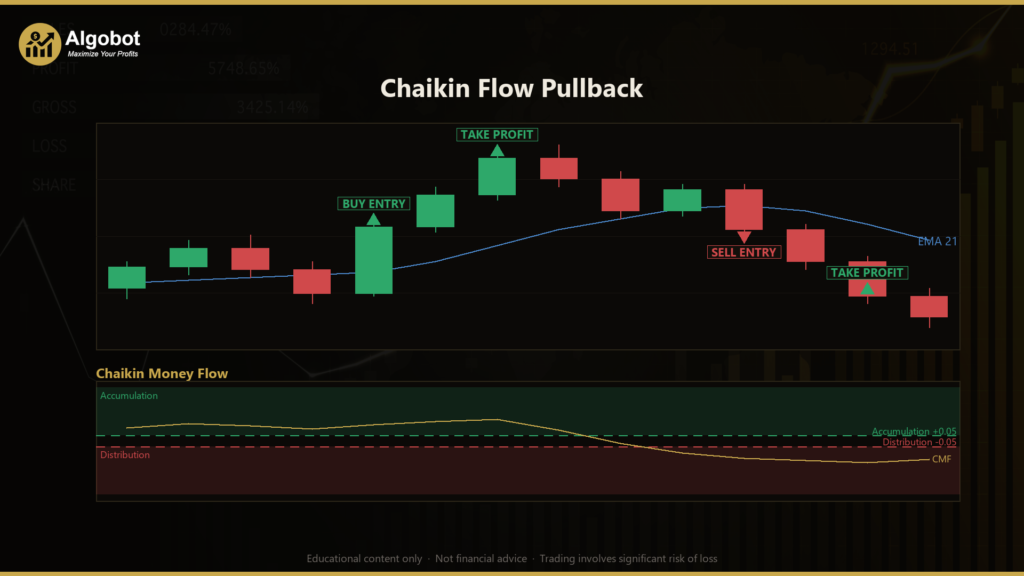
The Chaikin Flow Pullback is a trend-continuation strategy that combines the Chaikin Money Flow (CMF) indicator with an Exponential Moving Average (EMA) to time entries after a shallow price pullback. Chaikin Money Flow is a volume-weighted momentum indicator that measures whether buyers or sellers are dominating the close of each bar. The strategy uses CMF to define the market "regime" (accumulation or distribution) and the EMA to decide precisely when to enter within that regime. This is a classic "buy the pullback, not the extension" style of trading.
The core idea is that price rarely moves in a straight line. Even during a strong uptrend, price frequently dips back toward a moving average before continuing higher. Rather than chasing a market that has already extended far from value, this strategy waits for price to pull back, lose the EMA, and then reclaim it with a decisive bar closing in the direction of the underlying money flow. Buying a reclaim keeps the stop-loss close and the risk clearly defined, because the entry sits near the level that would invalidate the setup.
As a learning tool, the Chaikin Flow Pullback is well suited to traders who want to understand how a conviction filter (money flow) can be paired with a timing trigger (a moving-average reclaim). It demonstrates how volume-based indicators differ from pure price indicators, and how symmetric long and short rules can be constructed. It is best studied as a framework for trend-continuation logic rather than treated as a finished, hands-off system. This article analyzes how the strategy is built and what its behavior implies — it is not a promise of any particular outcome.
How It Works
The strategy evaluates its rules only once per completed bar. On each new bar it recalculates three values — the Chaikin Money Flow over its lookback window, the EMA of closing prices, and the Average True Range (ATR) used for stop sizing — and then checks for a valid long or short setup. It holds only one position per magic number at a time, so a new signal is ignored while a trade is already open.
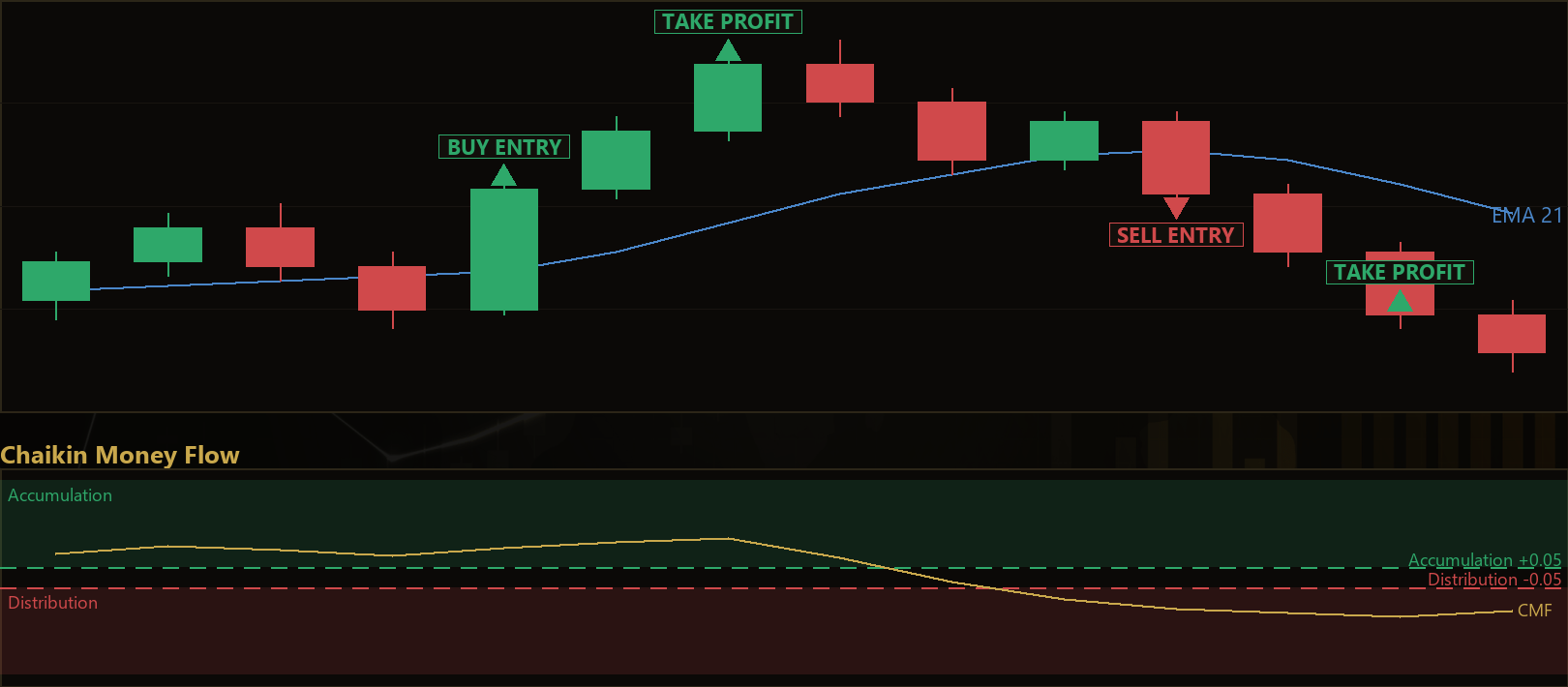
Long entry — the strategy signals a long when all of the following are true:
- Regime: CMF is greater than or equal to the positive threshold (
CmfThreshold), indicating persistent buying pressure (accumulation). - Pullback: The prior completed bar closed below the EMA — price had dipped against the trend.
- Reclaim: The just-closed bar closed above the EMA, recovering the level.
- Confirmation: That reclaiming bar has a bullish body (close above open).
Short entry — the strategy signals a short when the mirror conditions hold:
- Regime: CMF is less than or equal to the negative threshold, indicating persistent selling pressure (distribution).
- Bounce: The prior completed bar closed above the EMA.
- Loss of EMA: The just-closed bar closed below the EMA.
- Confirmation: That bar has a bearish body (close below open).
Stop-loss logic:
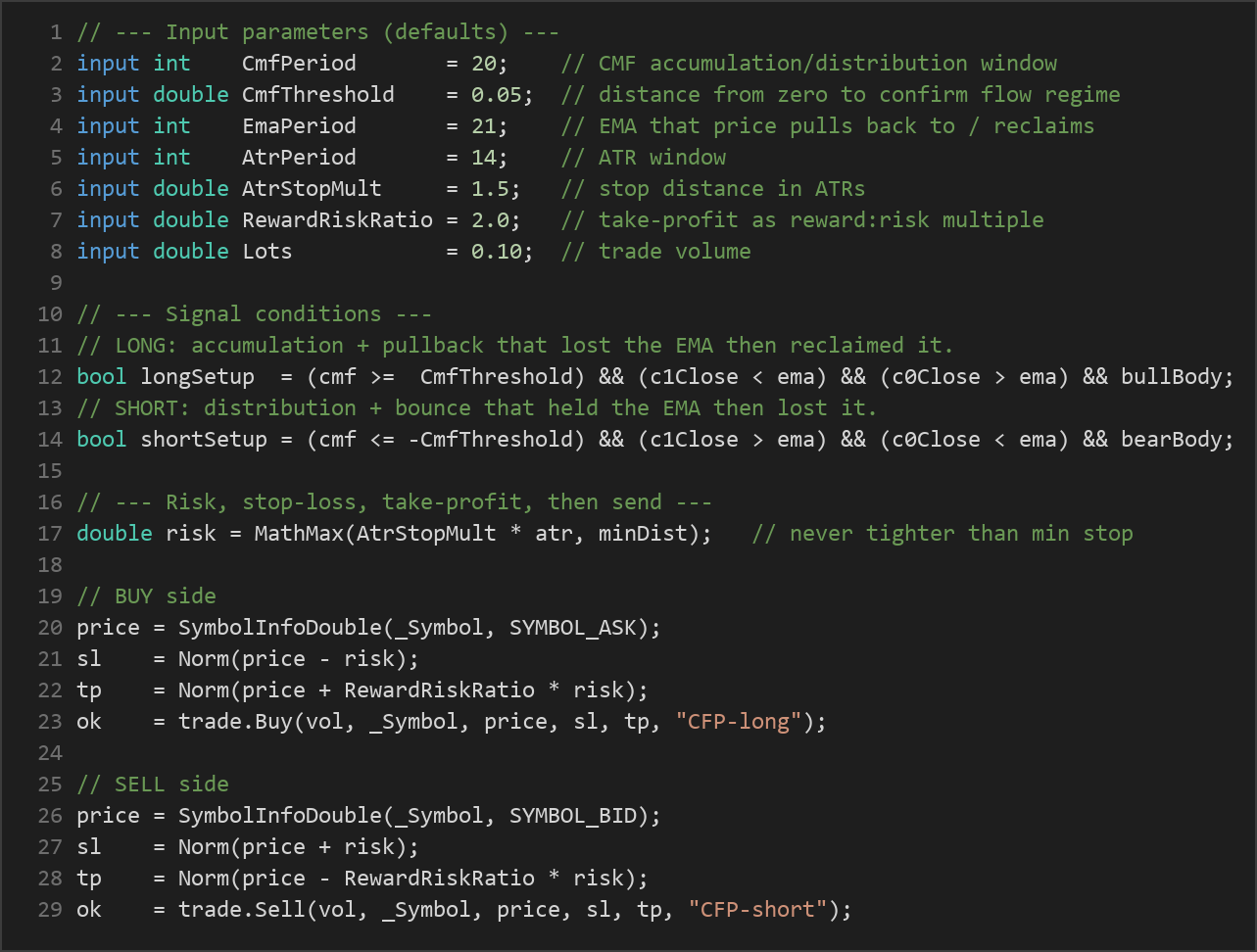
- The stop distance is calculated as
AtrStopMult × ATR. Basing the stop on ATR means it automatically widens in volatile conditions and tightens in quiet ones. - The distance is then compared against the broker's minimum stop distance (
StopLevel), and the larger of the two is used — so the stop always respects the broker's rules. - For a long, the stop is placed below the entry price; for a short, above it.
Take-profit logic:
- The take-profit is set at a fixed reward-to-risk multiple of the stop distance, controlled by
RewardRiskRatio. With the default of 2.0, the target is placed twice as far from entry as the stop. - Position size is snapped to the symbol's volume step and clamped to its minimum and maximum allowed lots before the order is sent.
Because every calculation uses the chart's primary timeframe, the strategy adapts to whatever timeframe you attach it to at test time.
Strategy Parameters
| Parameter | Default | Min | Max | Description |
|---|---|---|---|---|
| CmfPeriod | 20 | 8 | 50 | Lookback window (in bars) for the Chaikin Money Flow accumulation/distribution gauge. |
| CmfThreshold | 0.05 | 0.0 | 0.30 | How far CMF must be from zero to confirm a one-sided flow regime. Higher values demand stronger conviction. |
| EmaPeriod | 21 | 8 | 80 | Period of the EMA that price pulls back to and must reclaim for the entry trigger. |
| AtrPeriod | 14 | 5 | 40 | Lookback window for the ATR used to size the stop-loss. |
| AtrStopMult | 1.5 | 0.5 | 4.0 | Stop-loss distance expressed as a multiple of ATR. |
| RewardRiskRatio | 2.0 | 1.0 | 5.0 | Take-profit distance as a reward:risk multiple of the stop distance. |
| Lots | 0.10 | 0.01 | 1.0 | Trade volume in lots (snapped to the symbol's volume limits). |
Recommended Chart Settings
The Chaikin Flow Pullback is designed as a single-timeframe system: every indicator reads from the chart's primary timeframe, so it runs on whatever timeframe you attach it to. The default parameters — a 20-bar CMF, a 21-period EMA, and a 14-period ATR — are tuned for intraday to swing timeframes such as the H1 (1-hour) or H4 (4-hour) charts on major forex pairs, where tick-volume data is reasonably representative of activity.
Because CMF here relies on tick volume (the number of price changes per bar) rather than true exchange volume, the strategy is best studied on liquid instruments where tick volume tracks real participation. Keep in mind that results will vary significantly across different symbols, timeframes, and market conditions. Any parameter set that appears favorable in one period may behave very differently in another, so treat the defaults as a starting point for study rather than a fixed recommendation.
How to Install on MetaTrader 5
- Download the .ex5 file from the link below
- Copy it to your MT5
MQL5\Expertsfolder - Restart MetaTrader 5 or refresh the Navigator panel
- Drag the EA onto a chart matching the recommended symbol and timeframe
- Configure the input parameters and enable Algo Trading
What to Consider Before Using This EA
Strengths of this approach. Pairing a money-flow filter with a moving-average reclaim gives the strategy two independent conditions that must agree before it acts. The CMF regime filter aims to keep trades aligned with the prevailing pressure, while the EMA reclaim provides a defined, repeatable trigger. Because entries occur near the EMA rather than far from it, the ATR-based stop can sit relatively close, keeping risk defined on every trade. The symmetric long/short logic means the strategy can, in principle, participate in both up and down trends.
Known limitations. Chaikin Money Flow is a volume-weighted indicator, and in the retail forex environment it uses tick volume as a proxy for real volume. Tick volume correlates with real activity but is not identical to it, which can make CMF readings less reliable on thin or illiquid instruments. The EMA reclaim also carries an inherent trade-off: a reclaim can be a genuine continuation or the start of a whipsaw, and the strategy cannot tell the difference in advance.
Where it may underperform. Like most trend-continuation systems, this approach may struggle in choppy, range-bound markets where price repeatedly crosses back and forth over the EMA without follow-through — producing frequent losing reclaims. It may also lag at sharp reversals, since a strong prior regime reading can keep the filter pointed the wrong way just as the trend turns. And because it holds only one position per magic number, it will sit out additional opportunities while a trade is open. None of these are flaws to be "fixed" — they are the natural characteristics of the design that you should understand before testing it.
Risk Management Tips
Regardless of how any strategy is constructed, disciplined risk management is what keeps a trading account intact long enough to learn. Consider the following general principles:
- Risk a small, fixed fraction per trade. Many educational sources suggest never risking more than 1–2% of account equity on a single position. Adjust the
Lotsparameter so that the ATR-based stop distance corresponds to that fraction rather than using an arbitrary lot size. - Test on a demo account first. Run the strategy on a demo or paper account across a variety of market conditions before considering any real capital. This lets you observe its behavior without financial consequences.
- Understand drawdown. Every strategy experiences losing streaks. Study the maximum drawdown a parameter set produces and ask whether you could tolerate that decline emotionally and financially before it recovers — if it recovers at all.
- Account for costs. Spreads, commissions, and slippage all erode results, especially on lower timeframes with frequent trades. Include realistic costs in any evaluation.
- Avoid over-optimization. A parameter set that looks ideal on past data may simply be curve-fitted to noise. Favor robustness across ranges over a single "perfect" configuration.
- Never trade money you cannot afford to lose. Leverage magnifies both gains and losses, and losses can exceed expectations.
Risk Warning
Trading foreign exchange, CFDs, and other leveraged financial instruments involves substantial risk of loss and is not suitable for all investors. The strategies and tools discussed on this page are provided for educational purposes only and do not constitute financial advice, investment recommendations, or solicitation to trade. Always consult a qualified financial adviser before making trading decisions. Past backtest performance is not indicative of future results.
Downloads
- Expert Advisor: ChaikinFlowPullback.ex5 (59 downloads)
- Source Code: ChaikinFlowPullback.mq5 (62 downloads)
- Documentation: ChaikinFlowPullback.pdf (66 downloads)