Disclaimer: This article is for educational and informational purposes only. It does not constitute financial or investment advice. Trading forex and CFDs carries significant risk of loss. Past performance of any strategy — including backtests — does not guarantee future results. Never trade with money you cannot afford to lose.
What Is This Strategy?
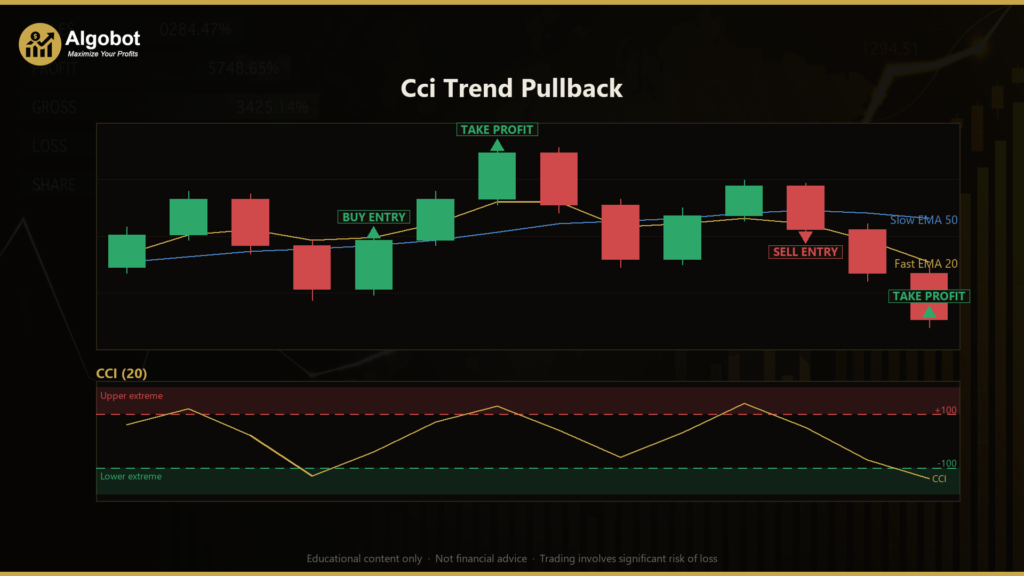
The Cci Trend Pullback strategy is a trend-following pullback system built around the Commodity Channel Index (CCI) — a momentum oscillator that measures how far price has stretched away from its statistical average. Rather than chasing breakouts, this approach waits inside an established trend for a temporary counter-move (a "pullback") and then looks for momentum to resume in the direction of the larger trend. It is designed to study how oscillator timing can be combined with a directional filter for lower-risk entries.
At its core, the strategy layers two independent, objective building blocks. First, an Exponential Moving Average (EMA) trend filter — a faster EMA measured against a slower EMA — defines whether the market is drifting up or down. A moving average is simply a rolling average of recent closing prices, and the EMA weights recent prices more heavily so it reacts faster than a simple average. Trades are only considered in the direction of this bias. Second, the CCI acts as a pullback gate: within an uptrend the strategy waits for CCI to dip into oversold territory, then signals only when momentum snaps back the other way.
This makes the Cci Trend Pullback a useful learning tool for traders who want to understand how to filter oscillator signals with a trend context, and how the Average True Range (ATR) — a measure of recent volatility — can frame stops and targets that adapt to changing market conditions. It is intended as a strategy analysis and study framework, not a shortcut to returns. It suits self-directed learners studying trend alignment, mean-reversion timing, and volatility-based risk framing.
How It Works
The strategy evaluates conditions once per completed bar (candle), so it acts on confirmed data rather than a still-forming candle. Each of the following conditions must line up before a trade is signaled.
Entry conditions (long / buy):
- The EMA trend filter confirms an uptrend — the fast EMA is above the slow EMA.
- The CCI on the previous bar had dipped to or below the negative threshold (a counter-trend pullback that shakes out weak hands).
- On the signal bar, the CCI has snapped back up through the negative threshold — momentum resuming with the trend.
- The signal candle closes higher than it opened (a bullish confirmation candle).
Entry conditions (short / sell):
- The EMA trend filter confirms a downtrend — the fast EMA is below the slow EMA.
- The CCI on the previous bar had popped to or above the positive threshold.
- On the signal bar, the CCI has rolled back down through the positive threshold.
- The signal candle closes lower than it opened (a bearish confirmation candle).
Stop-loss logic:
- The protective stop is placed a multiple of ATR away from entry (default 1.5 × ATR). Because ATR expands in volatile markets and contracts in quiet ones, the stop distance adapts automatically rather than using a fixed pip value.
Take-profit logic:
- The target is set a wider multiple of ATR from entry (default 2.5 × ATR), aiming for a reward that is larger than the risk taken on each trade.
Trade management and exits:
- The strategy holds one position at a time per instance. If a trade is open and the EMA trend filter flips against it, the position is closed — a long is exited if the trend turns down, and a short is exited if the trend turns up. This is intended to release stale trades when the underlying bias changes, rather than waiting passively for the stop.
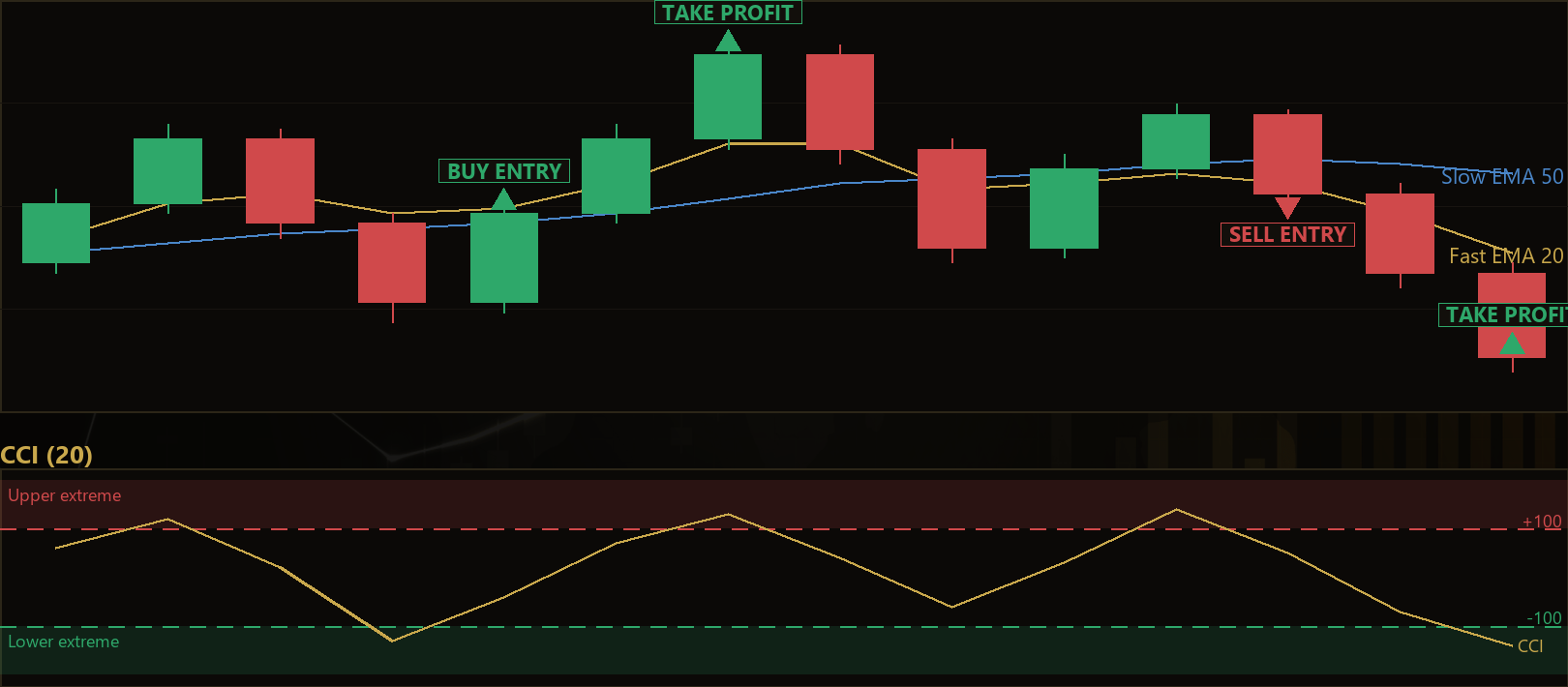
By requiring trend agreement, a CCI extreme that must first be reached, and a confirming candle body, the strategy filters potential signals three separate ways before committing to a trade.
Strategy Parameters
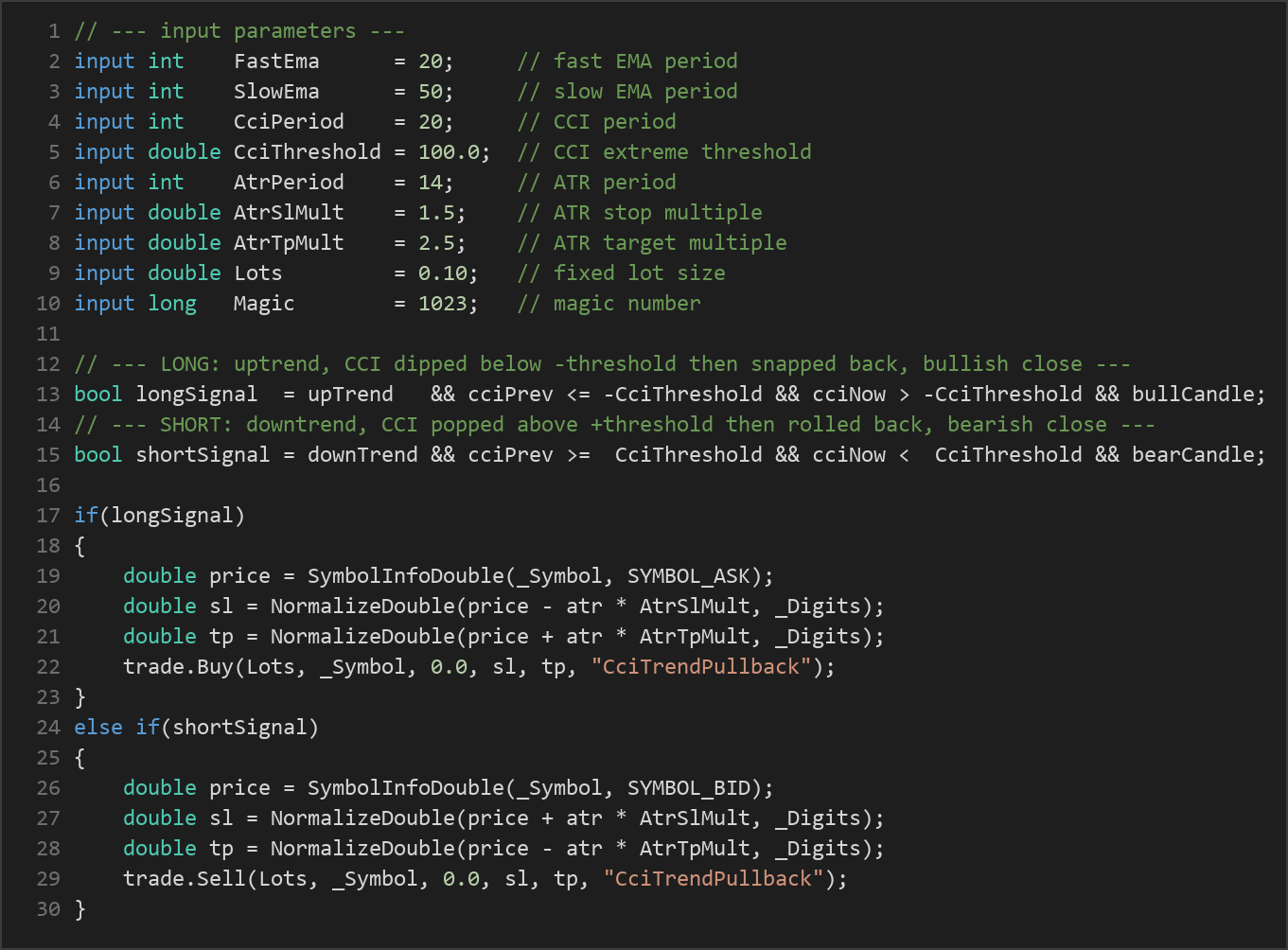
| Parameter | Default | Min | Max | Description |
|---|---|---|---|---|
| FastEma | 20 | 5 | 50 | Period of the fast EMA in the trend filter. Lower values react more quickly to price changes. |
| SlowEma | 50 | 20 | 150 | Period of the slow EMA. The fast/slow relationship defines the trend direction. |
| CciPeriod | 20 | 7 | 40 | Number of bars used to calculate the Commodity Channel Index. Shorter periods produce a more sensitive oscillator. |
| CciThreshold | 100.0 | 50.0 | 200.0 | The CCI extreme that must be reached before a pullback entry is considered (used as both ±threshold). |
| AtrPeriod | 14 | 7 | 28 | Number of bars used to measure Average True Range volatility for stop and target framing. |
| AtrSlMult | 1.5 | 0.5 | 4.0 | Stop-loss distance as a multiple of ATR. Larger values give the trade more room but a wider risk. |
| AtrTpMult | 2.5 | 1.0 | 6.0 | Take-profit distance as a multiple of ATR. Sets the reward side of the reward-to-risk profile. |
| Lots | 0.10 | 0.01 | 1.0 | Fixed trade size in lots. Should be aligned with your account size and risk tolerance. |
Recommended Chart Settings
The Cci Trend Pullback is symbol- and timeframe-agnostic — every calculation runs on whichever timeframe you attach it to. Based on its design, it is well suited to liquid FX pairs such as EUR/USD or GBP/USD, or gold (XAU/USD), on the M15 to H1 timeframes, where trends have room to develop and pullbacks are frequent enough to generate signals.
Keep in mind that results will vary considerably across different symbols, timeframes, and market conditions. A setting that behaves well on one pair during a trending phase may behave very differently on another instrument or during a range-bound period. Always study the behavior on a demo account across a range of conditions before drawing conclusions.
How to Install on MetaTrader 5
- Download the .ex5 file from the link below
- Copy it to your MT5
MQL5\Expertsfolder - Restart MetaTrader 5 or refresh the Navigator panel
- Drag the EA onto a chart matching the recommended symbol and timeframe
- Configure the input parameters and enable Algo Trading
What to Consider Before Using This EA
Strengths of this approach. The strategy is disciplined by design. By only trading in the direction of the EMA trend and by waiting for a CCI extreme plus a confirmation candle, it aims to avoid entering against strong momentum or catching a "falling knife." The ATR-based stops and targets adapt to volatility, and the trend-flip exit is a sensible way to release trades whose underlying premise has changed. The reward-to-risk framing (a wider target than stop) means the strategy does not need a high hit rate to remain balanced over a sample of trades.
Known limitations. Like all trend-following systems, this one depends on trends actually persisting. In choppy, sideways markets the EMA filter can flip back and forth, producing whipsaws where trades are opened and then closed on a trend reversal without ever reaching a meaningful target. The CCI, meanwhile, can remain at an extreme far longer than expected during strong moves, so a "pullback" signal may sometimes appear just as the trend is exhausting. Because the strategy uses a fixed lot size, it does not scale risk to account equity unless you adjust the parameter yourself.
Where it may underperform. Expect the strategy to struggle in low-volatility ranges, during major news-driven spikes that ignore technical structure, and around session opens or thin liquidity where spreads widen. No indicator combination removes these risks — the CCI and EMA are lagging or reactive by nature, and pullback timing is inherently imperfect. Treat every signal as a probability, not a certainty.
Risk Management Tips
Sound risk management matters far more than any single entry rule. Consider the following general principles as you study this strategy:
- Risk a small, fixed percentage per trade. Many educational sources suggest risking no more than 1–2% of account equity on any single position, so that a string of losses does not threaten your account.
- Size positions deliberately. Rather than accepting the default lot size, calculate a size that keeps your per-trade risk within your chosen percentage given the ATR-based stop distance.
- Always test on a demo account first. Run the strategy in a risk-free simulated environment across multiple market conditions before considering any live use.
- Understand drawdown. Every strategy experiences losing streaks. Know the maximum peak-to-trough decline you are prepared to tolerate, and how it would feel in real time.
- Never trade money you cannot afford to lose, and avoid over-leveraging, which magnifies both gains and losses.
Used this way, the Cci Trend Pullback becomes a framework for learning how trend filters, oscillator timing, and volatility-based risk fit together — which is its most valuable purpose.
Risk Warning
Trading foreign exchange, CFDs, and other leveraged financial instruments involves substantial risk of loss and is not suitable for all investors. The strategies and tools discussed on this page are provided for educational purposes only and do not constitute financial advice, investment recommendations, or solicitation to trade. Always consult a qualified financial adviser before making trading decisions. Past backtest performance is not indicative of future results.
Downloads
- Expert Advisor: CciTrendPullback.ex5 (45 downloads)
- Source Code: CciTrendPullback.mq5 (43 downloads)
- Documentation: CciTrendPullback.pdf (49 downloads)