Disclaimer: This article is for educational and informational purposes only. It does not constitute financial or investment advice. Trading forex and CFDs carries significant risk of loss. Past performance of any strategy — including backtests — does not guarantee future results. Never trade with money you cannot afford to lose.
What Is This Strategy?
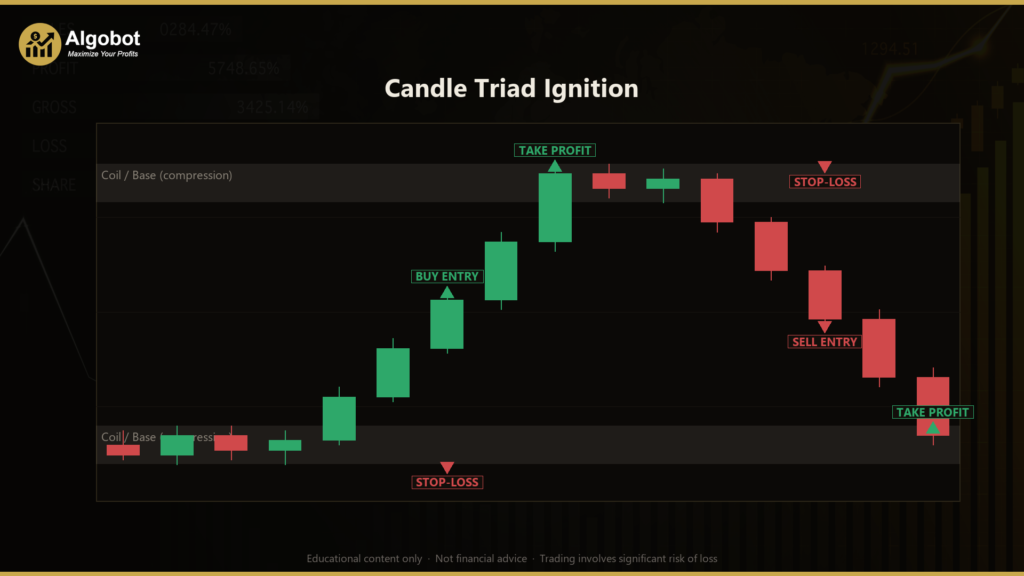
Candle Triad Ignition is a pure price-action breakout-continuation strategy that reads raw candlestick geometry and uses the Average True Range (ATR) — a volatility measure derived from the average size of recent bars — purely to scale its tests and stops, never as an entry trigger. Instead of leaning on a moving average or an oscillator, it looks for a very specific footprint on the chart: a quiet, compressed base followed by three decisive candles that "ignite" out of it in the same direction. That trio of candles is the "triad" in the name.
The core belief behind the strategy is that the highest-quality breakouts are born from quiet, not from an already-running move. Markets frequently coil into tight ranges as buyers and sellers reach a temporary balance. When that balance finally breaks, the first clean thrust out of the base can mark the beginning of a fresh directional leg. Candle Triad Ignition tries to catch that transition — the moment a range stops being a range — while deliberately filtering out candles that look like climactic, exhausted spikes.
As a learning tool, this strategy is well suited to traders who want to study breakout mechanics, candle body-versus-wick analysis, and volatility-scaled risk placement. Because everything is derived from price and ATR alone, it can be attached to any symbol and timeframe in the MetaTrader 5 Strategy Tester, making it a flexible sandbox for understanding how compression-then-expansion patterns behave across different markets.
How It Works
The strategy evaluates its rules once per freshly closed candle and holds only one position at a time per magic number, letting the stop-loss and take-profit manage the exit. Here is what it checks, step by step.
The coil (compression filter):
- The strategy measures the full High-to-Low range of the
BasePeriodbars sitting directly beneath the three signal candles (the base excludes the triad itself). - That base range must be smaller than
BaseFactor × ATR. In plain terms, the recent price action must be genuinely tight relative to current volatility — a real coil, not just a slow drift.
The triad (three conviction candles):
- It inspects the three most recently closed candles (oldest to newest). All three must share the same colour — three bullish candles for a long setup, three bearish for a short.
- Each candle must show a dominant body: the absolute body size must be at least
BodyFrac × range. A large body with small wicks signals real intent rather than indecision. - Each candle must close beyond the previous candle's close, so the move is a progressive advance rather than a stall that happens to point the same way.
- None of the three candles may be a blow-off: if any candle's range exceeds
BlowoffFactor × ATR, the setup is rejected. This keeps the strategy igniting with an emerging move rather than chasing an exhausted, climactic spike.
The breakout confirmation:
- The third (newest) candle must close clear of the coil — above the base high for a long, or below the base low for a short. This is the actual breakout of the compressed base.
Entry:
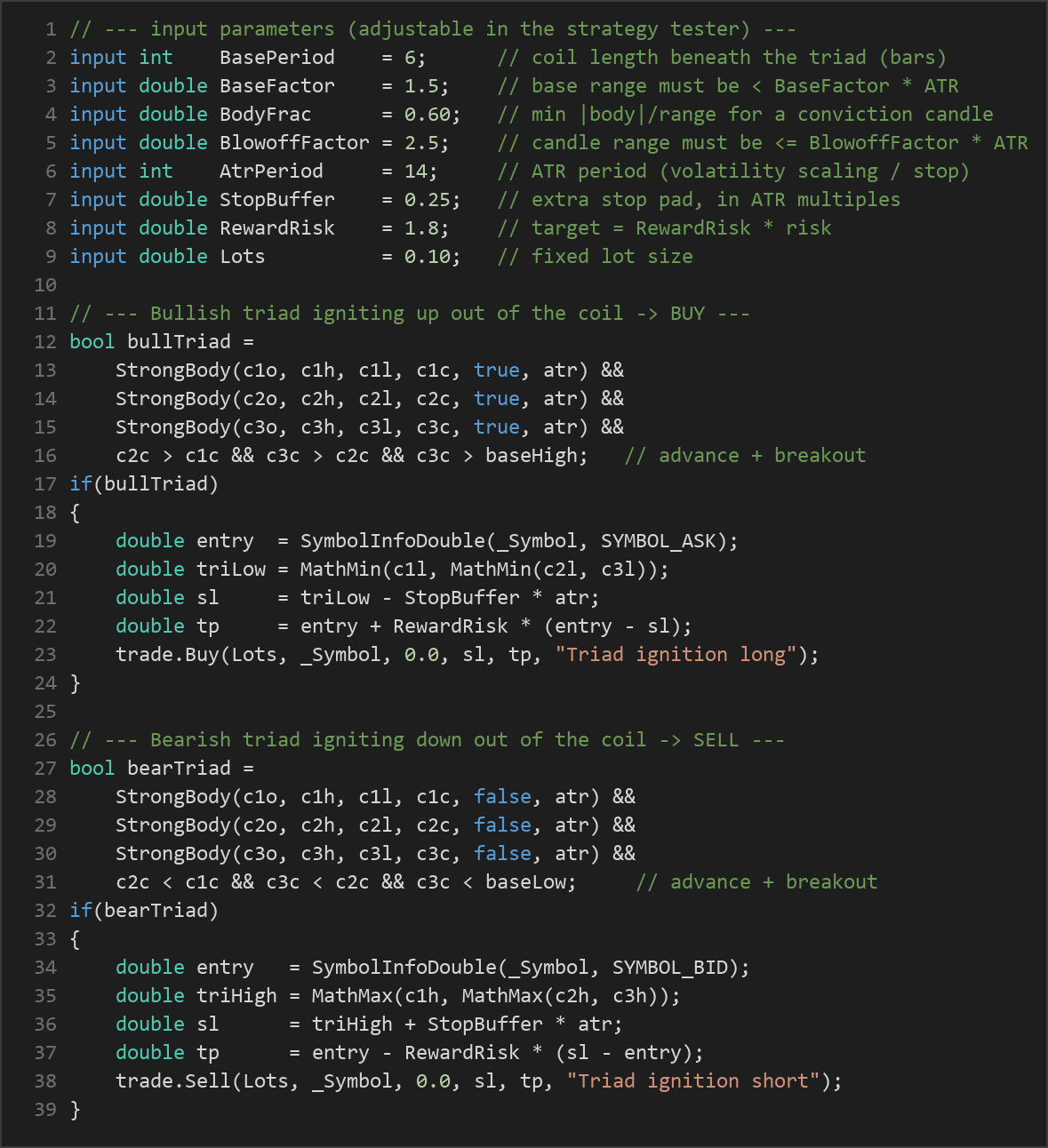
- When a bullish triad breaks above the coil, the strategy signals a BUY at the current ask price.
- When a bearish triad breaks below the coil, the strategy signals a SELL at the current bid price.
Stop-loss logic:
- The stop is structural and price-derived. For a long, it is placed just below the lowest low of the three triad candles, minus a
StopBuffer × ATRpad. For a short, it sits just above the highest high of the triad, plus the same pad. - This anchors risk to the pattern's own structure — if price falls back through the triad, the premise of the trade is invalidated.
Take-profit logic:
- The distance from entry to stop defines the trade's risk. The target is then placed at
RewardRisk × riskin the direction of the trade, giving a fixed, configurable reward-to-risk ratio on every position.
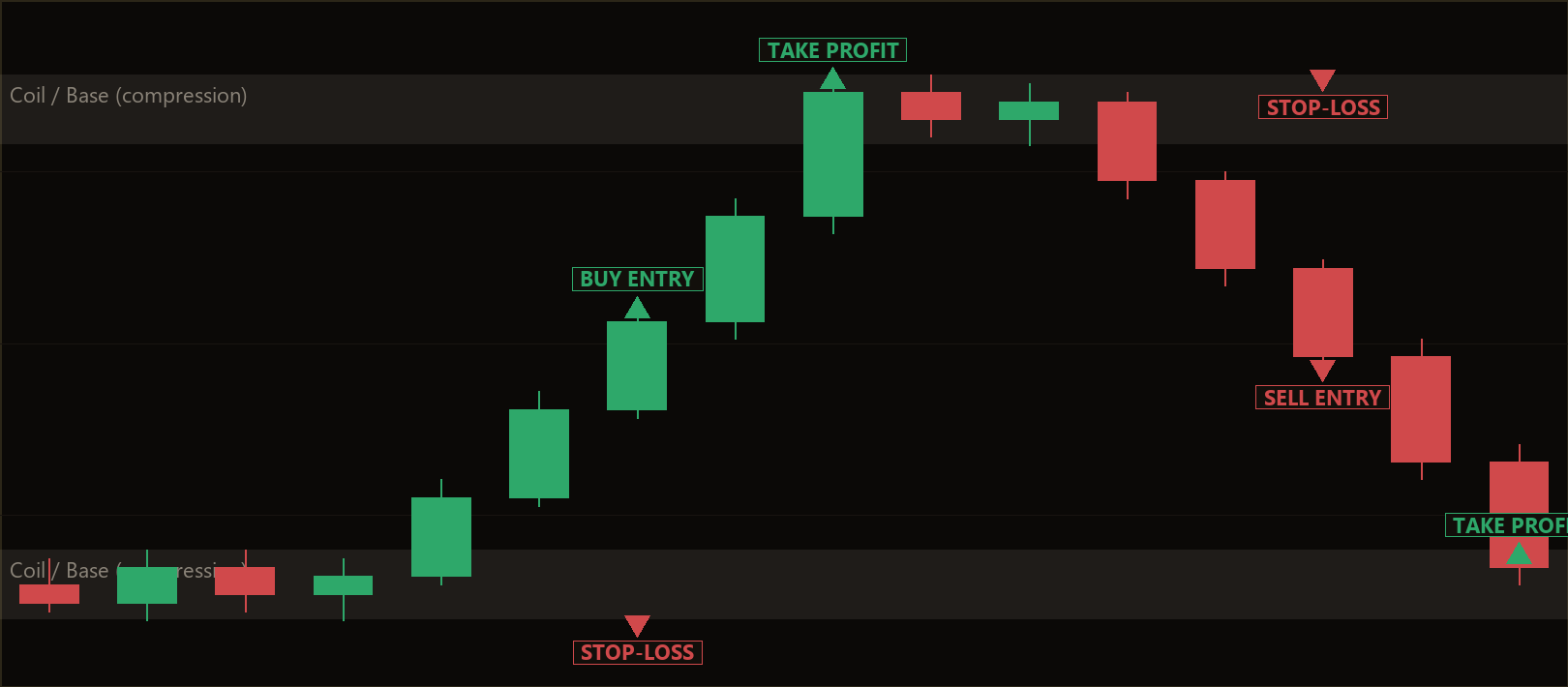
Strategy Parameters
| Parameter | Default | Min | Max | Description |
|---|---|---|---|---|
| BasePeriod | 6 | 3 | 20 | Number of bars in the coil/base measured directly beneath the triad. |
| BaseFactor | 1.5 | 0.5 | 4.0 | The base's High-Low range must be smaller than this multiple of ATR to count as compression. |
| BodyFrac | 0.60 | 0.30 | 0.90 | Minimum body-to-range ratio for a candle to qualify as a conviction candle (small wicks). |
| BlowoffFactor | 2.5 | 1.0 | 5.0 | A candle whose range exceeds this multiple of ATR is treated as a climactic blow-off and rejected. |
| AtrPeriod | 14 | 5 | 50 | Lookback period for the ATR used to scale the coil test and the stop distance. |
| StopBuffer | 0.25 | 0.0 | 1.0 | Extra padding beyond the triad's extreme for the stop, in ATR multiples. |
| RewardRisk | 1.8 | 0.5 | 5.0 | Take-profit distance as a multiple of the measured risk (entry-to-stop distance). |
| Lots | 0.10 | 0.01 | 1.0 | Fixed lot size for each trade. |
Recommended Chart Settings
Because Candle Triad Ignition is built entirely from raw candle geometry and ATR, it is not hard-wired to a single symbol or timeframe — it runs on whatever chart the Strategy Tester selects. That said, breakout-continuation logic tends to be studied most cleanly on liquid instruments where candle bodies reflect genuine order flow, such as major forex pairs (for example EUR/USD) or major indices. Intraday timeframes like M15, M30, or H1 are a reasonable starting point for observing compression-then-expansion behaviour, while H4 and D1 produce fewer but larger setups.
Keep in mind that results will vary considerably across symbols, timeframes, and market conditions. A parameter set that produces frequent, tidy signals on one instrument may generate very few — or very different — signals on another. Always test any configuration on historical data and a demo account before drawing conclusions.
How to Install on MetaTrader 5
- Download the .ex5 file from the link below
- Copy it to your MT5
MQL5\Expertsfolder - Restart MetaTrader 5 or refresh the Navigator panel
- Drag the EA onto a chart matching the recommended symbol and timeframe
- Configure the input parameters and enable Algo Trading
What to Consider Before Using This EA
Strengths of the approach. The strategy's biggest conceptual strength is that it insists on context before it acts. Rather than reacting to a single strong candle, it requires a compressed base, three aligned conviction candles, and a clean break of the coil. Layering these filters is designed to screen out noisy, low-quality breakouts. The blow-off filter is a thoughtful touch: by rejecting oversized candles, the strategy tries to enter early in a move rather than at its exhaustion. Its stops are structural and volatility-scaled, which keeps risk tied to the actual pattern rather than to an arbitrary fixed distance.
Known limitations. Breakout systems are, by nature, vulnerable to false breakouts — price can push clear of the coil, trigger an entry, then immediately reverse back into the range. No filter eliminates this entirely. Because the strategy demands three consecutive same-colour candles with dominant bodies and a tight base, qualifying setups can be relatively rare, so the strategy may sit idle for long stretches. The tight-base requirement also means the strategy can miss breakouts that emerge from wider, choppier consolidations that never compress enough to pass the BaseFactor test.
Where it may underperform. In persistently choppy or mean-reverting conditions, coils may form and break repeatedly without following through, which can lead to a string of stopped-out trades. During very high-volatility news events, candles can balloon past the blow-off threshold and disqualify otherwise-directional moves. Conversely, in extremely quiet, low-volatility regimes, ATR shrinks and the base test becomes easier to pass, which may admit weaker setups. Understanding these regime sensitivities is part of what makes the strategy useful as a study tool.
Risk Management Tips
Risk management is what separates a durable learning process from a costly one. Regardless of how a strategy is configured, the following principles apply:
- Size positions deliberately. Rather than trading a fixed lot without context, calculate your position size from the distance to your stop and the amount of account equity you are willing to risk.
- Cap risk per trade. A widely taught guideline is to risk no more than 1–2% of account equity on any single position, so that a losing streak does not do lasting damage.
- Start on a demo account. Test any parameter set in the MT5 Strategy Tester and on a demo account first, across multiple market conditions, before considering live capital.
- Understand drawdown. Every strategy experiences losing runs. Study the depth and duration of historical drawdowns so that your expectations — and your emotions — are prepared for them.
- Keep the reward-to-risk honest. The
RewardRiskparameter defines your target relative to risk, but a favourable ratio only helps if your win rate and slippage assumptions hold up in realistic testing.
Approach this EA as an educational instrument for studying compression-and-breakout behaviour, not as a shortcut. The goal is to learn how the pattern behaves and where it fails, not to deploy it blindly.
Risk Warning
Trading foreign exchange, CFDs, and other leveraged financial instruments involves substantial risk of loss and is not suitable for all investors. The strategies and tools discussed on this page are provided for educational purposes only and do not constitute financial advice, investment recommendations, or solicitation to trade. Always consult a qualified financial adviser before making trading decisions. Past backtest performance is not indicative of future results.
Downloads
- Expert Advisor: CandleTriadIgnition.ex5 (19 downloads)
- Source Code: CandleTriadIgnition.mq5 (20 downloads)
- Documentation: CandleTriadIgnition.pdf (28 downloads)