Disclaimer: This article is for educational and informational purposes only. It does not constitute financial or investment advice. Trading forex and CFDs carries significant risk of loss. Past performance of any strategy — including backtests — does not guarantee future results. Never trade with money you cannot afford to lose.
What Is This Strategy?
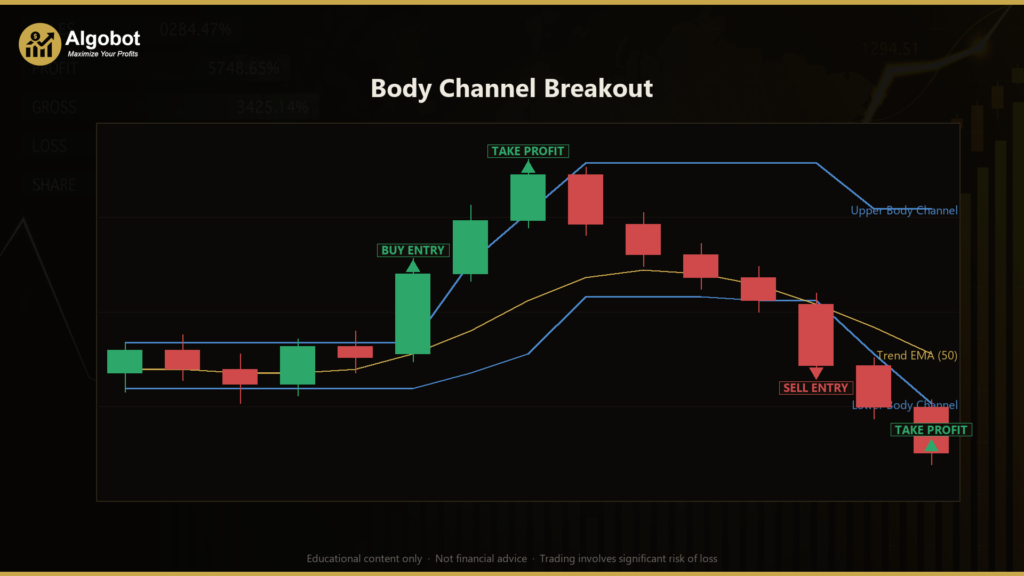
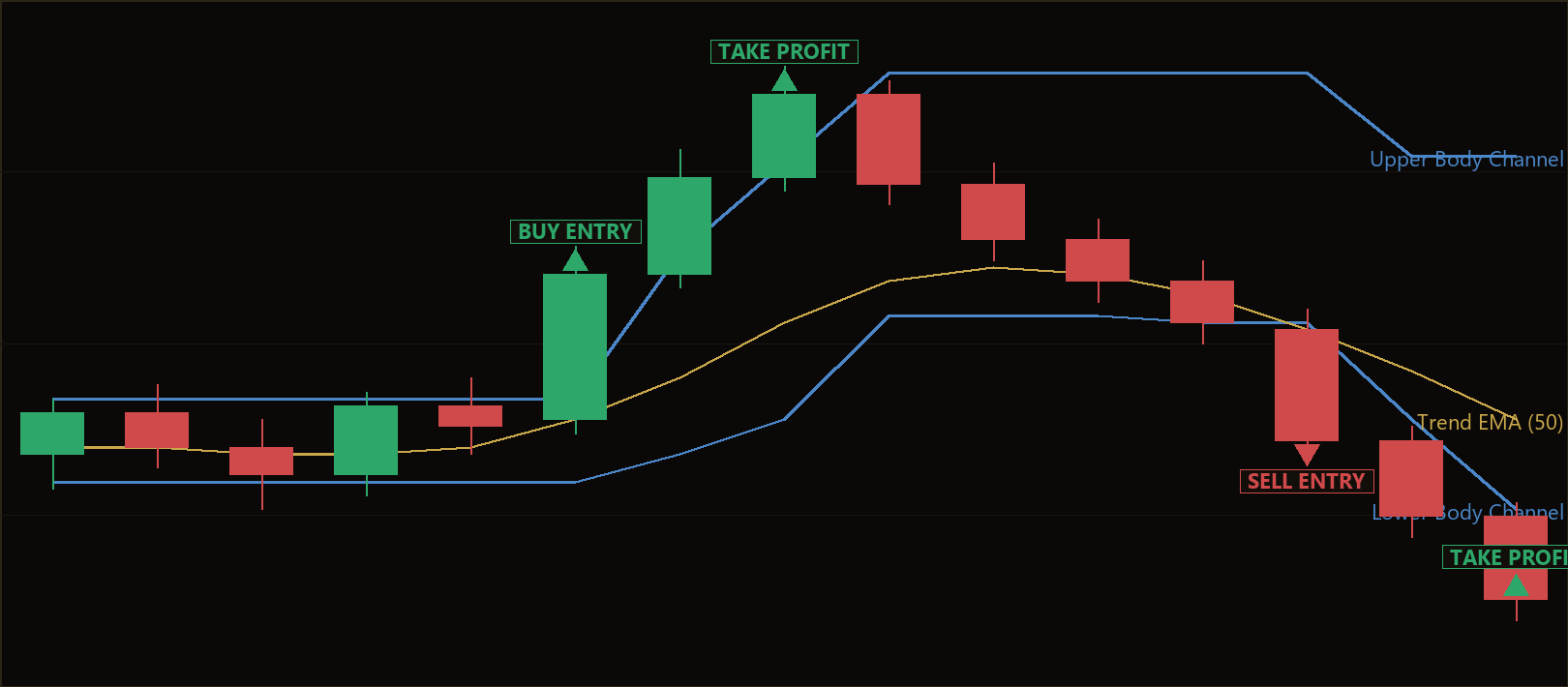
The Body Channel Breakout strategy is a trend-following breakout system that builds its trading channel from candlestick bodies (the distance between each bar's open and close) rather than the more common high/low Donchian channel. A Donchian channel tracks the extreme highs and lows of recent price, which means it captures every wick — the thin excursions where price briefly probed a level and was rejected. Body Channel Breakout deliberately ignores those wicks and measures only the range that price actually accepted during each bar.
The core idea comes from auction-market thinking: a candle's body represents value that was accepted and held into the close, while the wicks represent price levels the market tested and then abandoned. Ordinary channel breakouts fire on wick extremes, so they are frequently tripped by stop-runs and single-tick pokes that snap back immediately. By drawing the channel from the highest body-top and lowest body-bottom over a lookback window, this strategy only registers a breakout when a fresh candle closes its entire body beyond the channel — a signal of a genuine shift in accepted value. That single filter is designed to remove a large share of false breaks.
As a learning tool, this strategy is well suited to traders who want to understand how breakout confirmation, trend gating, and structural stop placement fit together. It combines an exponential moving average (EMA) trend filter, an Average True Range (ATR) volatility-based risk model, and a breakeven-plus-trailing exit into one compact framework. It is best studied on liquid, trending instruments and is not designed for tight, range-bound markets.
How It Works
The strategy evaluates a new signal only when a bar closes, and it manages any open position on every tick. It is fully symmetric — the long and short logic are mirror images of each other.
Entry conditions (long example):
- Trend gate — slope and side. The strategy computes an EMA of closing prices and compares its current value to its value a few bars earlier. For a long, the EMA must be sloping up and the just-closed candle must close above the EMA. This confirms price is on the correct side of an established uptrend.
- Body channel breakout. The channel's upper edge is the highest candle-body top over the lookback window preceding the breakout candle. The just-closed candle's close must print above that upper body channel.
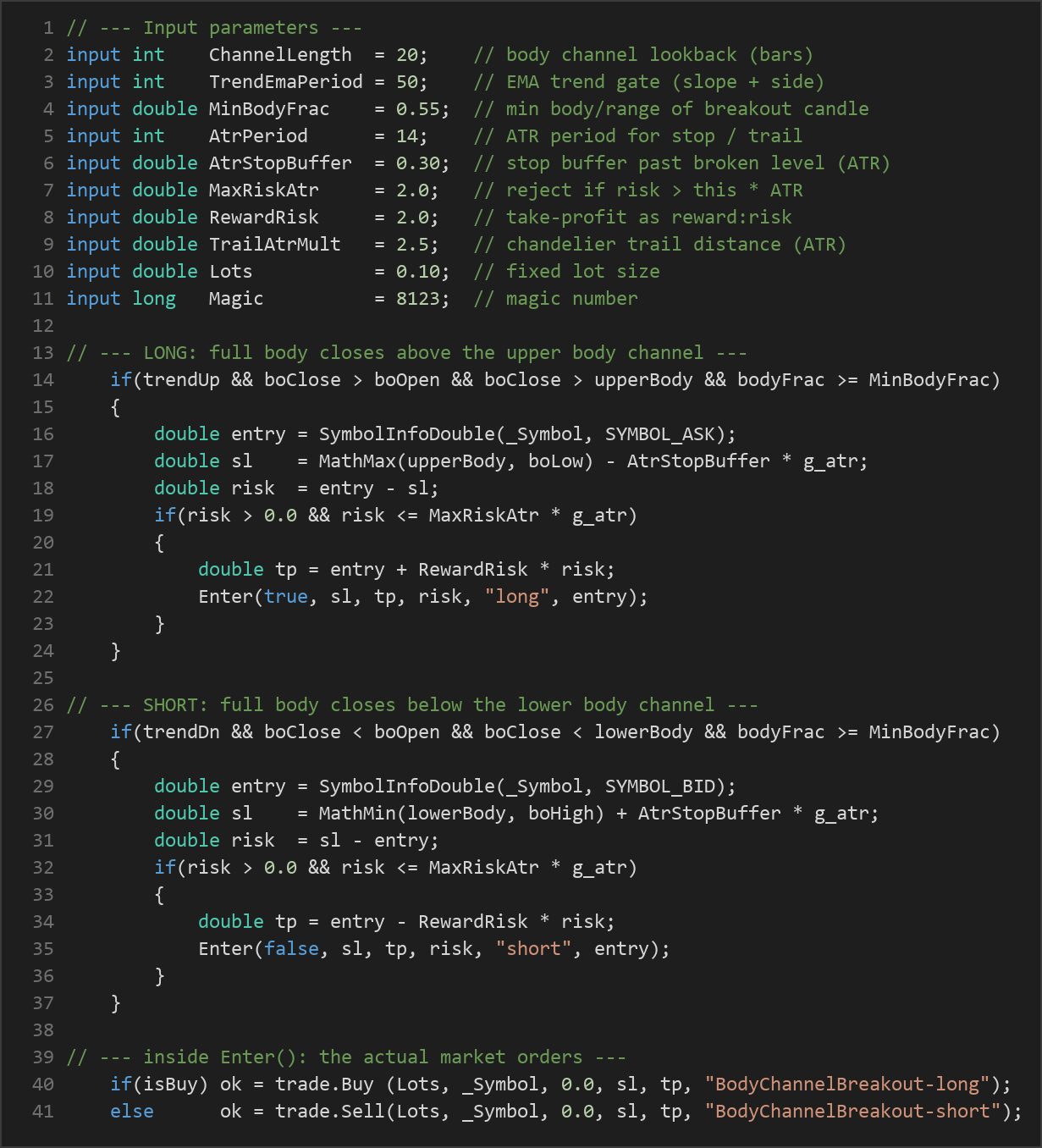
- Bullish acceptance candle. The breakout candle must be bullish (close above open), and its body must fill at least
MinBodyFracof the candle's full high-to-low range. This favors decisive, low-wick "acceptance" bars over indecisive ones. - Short entries apply the exact mirror: EMA sloping down, price below the EMA, a bearish candle closing below the lower body channel, with the same minimum body fraction.
Stop-loss logic:
- The stop is placed just past the broken body level — the natural "failed breakout" invalidation point — buffered by
AtrStopBuffermultiplied by the current ATR. This keeps the stop structurally tight rather than arbitrarily wide. - If the resulting entry-to-stop distance (the trade's risk) exceeds
MaxRiskAtrtimes ATR, the trade is rejected. This prevents the strategy from chasing an over-extended breakout and keeps per-trade risk roughly uniform.
Take-profit and trade management:
- The take-profit is set at
RewardRiskmultiplied by the measured risk distance, giving a fixed reward-to-risk target. - Once price advances by one full unit of risk (+1R), the stop is pulled to breakeven, so the trade can no longer become a loser.
- After that, an ATR "chandelier" trail follows price at a distance of
TrailAtrMulttimes ATR, locking in gains while capping how much profit can be given back. - Only one position per Magic number is allowed at a time, so entries never stack.
Strategy Parameters
| Parameter | Default | Min | Max | Description |
|---|---|---|---|---|
| ChannelLength | 20 | 8 | 40 | Lookback in bars for the body-channel envelope (how many prior candles define the breakout level). |
| TrendEmaPeriod | 50 | 20 | 150 | EMA period used as the trend gate — controls both slope measurement and which side of the average price must be on. |
| MinBodyFrac | 0.55 | 0.30 | 0.80 | Minimum body-to-range fraction of the breakout candle; higher values demand a more decisive, low-wick "acceptance" bar. |
| AtrPeriod | 14 | 7 | 30 | ATR period used for the stop buffer and the trailing distance. |
| AtrStopBuffer | 0.30 | 0.0 | 1.5 | Extra stop room beyond the broken body level, expressed in ATR multiples. |
| MaxRiskAtr | 2.0 | 1.0 | 5.0 | Maximum allowed entry-to-stop risk in ATR multiples; breakouts with larger risk are skipped (no chasing). |
| RewardRisk | 2.0 | 1.0 | 4.0 | Take-profit target as a reward-to-risk multiple of the stop distance. |
| TrailAtrMult | 2.5 | 1.0 | 5.0 | Chandelier trailing distance in ATR multiples once the position is protected. |
| Lots | 0.10 | 0.01 | 1.0 | Fixed trade volume in lots. |
Recommended Chart Settings
The Body Channel Breakout was designed with liquid forex pairs and index CFDs in mind — for example EURUSD, GBPUSD, or US500 — on intraday timeframes in the M15 to H1 range. The code never hardcodes a timeframe: every calculation uses whatever timeframe the chart or backtest is set to, so you are free to experiment. Trending, liquid instruments give the breakout logic the clean directional moves it is built to capture, while wider spreads and thin liquidity can erode the tight structural stops.
Keep in mind that results will vary considerably across different symbols, timeframes, and market conditions. A setting that behaves well on one instrument during a trending period may behave very differently during a choppy, range-bound phase.
How to Install on MetaTrader 5
- Download the
.ex5file from the link below. - Copy it to your MT5
MQL5\Expertsfolder. - Restart MetaTrader 5 or refresh the Navigator panel.
- Drag the EA onto a chart matching the recommended symbol and timeframe.
- Configure the input parameters and enable Algo Trading.
What to Consider Before Using This EA
Strengths of the approach. The body-channel concept addresses a well-known weakness of classic breakout systems: their tendency to be triggered by wick spikes and stop-runs that reverse immediately. By requiring a full-body close beyond the channel, the strategy filters for breaks that reflect a real change in accepted value. The layered gates — trend slope, price side, and body fraction — mean a signal has to clear several independent conditions before a trade is placed. The risk model is also disciplined: stops are structural rather than arbitrary, over-extended breakouts are rejected, and the breakeven-plus-trail logic is designed to keep drawdown contained.
Known limitations. Like all trend-following breakout systems, this one is vulnerable to whipsaws in sideways markets, where price repeatedly pokes above and below a channel without following through. The multiple filters reduce but cannot eliminate false signals. Because it waits for a bar to close and for a decisive body, entries occur slightly later than a raw wick breakout would, which can mean giving up some of the initial move. The fixed reward-to-risk take-profit may cap winners during strong, extended trends, while the ATR trail can exit prematurely during volatile pullbacks. Fixed-lot sizing does not adapt to account equity, so position size should be reviewed as balance changes.
When it may underperform. Expect weaker behavior during low-volatility consolidation, during news-driven spikes that gap through stops, and on illiquid instruments where spreads are wide relative to the tight structural stop. This is a strategy to study and stress-test, not a set-and-forget solution.
Risk Management Tips
Sound risk management matters far more than any single entry signal. As a general educational guideline:
- Risk a small, fixed fraction per trade. Many educators suggest never risking more than 1–2% of account equity on any single position. Adjust the lot size so that the distance from entry to stop represents that fraction, rather than trading a fixed lot blindly.
- Understand your drawdown tolerance. Even a well-constructed strategy will experience losing streaks. Know in advance how large a peak-to-trough decline you are willing to accept, and how it would feel in real money.
- Test on a demo account first. Run the EA on a demo or a small account for an extended period across different market conditions before committing meaningful capital. This helps you understand its behavior, its frequency of trades, and how it handles volatility.
- Account for costs. Spreads, commissions, and slippage all erode results, especially for a strategy that uses tight structural stops. Include realistic costs in any backtest.
- Never over-leverage. Leverage magnifies both gains and losses. Use only what you fully understand and can manage.
Treat this strategy as a framework for learning how breakout confirmation, trend filtering, and volatility-based risk control interact — not as a guaranteed outcome of any kind.
Risk Warning
Trading foreign exchange, CFDs, and other leveraged financial instruments involves substantial risk of loss and is not suitable for all investors. The strategies and tools discussed on this page are provided for educational purposes only and do not constitute financial advice, investment recommendations, or solicitation to trade. Always consult a qualified financial adviser before making trading decisions. Past backtest performance is not indicative of future results.
Downloads
- Expert Advisor: BodyChannelBreakout.ex5 (31 downloads)
- Source Code: BodyChannelBreakout.mq5 (27 downloads)
- Documentation: BodyChannelBreakout.pdf (32 downloads)