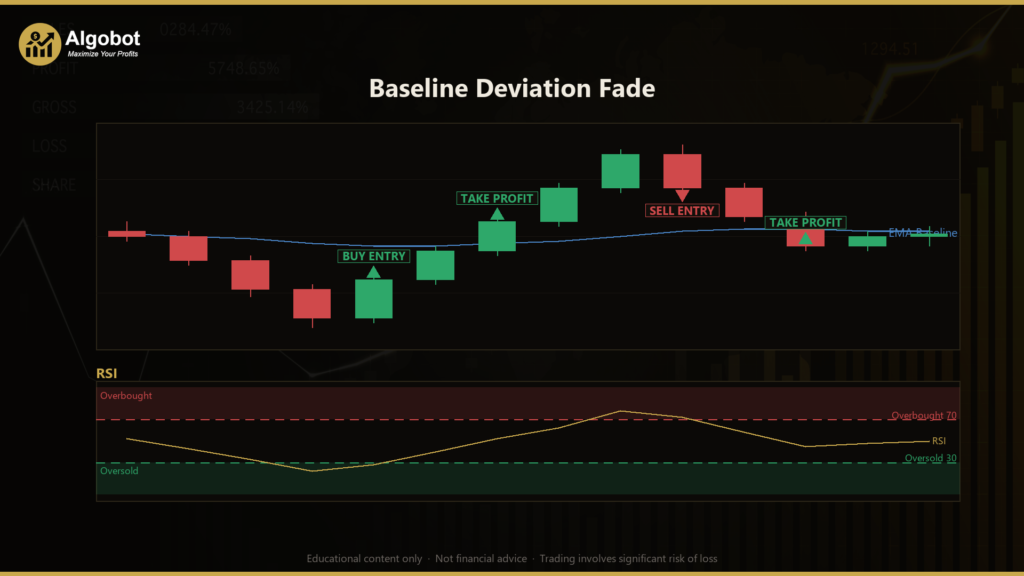
Disclaimer: This article is for educational and informational purposes only. It does not constitute financial or investment advice. Trading forex and CFDs carries significant risk of loss. Past performance of any strategy — including backtests — does not guarantee future results. Never trade with money you cannot afford to lose.
What Is This Strategy?
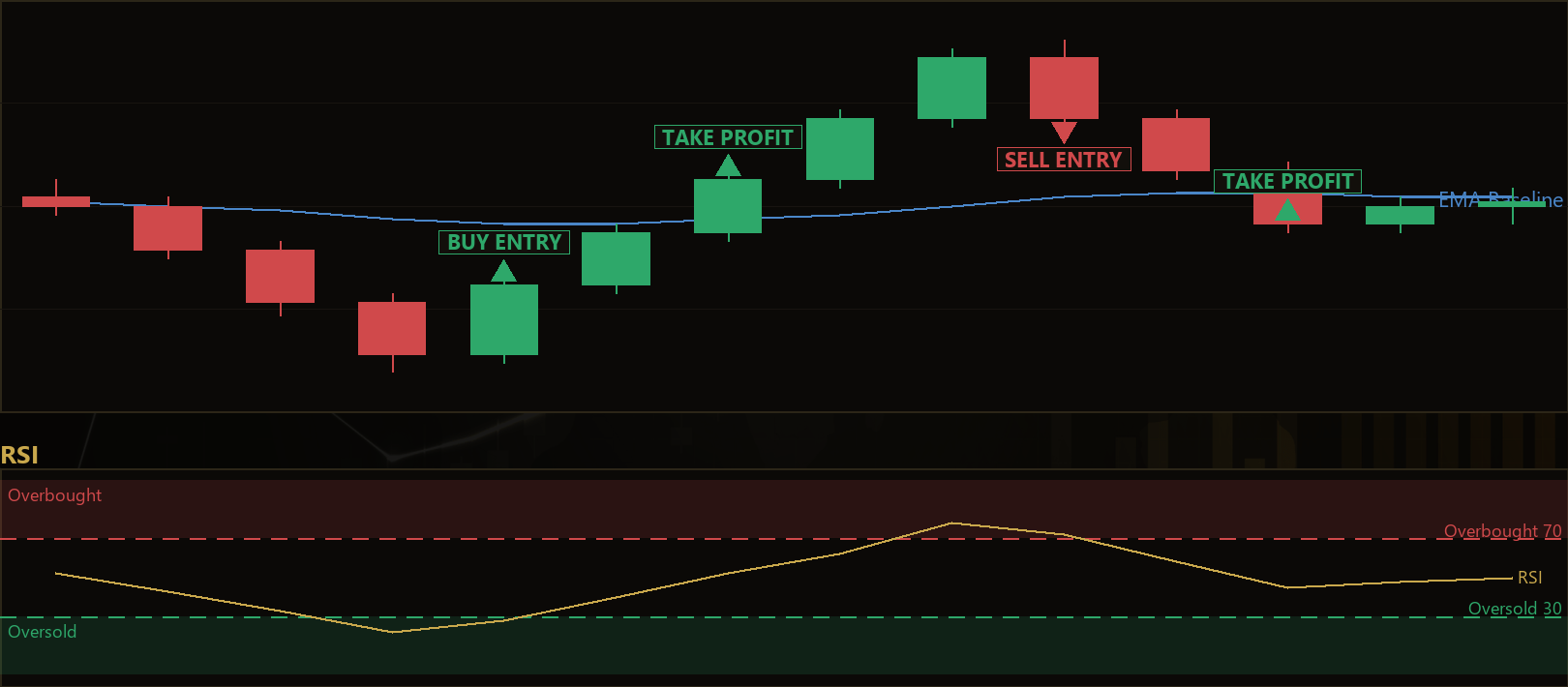
The Baseline Deviation Fade is a regime-filtered mean-reversion strategy built around an EMA (Exponential Moving Average) baseline combined with ATR (Average True Range) volatility scaling and an RSI (Relative Strength Index) momentum filter. In plain terms, "mean reversion" is the idea that when price stretches unusually far away from a central average, it often snaps back toward that average. This EA (Expert Advisor — an automated program that runs on MetaTrader 5) is designed to detect those over-extensions and fade them, meaning it trades against the recent move in anticipation of a pullback toward the baseline.
Because raw distance from a moving average means very little on its own — a "big" move on a quiet day may be tiny on a volatile day — the strategy measures deviation in ATR units rather than in fixed pips. ATR is a common gauge of how much a market typically moves per bar, so it lets the strategy ask a more meaningful question: "How far is far, relative to current volatility?" This normalisation is what allows the same rule set to behave consistently across calm and choppy periods.
Baseline Deviation Fade is best understood as a learning tool for traders who want to study how confirmation filters are stacked together to reduce false signals. It is designed for range-bound or gently drifting market conditions rather than strong trends. It is symmetric (it treats long and short setups with mirror-image logic), single-timeframe, and fully rule-based, which makes it a clear case study in objective, non-discretionary strategy design. It is not a shortcut to results, and it will not suit every market or every period.
How It Works
The strategy only evaluates signals on a freshly-closed bar — it ignores intrabar price churn, which avoids "repainting" (signals that appear and then vanish before a bar completes). On each newly-completed bar it recalculates the EMA baseline, the ATR, and the RSI, then checks whether four independent conditions all agree. Requiring agreement across four filters is the core mechanism the strategy uses to suppress weak or premature signals.
For a long (buy) setup, the strategy signals only when all of the following are true:
- Statistical stretch: The just-closed bar's close sits at least
DeviationAtrMultATRs below the EMA baseline — an unusually deep dip relative to current volatility. - Momentum extreme: The RSI is oversold (below the
RsiThresholdlevel), suggesting selling pressure may be exhausted. - Candle turn: That same bar closed bullish (close above its open), so the strategy is not fading into a move that is still accelerating downward.
- Regime gate: The EMA slope — measured in ATR units per bar — is shallow (its absolute value is at or below
SlopeAtrMax). This filter is what keeps the EA out of strong trends, where mean-reversion tends to bleed.
A short (sell) setup is the exact mirror image: the close must be at least DeviationAtrMult ATRs above the baseline, RSI must be overbought (above 100 − RsiThreshold), the signal bar must close bearish, and the same shallow-slope regime gate must hold.
Entry and order placement:
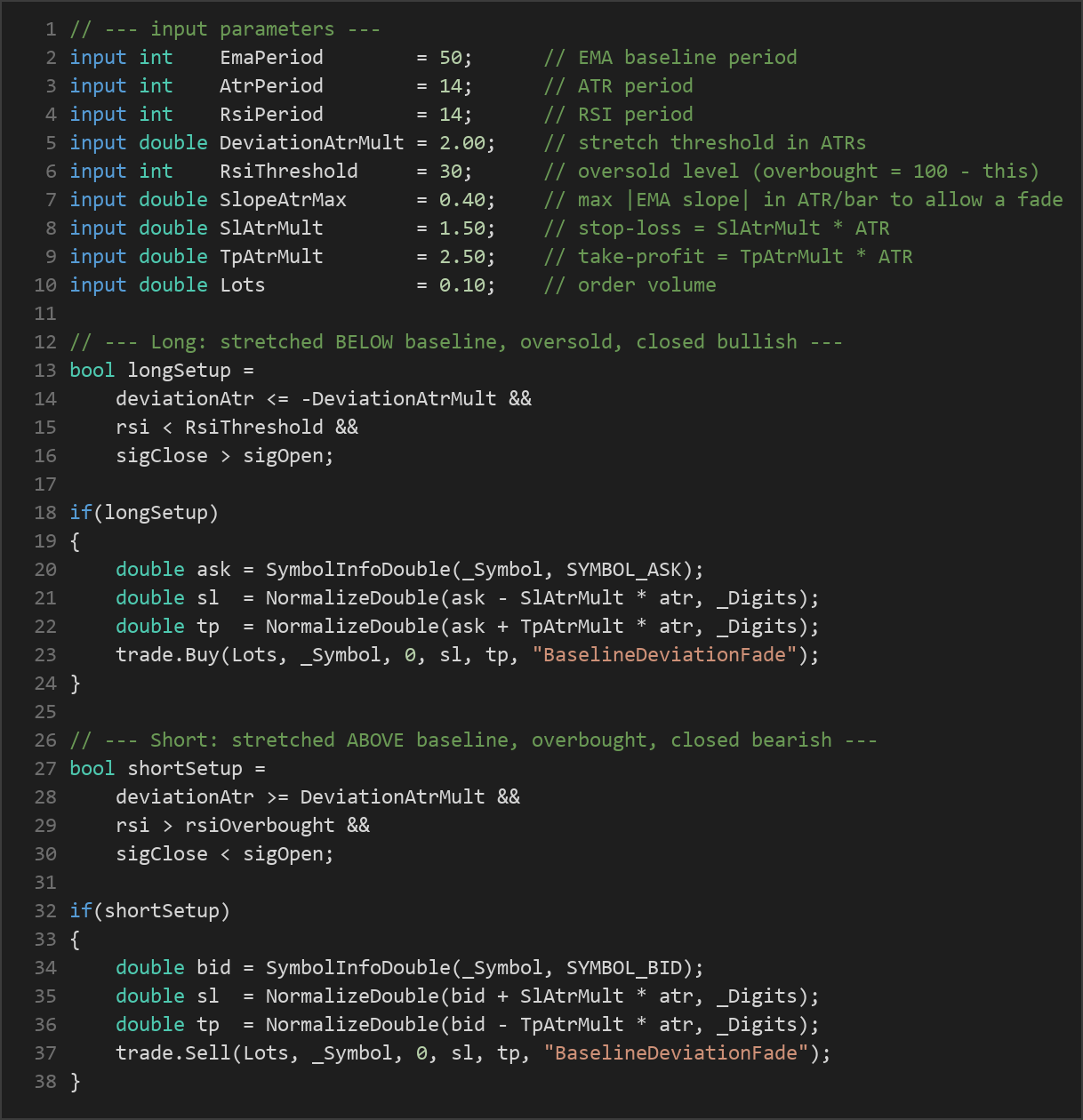
- On a valid long signal, the EA buys at the current ask price. On a valid short signal, it sells at the current bid.
- Only one position is held at a time — the strategy never stacks multiple fades on top of each other.
Exit logic works on three fronts:
- Stop-loss (SL): Placed
SlAtrMultATRs away from entry (below entry for longs, above for shorts), so the risk distance automatically widens or tightens with volatility. - Take-profit (TP): Placed
TpAtrMultATRs away from entry in the profit direction. - Baseline reclaim exit: If price closes back at or beyond the EMA baseline before the SL or TP is hit, the position is closed early. The logic here is that once price has reverted to the mean, the original reason for the trade has played out.
Framed carefully: the strategy signals a fade when stretch, momentum, candle turn, and a calm regime all line up — it does not predict that any individual trade will succeed.
Strategy Parameters
| Parameter | Default | Min | Max | Description |
|---|---|---|---|---|
| EmaPeriod | 50 | 20 | 150 | Look-back period of the EMA baseline (the central average price fades toward). |
| AtrPeriod | 14 | 7 | 28 | Look-back period for ATR, used to normalise deviation and size the SL/TP. |
| RsiPeriod | 14 | 7 | 21 | Look-back period for the RSI momentum filter. |
| DeviationAtrMult | 2.00 | 1.00 | 4.00 | How many ATRs from the baseline the close must reach to count as "stretched." Higher = rarer, more extreme setups. |
| RsiThreshold | 30 | 15 | 40 | Oversold level for longs; the overbought level for shorts is derived as 100 − this value. |
| SlopeAtrMax | 0.40 | 0.10 | 1.50 | Maximum absolute EMA slope (in ATR per bar) allowed. Lower = stricter about only trading flat regimes. |
| SlAtrMult | 1.50 | 0.50 | 4.00 | Stop-loss distance as a multiple of ATR. |
| TpAtrMult | 2.50 | 0.50 | 6.00 | Take-profit distance as a multiple of ATR. |
| Lots | 0.10 | 0.01 | 1.00 | Order volume (position size) in lots. |
Recommended Chart Settings
The Baseline Deviation Fade is a single-timeframe strategy and its defaults (a 50-period EMA, 14-period ATR and RSI) are tuned for intraday-to-swing style charts such as the H1 (1-hour) timeframe on a major forex pair like EUR/USD, where clean ranges and periodic over-extensions are common. Because the strategy is built for range-bound or gently drifting conditions, it is most at home on liquid instruments with tight spreads.
That said, no single symbol or timeframe is universally "correct." Results will vary considerably across different instruments, sessions, and market regimes, and any change to the timeframe will interact with every ATR- and period-based parameter. Treat the defaults as a starting point for study and testing, not as a fixed recommendation.
How to Install on MetaTrader 5
- Download the
BaselineDeviationFade.ex5file from the link below. - Copy it to your MT5
MQL5\Expertsfolder. - Restart MetaTrader 5 or refresh the Navigator panel.
- Drag the EA onto a chart matching the recommended symbol and timeframe.
- Configure the input parameters and enable Algo Trading.
What to Consider Before Using This EA
Strengths of the approach. The most notable design feature is the four-filter confirmation stack. By requiring statistical stretch, an RSI extreme, a reversing candle, and a calm regime simultaneously, the strategy is deliberately selective and avoids many of the "catch a falling knife" entries that plague simpler mean-reversion rules. Measuring everything in ATR units also means the logic adapts to changing volatility instead of relying on fixed distances, and the baseline-reclaim exit gives the strategy a clear, thesis-based reason to leave a trade rather than only waiting for a hard stop or target.
Known limitations. Mean-reversion strategies share a well-documented weakness: they struggle badly in strong, persistent trends, because "stretched" price can keep stretching. The SlopeAtrMax regime gate is included specifically to sidestep this, but no slope filter is perfect — a market can transition from range to trend faster than a lagging EMA slope registers. In those transitions the strategy may fade a move that simply continues. RSI and EMA are both lagging indicators, so extreme readings can persist longer than expected. Finally, because only one position is held at a time, the EA may sit on the sidelines during otherwise-eligible setups while managing an existing trade.
Where it may underperform. Trending markets, news-driven breakouts, thin or illiquid sessions with wide spreads, and periods of sudden volatility expansion are all environments where a fade-the-extreme approach historically faces more losing signals. The strategy is best viewed as a study of conditional mean reversion — it may indicate opportunities only when its narrow regime conditions are met, and it makes no attempt to profit outside them. Thorough backtesting and forward-testing on a demo account are essential before drawing any conclusions.
Risk Management Tips
Sound risk management matters far more than any single entry rule. Consider these general principles:
- Position sizing: Set the
Lotsparameter so that the ATR-based stop-loss represents a small, controlled fraction of your account. Do not size positions by how confident you feel. - The 1–2% rule: A widely-taught guideline is to risk no more than 1–2% of your account balance on any single trade. Size your lots to respect that ceiling given your stop distance.
- Use a demo account first: Test the strategy on a demo or simulated account across many market conditions before ever considering real capital. This helps you understand its behaviour without financial exposure.
- Understand drawdown: Every strategy experiences losing streaks. Study the maximum peak-to-trough decline in your testing so you know what you may need to tolerate emotionally and financially.
- Diversify and avoid over-leverage: Concentrating risk in one instrument or using excessive leverage can turn a normal losing streak into a serious loss. Keep leverage conservative.
- Review regularly: Markets change. Periodically re-evaluate whether the parameters and regime assumptions still fit current conditions.
Risk Warning
Trading foreign exchange, CFDs, and other leveraged financial instruments involves substantial risk of loss and is not suitable for all investors. The strategies and tools discussed on this page are provided for educational purposes only and do not constitute financial advice, investment recommendations, or solicitation to trade. Always consult a qualified financial adviser before making trading decisions. Past backtest performance is not indicative of future results.
Downloads
- Expert Advisor: BaselineDeviationFade.ex5 (79 downloads)
- Source Code: BaselineDeviationFade.mq5 (64 downloads)
- Documentation: BaselineDeviationFade.pdf (67 downloads)