Disclaimer: This article is for educational and informational purposes only. It does not constitute financial or investment advice. Trading forex and CFDs carries significant risk of loss. Past performance of any strategy — including backtests — does not guarantee future results. Never trade with money you cannot afford to lose.
What Is This Strategy?
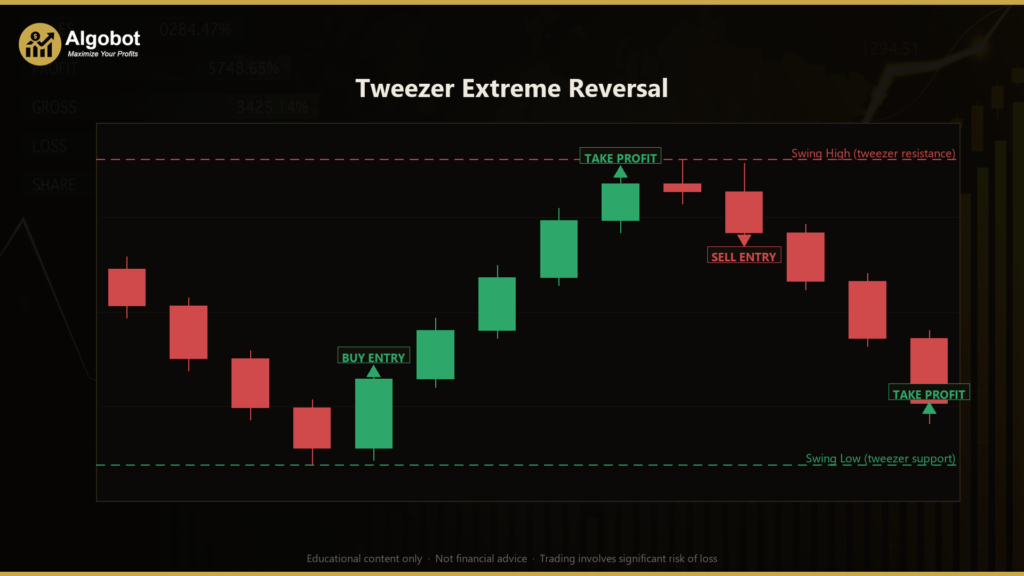
The Tweezer Extreme Reversal is a pure price-action reversal strategy built around the tweezer candlestick pattern — a pair of consecutive bars whose extremes (the lows at a market bottom or the highs at a market top) print at almost exactly the same level. This shared extreme is read as a sign of exhaustion: price probed a level twice, failed to push beyond it both times, and then turned back. Because it relies entirely on candle structure, the strategy uses no technical indicators at all — no moving averages, no oscillators, just the raw open, high, low, and close of recent bars.
This is a counter-trend, mean-reversion style of trading. It is designed for moments when a directional move runs out of steam at a fresh swing high or low, rather than for trend-following or breakout conditions. The strategy waits for a candidate tweezer to form at a recent extreme of the market and then requires a confirmation bar before committing — it does not buy or sell on the bare pattern alone. That extra confirmation step is what separates this approach from naively trading every twin-extreme that appears.
As a learning tool, the Tweezer Extreme Reversal is well suited to traders who want to study how reversal patterns, swing structure, and risk-defined stop placement fit together. Because the stop-loss and take-profit are both derived directly from price (the shared extreme of the tweezer) rather than from arbitrary fixed distances, it is a clean example of structural risk management. It is best treated as an educational template for understanding exhaustion reversals, not as a finished, hands-off system.
How It Works
The strategy evaluates the market once per freshly closed bar and only ever holds one position at a time per magic number, letting the stop-loss and take-profit manage every exit. It examines the two most recently closed bars as a candidate tweezer pair, where bar 2 is the first bar of the pair and bar 1 is the confirmation bar that follows it.
Before any signal can fire, the strategy measures the average recent bar range over the configured RangePeriod. This average is used to size two things adaptively: the tolerance for how "equal" the two extremes must be, and the buffer placed beyond the extreme for the stop. Sizing these from real recent volatility means the rules scale with the instrument and the current market.
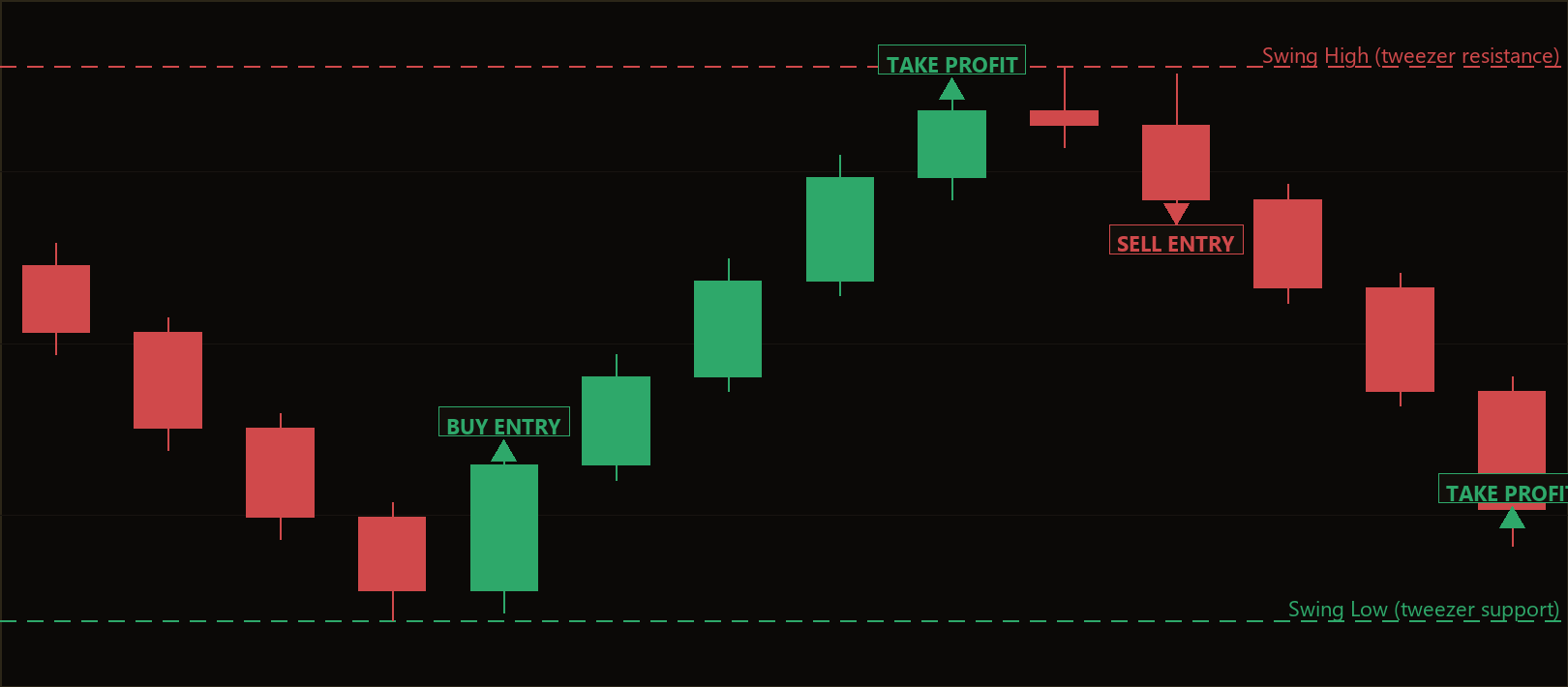
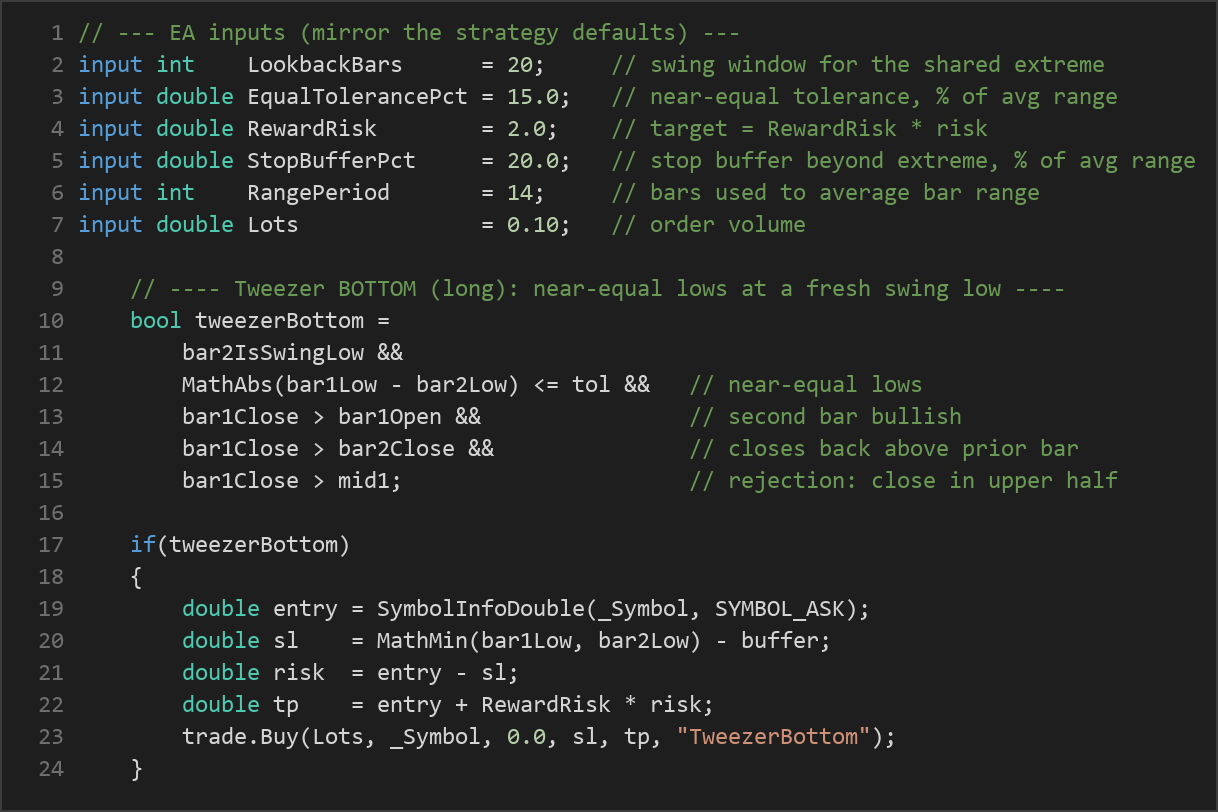
For a Tweezer Bottom (long signal), the strategy signals an entry when all of the following are true:
- The first bar's low is a fresh swing low — no bar within the
LookbackBarswindow printed a lower low. - The two bars' lows are near-equal, within a tolerance of
EqualTolerancePct× the average range. - The confirmation bar is bullish (it closes above its open).
- The confirmation bar closes back above the prior bar's close.
- The confirmation bar closes in its upper half, signalling rejection of the lows.
For a Tweezer Top (short signal), the mirror conditions apply:
- The first bar's high is a fresh swing high — no bar within the lookback window printed a higher high.
- The two highs are near-equal, within the same range-based tolerance.
- The confirmation bar is bearish (it closes below its open).
- The confirmation bar closes back below the prior bar's close.
- The confirmation bar closes in its lower half, signalling rejection of the highs.
Stop-loss logic: For a long, the stop sits just below the lower of the two shared lows, minus a buffer of StopBufferPct × the average range. For a short, it sits just above the higher of the two highs, plus that same buffer. The stop is therefore placed beyond the structural level that, if broken, would invalidate the reversal idea.
Take-profit logic: The distance from entry to stop defines the trade's risk. The take-profit is set at RewardRisk multiplied by that risk distance, projected in the trade's direction. With the default reward-to-risk of 2.0, the target is twice the distance to the stop. A trade is only sent if the calculated risk is positive.
Strategy Parameters
| Parameter | Default | Min | Max | Description |
|---|---|---|---|---|
| LookbackBars | 20 | 5 | 60 | Number of bars used as the swing window. The first bar's extreme must be the lowest low (or highest high) across this window to qualify as a fresh swing extreme. |
| EqualTolerancePct | 15.0 | 2.0 | 50.0 | How close the two extremes must be to count as "equal", expressed as a percentage of the average bar range. Lower values demand a tighter tweezer; higher values are more permissive. |
| RewardRisk | 2.0 | 0.5 | 5.0 | The reward-to-risk multiple. The take-profit distance equals this number times the entry-to-stop distance. |
| StopBufferPct | 20.0 | 0.0 | 100.0 | Extra padding placed beyond the shared extreme for the stop-loss, as a percentage of the average bar range. Larger buffers reduce premature stop-outs but widen risk. |
| RangePeriod | 14 | 5 | 30 | Number of recent bars averaged to measure typical bar range. This average drives both the equality tolerance and the stop buffer. |
| Lots | 0.10 | 0.01 | 1.0 | The fixed order volume in lots for each trade. |
Recommended Chart Settings
This strategy is a general-purpose, indicator-free reversal template, so it is not locked to a single symbol. A sensible starting point for study is a major forex pair such as EUR/USD on an intraday timeframe like M15 or H1, where swing structure is reasonably clean and bar ranges are stable enough for the volatility-based tolerance to behave consistently. The default LookbackBars of 20 and RangePeriod of 14 are tuned for these mid-range timeframes.
Because every threshold scales from the average bar range, the strategy can be tested on other instruments and timeframes, but its behaviour will change with each market's volatility and character. Results will vary across different market conditions, and any settings that look reasonable on one symbol should be re-examined before being applied to another.
How to Install on MetaTrader 5
- Download the .ex5 file from the link below
- Copy it to your MT5
MQL5\Expertsfolder - Restart MetaTrader 5 or refresh the Navigator panel
- Drag the EA onto a chart matching the recommended symbol and timeframe
- Configure the input parameters and enable Algo Trading
What to Consider Before Using This EA
The main strength of the Tweezer Extreme Reversal is its discipline. It does not act on a tweezer alone; it requires the pattern to occur at a fresh swing extreme and demands a confirmation close before entering. Risk is defined structurally — the stop lives just beyond the level that would prove the setup wrong — and the reward target is a clean multiple of that risk. The volatility-scaled tolerance and buffer mean the same logic adapts across instruments rather than relying on hard-coded pip values.
That said, reversal trading carries well-known limitations. Counter-trend setups, by definition, fight the prevailing move, and a strong trend can blow straight through a "fresh" extreme, turning what looked like exhaustion into continuation. In choppy, low-momentum ranges the tweezer pattern may appear frequently but produce many small, indecisive turns. The fixed Lots sizing does not adjust to account equity or to the varying stop distance, so risk per trade is not constant. And because exits are left entirely to the stop and target, there is no trailing logic or break-even mechanism to protect an open profit if price stalls before reaching the target.
The honest takeaway: this is a focused, well-structured example of an exhaustion-reversal system, not a guaranteed edge. Its performance will depend heavily on the instrument, the timeframe, and the market regime in which it is used.
Risk Management Tips
Sound risk management matters more than any single entry rule. As you study this strategy, keep the following educational principles in mind:
- Risk a small, fixed percentage per trade — many educators suggest never risking more than 1–2% of account equity on a single position. Because this EA uses a fixed lot size, you may need to adjust
Lotsso the entry-to-stop distance matches that percentage on your account. - Always test on a demo account first. Run the strategy in MT5's Strategy Tester and on a demo account across varied conditions before risking real capital.
- Understand drawdown. Even a logically sound reversal system will experience losing streaks. Know the maximum drawdown you are prepared to tolerate before you begin.
- Mind correlation and exposure. Running the EA on several correlated symbols at once can multiply your true risk beyond what each individual trade suggests.
- Review, don't "set and forget." Periodically check that the market's behaviour still resembles the conditions the strategy was designed for.
Risk Warning
Trading foreign exchange, CFDs, and other leveraged financial instruments involves substantial risk of loss and is not suitable for all investors. The strategies and tools discussed on this page are provided for educational purposes only and do not constitute financial advice, investment recommendations, or solicitation to trade. Always consult a qualified financial adviser before making trading decisions. Past backtest performance is not indicative of future results.
Downloads
- Expert Advisor: TweezerExtremeReversal.ex5 (62 downloads)
- Source Code: TweezerExtremeReversal.mq5 (53 downloads)
- Documentation: TweezerExtremeReversal.pdf (63 downloads)