Disclaimer: This article is for educational and informational purposes only. It does not constitute financial or investment advice. Trading forex and CFDs carries significant risk of loss. Past performance of any strategy — including backtests — does not guarantee future results. Never trade with money you cannot afford to lose.
What Is This Strategy?
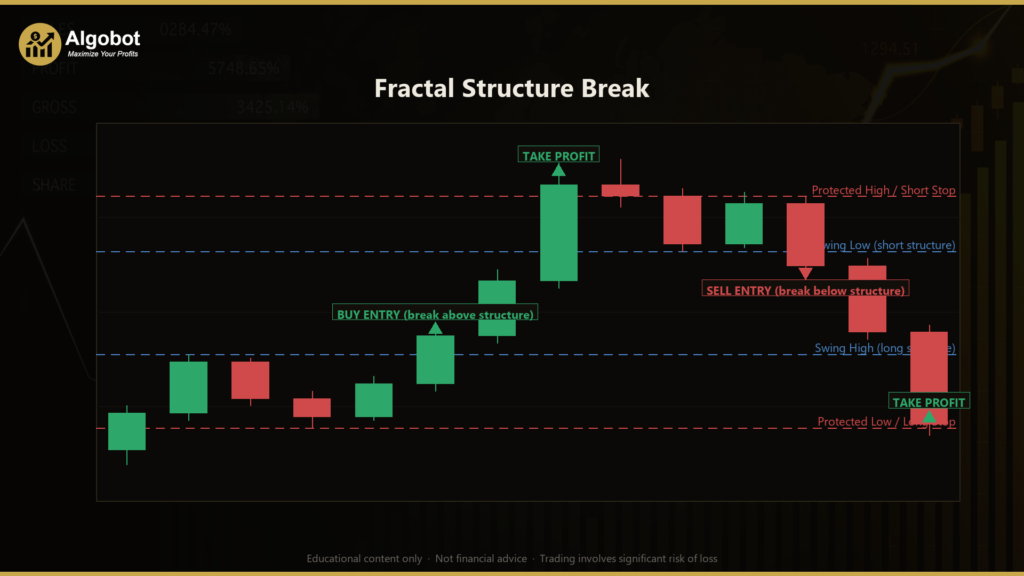
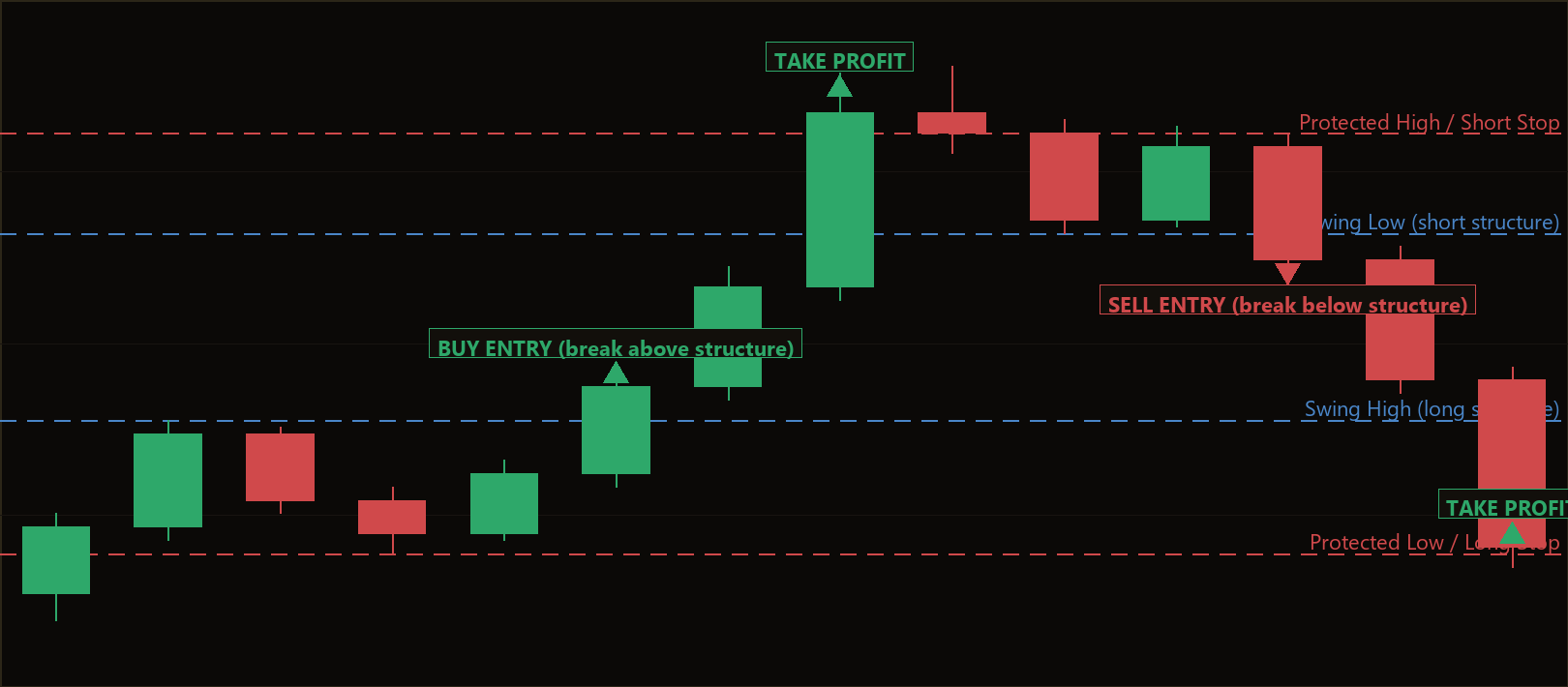
The Fractal Structure Break strategy is a pure price-action trend-continuation system built around the ICT concept of a Break of Structure (BoS). Instead of relying on moving averages, oscillators, or any other calculated indicator, it reads the raw geometry of the chart: it locates swing points using a symmetric fractal (a pivot bar that stands above or below its neighbours) and then watches for the moment price decisively closes beyond the most recent swing. In trader shorthand, a "break of structure" is the point where the market confirms it wants to keep moving in the prevailing direction.
This is a trend-continuation approach, which means it is designed for markets that are already showing directional intent — a sequence of Higher Highs and Higher Lows for an uptrend, or Lower Highs and Lower Lows for a downtrend. The strategy does not try to predict reversals or pick tops and bottoms. It waits for the structure to declare itself, then looks for the break that historically signals the trend may extend. Because everything is derived from candle highs, lows, and closes, the logic stays close to what discretionary price-action and Smart Money Concepts (SMC) traders study by eye.
As a learning tool, the Fractal Structure Break is well suited to traders who want to understand how market structure is defined mechanically rather than intuitively. By exposing the swing-detection width, the break buffer, and the structural stop placement as adjustable inputs, it lets you see exactly how a "swing" and a "valid break" are quantified. Frame your use of it as an educational study of structure-based logic — not as a shortcut to results.
How It Works
The strategy processes only closed bars (it ignores the still-forming candle) and holds at most one position at a time per Magic number. Here is the full logic in plain English:
- Swing detection (the fractal): A bar is marked as a swing High when its high is strictly above the highs of the
SwingStrengthbars on each side of it. A swing Low is the mirror — a low strictly below the lows of its neighbours on both sides. The strategy keeps the two most recent confirmed swings on each side (the newest and the prior one). - Reading structure: Market structure is judged from those swings. A Higher Low (the latest swing Low sits above the previous swing Low) is read as bullish structure. A Lower High (the latest swing High sits below the previous one) is read as bearish structure.
- Recent range (for buffers): The strategy averages the high-to-low range of the last
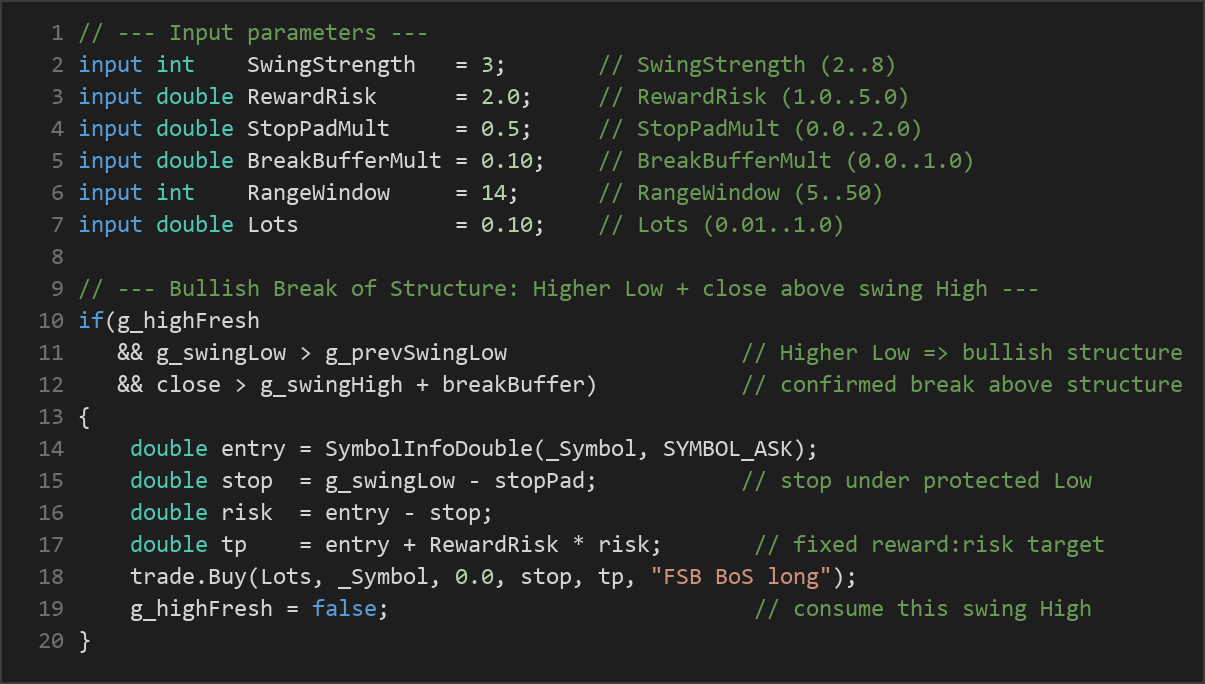
RangeWindowbars to estimate a "recent range." This single price-derived figure scales both the break confirmation buffer and the stop padding, so the thresholds adapt to current volatility without using a volatility indicator. - Long entry signal: The strategy signals a buy when (1) there is a fresh swing High that has not yet been used, (2) structure is bullish (Higher Low in place), and (3) a bar closes above that swing High by at least
BreakBufferMult× recent range. Entry is taken at the Ask price. - Short entry signal: The strategy signals a sell when (1) there is a fresh swing Low not yet used, (2) structure is bearish (Lower High in place), and (3) a bar closes below that swing Low by at least
BreakBufferMult× recent range. Entry is taken at the Bid price. - Stop-loss logic: The protective stop is anchored to the opposing structural swing. For a long, the stop sits below the protected (higher) swing Low, padded down by
StopPadMult× recent range. For a short, the stop sits above the protected (lower) swing High, padded up by the same amount. This ties risk directly to the structure that would be invalidated if price reversed. - Take-profit logic: The take-profit is a fixed reward-to-risk multiple. The strategy measures the structural risk (the distance from entry to stop) and projects the target at
RewardRisk× that distance in the direction of the trade. - One-shot per swing: Once a swing is broken and a trade is sent, that swing is "consumed" so the same level cannot trigger repeated entries. A new fresh swing must form before another signal of that type can fire.
Strategy Parameters
| Parameter | Default | Min | Max | Description |
|---|---|---|---|---|
| SwingStrength | 3 | 2 | 8 | Fractal half-width — the number of bars required on each side of a pivot for it to confirm as a swing High or Low. Larger values demand more significant, slower-forming swings. |
| RewardRisk | 2.0 | 1.0 | 5.0 | Reward-to-risk multiple applied to the structural stop distance to set the take-profit. A value of 2.0 places the target twice as far as the stop. |
| StopPadMult | 0.5 | 0.0 | 2.0 | Extra padding placed beyond the opposing structural swing for the stop, expressed as a fraction of recent range. Gives the stop breathing room behind structure. |
| BreakBufferMult | 0.10 | 0.0 | 1.0 | How far the close must clear the broken swing — as a fraction of recent range — before the break counts as a valid Break of Structure. Higher values filter out marginal pokes. |
| RangeWindow | 14 | 5 | 50 | Number of recent bars averaged to estimate "recent range," which scales the break buffer and stop padding. |
| Lots | 0.10 | 0.01 | 1.0 | Fixed trade size in lots for each position. |
Recommended Chart Settings
The Fractal Structure Break is a single-timeframe strategy: every bar it reads uses the chart's primary timeframe, so it runs on whatever timeframe you attach it to. Structure-based logic like this is most often studied on the H1 (1-hour) or H4 (4-hour) charts of major forex pairs such as EUR/USD or GBP/USD, where swings are well-defined and spreads are typically tight. Lower timeframes produce more swings and more signals but also more noise, while higher timeframes produce fewer, slower setups.
There is no universally "correct" symbol or timeframe — the way swings and breaks form differs across instruments and market regimes. Results will vary considerably across different market conditions, so treat any chart as a starting point for study rather than a fixed recommendation, and re-examine the SwingStrength and BreakBufferMult settings whenever you change instrument or timeframe.
How to Install on MetaTrader 5
- Download the .ex5 file from the link below
- Copy it to your MT5
MQL5\Expertsfolder - Restart MetaTrader 5 or refresh the Navigator panel
- Drag the EA onto a chart matching the recommended symbol and timeframe
- Configure the input parameters and enable Algo Trading
What to Consider Before Using This EA
Strengths of the approach. The Fractal Structure Break is transparent and rule-based. Because it uses no indicators, there are no smoothing lags or repainting issues to worry about — a swing is either confirmed by its neighbours or it is not, and a break is either closed-beyond-buffer or it is not. Tying both the stop and the buffer to recent range means the logic adapts to volatility automatically, and anchoring the stop to real structure produces a clean, explainable risk model.
Known limitations. Fractal swings are only confirmed after SwingStrength bars have formed on the right side, so the strategy inherently reacts to structure with a built-in delay — the more strength you require, the later a swing is recognised. As a trend-continuation system, it depends on trends actually continuing; in ranging or choppy markets the same horizontal levels can be broken in both directions, producing whipsaw entries that get stopped out. False breaks (a close just past a swing that quickly reverses) are the classic failure mode of any breakout logic, and a low BreakBufferMult makes the strategy more vulnerable to them.
Conditions where it may underperform. Expect weaker behaviour during low-volatility consolidations, around major news releases where price gaps through levels, and on instruments with wide or variable spreads that can eat into the structural risk distance. The fixed reward-to-risk target also means trades may run to a full target only when the trend has enough room to travel; in compressed markets the target may sit beyond the available move. None of this makes the approach "good" or "bad" — it simply defines the environment the logic was built for, which is exactly what you should be studying.
Risk Management Tips
Sound risk management matters far more than any single entry rule. Keep these educational principles in mind:
- Size positions deliberately. A common guideline is to risk no more than 1–2% of account equity per trade. Because this EA uses a fixed
Lotsvalue, you should calculate whether that lot size keeps your structural stop within that 1–2% limit on your account and instrument. - Test on a demo account first. Run the strategy on a demo account for an extended period before considering any live use, so you can observe how it behaves across different market conditions without financial exposure.
- Understand drawdown. Even a well-defined system experiences losing streaks. Study the historical sequence of losses, not just isolated wins, and ask whether you could tolerate that drawdown emotionally and financially.
- Respect the stop. The structural stop is part of the strategy's design — overriding or widening it manually changes the risk model the logic depends on.
- Diversify and review. Avoid concentrating all risk in one instrument or one strategy, and review performance periodically rather than judging it on a handful of trades.
Risk Warning
Trading foreign exchange, CFDs, and other leveraged financial instruments involves substantial risk of loss and is not suitable for all investors. The strategies and tools discussed on this page are provided for educational purposes only and do not constitute financial advice, investment recommendations, or solicitation to trade. Always consult a qualified financial adviser before making trading decisions. Past backtest performance is not indicative of future results.
Downloads
- Expert Advisor: FractalStructureBreak.ex5 (40 downloads)
- Source Code: FractalStructureBreak.mq5 (42 downloads)
- Documentation: FractalStructureBreak.pdf (48 downloads)