Disclaimer: This article is for educational and informational purposes only. It does not constitute financial or investment advice. Trading forex and CFDs carries significant risk of loss. Past performance of any strategy — including backtests — does not guarantee future results. Never trade with money you cannot afford to lose.
What Is This Strategy?
Thrust Retrace Ignition is a pure price-action, momentum-continuation scalping strategy built for the M5 (5-minute) chart of XAUUSD (gold versus the US dollar). Unlike strategies that lean on moving averages, oscillators, or other technical indicators, this approach reads nothing but raw candle geometry — the open, high, low, and close of each completed bar. In trading terminology, "price action" simply means making decisions from the shape and position of candles themselves rather than from a calculated indicator line.
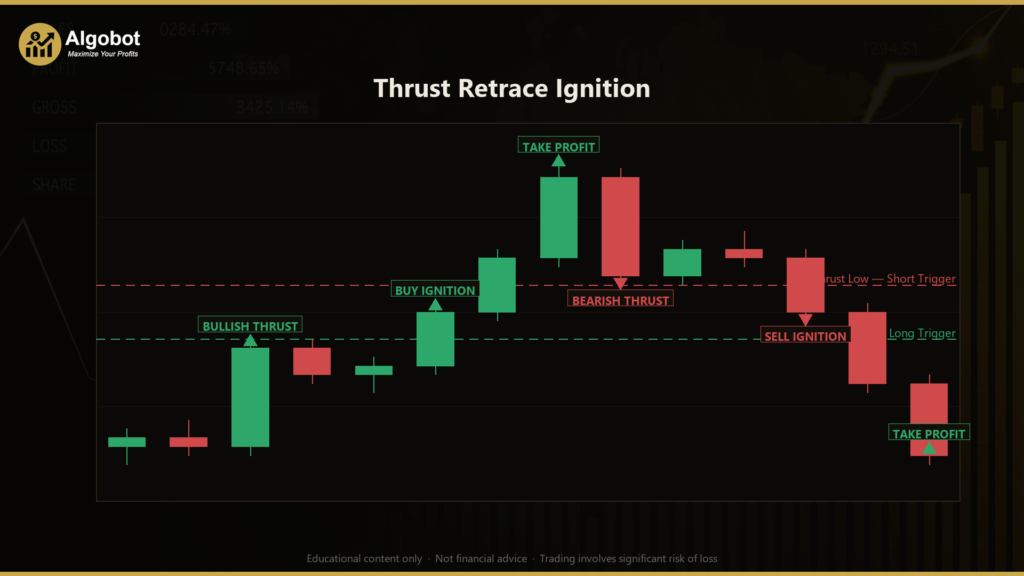
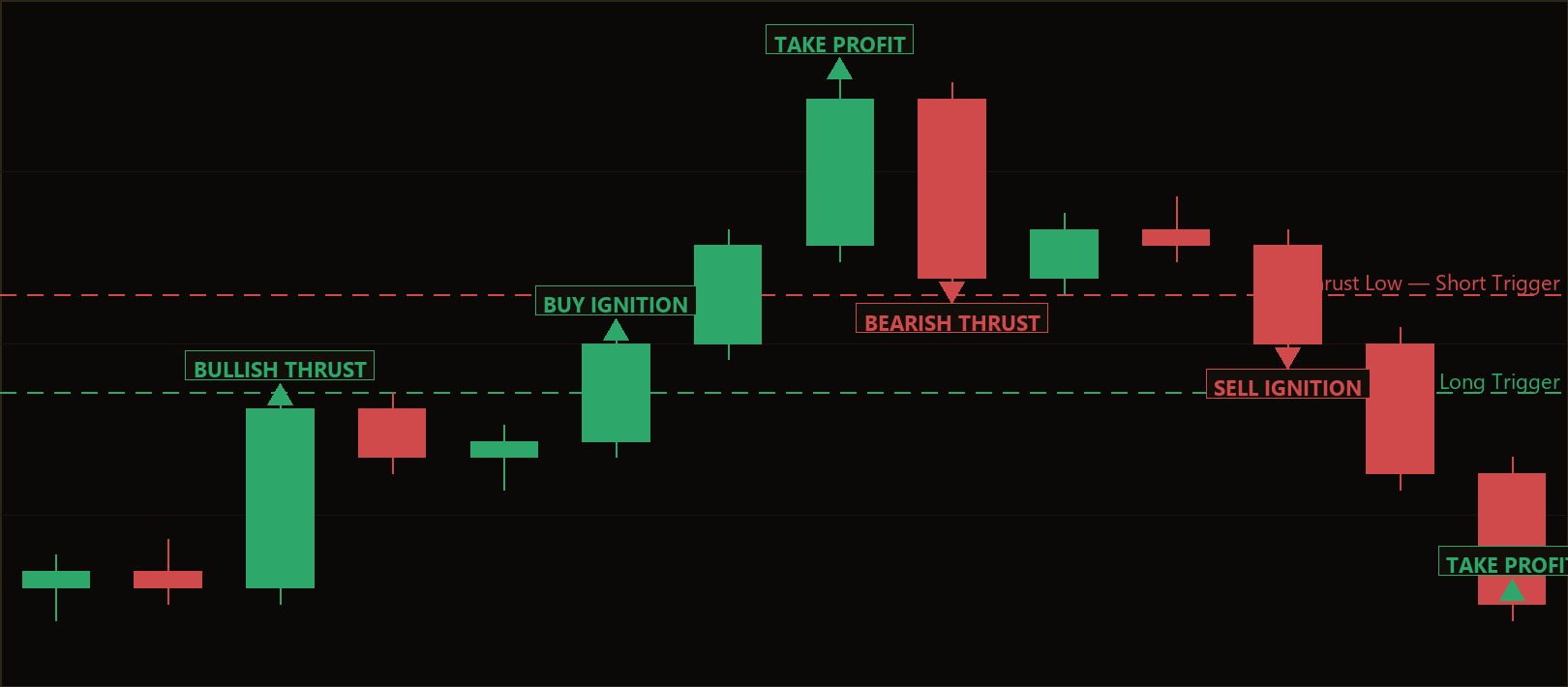
The strategy is designed for fast, trending conditions where a sharp burst of buying or selling pressure is followed by a brief pause before the move continues. It looks for a single dominant candle — a near-marubozu, meaning a candle with very little wick and a body that fills most of its range — to mark a momentum event. It then waits to see whether the market merely catches its breath (a shallow pullback) before pushing on, or whether the move fully reverses. Only the former is traded.
As a learning tool, Thrust Retrace Ignition is well suited to traders who want to study how displacement, retracement, and breakout confirmation fit together inside a single mechanical framework. It is best read as a worked example of a continuation pattern, not as a profit opportunity. If you are studying how candle structure alone can define an entry, a stop, and a target, this strategy offers a clean, indicator-free case study.
How It Works
The strategy moves through a simple three-stage state machine — thrust, retrace, ignition — and acts only once per completed bar. Every decision is made on closed candles, never on the still-forming bar.
- Thrust detection (the power candle): The strategy scans the most recently closed bar and compares its body to the average bar range over the lookback window. The bar qualifies as a "thrust" when its body is at least
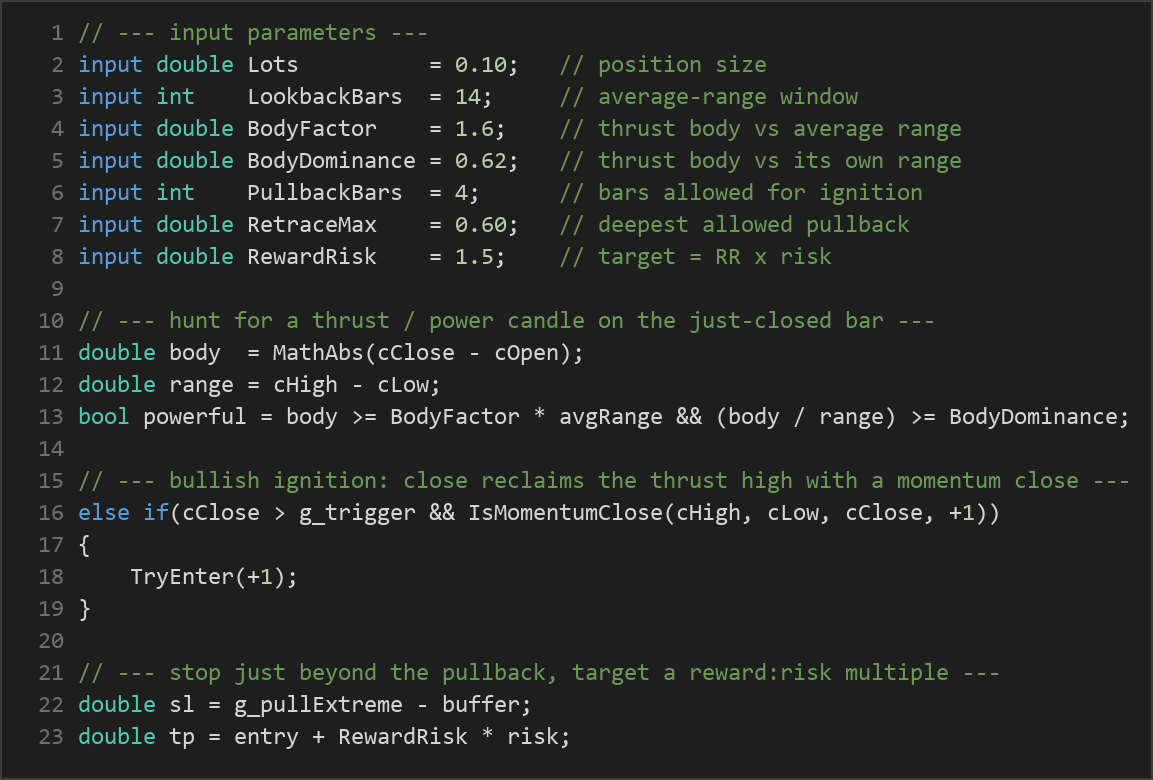
BodyFactortimes the recent average range and the body fills at leastBodyDominanceof the candle's full high-to-low range. This identifies a strong displacement candle with little wick. A bullish thrust arms the strategy for a long setup; a bearish thrust arms it for a short — the logic is fully symmetric. - Setting the breakout level: Once a thrust is found, the strategy records the thrust's extreme as the breakout "trigger" — the high for a bullish thrust, the low for a bearish one. It also stores the thrust's range as a yardstick for measuring everything that follows.
- Retrace validation (the shallow pullback): Over the next few bars (
PullbackBars), the strategy tracks how far price pulls back from the trigger. It continuously updates the pullback extreme — the lowest low for longs, the highest high for shorts. If the pullback depth exceedsRetraceMaxof the thrust's range, the setup is voided, because a deep retracement signals the momentum has been absorbed. - Ignition (the entry signal): The strategy signals an entry when a later bar closes back through the breakout trigger in the thrust's direction and does so with a momentum close — meaning the candle closes within the leading 60% of its own range. For a long, the close must finish in the upper portion of the bar; for a short, the lower portion. This confirmation step helps filter out weak, indecisive breaks.
- Stop-loss logic: The stop is placed just beyond the pullback extreme, offset by a small buffer equal to
BufferFactortimes the thrust range. The idea is that if price returns past the point where the retrace bottomed (or topped), the continuation thesis has failed. - Take-profit logic: The distance from entry to stop defines the risk. The target is set at
RewardRiskmultiplied by that risk distance, giving a fixed reward-to-risk ratio derived entirely from price action — no indicator is involved. - Trade and spread filters: Only one position is held at a time; while a trade is live, its stop and target manage it. Before entering, the strategy checks that the current spread does not exceed
MaxSpreadpoints, helping avoid execution in poor conditions. If the ignition window passes without a valid signal, the setup expires and the strategy resumes hunting for a fresh thrust.
Strategy Parameters
| Parameter | Default | Min | Max | Description |
|---|---|---|---|---|
| Lots | 0.10 | 0.01 | 1.00 | Fixed trade volume in lots for each position. |
| LookbackBars | 14 | 5 | 40 | Number of prior bars used to compute the average bar range that the thrust is measured against. |
| BodyFactor | 1.6 | 0.8 | 3.0 | How many times larger the thrust body must be than the average range to qualify as a power candle. |
| BodyDominance | 0.62 | 0.40 | 0.90 | Minimum fraction of the candle's range that must be solid body (filters out wide-wick bars). |
| PullbackBars | 4 | 1 | 10 | Number of bars allowed for the retrace and ignition to occur before the setup expires. |
| RetraceMax | 0.60 | 0.20 | 0.95 | Maximum allowed pullback depth as a fraction of the thrust range; deeper retracements void the setup. |
| RewardRisk | 1.5 | 0.5 | 4.0 | Reward-to-risk multiple used to set the take-profit relative to the stop distance. |
| BufferFactor | 0.12 | 0.00 | 0.50 | Extra cushion beyond the pullback extreme for the stop, as a fraction of the thrust range. |
| MaxSpread | 200 | 10 | 800 | Maximum spread (in points) permitted at entry; trades are skipped above this. |
Recommended Chart Settings
Thrust Retrace Ignition was designed and commented specifically for XAUUSD on the M5 (5-minute) timeframe. Gold on a short timeframe tends to produce the sharp, impulsive candles the thrust logic is built to detect, which is why this pairing is the intended environment.
You can experiment with other symbols and timeframes, but be aware that the parameter defaults — particularly BodyFactor, RetraceMax, and MaxSpread — are calibrated for gold's volatility and typical spread. Different instruments behave differently, and results will vary considerably across changing market conditions. Any change of symbol or timeframe should be studied carefully on a demo account before drawing conclusions.
How to Install on MetaTrader 5
- Download the .ex5 file from the link below
- Copy it to your MT5
MQL5\Expertsfolder - Restart MetaTrader 5 or refresh the Navigator panel
- Drag the EA onto a chart matching the recommended symbol and timeframe
- Configure the input parameters and enable Algo Trading
What to Consider Before Using This EA
Every strategy has strengths and trade-offs, and an honest assessment helps you study it effectively.
Strengths. Because Thrust Retrace Ignition uses no indicators, its logic is transparent and easy to reason about — every decision traces back to candle geometry you can see on the chart. The built-in retrace filter and momentum-close confirmation are designed to avoid chasing breaks that lack follow-through, and the price-action-based stop and target keep risk defined on every trade. The one-position-at-a-time rule and spread filter add a layer of execution discipline.
Known limitations. Continuation strategies like this one tend to perform best in clean, trending conditions. In choppy, range-bound markets, thrust candles can appear and then immediately reverse, producing failed setups. The strategy also depends on a single dominant candle to define the setup, so it may be sensitive to sudden news-driven spikes that do not represent genuine momentum. Tight PullbackBars windows can cause valid continuations to expire before ignition, while loose ones may admit weaker setups.
Where it may underperform. Low-volatility sessions, periods of erratic spread widening (common around major news releases), and sideways consolidation are all conditions where this approach historically struggles. No single mechanical strategy adapts to every regime, and this one is no exception. Treat it as one analytical lens among many, not a complete trading system.
Risk Management Tips
Sound risk management matters more than any single entry signal. The following are general educational principles, not guarantees:
- Size positions conservatively. A common guideline is to risk no more than 1–2% of your account on any single trade. Adjust the
Lotssetting so the distance to your stop reflects that limit. - Always demo first. Run the EA on a demo account across many different market conditions before considering any live use. This helps you understand its behavior without financial exposure.
- Understand drawdown. Even well-designed strategies experience losing streaks. Study the depth and duration of drawdowns so you know what is normal for this approach and can decide whether you could tolerate it.
- Respect the spread filter. The
MaxSpreadparameter exists for a reason; widening spreads around news can turn an otherwise valid setup into a poor entry. - Never over-leverage. Leverage magnifies losses as much as gains. Use it cautiously and never trade with money you cannot afford to lose.
Risk Warning
Trading foreign exchange, CFDs, and other leveraged financial instruments involves substantial risk of loss and is not suitable for all investors. The strategies and tools discussed on this page are provided for educational purposes only and do not constitute financial advice, investment recommendations, or solicitation to trade. Always consult a qualified financial adviser before making trading decisions. Past backtest performance is not indicative of future results.
Downloads
- Expert Advisor: ThrustRetraceIgnition.ex5 (50 downloads)
- Source Code: ThrustRetraceIgnition.mq5 (49 downloads)
- Documentation: ThrustRetraceIgnition.pdf (49 downloads)