Disclaimer: This article is for educational and informational purposes only. It does not constitute financial or investment advice. Trading forex and CFDs carries significant risk of loss. Past performance of any strategy — including backtests — does not guarantee future results. Never trade with money you cannot afford to lose.
What Is This Strategy?
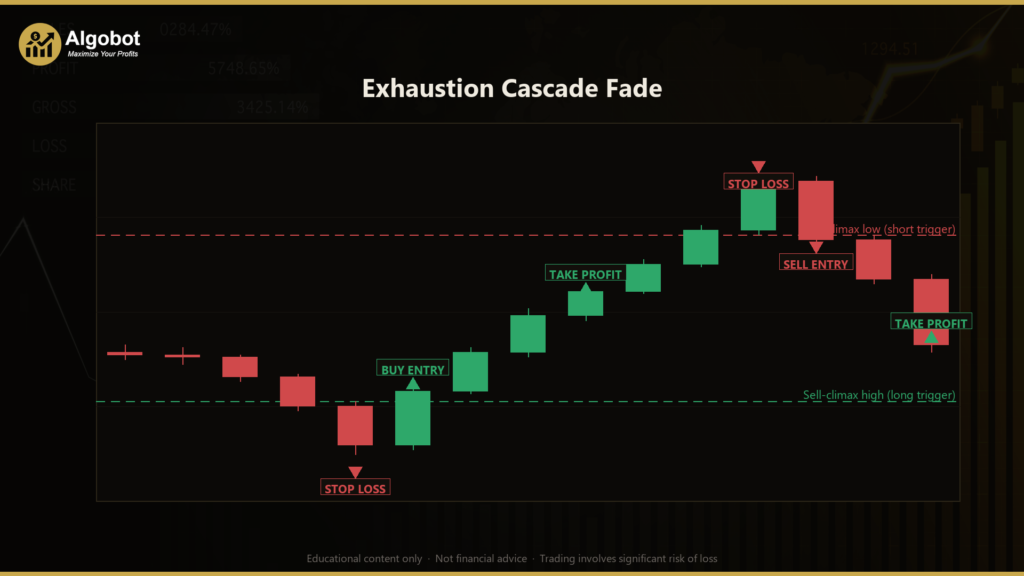
The Exhaustion Cascade Fade is a pure price-action mean-reversion scalping strategy that fades a buying or selling climax — and it does so using nothing but raw candle geometry. There are no moving averages, no RSI, no ATR, and no indicators of any kind. Every decision is made by reading the size, direction, and sequence of recent candles, which makes it a useful teaching example for traders who want to understand market structure without the smoothing layer that indicators add.
The core idea is built around a "cascade": a short run of consecutive same-direction candles that keep punching to new extremes — lower lows in a sell-off, or higher highs in a rally. This kind of one-way order flow often reflects panic or forced liquidation, and it tends to end in a climax bar (sometimes called a blow-off) — the widest, most dramatic candle of the run, where the last weak hands are flushed out and short-term liquidity is exhausted. The Exhaustion Cascade Fade is designed to study what happens after that exhaustion, when price frequently snaps back in the opposite direction.
This strategy is best suited as a learning tool for traders interested in counter-trend (mean-reversion) scalping on fast, liquid, tight-spread instruments. It deliberately avoids "catching the falling knife" — instead of buying into a crash, it waits for the first candle that decisively rejects the move before fading it. Because it is a counter-trend approach, it is most instructive for those who already understand that fading momentum carries a distinct risk profile compared with trend-following.
How It Works
The strategy evaluates conditions once per newly-closed candle and only ever holds one position at a time (identified by its magic number). It also checks the live spread before acting and skips the setup if the spread is wider than the configured limit. When a position is open, it simply lets the stop-loss and take-profit manage the exit.
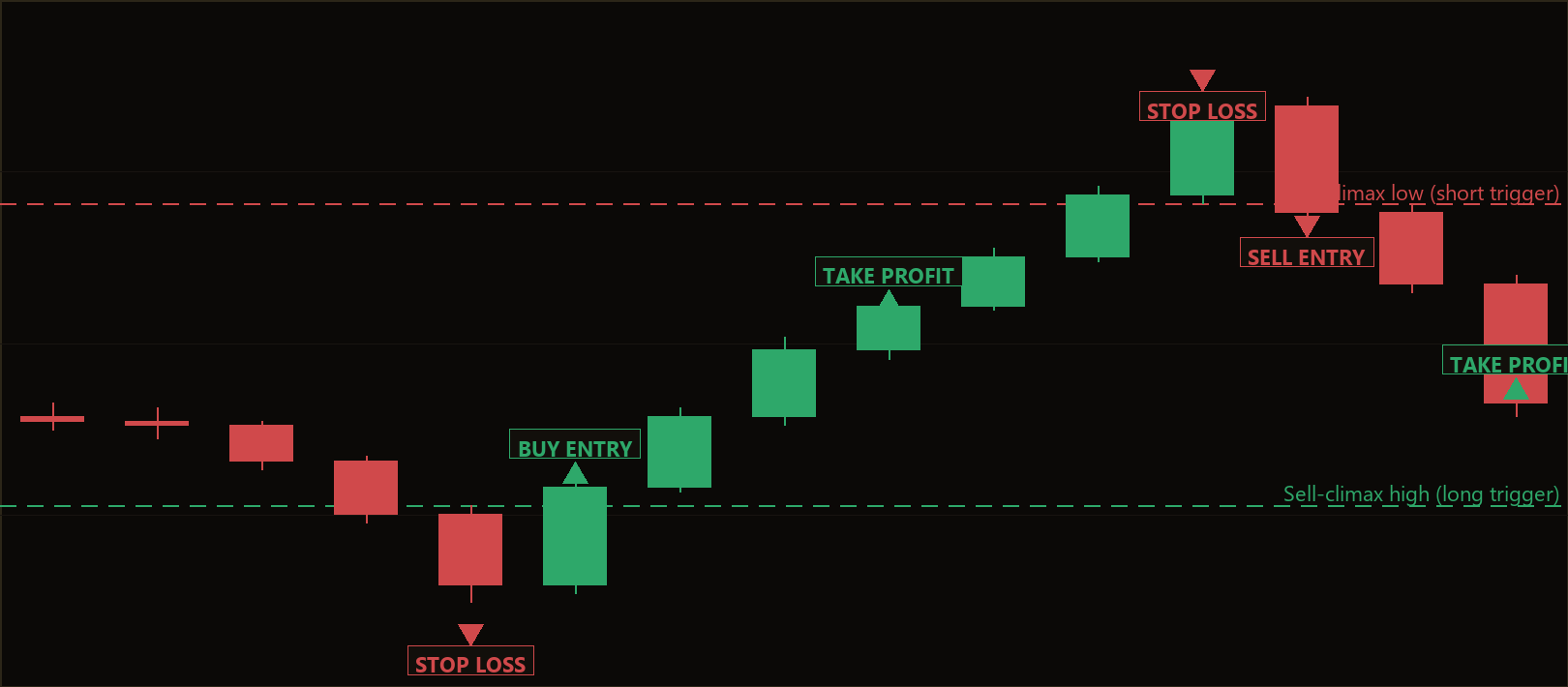
For a long trade (fading a selling climax), the strategy signals an entry when all of the following are true:
- A bearish cascade has formed — a run of
StreakLengthconsecutive bearish candles (close below open), each making a lower low than the one before it. - The final run candle is a genuine blow-off climax — it is the widest candle of the entire run, and its high-to-low range is at least
ClimaxFactortimes the average range of the quietBaselineLookbackcandles that preceded the cascade. - A recovery candle confirms rejection — the just-closed candle is bullish (close above open) and closes above the climax candle's high, signalling that sellers may be spent.
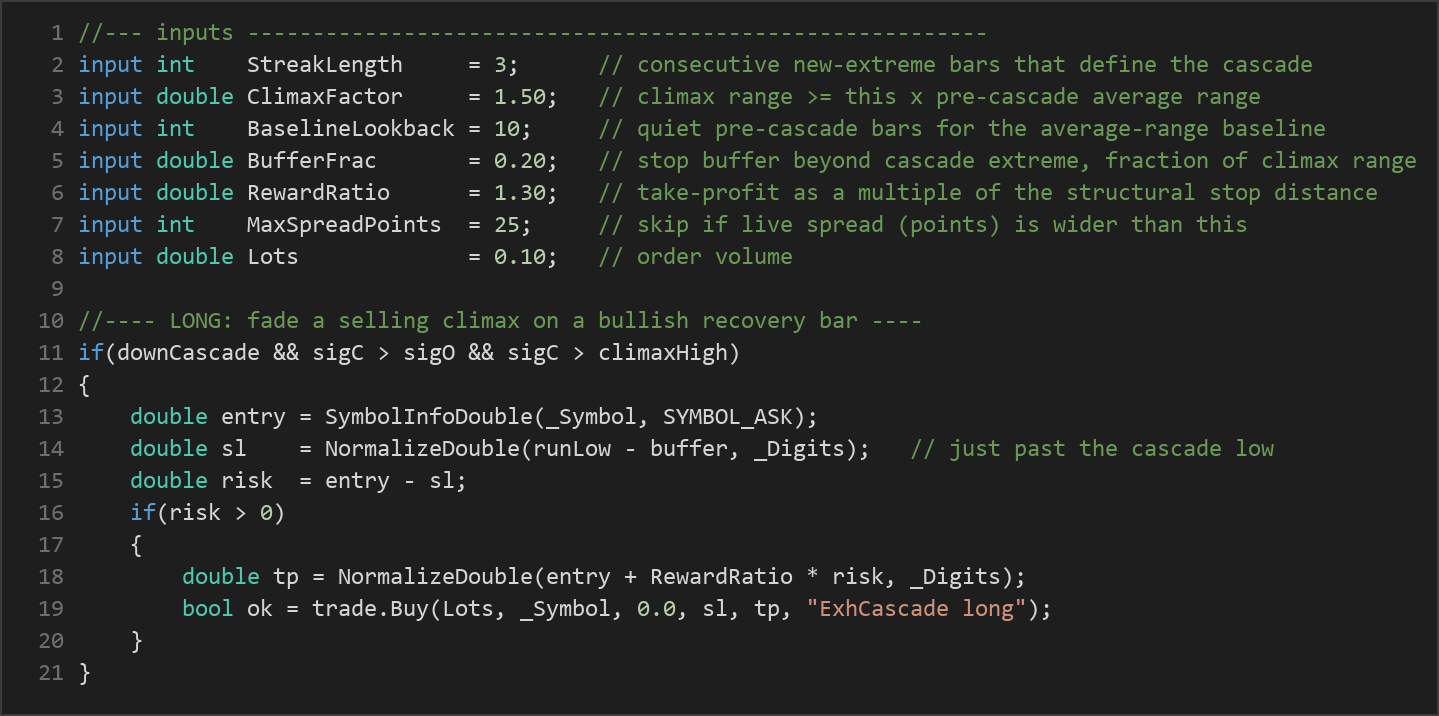
When these align, the strategy enters a buy at the current Ask. The stop-loss is placed just below the lowest low of the cascade, offset by a buffer equal to BufferFrac of the climax range — this sits past the point where the exhaustion thesis would be considered wrong. The take-profit is set at a fixed RewardRatio multiple of that stop distance.
A short trade (fading a buying climax) is the exact mirror image:
- A run of
StreakLengthconsecutive bullish candles, each making a higher high. - A climax candle that is the widest of the run and at least
ClimaxFactortimes the pre-cascade average range. - A bearish recovery candle that closes below the climax candle's low.
The short is entered at the current Bid, with the stop placed just above the highest high of the cascade (plus the buffer) and the take-profit set at the same RewardRatio multiple of the stop distance. In both directions, the structural stop and the reward-to-risk target define every exit — there is no trailing logic or discretionary close.
Strategy Parameters
| Parameter | Default | Min | Max | Description |
|---|---|---|---|---|
| StreakLength | 3 | 2 | 6 | Number of consecutive same-direction "new extreme" candles required to define a cascade. |
| ClimaxFactor | 1.50 | 1.00 | 4.00 | The climax candle's range must be at least this multiple of the pre-cascade average range to qualify as a blow-off. |
| BaselineLookback | 10 | 5 | 40 | How many quiet candles before the cascade are used to compute the average-range baseline. |
| BufferFrac | 0.20 | 0.00 | 1.00 | Stop-loss buffer placed beyond the cascade extreme, expressed as a fraction of the climax range. |
| RewardRatio | 1.30 | 0.50 | 4.00 | Take-profit distance as a multiple of the structural stop distance. |
| MaxSpreadPoints | 25 | 1 | 200 | Skips the setup if the live spread (in points) is wider than this value. |
| Lots | 0.10 | 0.01 | 1.00 | Order volume (lot size) for each trade. |
| Magic | 5273 | 0 | 9,999,999 | Unique identifier used to track this EA's positions. |
Recommended Chart Settings
The Exhaustion Cascade Fade was designed for a fast, tight-spread instrument such as EUR/USD or USD/JPY on the M1 or M5 timeframe. These conditions matter: because it is a scalping approach with relatively tight structural stops, a wide spread can quickly erode the reward-to-risk profile, which is exactly why the MaxSpreadPoints gate exists.
The strategy operates on a single primary timeframe and can technically run on any liquid symbol or timeframe, but its behaviour — and the frequency and quality of the climax setups it detects — will vary considerably across different instruments and market conditions. Always study how it behaves on your chosen symbol and timeframe before drawing conclusions.
How to Install on MetaTrader 5
- Download the .ex5 file from the link below
- Copy it to your MT5
MQL5\Expertsfolder - Restart MetaTrader 5 or refresh the Navigator panel
- Drag the EA onto a chart matching the recommended symbol and timeframe
- Configure the input parameters and enable Algo Trading
What to Consider Before Using This EA
Like any approach, the Exhaustion Cascade Fade has clear strengths and equally clear limitations that are worth understanding before you ever consider live use.
Strengths. Because it relies only on candle geometry, the logic is transparent and easy to reason about — there are no hidden indicator lags to interpret. The requirement for a confirmed recovery candle means it does not blindly fade momentum; it waits for evidence that the move has stalled. And every trade has a pre-defined, structural stop and a fixed reward-to-risk target, which enforces discipline around exits.
Limitations. Counter-trend strategies face a fundamental challenge: a "cascade" that looks like exhaustion can simply be the early stage of a much larger directional move. When that happens, the recovery candle can be a brief pause rather than a true reversal, and the position may be stopped out. Strong-trend and high-impact news environments are precisely where this kind of fade may underperform, because one-way order flow can persist far longer than any single climax suggests. The strategy also trades infrequently by design — genuine blow-off climaxes that satisfy every condition are relatively rare — so it requires patience and may experience extended periods with no signals.
The default RewardRatio of 1.30 means each winner is modestly larger than each loser, so the approach depends on the quality of its win rate over time. There is no guarantee that historical patterns will repeat, and changing market microstructure, spreads, or volatility can all affect outcomes. Treat this EA as a study of climax-reversal mechanics, not as a finished system.
Risk Management Tips
Sound risk management matters far more than any single entry signal. As a general educational framework:
- Size positions conservatively. A widely taught guideline is to risk no more than 1–2% of account equity on any single trade. Adjust the
Lotsparameter so that the distance to your stop-loss reflects that limit rather than using a fixed lot size blindly. - Always test on a demo account first. Run the strategy in a risk-free simulated environment for an extended period to understand its trade frequency, drawdown behaviour, and how it reacts to different market conditions before considering any real capital.
- Understand drawdown. Even a well-behaved strategy will experience losing streaks. Know the maximum drawdown you are emotionally and financially prepared to tolerate, and stop if it is exceeded.
- Account for costs. Spreads, commissions, and slippage all reduce net results, especially for a scalping approach. The
MaxSpreadPointsfilter helps, but real-world execution still differs from idealised backtests. - Never trade with money you cannot afford to lose, and consider how a single strategy fits into your broader, diversified plan.
Risk Warning
Trading foreign exchange, CFDs, and other leveraged financial instruments involves substantial risk of loss and is not suitable for all investors. The strategies and tools discussed on this page are provided for educational purposes only and do not constitute financial advice, investment recommendations, or solicitation to trade. Always consult a qualified financial adviser before making trading decisions. Past backtest performance is not indicative of future results.
Downloads
- Expert Advisor: ExhaustionCascadeFade.ex5 (40 downloads)
- Source Code: ExhaustionCascadeFade.mq5 (43 downloads)
- Documentation: ExhaustionCascadeFade.pdf (51 downloads)