Disclaimer: This article is for educational and informational purposes only. It does not constitute financial or investment advice. Trading forex and CFDs carries significant risk of loss. Past performance of any strategy — including backtests — does not guarantee future results. Never trade with money you cannot afford to lose.
What Is This Strategy?
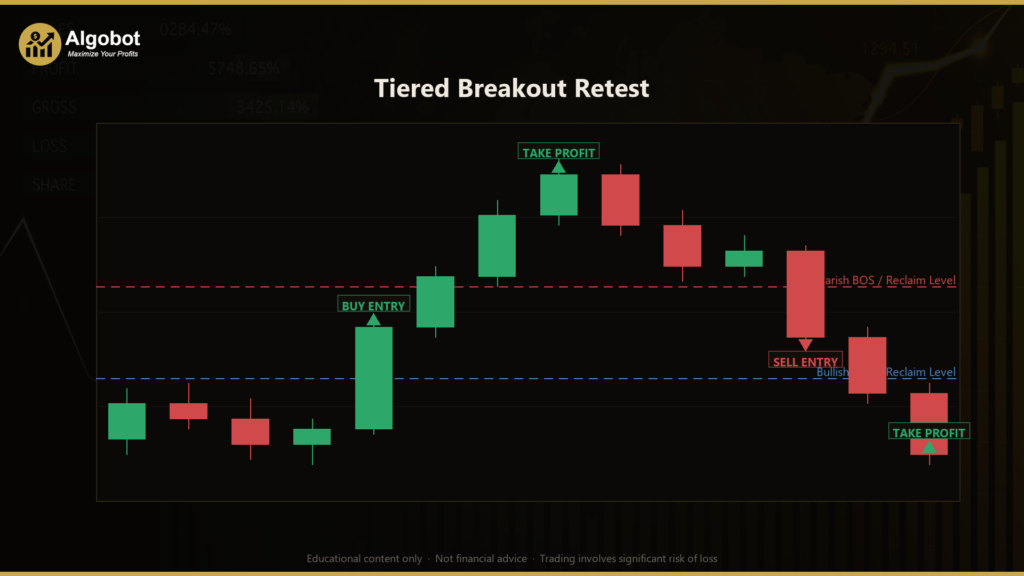
The Tiered Breakout Retest is a pure price-action, multi-timeframe breakout strategy for MetaTrader 5 that uses no technical indicators at all — no moving averages, no oscillators, no lagging filters. Instead, it reads raw market structure through fractal swing pivots and a break of structure (BOS) concept, the same building blocks used in classic Smart Money and supply-and-demand trading. A "fractal swing pivot" is simply a high or low that stands taller (or lower) than the bars immediately on either side of it, marking a turning point in price.
What makes this strategy distinctive is its "tiered" design. It works on two cooperating layers of time. A higher timeframe (HTF) is built internally by aggregating a fixed number of primary-timeframe candles into one larger synthetic candle, which the strategy uses to define directional bias. The lower tier — your actual chart timeframe — then waits for a momentum candle to confirm that bias before any trade is signalled. This two-step filtering is designed to keep you trading with the dominant trend while still timing entries on fresh momentum.
As a learning tool, the Tiered Breakout Retest is well suited to traders who want to study how market structure and breakout-retest logic combine in trending conditions. It is not a "set and forget" money machine, and it is not designed for choppy, range-bound markets. Treat it as a transparent, readable example of how price-action concepts can be coded into a rules-based system you can study, backtest, and adapt.
How It Works
The strategy operates in two tiers that must agree before an entry is signalled. Everything is evaluated once per completed bar to avoid acting on noisy, unfinished candles.
Higher-tier signal (directional bias):
- Every
HtfFactorprimary bars are merged into one synthetic higher-timeframe candle (tracking its high, low, and close). - On that HTF series, the strategy locates the most recent confirmed fractal swing high and swing low, using
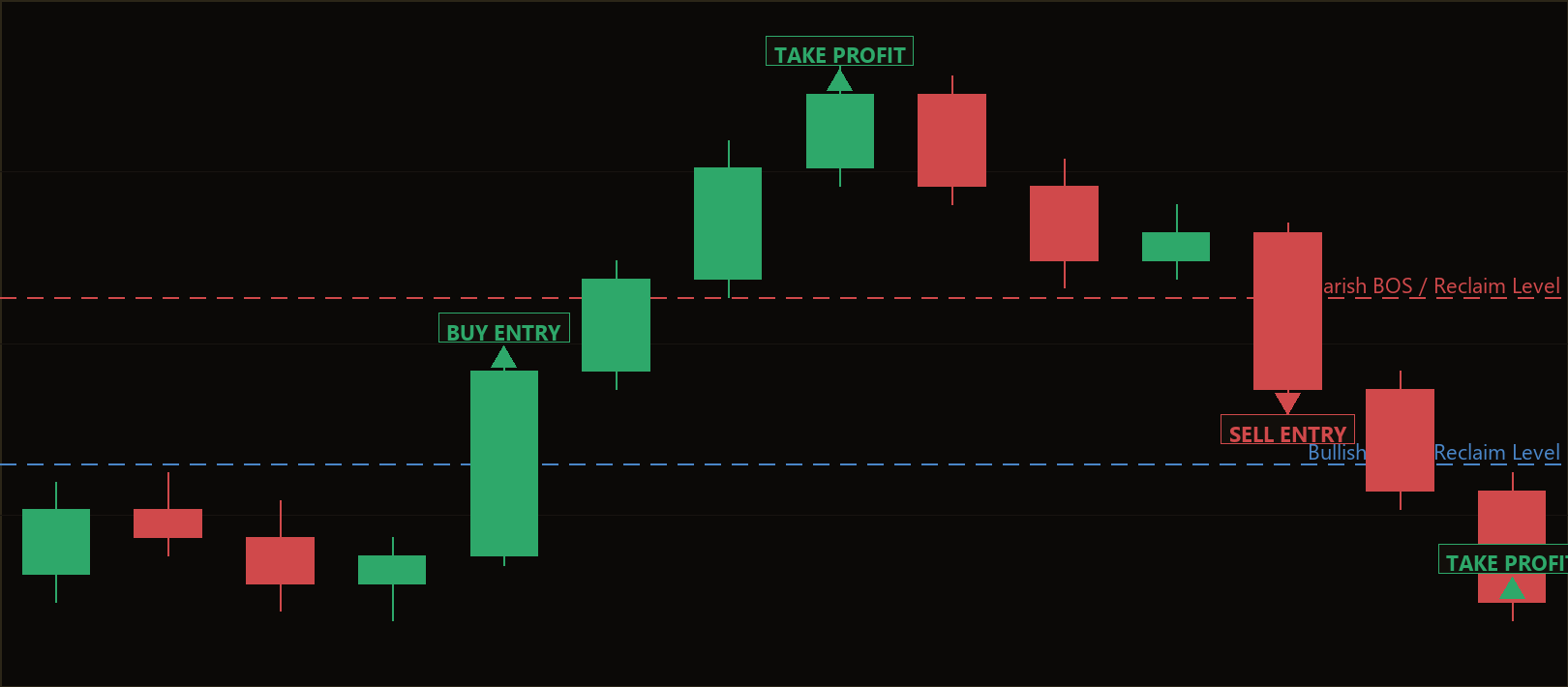
PivotLeftRightbars on each side to validate a pivot. - When an HTF candle closes above the latest swing high, that is a bullish break of structure and the bias flips to long; the broken swing high becomes the "reclaim line."
- When an HTF candle closes below the latest swing low, that is a bearish break of structure and the bias flips to short; the broken swing low becomes the reclaim line.
- If price later closes back through that broken level, the bias is invalidated and reset to neutral — the strategy will not keep trading a structure that has failed.
Lower-tier confirmation (entry trigger):
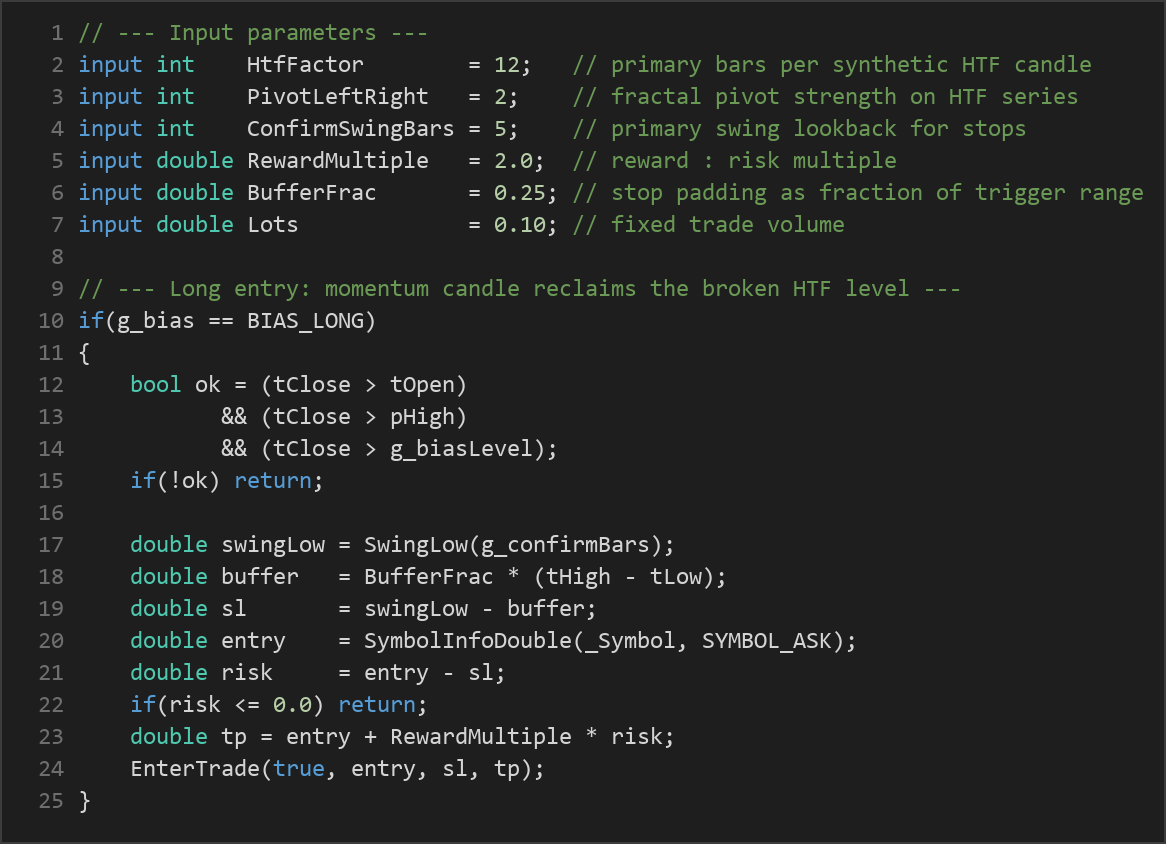
- For a long setup, the strategy signals an entry only when the latest completed candle is bullish (close above its open), its close breaks the prior bar's high, and its close holds above the broken HTF reclaim line.
- For a short setup, it signals when the latest candle is bearish (close below its open), its close breaks the prior bar's low, and its close holds below the reclaim line.
- Only one entry is allowed per break-of-structure event, and only one open position at a time, preventing the system from stacking trades on a single signal.
Stop-loss logic:
- The stop is placed at the most recent primary-timeframe swing (a structure stop) — the swing low for longs, the swing high for shorts — measured over the last
ConfirmSwingBarscandles. - That level is then padded by a buffer equal to
BufferFracmultiplied by the trigger candle's full range (high minus low), giving the trade a little breathing room beyond raw structure.
Take-profit logic:
- Risk is measured as the distance between entry price and stop-loss.
- The take-profit is set at a fixed reward multiple of that risk:
RewardMultiple × risk. With the default of 2.0, the target sits twice as far from entry as the stop, a 1:2 risk-to-reward framework.
Strategy Parameters
| Parameter | Default | Min | Max | Description |
|---|---|---|---|---|
| HtfFactor | 12 | 4 | 48 | Number of primary-timeframe bars aggregated into one synthetic higher-timeframe candle. Larger values create a slower, higher-level structure. |
| PivotLeftRight | 2 | 1 | 5 | Fractal pivot strength on the HTF series — how many bars must sit on each side of a swing for it to count as a valid pivot. |
| ConfirmSwingBars | 5 | 2 | 20 | Primary-timeframe lookback used to locate the swing high/low for structure-based stop placement. |
| RewardMultiple | 2.0 | 1.0 | 5.0 | Reward-to-risk multiple. The take-profit is this multiple of the measured stop distance. |
| BufferFrac | 0.25 | 0.0 | 1.0 | Stop padding as a fraction of the trigger candle's range, added beyond the swing level. |
| Lots | 0.10 | 0.01 | 1.0 | Fixed trade volume (position size) per entry. |
Recommended Chart Settings
Because the higher timeframe is built internally by aggregating bars, the Tiered Breakout Retest is flexible about which chart you attach it to. A practical starting point is to run it on an intraday primary timeframe such as M15 or H1 on a liquid instrument like EUR/USD, where clean structure and reliable breakouts tend to appear. With the default HtfFactor of 12, an M15 chart produces a synthetic HTF roughly equivalent to a 3-hour structure, while an H1 chart produces a roughly half-day structure.
Remember that these are starting suggestions, not optimised settings. Results will vary considerably across different symbols, sessions, spreads, and market regimes. Always test on the specific instrument and timeframe you intend to study before drawing any conclusions.
How to Install on MetaTrader 5
- Download the
TieredBreakoutRetest.ex5file from the link below. - Copy it to your MT5
MQL5\Expertsfolder. - Restart MetaTrader 5 or refresh the Navigator panel.
- Drag the EA onto a chart matching the recommended symbol and timeframe.
- Configure the input parameters and enable Algo Trading.
What to Consider Before Using This EA
Strengths of this approach. The Tiered Breakout Retest is fully transparent — with no indicators, every decision traces back to visible price structure you can verify on the chart. The dual-tier filter is designed to avoid counter-trend entries, and the built-in bias invalidation means a failed breakout removes the directional bias rather than leaving you committed to a broken idea. Risk is defined before entry, with the stop anchored to real market structure and the target tied to a consistent reward multiple.
Known limitations. Breakout-and-retest systems are inherently trend-following, so they tend to struggle in sideways, range-bound, or low-volatility conditions where false breakouts are common. The "one entry per break of structure" rule keeps trade frequency low, which means the strategy may go long stretches without signalling anything — this is by design, but it requires patience. Because the HTF is synthetic and depends on HtfFactor, the structure it reads can differ from what you see on a native higher-timeframe chart in your platform.
Where it may underperform. Expect weaker behaviour around major news spikes, during thin liquidity sessions, and on instruments with wide or erratic spreads, since the entry depends on a clean closing break of the prior bar's extreme. The fixed reward multiple does not adapt to volatility, so in fast markets the target may be reached easily, while in slow markets it may rarely be hit. Studying these conditions in a tester is the best way to understand the strategy's character.
Risk Management Tips
Sound risk management matters more than any single entry rule. Consider these general principles as you study the strategy:
- Risk a small, fixed fraction per trade. Many educators suggest limiting exposure to 1–2% of account equity on any single position, and sizing your
Lotsaccordingly rather than using a large fixed lot. - Start on a demo account. Test the Tiered Breakout Retest in MT5's Strategy Tester and on a demo account across different market conditions before considering any live use.
- Understand drawdown. Even a well-designed trend strategy can experience strings of losing trades. Know the maximum losing streak and equity decline you are prepared to tolerate.
- Mind the reward-to-risk balance. A higher
RewardMultiplecan improve average winners but typically lowers your win rate; study how that trade-off feels before committing. - Account for costs. Spreads, slippage, and commissions all erode breakout entries — include realistic costs in any testing.
Risk Warning
Trading foreign exchange, CFDs, and other leveraged financial instruments involves substantial risk of loss and is not suitable for all investors. The strategies and tools discussed on this page are provided for educational purposes only and do not constitute financial advice, investment recommendations, or solicitation to trade. Always consult a qualified financial adviser before making trading decisions. Past backtest performance is not indicative of future results.
Downloads
- Expert Advisor: TieredBreakoutRetest.ex5 (65 downloads)
- Source Code: TieredBreakoutRetest.mq5 (60 downloads)
- Documentation: TieredBreakoutRetest.pdf (65 downloads)