Disclaimer: This article is for educational and informational purposes only. It does not constitute financial or investment advice. Trading forex and CFDs carries significant risk of loss. Past performance of any strategy — including backtests — does not guarantee future results. Never trade with money you cannot afford to lose.
What Is This Strategy?
The Double Tap Reversal is a pure price-action reversal strategy built around the classic double-top and double-bottom chart pattern — the familiar "M-top" and "W-bottom" shapes that traders have studied for decades. What makes this version distinctive is that it uses no indicators whatsoever. There is no moving average, no RSI, no ATR, no Bollinger Bands — nothing. Every decision is derived directly from raw candle highs, lows, opens, and closes. In trading terms, this is a swing reversal style: it waits for a trend or a push into a level to exhaust itself, then trades the turn.
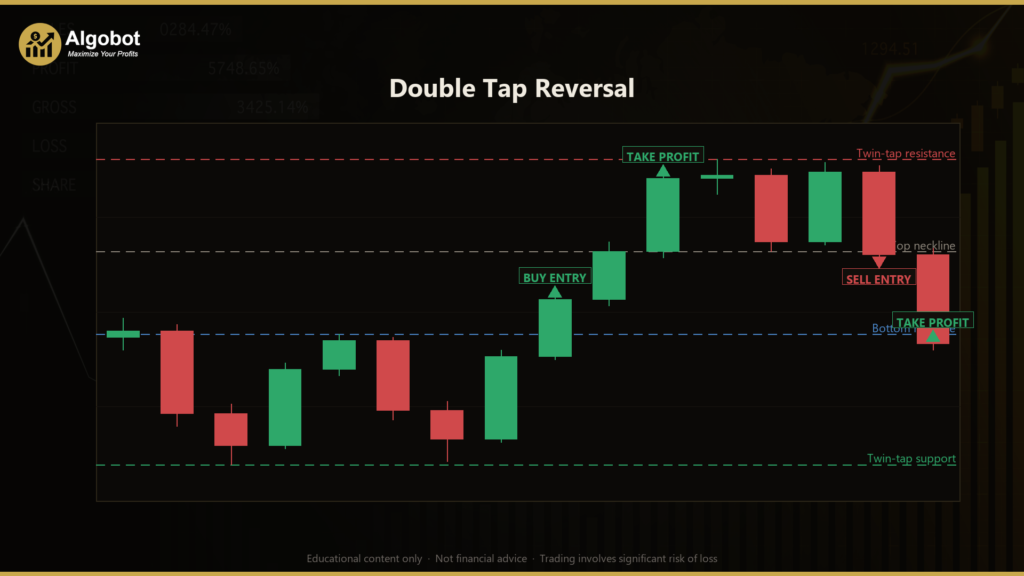
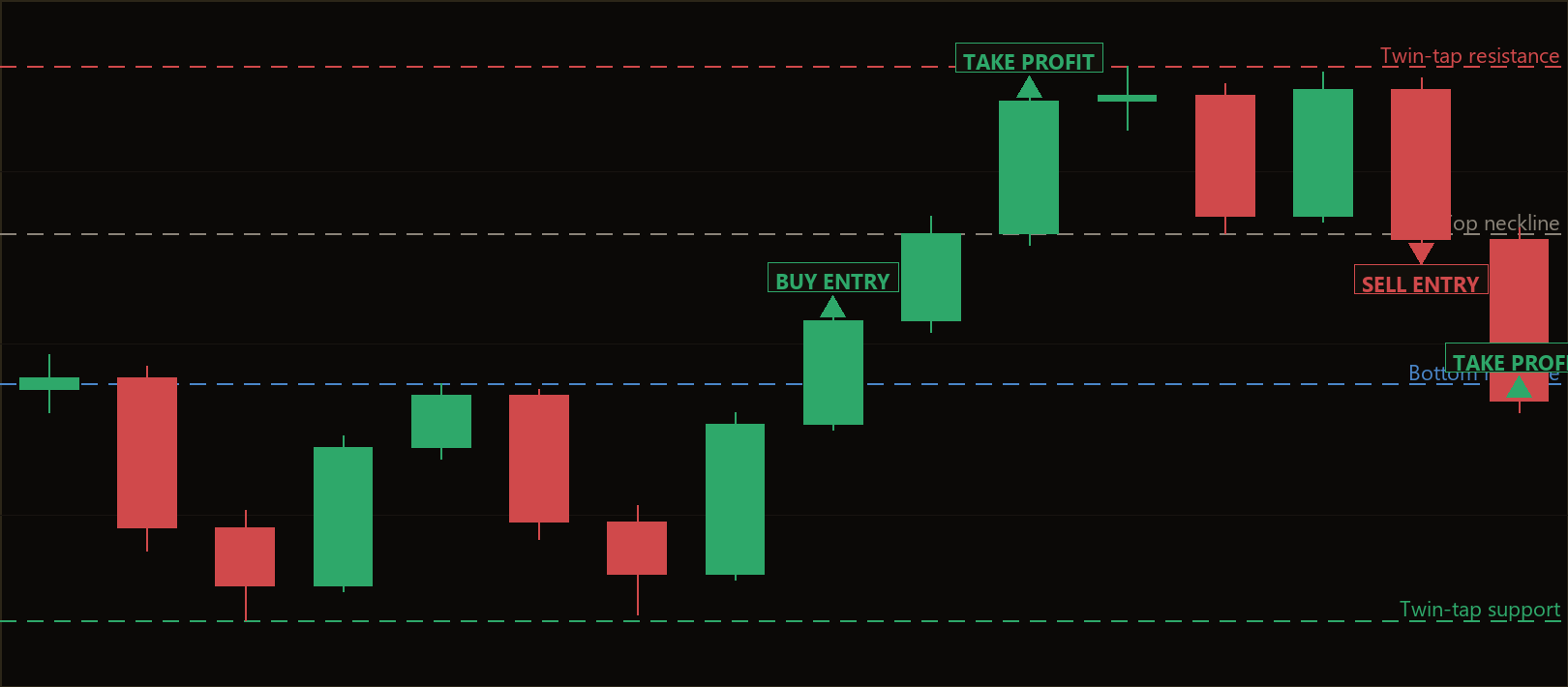
The core idea is what the strategy calls "the double tap." Price drives into a level, fails, pulls back, then drives into the same level a second time and fails again. When a level is defended twice, it tells you that a large pool of continuation traders are now offside — the market has shown it cannot break through. The pattern resolves when price snaps back through the swing that separates the two taps, a level commonly known as the neckline. That neckline break is the trigger the strategy waits for: it is the moment trapped traders are forced to bail and fresh reversal flow piles in.
As a learning tool, the Double Tap Reversal is well suited to traders who want to understand how structural, indicator-free pattern recognition can be coded into rules. It rewards patience — the strategy sits on its hands until two confirmed swing pivots line up at one price and a decisive close-through occurs. This article frames the strategy as an analysis of a well-known pattern, not as a profit opportunity. Think of it as a way to study how a textbook reversal pattern can be defined precisely enough for a machine to recognize it.
How It Works
The strategy builds the pattern from confirmed swing pivots rather than from a single candle. A swing low is a bar whose low is the strict minimum over a set number of bars on each side; a swing high is the mirror. Because a pivot is only used once it has the required number of bars to its right, the levels are non-repainting — they never change after the fact.
Here is how the strategy signals a trade:
- It identifies the double bottom (for longs): The two most recent confirmed swing lows must sit at roughly the same price — these are the "two taps" — separated by at least one bar. The neckline is set as the highest high of the bars between the two taps (the rejection peak).
- It identifies the double top (for shorts): The mirror image — the two most recent confirmed swing highs at the same price, with the neckline set as the lowest low of the bars between them.
- It checks that the taps are "equal" in a scale-free way: The price gap between the two taps must be no larger than
EqualTolerancemultiplied by the pattern height (the neckline-to-tap distance). Because this is a ratio, the rule adapts to any symbol or timeframe with no pip or point math. - It waits for the neckline break (long): A confirmed double bottom signals a long only when the just-closed bar closes strictly above the neckline for the first time (the previous bar was at or below it), and the second tap is no older than
MaxBreakBars. - It waits for the neckline break (short): A confirmed double top signals a short only when the just-closed bar closes strictly below the neckline for the first time, again within
MaxBreakBarsof the second tap.
The exit logic is structural and self-scaling, with no fixed pip distances:
- Stop-loss: For a long, the stop sits just below both tap lows, buffered by a fraction of the pattern height (
StopBufferFrac). For a short, it sits just above both tap highs. The logic is simple — if price pushes through the level a third time, the double pattern is invalidated, so the trade should be closed. - Take-profit: The target is a fixed reward-to-risk multiple (
RewardRatio) of the structural stop distance. This lets the post-break reversal run a measured distance while keeping the risk defined by the pattern itself.
Only one position per magic number is held at a time, and the structural stop and target manage the exit — the strategy does not stack trades.
Strategy Parameters
| Parameter | Default | Min | Max | Description |
|---|---|---|---|---|
| PivotLeftRight | 3 | 2 | 8 | Number of bars required on each side of a bar for it to qualify as a confirmed swing pivot. Higher values demand more significant, slower swings. |
| EqualTolerance | 0.20 | 0.02 | 0.60 | Maximum price gap between the two taps, expressed as a fraction of the pattern height, for them to count as the "same" level. Lower values demand tighter, cleaner double tops/bottoms. |
| MaxBreakBars | 8 | 2 | 30 | The neckline break must occur within this many bars of the second tap, keeping the pattern fresh and ignoring stale, far-away taps. |
| StopBufferFrac | 0.10 | 0.00 | 1.00 | Extra distance placed beyond the twin taps for the stop-loss, as a fraction of the pattern height. Larger values give the trade more breathing room. |
| RewardRatio | 2.00 | 1.00 | 6.00 | Take-profit distance as a multiple of the structural stop distance. A value of 2.00 targets twice the risk. |
| Lots | 0.10 | 0.01 | 1.00 | Fixed trade volume in lots. Should be set according to your account size and risk tolerance. |
| Magic | 9301 | 0 | 9,999,999 | Unique identifier so the EA can manage only its own trades on the account. |
Recommended Chart Settings
The Double Tap Reversal was designed for a liquid FX major or metal — for example EURUSD, GBPUSD, or XAUUSD (gold) — on the M30 or H1 timeframe. These markets and timeframes tend to produce clean, well-defined swing structure, which is what a double-top/double-bottom pattern needs to form reliably. The swing-reversal style fits these slower charts, where a level rejected twice carries more meaning than it would on very fast intraday charts dominated by noise.
As always, results will vary across different symbols, timeframes, and market conditions. A pattern-based reversal approach behaves very differently in a strongly trending market versus a ranging one, so treat the recommended settings as a starting point for study rather than a fixed prescription. Testing on a demo account across several market regimes is the best way to understand how the strategy behaves.
Historical Backtest Results
Note: The figures below are from a historical backtest simulation. Backtests have inherent limitations — they do not account for slippage, requotes, spread widening, or psychological factors. These results should not be interpreted as a prediction of future performance.
No backtest data has been generated for this strategy yet. When a historical simulation is run, the key metrics — such as Net Profit, Profit Factor, Sharpe Ratio, Win Rate, Maximum Drawdown, and Total Trades — will be reported here using the real figures only. Until then, evaluate the strategy on the logic of its rules and on your own forward testing in a demo environment rather than on any performance numbers.
How to Install on MetaTrader 5
- Download the
DoubleTapReversal.ex5file from the link below. - Copy it to your MT5
MQL5\Expertsfolder. - Restart MetaTrader 5 or refresh the Navigator panel.
- Drag the EA onto a chart matching the recommended symbol and timeframe (for example, EURUSD H1).
- Configure the input parameters and enable Algo Trading.
What to Consider Before Using This EA
The strength of the Double Tap Reversal lies in its discipline. Because it requires two confirmed pivots at one price plus a decisive close through the neckline, it filters out most of the single-touch noise that wrecks naive top-and-bottom picking. The non-repainting pivots mean the signals you see in a backtest are the signals you would have seen live, which makes the strategy honest to study. The structural, self-scaling stop is another educational highlight: risk is defined by the pattern itself, not by an arbitrary pip count.
The limitations are equally important to understand. Reversal strategies, by their nature, trade against the prevailing move, so they can struggle in strong, persistent trends where a level that is "defended twice" eventually gives way. Double patterns are relatively rare, which means the strategy may trade infrequently and can sit idle for long stretches. There is also subjectivity baked into any pattern definition — the EqualTolerance and PivotLeftRight settings materially change what counts as a valid double tap, and a setting that works on one symbol may not transfer to another. During choppy, low-conviction markets, neckline breaks can fail and reverse, producing losing trades.
This is not a strategy to oversell or to dismiss. It is a clean, transparent implementation of a textbook pattern, best used as a tool for learning how price structure can be turned into precise rules.
Risk Management Tips
Sound risk management matters more than any single strategy. Consider these general principles as you study the Double Tap Reversal:
- Position sizing: Set your
Lotsso that a stop-out costs only a small, predefined slice of your account. Many educational sources suggest risking no more than 1–2% of account equity per trade. - Test on a demo account first: Run the EA in a demo environment across different market conditions before risking real capital, so you understand its behavior and trade frequency.
- Understand drawdown: Even a sound strategy will have losing streaks. Know the historical maximum drawdown and ask yourself whether you could tolerate that decline emotionally and financially.
- Don't over-optimize: Tuning parameters to fit past data perfectly often produces results that fall apart going forward. Favor robust settings that work reasonably across conditions.
- Mind the spread and session: Pattern breaks near news events or during thin liquidity can behave unpredictably, so be aware of when your chosen market is most active.
Risk Warning
Trading foreign exchange, CFDs, and other leveraged financial instruments involves substantial risk of loss and is not suitable for all investors. The strategies and tools discussed on this page are provided for educational purposes only and do not constitute financial advice, investment recommendations, or solicitation to trade. Always consult a qualified financial adviser before making trading decisions. Past backtest performance is not indicative of future results.
Downloads
- Expert Advisor: DoubleTapReversal.ex5 (61 downloads)
- Source Code: DoubleTapReversal.mq5 (59 downloads)
- Documentation: DoubleTapReversal.pdf (55 downloads)