Disclaimer: This article is for educational and informational purposes only. It does not constitute financial or investment advice. Trading forex and CFDs carries significant risk of loss. Past performance of any strategy — including backtests — does not guarantee future results. Never trade with money you cannot afford to lose.
What Is This Strategy?
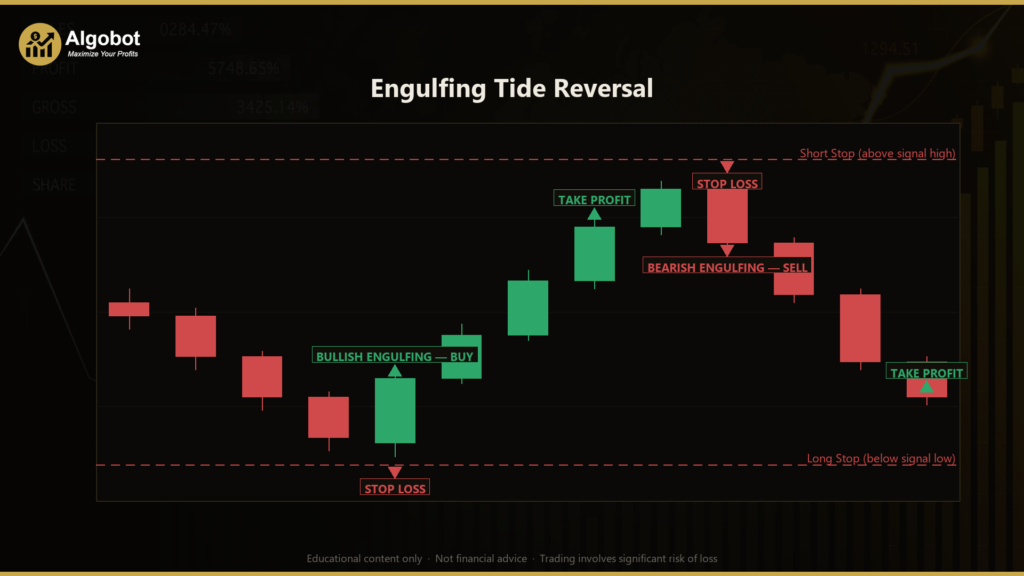
The Engulfing Tide Reversal is a pure price-action trading strategy built around the classic engulfing candlestick pattern — a two-candle formation where one bar's body completely "engulfs" the previous bar's body. Unlike most automated systems, it uses no technical indicators at all: no moving averages, no RSI, no ATR, no oscillators of any kind. Every decision is made from raw candle data — open, high, low, and close — which keeps the logic transparent and easy to study.
What makes this approach distinct is where it looks for the engulfing pattern. A bullish or bearish engulfing candle can appear anywhere on a chart, but it only carries meaning at a genuine turning point. The Engulfing Tide Reversal therefore demands that the signal candle also marks a fresh swing extreme — the lowest low (for longs) or highest high (for shorts) over a recent window of bars. In plain terms, it waits for one side of the market to exhaust itself at the edge of a short swing, then for the opposite side to overwhelm it. This is a counter-trend, mean-reversion swing style that fades over-extended micro-moves rather than chasing momentum.
As a learning tool, this strategy suits traders who want to understand candlestick reversals, structural stop placement, and reward-to-risk mechanics without the noise of stacked indicators. It is designed primarily for liquid FX majors such as EURUSD or GBPUSD on the H1 (1-hour) timeframe. Treat it as a framework for studying price-action behavior — not as a shortcut to results.
How It Works
The strategy evaluates only closed bars, acting once per newly completed candle. The most recently closed bar is called the signal bar, and the bar immediately before it is the prior bar. Here is how the logic unfolds:
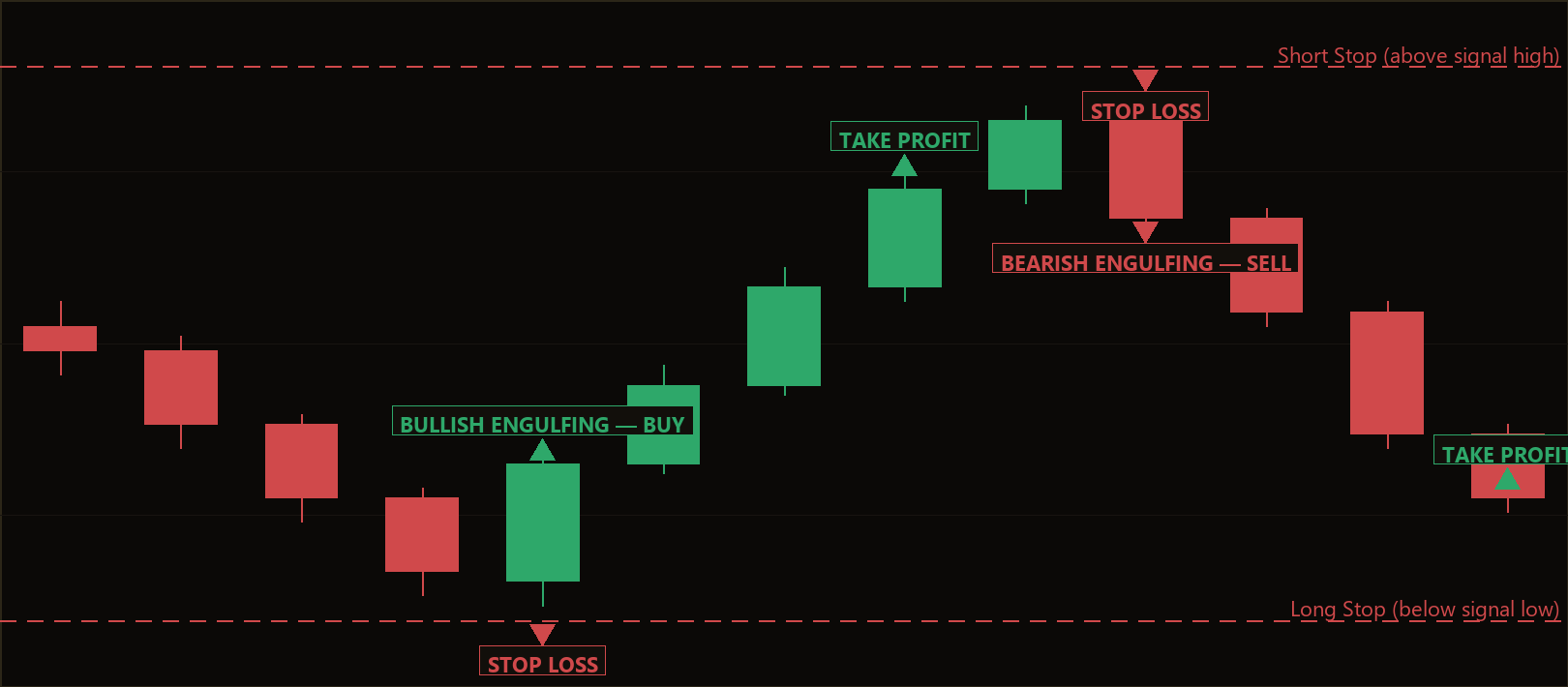
- It scans for a long (buy) setup when a bullish engulfing pattern forms at a swing low. Specifically, the strategy signals a long when:
- The prior bar is bearish (it closed below its open).
- The signal bar is bullish (it closed above its open).
- The signal bar's body fully engulfs the prior bar's body — its open is at or below the prior close, and its close is at or above the prior open.
- The signal body is at least EngulfFactor times larger than the prior body (a genuinely dominant engulf, not a marginal one).
- The signal body is a decisive close — its body is at least MinBodyFrac of the full candle range, filtering out indecisive candles with long wicks on both sides.
- Context filter: the signal bar's low is the lowest low of the last LookbackBars candles, confirming the engulf caps a fresh down-swing rather than appearing mid-range.
- It scans for a short (sell) setup using the exact mirror image: a bearish engulfing candle at a swing high, where the prior bar is bullish, the signal bar is bearish and dominant, the close is decisive, and the signal bar's high is the highest high over the lookback window.
- Stop-loss logic is structural, not based on a fixed pip count. Stops are expressed as a fraction of the signal bar's own range, so they automatically scale to any symbol or timeframe:
- For a long:
Stop Loss = signal Low − (StopBufferFrac × range). - For a short:
Stop Loss = signal High + (StopBufferFrac × range).
- Take-profit logic is a multiple of that structural risk. The distance from entry to stop is the "risk," and the target is placed at RewardRatio times that distance:
- For a long:
Take Profit = entry + (RewardRatio × risk). - For a short:
Take Profit = entry − (RewardRatio × risk).
- Position management is deliberately simple. The strategy holds only one position at a time per magic number and lets the structural stop and target manage the exit — there is no trailing, averaging, or grid logic.
Strategy Parameters
| Parameter | Default | Min | Max | Description |
|---|---|---|---|---|
| LookbackBars | 6 | 2 | 20 | How many bars back the signal candle must be the swing extreme (low for longs, high for shorts). Larger values demand a more developed swing before an engulf qualifies. |
| EngulfFactor | 1.20 | 1.00 | 3.00 | Minimum size of the signal body as a multiple of the engulfed prior body. Higher values insist on a more dominant engulfing candle. |
| MinBodyFrac | 0.50 | 0.20 | 0.90 | Minimum signal-body size as a fraction of its full candle range. Higher values require a more decisive close and reject doji-like candles. |
| StopBufferFrac | 0.10 | 0.00 | 1.00 | Extra stop buffer placed beyond the signal extreme, as a fraction of the bar's range. Higher values give the trade more breathing room. |
| RewardRatio | 1.80 | 1.00 | 5.00 | Take-profit distance as a multiple of the structural stop distance. A value of 1.80 targets 1.8× the risk. |
| Lots | 0.10 | 0.01 | 1.00 | Trade volume in lots. Adjust to suit your account size and risk tolerance. |
| Magic | 7401 | 0 | 9,999,999 | Unique identifier so the EA can recognize and manage only its own trades. |
Recommended Chart Settings
The Engulfing Tide Reversal was designed for liquid FX majors — for example EURUSD or GBPUSD — on the H1 (1-hour) timeframe. These conditions tend to produce clean, well-defined candle bodies and reliable swing structure, which is what the pattern logic depends on.
Because the stops and targets are expressed as fractions of each bar's range rather than fixed points, the strategy can technically be applied to other symbols and timeframes. However, behavior will vary considerably across different instruments, spreads, and volatility regimes. Always study the strategy on your specific broker's data before drawing conclusions, and remember that market conditions change over time.
Historical Backtest Results
Note: The figures below are from a historical backtest simulation. Backtests have inherent limitations — they do not account for slippage, requotes, spread widening, or psychological factors. These results should not be interpreted as a prediction of future performance.
No backtest data is available for this strategy at the time of writing. When a historical simulation has been run, key metrics such as Net Profit, Profit Factor, Sharpe Ratio, Win Rate, Maximum Drawdown, and Total Trades would be reported here. Until then, you are encouraged to run your own backtests in the MetaTrader 5 Strategy Tester using your broker's historical data, and to forward-test on a demo account before considering any live deployment.
How to Install on MetaTrader 5
- Download the
EngulfingTideReversal.ex5file from the link below. - Copy it to your MT5
MQL5\Expertsfolder. - Restart MetaTrader 5 or refresh the Navigator panel.
- Drag the EA onto a chart matching the recommended symbol and timeframe (for example, EURUSD H1).
- Configure the input parameters and enable Algo Trading.
If you prefer to study or modify the logic, the EngulfingTideReversal.mq5 source file can be opened in MetaEditor, and a .pdf reference may also be provided for offline reading.
What to Consider Before Using This EA
Strengths. The approach is refreshingly transparent. With no indicators to lag or repaint, every signal can be traced directly to candle data you can see on the chart. The structural, range-based stops adapt automatically across symbols and timeframes, and the swing-extreme context filter helps avoid engulfing patterns that occur in choppy, directionless ranges. The strict one-position rule keeps exposure simple and predictable.
Known limitations. Engulfing patterns are a well-documented but inherently probabilistic signal — they do not work every time, and counter-trend (mean-reversion) strategies can suffer during strong, sustained trends when "exhausted" swings simply keep extending. Requiring a fresh swing extreme reduces the number of trades, so signals may be infrequent. A fixed reward ratio means some winners are cut short while the market continues, and structural stops can occasionally sit wider than a fixed-pip stop during volatile bars. Spread and slippage around the close of a bar can also affect fills, especially on lower-liquidity symbols.
This strategy may underperform in trending, news-driven, or low-volatility ranging markets where engulfing reversals fail to follow through. Study its behavior carefully rather than assuming consistent outcomes.
Risk Management Tips
- Risk a small, fixed percentage per trade. A common educational guideline is to risk no more than 1–2% of account equity on any single position. Size your
Lotsaccordingly. - Test on a demo account first. Run the EA in a risk-free demo environment for an extended period to understand how it behaves across different market conditions before committing real capital.
- Understand drawdown. Every strategy experiences losing streaks. Know the maximum drawdown you are psychologically and financially prepared to tolerate, and stop trading if it is exceeded.
- Account for costs. Spreads, commissions, and swap fees all erode results. Factor them into any evaluation.
- Avoid over-optimization. Tuning parameters to fit past data ("curve-fitting") often produces results that fail going forward. Favor robust, sensible settings over perfect historical fits.
Risk Warning
Trading foreign exchange, CFDs, and other leveraged financial instruments involves substantial risk of loss and is not suitable for all investors. The strategies and tools discussed on this page are provided for educational purposes only and do not constitute financial advice, investment recommendations, or solicitation to trade. Always consult a qualified financial adviser before making trading decisions. Past backtest performance is not indicative of future results.
Downloads
- Expert Advisor: EngulfingTideReversal.ex5 (44 downloads)
- Source Code: EngulfingTideReversal.mq5 (44 downloads)
- Documentation: EngulfingTideReversal.pdf (48 downloads)