Disclaimer: This article is for educational and informational purposes only. It does not constitute financial or investment advice. Trading forex and CFDs carries significant risk of loss. Past performance of any strategy — including backtests — does not guarantee future results. Never trade with money you cannot afford to lose.
What Is This Strategy?
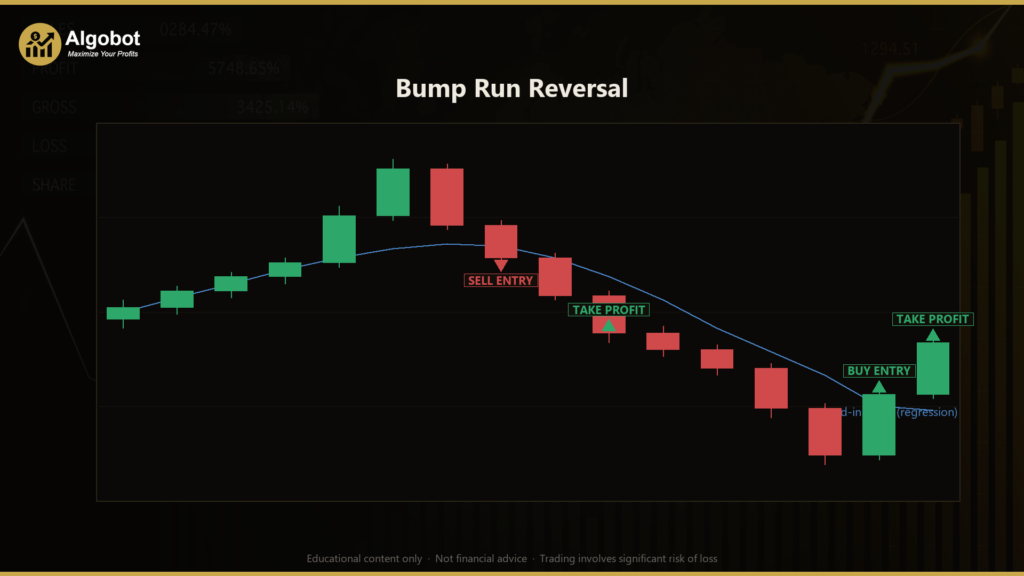
The Bump Run Reversal strategy is an automated, rules-based reading of Thomas Bulkowski's classic Bump-and-Run Reversal chart pattern, built on a least-squares linear regression line paired with the Average True Range (ATR) volatility gauge. In plain terms, it watches for a market that has been drifting quietly along a gentle trend, then suddenly lurches far away from that trend in a burst of one-sided emotion — the "bump" — before rolling back and reversing. This is a counter-trend reversal trading style that only acts once price has confirmed the turn, rather than trying to guess a top or bottom in advance.
The core idea rests on a simple market observation: extreme, emotional moves are usually unsustainable. When the last marginal buyers or sellers have committed, price tends to snap back toward its earlier, calmer path. A linear regression line — a straight line mathematically fitted through recent closing prices — acts as the strategy's reference "spine" for that calmer path. ATR, which measures the average size of recent price bars, defines how large a stretch away from the spine has to be before it counts as a genuine over-extension rather than ordinary noise.
As a learning tool, the Bump Run Reversal is well suited to traders who want to study how classic chart patterns can be translated into precise, testable code. It is designed for liquid instruments — an FX major, a metal like gold, or a stock index — on intraday timeframes such as M15 to H1, where orderly trends punctuated by emotional over-extensions are common. It is not a "set and forget" money machine; it is a framework for understanding reversal mechanics, disciplined confirmation, and tight risk control.
How It Works
The strategy evaluates a fresh setup only once per newly closed bar on the selected chart timeframe, and it manages any open trade on every tick. Its logic breaks into three measured stages — lead-in, bump, and reclaim — followed by a bracketed exit.
- Lead-in (the spine): The strategy fits a least-squares regression line over the last
LeadPeriodclosed bars. The slope of that line defines the gentle background trend, and the fitted line itself becomes the reference spine that price is measured against. - Bump (the over-excursion): Over the most recent slice of the lead-in window (roughly the last third of it), the strategy measures how far price stretched away from the spine — the highest High above it and the lowest Low below it. If that peak excursion reaches or exceeds
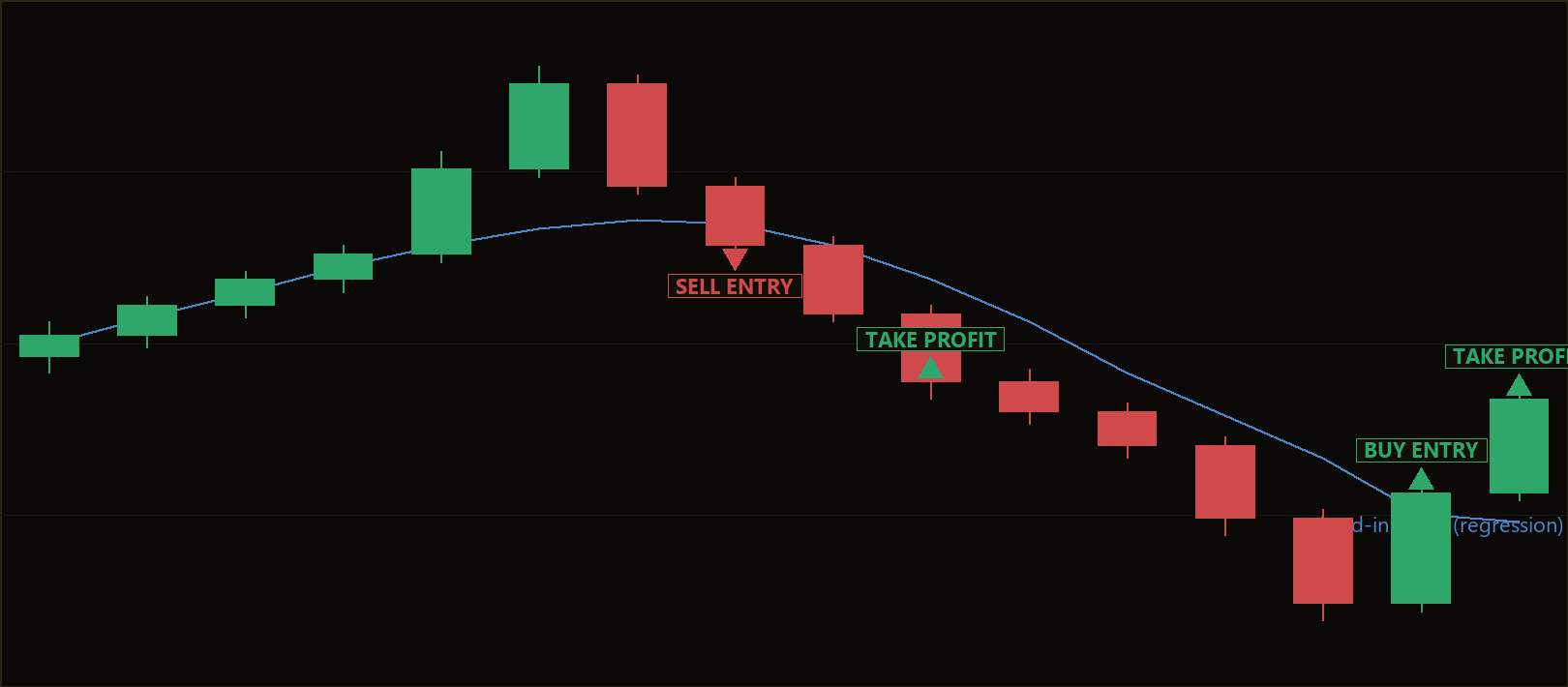
BumpAtrMult× ATR, an emotional bump is confirmed to be present. - Reclaim (the confirmation cross): A reversal is armed only when the freshly closed bar closes back through the spine — a fresh cross, not a bar that was already on the other side. This ensures the strategy waits for the run to actually begin instead of catching a still-moving market.
From these three stages, two mirror-image signals emerge:
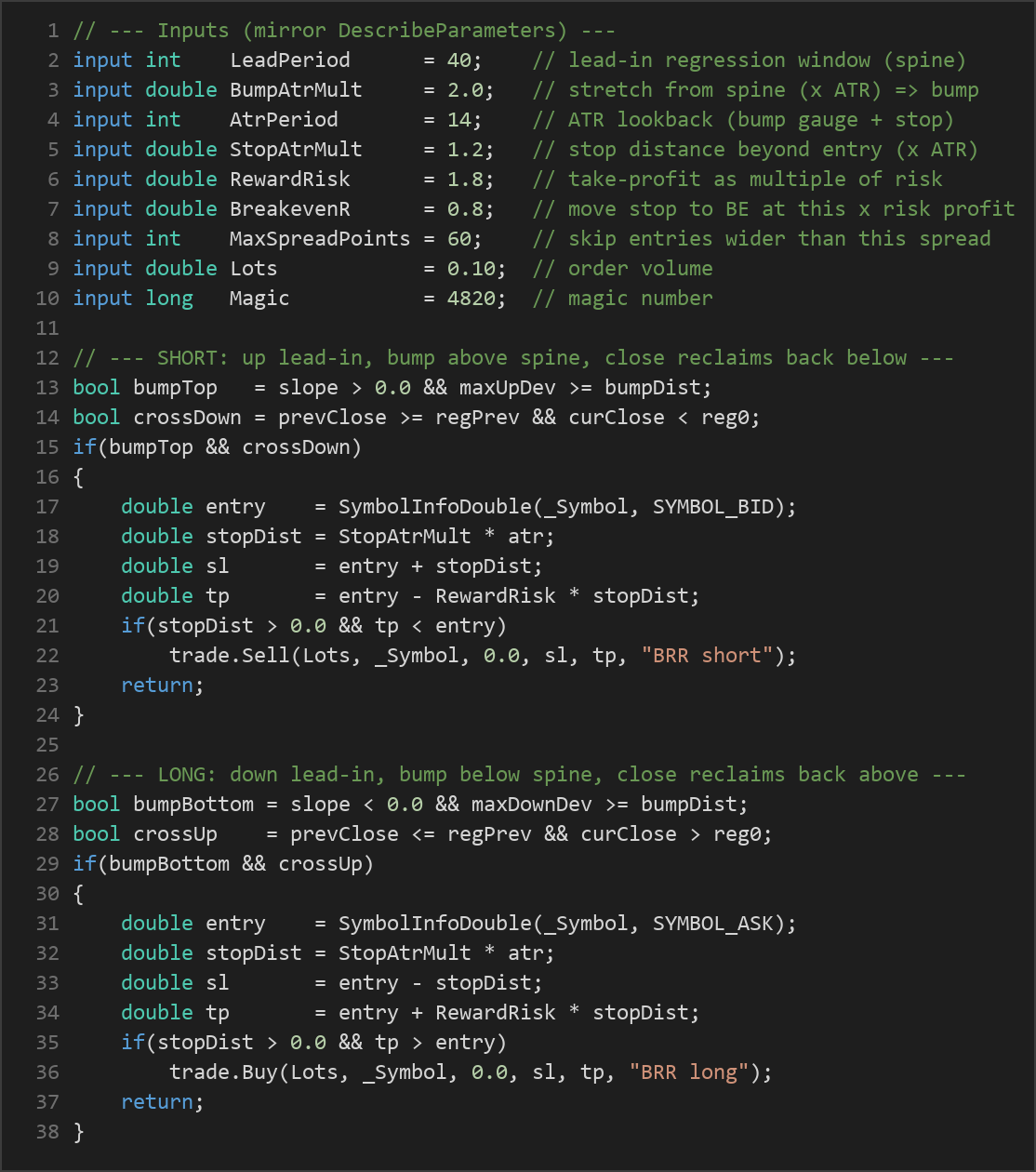
- Short signal: The lead-in slope is upward, the bump stretched above the spine, and the latest bar closes back below it. The strategy signals a sell, interpreting the reversal as the start of a downward run.
- Long signal: The lead-in slope is downward, the bump stretched below the spine, and the latest bar closes back above it. The strategy signals a buy, interpreting the reversal as the start of an upward run.
Before any entry, two filters must pass: no position may already be open under this strategy's magic number (only one trade is held at a time so the bracket cleanly manages the exit), and the current spread must be no wider than MaxSpreadPoints, which screens out illiquid or high-cost conditions.
Stop-loss and take-profit logic are defined immediately at entry:
- The stop-loss is placed
StopAtrMult× ATR beyond the entry price — above entry for a short, below entry for a long. Sizing the stop in ATR units keeps risk proportional to current volatility. - The take-profit is set at
RewardRiskmultiples of that stop distance, giving a fixed reward-to-risk ratio on every trade. - A breakeven lock then protects the position: once price moves
BreakevenR× the initial risk in your favor, the stop is pulled to the entry price, aiming to remove initial risk from the trade while it is still developing.
Strategy Parameters
| Parameter | Default | Min | Max | Description |
|---|---|---|---|---|
| LeadPeriod | 40 | 20 | 100 | Number of closed bars in the least-squares lead-in regression window (the trend "spine"). |
| BumpAtrMult | 2.0 | 1.0 | 4.0 | How far price must stretch from the spine, in multiples of ATR, to count as a bump. |
| AtrPeriod | 14 | 7 | 30 | ATR lookback used for both the bump gauge and the protective stop. |
| StopAtrMult | 1.2 | 0.5 | 3.0 | Protective stop distance beyond entry, as a multiple of ATR. |
| RewardRisk | 1.8 | 0.5 | 4.0 | Take-profit distance expressed as a multiple of the entry-to-stop risk. |
| BreakevenR | 0.8 | 0.1 | 2.0 | Move the stop to breakeven once price is this multiple of risk in profit. |
| MaxSpreadPoints | 60 | 5 | 300 | Skip new entries when the current spread (in points) is wider than this. |
| Lots | 0.10 | 0.01 | 1.0 | Order volume (position size) in lots. |
| Magic | 4820 | 0 | 9,999,999 | Unique magic number identifying this strategy's trades. |
Recommended Chart Settings
The Bump Run Reversal was designed with liquid instruments in mind — a major FX pair, a metal such as gold, or a stock index — on intraday timeframes in the M15 to H1 range. These markets tend to produce the orderly trends and periodic emotional over-extensions that the pattern is built to read. The strategy runs on whatever timeframe is selected at the time of testing, so you are free to explore other combinations.
Keep in mind that behavior will vary considerably across symbols, timeframes, and market regimes. A setting that appears balanced on one instrument may behave very differently on another. Always test any configuration thoroughly on historical data and a demo account before considering live use.
How to Install on MetaTrader 5
- Download the .ex5 file from the link below.
- Copy it to your MT5
MQL5\Expertsfolder. - Restart MetaTrader 5 or refresh the Navigator panel.
- Drag the EA onto a chart matching the recommended symbol and timeframe.
- Configure the input parameters and enable Algo Trading.
What to Consider Before Using This EA
Every strategy has strengths and limitations, and the Bump Run Reversal is no exception.
Strengths. The approach is disciplined about confirmation: it never enters until price has actually reclaimed the regression spine, which helps it avoid the classic mistake of catching a "falling knife." Its risk framework is deliberately tight — ATR-scaled stops, a fixed reward-to-risk target, and a breakeven lock — which can suit traders studying low-drawdown design. Sizing both the bump threshold and the stop in ATR units means the logic adapts to changing volatility rather than using fixed distances.
Limitations. Reversal strategies are, by nature, fighting the immediate move at the point of entry. In a genuinely strong, persistent trend, an apparent "bump" may simply be the trend accelerating, and the reclaim cross can produce a signal that is quickly overrun. Because the strategy takes only one position at a time and waits for a full three-stage setup, it can trade infrequently, and quiet or choppy markets may generate few valid signals. Linear regression is also sensitive to the chosen LeadPeriod: too short and the spine is noisy, too long and it lags real structure.
Where it may underperform. Strongly trending "runaway" markets, thin or news-driven conditions with erratic spreads, and range-bound noise that repeatedly crosses the spine without a real bump can all challenge the logic. Treat it as one analytical lens among many, not a complete system.
Risk Management Tips
Sound risk management matters far more than any single entry signal. As a general educational guideline, many traders limit the capital risked on any one trade to no more than 1–2% of account equity, sizing the Lots input accordingly rather than trading a fixed lot regardless of balance. Understand your potential drawdown — the peak-to-trough decline in equity — and ask whether you could sit through it calmly.
Always begin on a demo account to observe how the strategy behaves across different sessions and conditions before risking real funds. Review the stop-loss and reward-to-risk settings so you know your worst-case loss on every trade in advance, and never rely on a strategy to recover losses by increasing size. Diversifying across uncorrelated approaches and keeping detailed records of your testing will teach you far more than any single parameter tweak.
Risk Warning
Trading foreign exchange, CFDs, and other leveraged financial instruments involves substantial risk of loss and is not suitable for all investors. The strategies and tools discussed on this page are provided for educational purposes only and do not constitute financial advice, investment recommendations, or solicitation to trade. Always consult a qualified financial adviser before making trading decisions. Past backtest performance is not indicative of future results.
Downloads
- Expert Advisor: BumpRunReversal.ex5 (42 downloads)
- Source Code: BumpRunReversal.mq5 (42 downloads)
- Documentation: BumpRunReversal.pdf (46 downloads)