
Disclaimer: This article is for educational and informational purposes only. It does not constitute financial or investment advice. Trading forex and CFDs carries significant risk of loss. Past performance of any strategy — including backtests — does not guarantee future results. Never trade with money you cannot afford to lose.
What Is This Strategy?
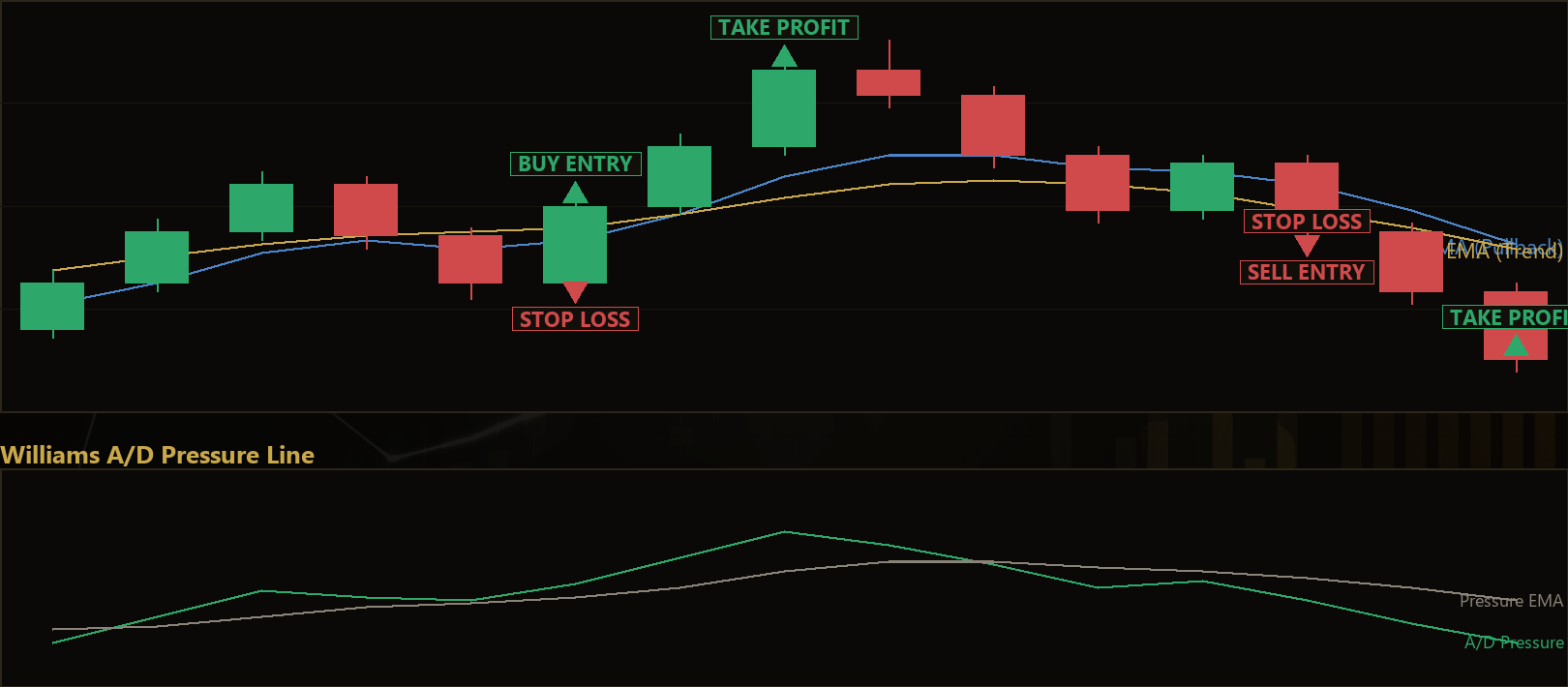
Pressure Line Trend Reclaim is a with-trend, pullback-continuation strategy for MetaTrader 5 built around Larry Williams' Accumulation/Distribution (A/D) line — a cumulative "pressure line" that measures buying and selling conviction from true-range geometry rather than from tick volume. Because it is derived only from price (highs, lows and closes), this pressure reading behaves consistently across any symbol, regardless of how reliable a broker's volume feed happens to be. The strategy pairs that conviction filter with two exponential moving averages (EMAs) and an Average True Range (ATR) risk model.
The idea it explores is simple to state but often overlooked: not every dip in a trend is a healthy buying opportunity. Sometimes a pullback is quiet distribution — smart money stepping away while the chart still looks bullish. The Williams A/D pressure line attempts to distinguish "the trend is merely resting" from "the trend is being sold into." Pressure Line Trend Reclaim only takes a pullback entry when the trend, the pressure line, and the price action all agree.
As a learning tool, this strategy is best suited to traders who already understand basic trend-following and want to study how a conviction/volume-substitute filter can be layered on top of a moving-average pullback system. It is designed for trending markets on intraday timeframes and is not intended for choppy, directionless ranges. Treat it as a framework for studying trade quality filters, not as a shortcut of any kind.
How It Works
The strategy evaluates conditions only on a freshly closed bar, which avoids acting on the noise of a still-forming candle. For every long setup (short setups are the exact mirror image), three separate conditions must line up at the same time.
- Regime — is this a real trend? The most recent close must be above a slow EMA (default 50 periods), and that slow EMA must itself be rising compared with where it stood a few bars earlier (the
SlopeLookbackwindow). This filters out flat, sideways markets where an EMA might be technically "above price" but going nowhere. - Pressure — is accumulation still leading? The cumulative Williams A/D pressure line (WAD) must be above its own EMA. A rising pressure line relative to its signal average is read as net accumulation; a falling one is read as distribution. This is the filter that separates this strategy from a plain moving-average pullback.
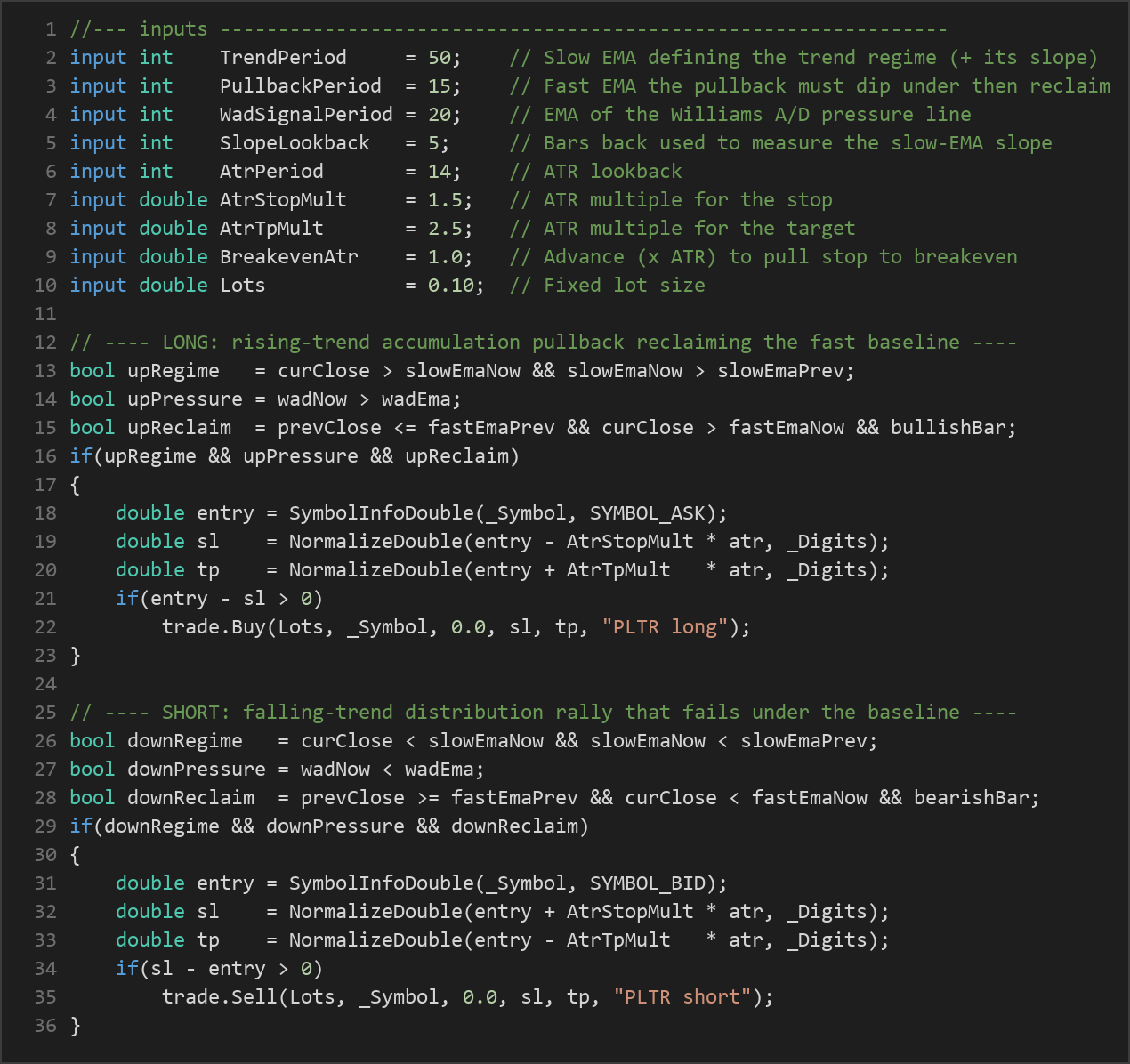
- Reclaim — has the pullback resolved with the trend? The prior bar must have dipped down to or under the fast EMA baseline (default 15 periods), and the current bar must close back above that fast EMA as a bullish candle (close above open). In other words, the market pulled back into the baseline and then reclaimed it.
When all three align — rising trend, leading accumulation, and a completed dip-and-reclaim — the strategy signals a long entry. The short side is the inverse: price below a falling slow EMA, the pressure line below its EMA (distribution leading), and a rally that fails and closes back below the fast EMA as a bearish candle.
Exit and risk logic is handled entirely by ATR-based brackets and a breakeven lock:
- Stop-loss: placed one
AtrStopMultmultiple of ATR away from entry (below entry for longs, above for shorts). Because it scales with ATR, the stop automatically widens in volatile conditions and tightens in calm ones. - Take-profit: set at
AtrTpMultmultiples of ATR in the trade's favour. With the defaults (1.5 stop, 2.5 target), the strategy aims for a reward that is larger than its risk on each trade. - Breakeven lock: once price has advanced
BreakevenAtrmultiples of ATR in your favour, the stop is pulled up to the entry price. After that point, the trade is protected so that a winner cannot round-trip into a loss. - One position at a time: only a single position per magic number is ever held, which keeps exposure — and therefore potential drawdown — tightly bounded.
A spread filter (MaxSpreadPoints) also blocks new entries whenever the current spread is unusually wide, helping avoid entering during illiquid or news-driven conditions.
Strategy Parameters
| Parameter | Default | Min | Max | Description |
|---|---|---|---|---|
| TrendPeriod | 50 | 20 | 200 | Slow EMA period that defines the trend regime; its slope must also agree with the trade direction. |
| PullbackPeriod | 15 | 5 | 60 | Fast EMA baseline the pullback must dip under and then reclaim. |
| WadSignalPeriod | 20 | 5 | 80 | EMA period applied to the Williams A/D pressure line — the accumulation/distribution gate. |
| SlopeLookback | 5 | 2 | 25 | Number of bars back used to measure the slow-EMA slope for regime confirmation. |
| AtrPeriod | 14 | 5 | 40 | Lookback period for the ATR used in stop, target and breakeven calculations. |
| AtrStopMult | 1.5 | 0.5 | 4.0 | ATR multiple that sets the stop-loss distance from entry. |
| AtrTpMult | 2.5 | 1.0 | 6.0 | ATR multiple that sets the take-profit distance from entry. |
| BreakevenAtr | 1.0 | 0.0 | 3.0 | Advance (in ATR multiples) after which the stop is pulled to breakeven; 0 disables the lock. |
| MaxSpreadPoints | 60 | 5 | 300 | New entries are skipped when the current spread (in points) exceeds this value. |
| Lots | 0.10 | 0.01 | 1.0 | Fixed trade size in lots. |
| Magic | 6412 | 0 | 9,999,999 | Magic number used to identify and manage this EA's own positions. |
Recommended Chart Settings
Pressure Line Trend Reclaim was designed with liquid, trending instruments in mind: an FX major (such as EUR/USD or GBP/USD), a metal like gold, or a major index. Its natural home is the M15 to H1 intraday timeframes, where trends develop with enough structure for pullbacks to form and resolve. That said, the code reads only the primary timeframe of whatever chart it is attached to, so it will run on any timeframe you select at backtest time.
Because market behaviour differs from one instrument, session and volatility regime to the next, results will vary considerably across different symbols and conditions. Always test on the specific symbol and timeframe you intend to study before drawing any conclusions.
How to Install on MetaTrader 5
- Download the .ex5 file from the link below.
- Copy it to your MT5
MQL5\Expertsfolder. - Restart MetaTrader 5 or refresh the Navigator panel.
- Drag the EA onto a chart matching the recommended symbol and timeframe.
- Configure the input parameters and enable Algo Trading.
What to Consider Before Using This EA
Strengths of the approach. The stand-out feature is the price-only pressure filter. Many pullback strategies buy every dip to a moving average; this one adds a conviction check that historically helps avoid dips occurring while the trend is being distributed into. Because the pressure line is derived from true-range geometry rather than tick volume, it is not distorted by unreliable broker volume feeds. The ATR-based risk model and the breakeven lock also give the strategy a disciplined, self-scaling exit framework, and the single-position rule keeps exposure predictable.
Known limitations. Every filter that improves trade quality also reduces trade frequency. Requiring regime, pressure and reclaim to align simultaneously means valid-looking pullbacks are often skipped, and the strategy may go long stretches without a signal. Like all trend-following systems, it can underperform in ranging, whipsawing markets where EMAs cross back and forth and the "reclaim" repeatedly fails. The cumulative A/D pressure line is a running sum, so its absolute level drifts over time — the strategy only compares it against its own EMA, which is the correct way to read it, but it means the raw number is not meaningful on its own.
Where it may struggle. Sharp, news-driven reversals can trigger a stop before the breakeven lock ever engages. Low-volatility or holiday sessions can shrink ATR enough that the ATR-scaled stops become very tight. And any fixed take-profit multiple will occasionally cap a trade that would have run much further, or exit into a snap-back. None of these are flaws unique to this strategy — they are the ordinary trade-offs of a rules-based pullback system, and studying how they show up in testing is part of the educational value.
Risk Management Tips
Sound risk management matters more than any single entry rule. Whatever you learn from this strategy, apply the following general principles:
- Position sizing: size trades so that a full stop-out costs only a small, pre-decided fraction of your account. A common educational guideline is to risk no more than 1–2% of account equity per trade, and to derive your lot size from that figure rather than trading a fixed lot blindly.
- Understand drawdown: even a well-designed strategy will experience losing streaks. Study the depth and length of drawdowns in testing so you are not surprised by them in practice.
- Use a demo account first: run the EA on a demo or simulated account until you fully understand how it behaves across different sessions and volatility regimes before considering any live capital.
- Respect the spread filter: the
MaxSpreadPointsinput exists for a reason. Trading during wide-spread, illiquid conditions can erode the edge that a stop/target model relies on. - Never over-leverage: leverage magnifies losses just as much as gains. Keep total exposure conservative, and remember that the single-position design of this EA is itself a risk-control feature worth preserving.
Risk Warning
Trading foreign exchange, CFDs, and other leveraged financial instruments involves substantial risk of loss and is not suitable for all investors. The strategies and tools discussed on this page are provided for educational purposes only and do not constitute financial advice, investment recommendations, or solicitation to trade. Always consult a qualified financial adviser before making trading decisions. Past backtest performance is not indicative of future results.
Downloads
- Expert Advisor: PressureLineTrendReclaim.ex5 (45 downloads)
- Source Code: PressureLineTrendReclaim.mq5 (37 downloads)
- Documentation: PressureLineTrendReclaim.pdf (39 downloads)