
Disclaimer: This article is for educational and informational purposes only. It does not constitute financial or investment advice. Trading forex and CFDs carries significant risk of loss. Past performance of any strategy — including backtests — does not guarantee future results. Never trade with money you cannot afford to lose.
What Is This Strategy?
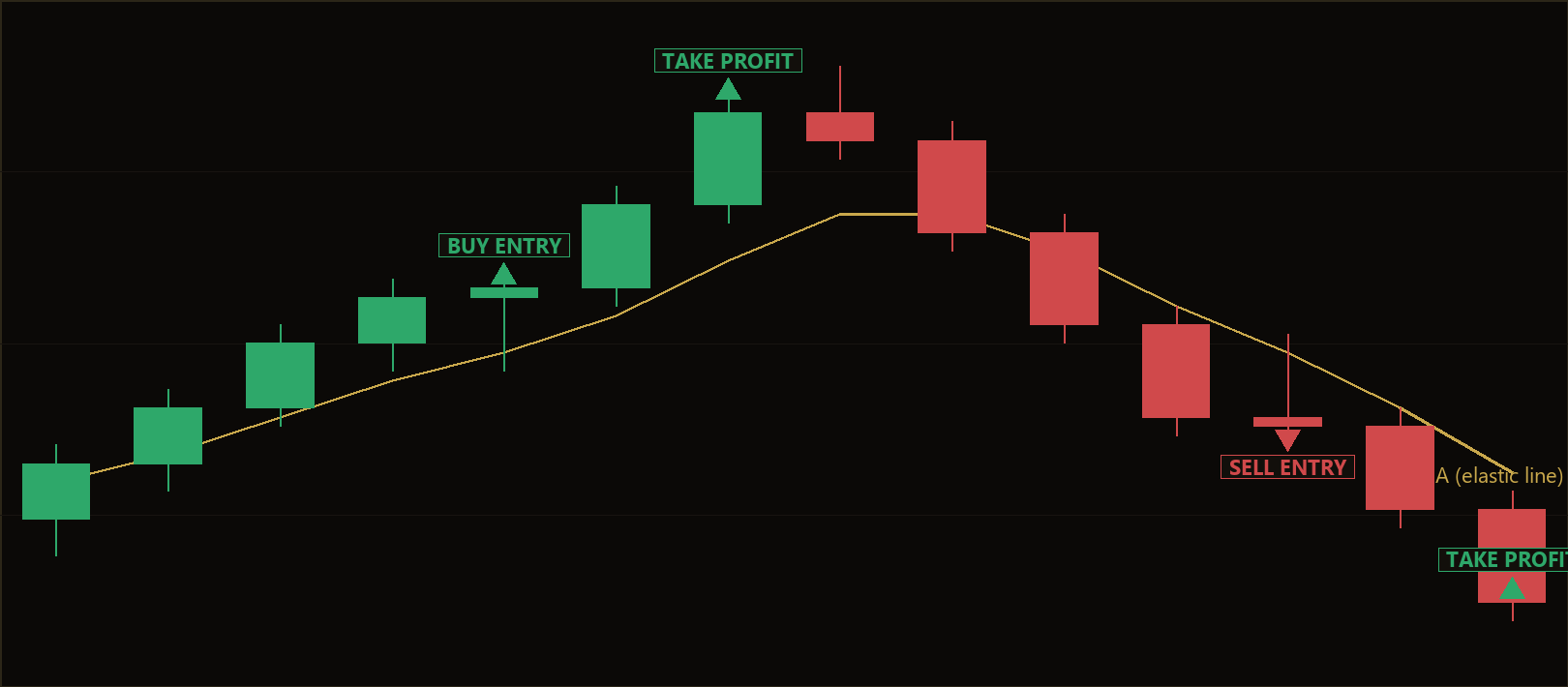
The Elastic Volume Trend Rider is a trend-following expert advisor (EA) built around the Elastic Volume-Weighted Moving Average (eVWMA), a volume-driven baseline that adjusts its own responsiveness bar by bar. Where a conventional moving average smooths price at a fixed pace, the eVWMA speeds up when heavy volume prints and slows down when volume is thin. In practice, this means the line "snaps" toward price when large participants are active and "coasts" quietly during quiet periods — giving you a fair-value reference that follows conviction rather than the clock.
This strategy is designed for trending markets with periodic pullbacks. It does not try to catch tops and bottoms in a range. Instead, it waits for a clearly sloped eVWMA, then looks for price to dip back to the line and reclaim it on a burst of volume — a classic "buy the pullback in an uptrend, sell the rally in a downtrend" structure, with a volume confirmation layer that ties directly to the indicator's own philosophy. Every threshold is normalized by the Average True Range (ATR) and by average volume, so the logic adapts to whatever symbol and timeframe you apply it to.
As a learning tool, the Elastic Volume Trend Rider is well suited to traders who want to understand how volume, adaptive smoothing, and volatility-based risk can be combined in a single, rules-based system. It is best studied on a demo account, where you can observe how the eVWMA behaves against price and how the volume-surge filter changes the number of signals. Treat it as a framework for analysis and experimentation — not as a shortcut to results.
How It Works
The strategy evaluates its rules once per fully-closed bar on your chosen (primary) timeframe. It never acts on a still-forming candle, and it holds only one position at a time. Here is the logic in plain English.
Building the elastic line (eVWMA):
- Each bar, the strategy sums tick volume over the last
FloatPeriodbars to get a "float" — a measure of recent traded activity. - It computes an adaptation factor, alpha = current bar volume ÷ float. A heavy-volume bar produces a large alpha; a thin bar produces a small one.
- The eVWMA is then updated recursively: it retains most of its prior value on quiet bars and shifts sharply toward the current close on high-volume bars.
Trend regime gate (staying out of chop):
- The strategy measures the slope of the eVWMA over
SlopePeriodbars and divides it by ATR to make it comparable across instruments. - Only when this ATR-normalized slope is steep enough (at or beyond
SlopeThresh) does the strategy consider the market to be trending. Flat, choppy conditions are filtered out.
Volume-surge confirmation:
- A signal is only valid when the current bar's volume is at least
VolMulttimes the average volume over the float window. This "elastic push" requirement ensures the reclaim is backed by participation, not a quiet drift.
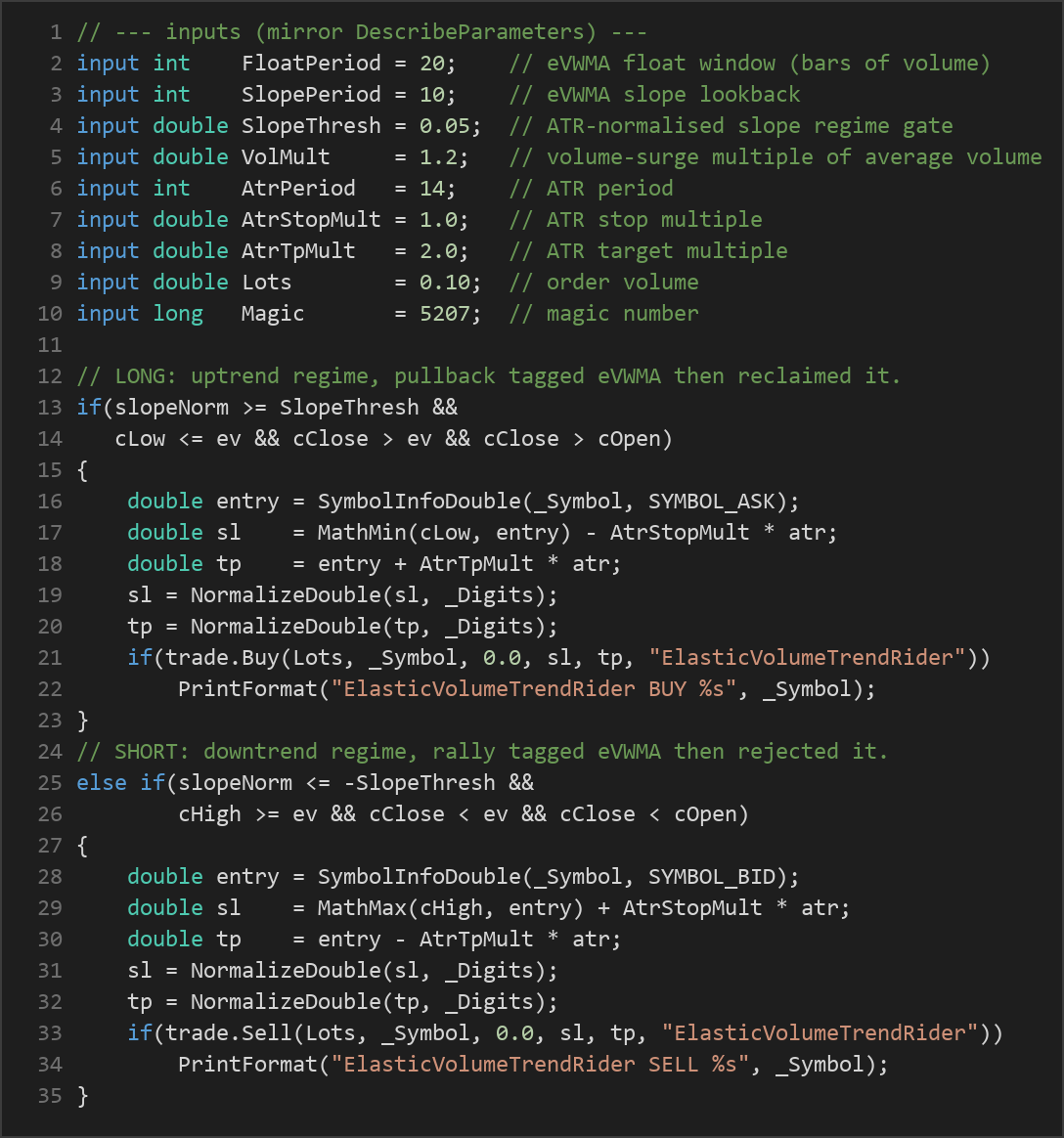
Long entry — the strategy signals a buy when:
- The eVWMA slope is up and at or above
SlopeThresh(uptrend regime), and - The bar's low pulled back to tag the eVWMA (Low ≤ eVWMA) but the bar closed back above the line, and
- The candle is bullish (Close > Open), and
- A volume surge is present.
Short entry — the strategy signals a sell when:
- The eVWMA slope is down and at or below
-SlopeThresh(downtrend regime), and - The bar's high rallied to tag the eVWMA (High ≥ eVWMA) but the bar closed back below the line, and
- The candle is bearish (Close < Open), and
- A volume surge is present.
Stop-loss logic:
- For longs, the stop is placed below the lower of the pullback low or the entry price, minus
AtrStopMult× ATR. - For shorts, the stop is placed above the higher of the pullback high or the entry price, plus
AtrStopMult× ATR. - Because the stop is anchored to both structure (the pullback extreme) and volatility (ATR), it adapts to current market conditions.
Take-profit logic:
- The target is set a fixed multiple of ATR away from entry —
AtrTpMult× ATR in the direction of the trade. - With the defaults, the target distance is twice the stop multiple, giving a 2:1 reward-to-risk shape on the bracket. Each position exits when either its stop or target is reached; there is no separate trailing mechanism.
Strategy Parameters
| Parameter | Default | Min | Max | Description |
|---|---|---|---|---|
| FloatPeriod | 20 | 5 | 60 | Number of bars whose tick volume forms the eVWMA "float"; larger values make the line adapt more slowly. |
| SlopePeriod | 10 | 3 | 40 | Lookback used to measure the slope of the eVWMA for the trend regime gate. |
| SlopeThresh | 0.05 | 0.0 | 0.50 | Minimum ATR-normalized eVWMA slope required to treat the market as trending; higher values demand stronger trends. |
| VolMult | 1.2 | 0.5 | 3.0 | Volume-surge multiple; the current bar must exceed this multiple of average float-window volume to qualify. |
| AtrPeriod | 14 | 5 | 30 | Period for the Average True Range used in slope normalization and stop/target sizing. |
| AtrStopMult | 1.0 | 0.2 | 3.0 | ATR multiple added beyond the pullback extreme to place the stop-loss. |
| AtrTpMult | 2.0 | 0.5 | 6.0 | ATR multiple used to set the take-profit distance from entry. |
| Lots | 0.10 | 0.01 | 1.0 | Fixed order volume in lots for each trade. |
| Magic | 5207 | 0 | 9,999,999 | Unique magic number identifying this EA's positions. |
Recommended Chart Settings
The Elastic Volume Trend Rider is built to run on a single primary timeframe and adapts to the symbol and timeframe you attach it to, since every threshold is ATR- and volume-normalized. A common starting point for study is a liquid major forex pair (for example, EUR/USD) on an intraday timeframe such as the H1 (1-hour) chart, where tick volume is meaningful and trends develop with periodic pullbacks.
Because the strategy depends on tick volume, apply it to instruments and brokers where volume data is reliable. Results will vary considerably across different symbols, timeframes, and market conditions, so use the parameter ranges above as a guide for careful, methodical testing rather than fixed recommendations.
How to Install on MetaTrader 5
- Download the .ex5 file from the link below
- Copy it to your MT5
MQL5\Expertsfolder - Restart MetaTrader 5 or refresh the Navigator panel
- Drag the EA onto a chart matching the recommended symbol and timeframe
- Configure the input parameters and enable Algo Trading
What to Consider Before Using This EA
Strengths of this approach. The eVWMA is an elegant way to weight recent activity without a fixed smoothing constant, and pairing it with a volume-surge filter means the strategy historically engages only when there is genuine participation behind a pullback reclaim. The ATR-normalized slope gate is a sensible attempt to avoid trading in directionless chop, and anchoring both stop and target to ATR keeps risk proportional to current volatility.
Known limitations. Like all trend-following systems, this one may struggle in ranging or whipsaw conditions, where a sloped eVWMA and a volume surge can appear right before price reverses. The requirement for a pullback-and-reclaim on a surge bar can also make signals relatively infrequent, and the fixed reward-to-risk bracket means individual trades are cut or capped rather than allowed to run indefinitely. Tick volume is a proxy for real traded volume in forex, so its quality depends on your broker's data feed.
Where it may underperform. Low-volatility drift, news-driven gaps, and choppy consolidations can all produce misleading signals. The strategy also takes one position at a time, so it may sit idle through moves that do not meet every condition. None of this is a flaw to be "fixed" — it is the natural trade-off of a selective, rules-based design, and understanding it is part of studying the system.
Risk Management Tips
Sound risk management matters more than any single indicator. Consider these general principles as you study this or any EA:
- Risk a small, fixed fraction per trade. Many educational sources suggest limiting risk to no more than 1–2% of account equity on any single position, adjusting your lot size accordingly rather than using a fixed lot blindly.
- Test on a demo account first. Run the strategy in a simulated environment long enough to see how it behaves across trending, ranging, and volatile conditions before considering real capital.
- Understand drawdown. Every strategy experiences losing streaks. Know how a sequence of stop-outs would affect your account and whether you could tolerate it emotionally and financially.
- Size positions to volatility. Since stops here are ATR-based, position sizing should account for how wide those stops can become on volatile instruments.
- Keep expectations grounded. Backtests and demo results are learning data, not predictions. Markets change, and no configuration is guaranteed to behave the same way going forward.
Risk Warning
Trading foreign exchange, CFDs, and other leveraged financial instruments involves substantial risk of loss and is not suitable for all investors. The strategies and tools discussed on this page are provided for educational purposes only and do not constitute financial advice, investment recommendations, or solicitation to trade. Always consult a qualified financial adviser before making trading decisions. Past backtest performance is not indicative of future results.
Downloads
- Expert Advisor: ElasticVolumeTrendRider.ex5 (32 downloads)
- Source Code: ElasticVolumeTrendRider.mq5 (30 downloads)
- Documentation: ElasticVolumeTrendRider.pdf (45 downloads)