Disclaimer: This article is for educational and informational purposes only. It does not constitute financial or investment advice. Trading forex and CFDs carries significant risk of loss. Past performance of any strategy — including backtests — does not guarantee future results. Never trade with money you cannot afford to lose.
What Is This Strategy?
The Teager Energy Momentum Burst is a momentum-ignition strategy for MetaTrader 5 built around the Teager-Kaiser Energy Operator (TKEO), a signal-processing tool that measures the instantaneous energy of an oscillation — roughly its amplitude multiplied by its frequency squared. Instead of only asking where momentum sits (the job of a traditional moving average or MACD line), this approach asks a different question: how hard is momentum firing right now? That distinction is the core idea behind the whole system.
To do this, the strategy first detrends price into a zero-centred oscillator using two exponential moving averages (EMAs) — the same construction that underpins the classic MACD. It then applies the discrete Teager-Kaiser operator to the most recent oscillator samples to estimate the energy of the move. A clean, directional thrust produces a large positive energy reading, while choppy, indecisive price action collapses that reading toward zero. Because the energy measure is direction-agnostic (a hard down-move charges just as much energy as a hard up-move), direction is read separately from the sign of the oscillator.
As a learning tool, the Teager Energy Momentum Burst is best suited to traders who already understand oscillators and ATR-based risk and want to explore how a signal-processing lens can filter momentum entries. It is designed for trending market conditions where a fresh burst of energy aligns with an existing directional drift. This article frames the strategy as an analytical study of that concept — not as an opportunity to generate returns — so you can evaluate the logic on its own merits.
How It Works
The strategy processes one newly-closed bar at a time and builds its signal in layers. Here is the full logic in plain English.
Building the oscillator and energy reading:
- Two EMAs are maintained on the closing price — a fast one (
FastPeriod) and a slow one (SlowPeriod). Their difference forms a detrended, MACD-style oscillator: positive when the fast EMA sits above the slow (bullish drift), negative when below (bearish drift). - The Teager-Kaiser energy is calculated from the last three oscillator samples, centred on the previous one:
energy = osc[t-1]² − osc[t-2] × osc[t]. This value spikes positive during a decisive directional thrust and shrinks toward zero during chop. - The energy is normalised by ATR² (the Average True Range squared). ATR measures recent volatility, so dividing by it lets a single threshold behave consistently across different symbols and timeframes. The result is called the normalised energy, or
eNorm.
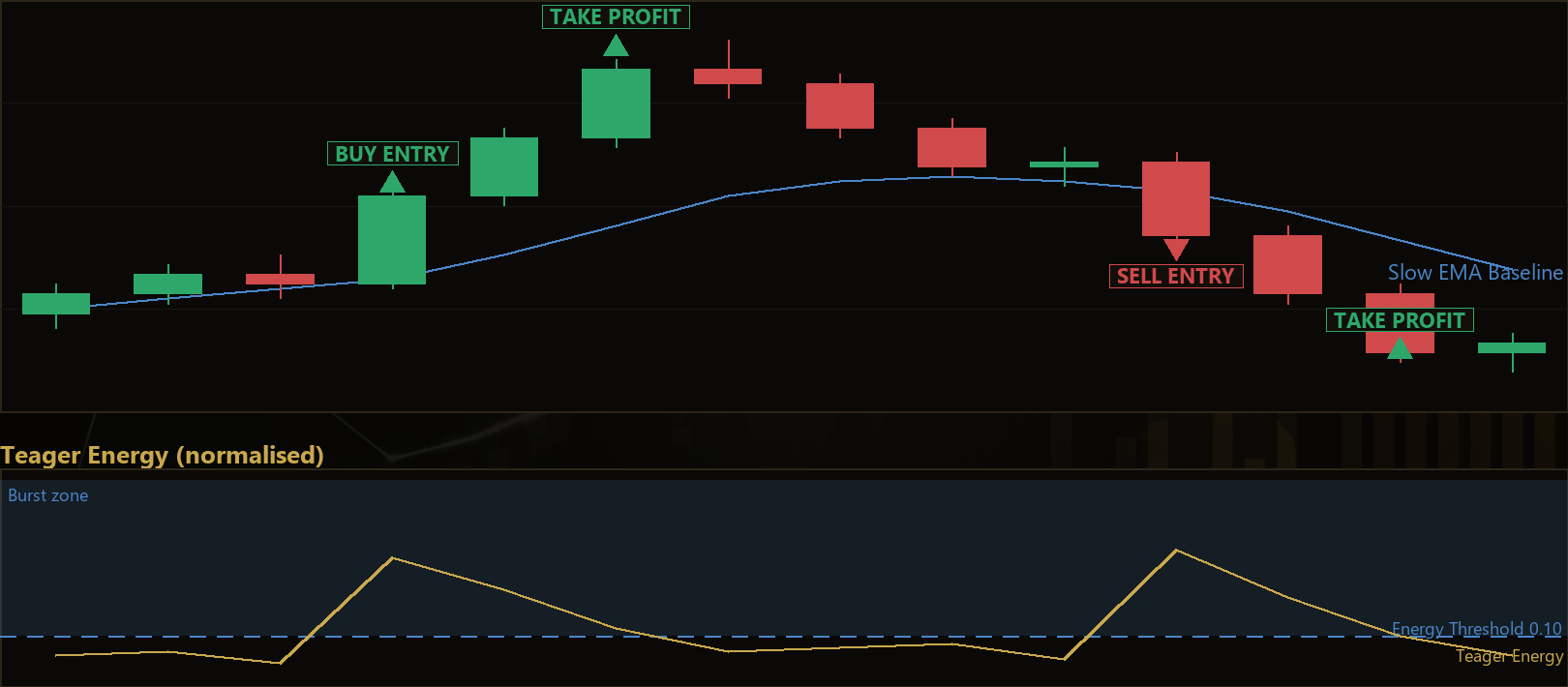
Entry conditions — the strategy signals a "fresh burst":
- The normalised energy must cross up through
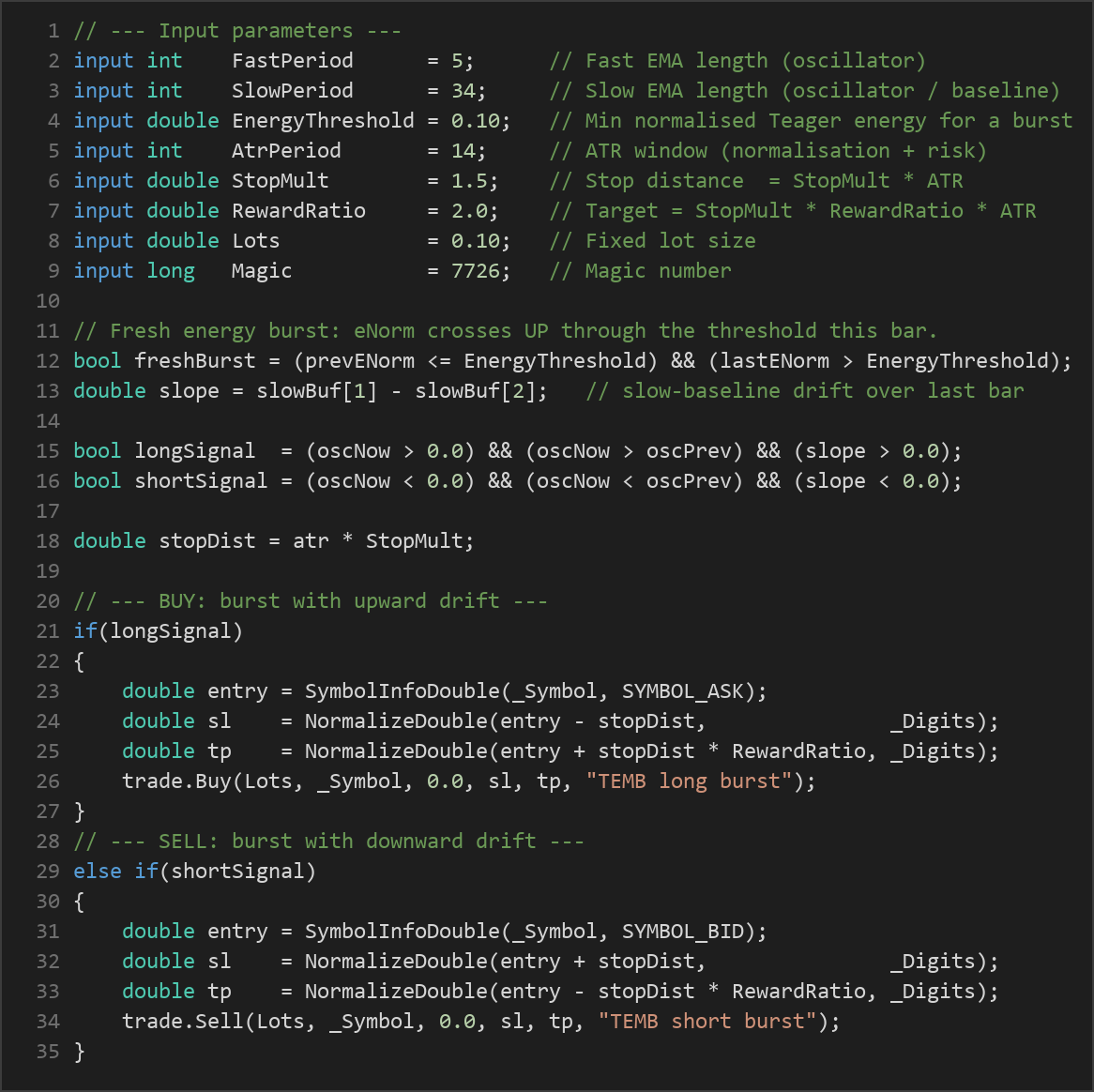
EnergyThresholdon the current bar (it was at or below the threshold last bar, and above it now). This "fresh cross" logic means the strategy fires once at ignition rather than repeatedly for every bar a move persists. - Long signal: the burst occurs while the oscillator is positive and rising (expanding upward), and the slow EMA baseline is sloping up. In other words, the energy burst must agree with the prevailing upward drift.
- Short signal: the burst occurs while the oscillator is negative and falling (expanding downward), and the slow EMA baseline is sloping down.
- This trend gate is the strategy's main drawdown control — it will not take an energy burst that fights the prevailing baseline.
Exit conditions:
- Stop-loss: placed at
StopMult × ATRaway from entry. Using ATR means the stop automatically widens in volatile conditions and tightens in quiet ones. - Take-profit: placed at
StopMult × RewardRatio × ATRaway from entry, so the reward target is a multiple of the risk taken. - Adaptive momentum-flip exit: if the oscillator crosses back through zero against an open position (turning negative while long, or positive while short), the trade is closed early — before the hard stop is reached. This is designed to cut losers and protect open profit when momentum reverses.
- Only one position per magic number is held at a time, keeping exposure simple and predictable.
Strategy Parameters
| Parameter | Default | Min | Max | Description |
|---|---|---|---|---|
| FastPeriod | 5 | 2 | 20 | Length of the fast EMA that forms the detrended oscillator. Smaller values react faster. |
| SlowPeriod | 34 | 10 | 100 | Length of the slow EMA (also the trend baseline). The oscillator is fast EMA minus slow EMA. |
| EnergyThreshold | 0.10 | 0.01 | 1.00 | Minimum normalised Teager energy (as a fraction of ATR²) required to call a burst. Higher values demand stronger thrusts. |
| AtrPeriod | 14 | 5 | 40 | ATR window used for volatility normalisation and risk sizing. |
| StopMult | 1.5 | 0.5 | 4.0 | Stop-loss distance as a multiple of ATR. |
| RewardRatio | 2.0 | 0.5 | 5.0 | Take-profit distance as a multiple of the stop distance (reward-to-risk ratio). |
| Lots | 0.10 | 0.01 | 1.00 | Fixed trade volume in lots. |
| Magic | 7726 | 0 | 9,999,999 | Unique identifier so the EA manages only its own positions. |
Recommended Chart Settings
The Teager Energy Momentum Burst is written for a single timeframe — it operates on whatever timeframe the chart is set to when it runs, with nothing hardcoded. A natural home is a liquid FX major such as EURUSD on the M15 or H1 timeframe, where spreads are tight and directional thrusts are common enough for the energy operator to work with. Because the energy reading is ATR-normalised, the same EnergyThreshold is intended to behave reasonably across symbols and timeframes, which makes the strategy convenient to explore on different charts.
That said, every market has its own character. Results will vary considerably across symbols, timeframes, broker spreads, and market regimes. Treat any chart choice as a starting point for study and testing, not a fixed prescription.
How to Install on MetaTrader 5
- Download the .ex5 file from the link below
- Copy it to your MT5
MQL5\Expertsfolder - Restart MetaTrader 5 or refresh the Navigator panel
- Drag the EA onto a chart matching the recommended symbol and timeframe
- Configure the input parameters and enable Algo Trading
What to Consider Before Using This EA
Strengths of the approach. The Teager-Kaiser operator is a genuinely different way to read momentum. By emphasising how hard a move is firing rather than only its position, it may indicate the difference between a decisive thrust and a slow drift that a plain oscillator would score similarly. The fresh-cross entry avoids chasing a move bar after bar, the trend gate keeps entries aligned with the baseline, and the adaptive momentum-flip exit gives the strategy a way to leave a trade before the hard stop when the oscillator reverses.
Known limitations. Like all momentum systems, this one is vulnerable to whipsaws in ranging or news-driven markets, where a burst of energy fires and then immediately fades. Because the energy operator relies on just a handful of oscillator samples, it can be sensitive to noise and to the choice of FastPeriod and SlowPeriod. The trend filter reduces counter-trend entries but also means the strategy will sit out sharp reversals until the baseline turns. In quiet, low-volatility conditions, few bursts may clear the threshold at all, leading to long idle stretches.
Where it may underperform. Tight, choppy ranges, low-liquidity sessions, and periods around major economic releases can all produce energy spikes that do not lead to sustained follow-through. No single parameter set is optimal across every regime, and over-tuning to past data (curve-fitting) is a real risk. Forward testing on a demo account is essential before drawing any conclusions.
Risk Management Tips
Sound risk management matters more than any single indicator. As general educational principles:
- Position sizing: size trades so that a losing streak cannot threaten your account. A common guideline is to risk no more than 1–2% of account equity per trade, adjusting the
Lotsinput to match your account size and the ATR-based stop distance. - Respect the stop: the ATR stop exists to define your risk on every trade. Removing or widening it defeats the purpose of the design.
- Use a demo account first: test the strategy on a demo account across different market conditions before considering any live use, so you understand its behaviour and typical drawdown.
- Understand drawdown: every strategy experiences losing periods. Know the largest peak-to-trough decline you are willing to tolerate, and treat that limit as a hard rule.
- Diversify your study: never let one automated system carry your entire account, and keep expectations grounded in the reality that no approach wins on every trade.
Risk Warning
Trading foreign exchange, CFDs, and other leveraged financial instruments involves substantial risk of loss and is not suitable for all investors. The strategies and tools discussed on this page are provided for educational purposes only and do not constitute financial advice, investment recommendations, or solicitation to trade. Always consult a qualified financial adviser before making trading decisions. Past backtest performance is not indicative of future results.
Downloads
- Expert Advisor: TeagerEnergyMomentumBurst.ex5 (51 downloads)
- Source Code: TeagerEnergyMomentumBurst.mq5 (33 downloads)
- Documentation: TeagerEnergyMomentumBurst.pdf (41 downloads)