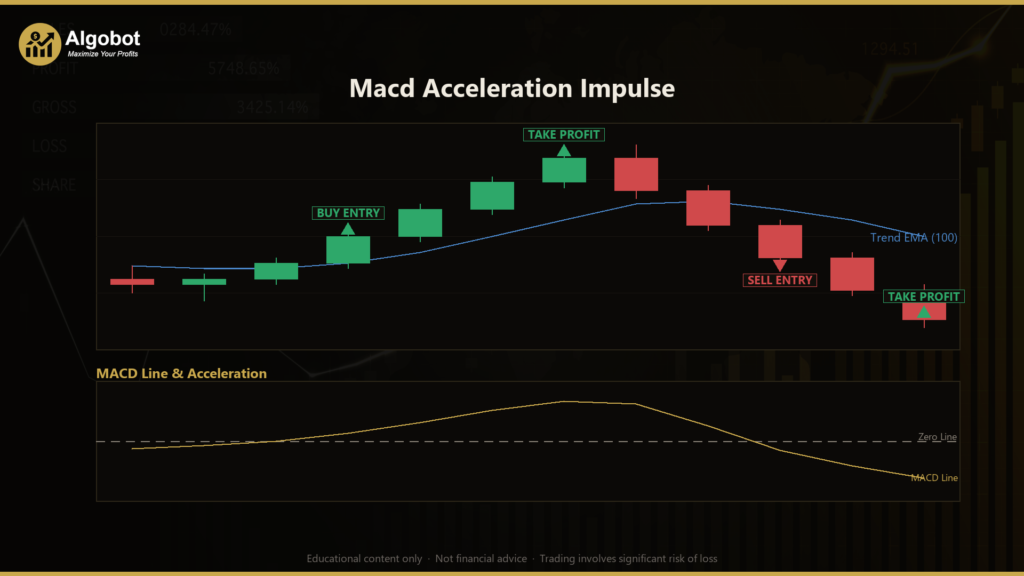
Disclaimer: This article is for educational and informational purposes only. It does not constitute financial or investment advice. Trading forex and CFDs carries significant risk of loss. Past performance of any strategy — including backtests — does not guarantee future results. Never trade with money you cannot afford to lose.
What Is This Strategy?
The Macd Acceleration Impulse strategy is a momentum-ignition system that reads the acceleration of the MACD line rather than the familiar MACD/signal crossover most traders rely on. MACD (Moving Average Convergence Divergence) is a classic momentum indicator built from the difference between a fast and a slow exponential moving average (EMA). Where a traditional MACD signal waits for that line to cross its own average — a lagging, first-order event — this strategy measures how fast the MACD line itself is changing from one bar to the next. That bar-to-bar change is its "acceleration," and it can turn positive the moment momentum begins to build, often earlier than a completed crossover.
In plain terms, the strategy is a trend-following, breakout-style approach designed for markets that are transitioning out of quiet consolidation and into a fresh directional push. It looks for the exact moment when momentum "ignites" — when the rate of change in the MACD line bursts outside its own recent range of normal fluctuation. A longer-period trend EMA keeps trades aligned with the broader move, so the system tries to catch acceleration in the direction the market is already leaning.
As a learning tool, Macd Acceleration Impulse is well suited to intermediate traders who already understand basic MACD behavior and want to explore second-order (derivative-based) signal construction, self-scaling thresholds, and volatility-based risk. It is best viewed as a study in how to build a robust, symbol-agnostic trigger — not as a shortcut to results. Treat it as a framework for understanding momentum ignition and disciplined risk management.
How It Works
The strategy evaluates its logic once per closed bar on a single primary timeframe. It computes the MACD line, tracks its acceleration, and compares that acceleration against two independent thresholds before considering any entry.
Core calculations:
- MACD line — the fast EMA minus the slow EMA of closing prices, recalculated each bar.
- Acceleration — the first difference of the MACD line (this bar's MACD value minus the previous bar's). This is the "speed" of momentum change.
- Dynamic band —
BandMult × standard deviationof the acceleration over the lastBandLengthbars. This is a self-scaling "release level" that represents recent noise; a real ignition must exceed it. - Dead zone —
AtrDeadFactor × ATR, an absolute floor. ATR (Average True Range) measures typical price movement, so this prevents a dead-flat market with a near-zero band from firing false signals. - Trend EMA — a longer moving average that defines which side of the larger move the trade should be on.
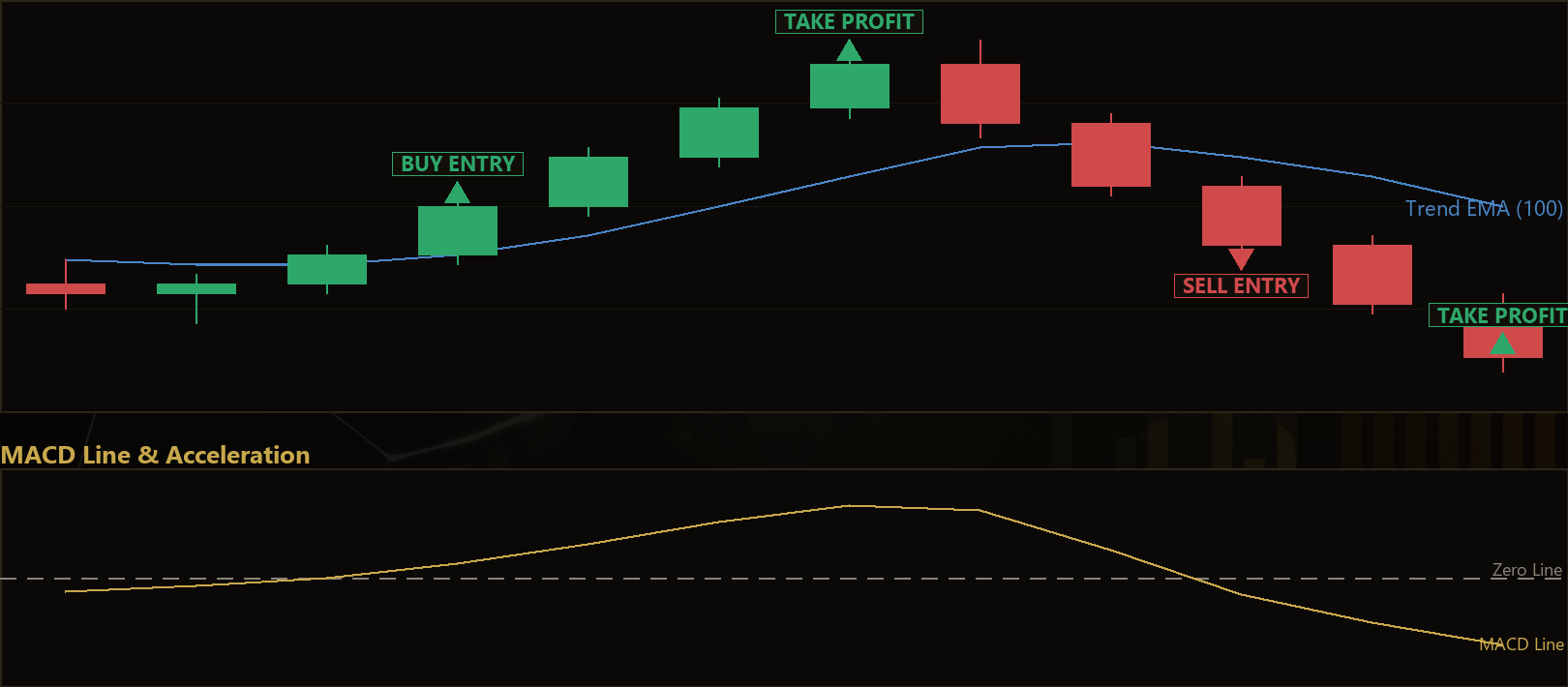
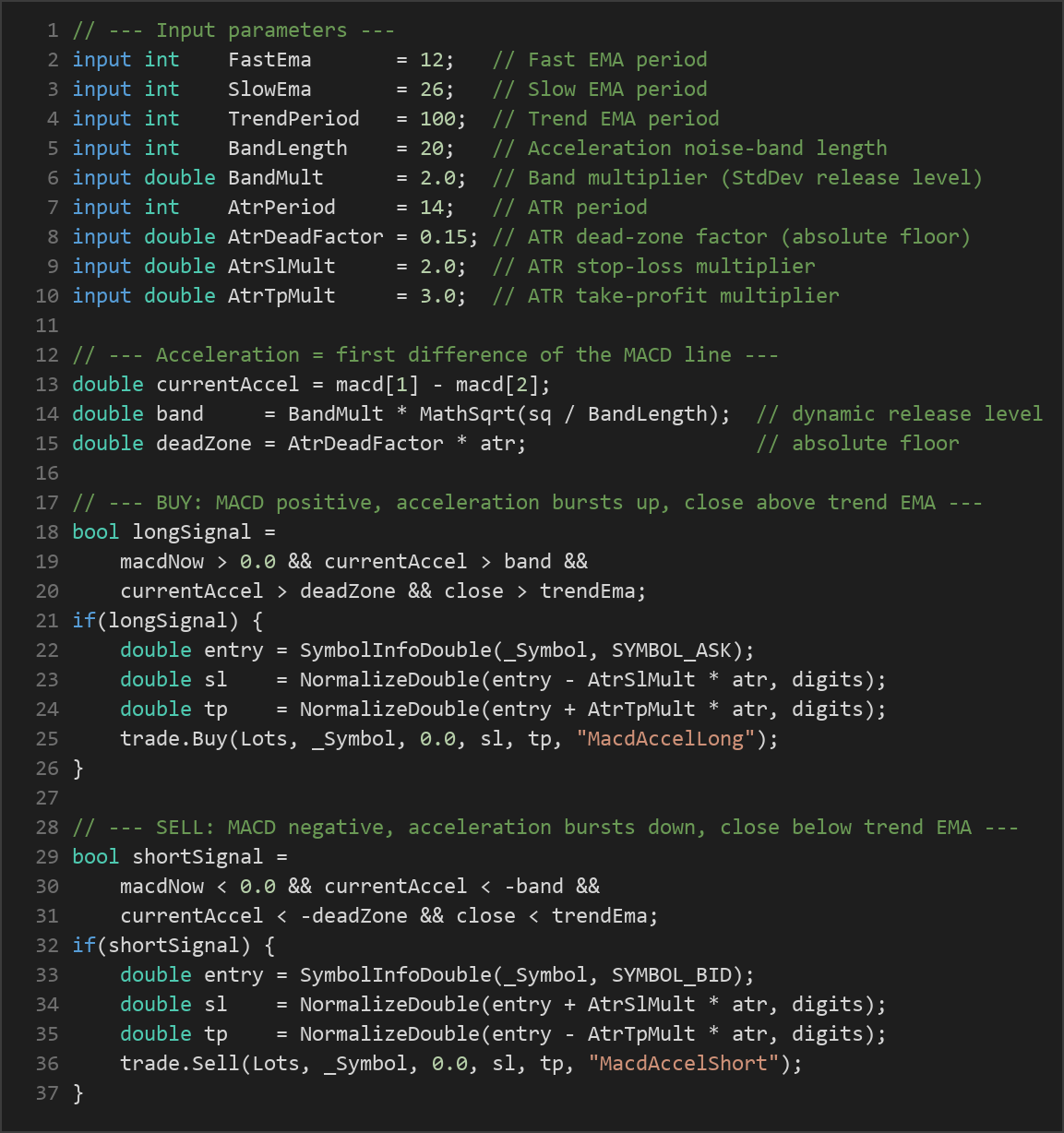
The strategy signals a BUY when all of the following align:
- The MACD line is above zero (momentum is already leaning up).
- Acceleration bursts up past the dynamic band (it exceeds recent noise).
- Acceleration also exceeds the ATR dead zone (it clears the absolute floor).
- The closing price is above the trend EMA (aligned with the larger uptrend).
The strategy signals a SELL under the symmetric mirror conditions:
- The MACD line is below zero.
- Acceleration bursts down past the negative band.
- Acceleration is more negative than the negative dead zone.
- The closing price is below the trend EMA.
Exit and position management:
- Stop-loss is placed at
AtrSlMult × ATRaway from entry, so protective distance adapts to current volatility. - Take-profit is placed at
AtrTpMult × ATRaway from entry, giving a volatility-scaled target. - Only one position per magic number is held at a time — the strategy never stacks trades.
- If an opposite ignition appears while a position is open, the strategy closes the current trade so the book always reflects the freshest impulse. It then waits for the next bar or a clean new signal to re-enter.
- A spread filter (
MaxSpreadPoints) skips entries when the spread is too wide, helping keep simulated fills realistic.
Because both the signal and its band are derived from the same acceleration series, the system needs no hand-tuned "magic sensitivity constant" and is designed to behave consistently across different symbols and timeframes.
Strategy Parameters
| Parameter | Default | Min | Max | Description |
|---|---|---|---|---|
| FastEma | 12 | 5 | 40 | Period of the fast EMA used in the MACD calculation. |
| SlowEma | 26 | 15 | 80 | Period of the slow EMA used in the MACD calculation. Must be greater than FastEma (the code swaps them if not). |
| TrendPeriod | 100 | 30 | 300 | Period of the trend-filter EMA that keeps entries aligned with the larger move. |
| BandLength | 20 | 8 | 60 | Number of bars used to measure the acceleration's "recent noise" band. |
| BandMult | 2.0 | 0.5 | 4.0 | Multiplier on the standard deviation that sets the dynamic release level. Higher values demand a stronger burst. |
| AtrPeriod | 14 | 5 | 40 | Period of the ATR used for the dead zone and for stop/target distances. |
| AtrDeadFactor | 0.15 | 0.0 | 1.0 | Fraction of ATR forming the absolute floor an ignition must clear (0 disables the floor). |
| AtrSlMult | 2.0 | 0.5 | 5.0 | Stop-loss distance as a multiple of ATR. |
| AtrTpMult | 3.0 | 0.5 | 8.0 | Take-profit distance as a multiple of ATR. |
| MaxSpreadPoints | 30 | 0 | 200 | Maximum allowable spread in points before an entry is skipped (0 = no filter). |
| Lots | 0.10 | 0.01 | 1.0 | Fixed order volume in lots. |
Recommended Chart Settings
Macd Acceleration Impulse is built for a single primary timeframe and applies all of its logic to fully closed bars. Because MACD and momentum ignition tend to be most informative on intraday-to-swing horizons, the H1 (1-hour) timeframe on major forex pairs such as EUR/USD or GBP/USD is a reasonable starting point for study. The self-scaling band and ATR-based dead zone are specifically designed to keep the trigger consistent across instruments, so you can also experiment with metals or indices.
That said, no single symbol or timeframe is universally "correct." Momentum-ignition behavior differs between trending and ranging conditions, and results will vary considerably across different market environments, brokers, and spread profiles. Always test any configuration on historical data and a demo account before drawing conclusions.
How to Install on MetaTrader 5
- Download the .ex5 file from the link below
- Copy it to your MT5
MQL5\Expertsfolder - Restart MetaTrader 5 or refresh the Navigator panel
- Drag the EA onto a chart matching the recommended symbol and timeframe
- Configure the input parameters and enable Algo Trading
What to Consider Before Using This EA
Strengths of this approach. Reading acceleration rather than waiting for a completed crossover is an attempt to detect momentum earlier, which may help the strategy engage as a move begins rather than after it matures. The fully self-scaling gate — a dynamic standard-deviation band combined with an ATR floor — removes the need for instrument-specific tuning constants and is designed to behave consistently across symbols. The dual trend-and-momentum confirmation (MACD sign plus trend EMA) helps filter out counter-trend noise, and ATR-based stops and targets adapt risk to current volatility.
Known limitations. Derivative-based signals like acceleration are inherently sensitive: taking the difference of an already-smoothed line can amplify short-term noise, which may produce whipsaws in choppy, sideways markets. The trend EMA and dead zone reduce this but cannot eliminate it. Like most breakout and momentum systems, the strategy may underperform during extended low-volatility ranges, around major news spikes, or when a market repeatedly ignites and then stalls. The fixed lot size does not scale to account equity, and the one-position-per-magic design means it will not pyramid into strong runs. As with any single-timeframe momentum method, historically it has periods of drawdown, and no parameter set performs well in all conditions. Study it, backtest it thoroughly, and understand its behavior before considering any live use.
Risk Management Tips
Sound risk management matters far more than any single entry signal. Consider these general principles as you study the strategy:
- Risk a small, fixed fraction per trade. A common guideline is to risk no more than 1–2% of account equity on any single position, adjusting your lot size to match the ATR-based stop distance rather than using a fixed lot blindly.
- Start on a demo account. Run the EA in simulation first to understand how often it trades, how it behaves in different regimes, and how drawdowns develop.
- Understand drawdown. Even a well-designed strategy experiences losing streaks. Know the maximum historical drawdown of your configuration and be honest about whether you could tolerate it emotionally and financially.
- Account for costs. Spreads, commissions, and slippage all erode results; the built-in spread filter helps, but real-world fills differ from backtests.
- Diversify and size sensibly. Avoid concentrating risk in correlated instruments, and never allocate money you cannot afford to lose.
Risk Warning
Trading foreign exchange, CFDs, and other leveraged financial instruments involves substantial risk of loss and is not suitable for all investors. The strategies and tools discussed on this page are provided for educational purposes only and do not constitute financial advice, investment recommendations, or solicitation to trade. Always consult a qualified financial adviser before making trading decisions. Past backtest performance is not indicative of future results.
Downloads
- Expert Advisor: MacdAccelerationImpulse.ex5 (45 downloads)
- Source Code: MacdAccelerationImpulse.mq5 (44 downloads)
- Documentation: MacdAccelerationImpulse.pdf (52 downloads)