Disclaimer: This article is for educational and informational purposes only. It does not constitute financial or investment advice. Trading forex and CFDs carries significant risk of loss. Past performance of any strategy — including backtests — does not guarantee future results. Never trade with money you cannot afford to lose.
What Is This Strategy?
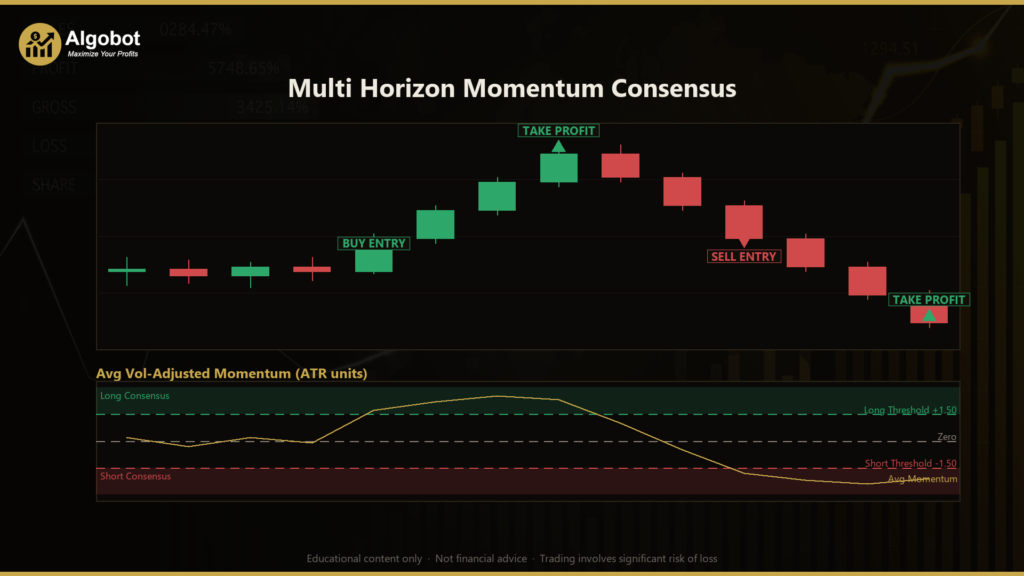
The Multi Horizon Momentum Consensus strategy is a volatility-normalized, indicator-based time-series momentum system for MetaTrader 5. Time-series momentum (sometimes called "absolute momentum") simply measures whether price is higher or lower than it was a fixed number of bars ago — a well-documented tendency for markets that have been rising to keep rising, and for markets that have been falling to keep falling. This trend-following EA takes that classic idea and adds a strict filter: instead of trusting a single lookback window, it demands agreement across four different time horizons before it will act.
The core problem the strategy is built to solve is noise. A 20-bar momentum reading can point up even while the deeper drift of the market is flat or turning. To separate genuine one-directional trends from short-lived spikes, Multi Horizon Momentum Consensus measures momentum across four geometrically spaced horizons — L, 2L, 4L, and 8L bars — and divides each reading by the current Average True Range (ATR), a standard measure of recent volatility. Normalizing by ATR makes the four numbers directly comparable, so a fast move and a slow drift are graded on the same scale.
As a learning tool, this strategy is well suited to traders who want to study how confirmation across multiple timeframes changes the character of a momentum system. It is designed for trending markets and is intentionally selective — it stays out of choppy, range-bound conditions where the horizons disagree. Beginners can use it to understand consensus filtering, while more experienced traders may find it a useful template for studying volatility normalization and disciplined entry timing. It is not a "set and forget" money machine; it is a structured framework for examining a specific market anomaly.
How It Works
The strategy evaluates the market once per newly closed bar and reduces every decision to a single question: do all four momentum horizons agree? Here is how the logic unfolds.
- Volatility measurement: On each closed bar the strategy calculates the ATR over the configured period. This value is used both to normalize the four momentum readings and to size the stop-loss and take-profit distances.
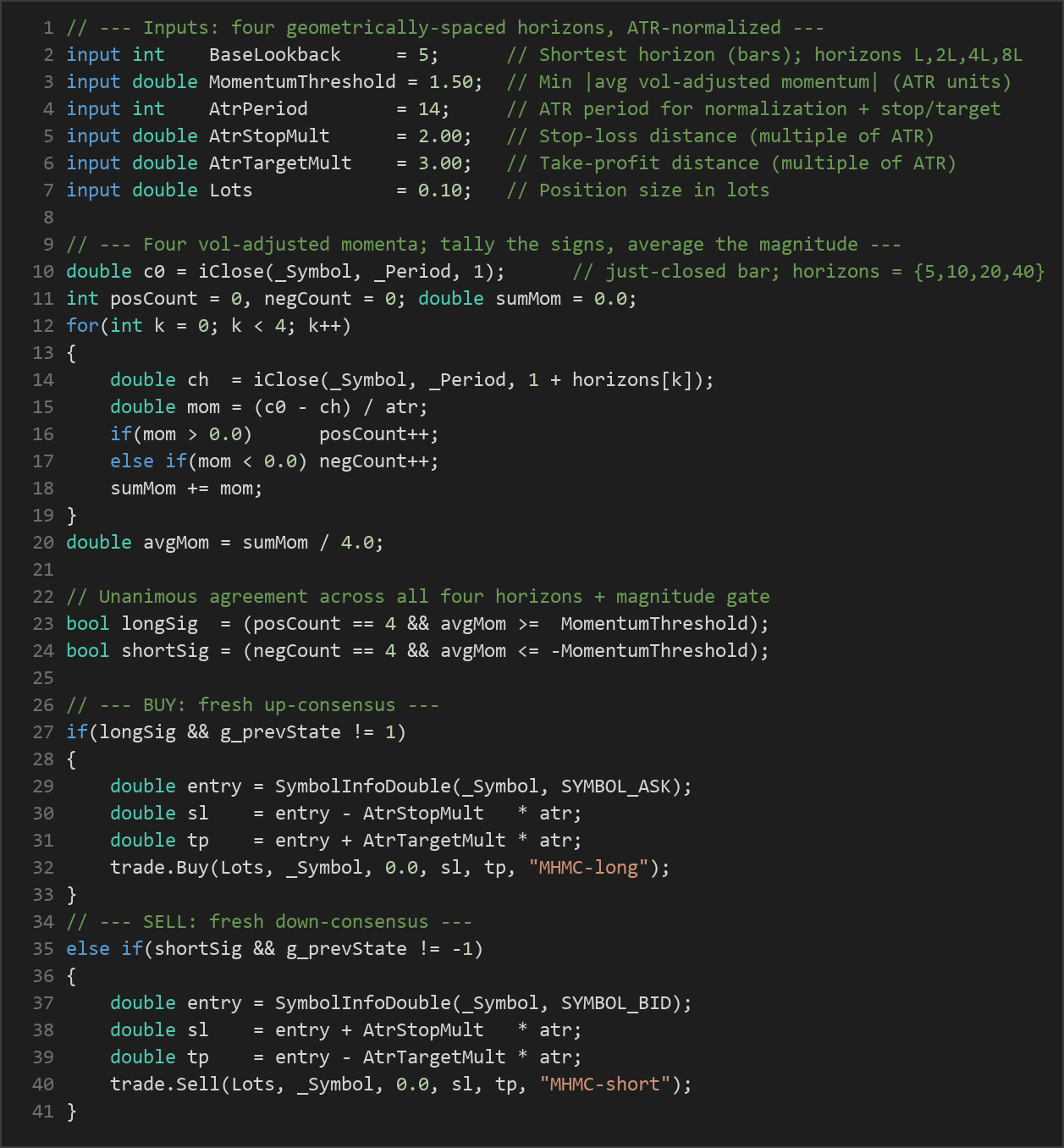
- Four momentum readings: Using the shortest horizon
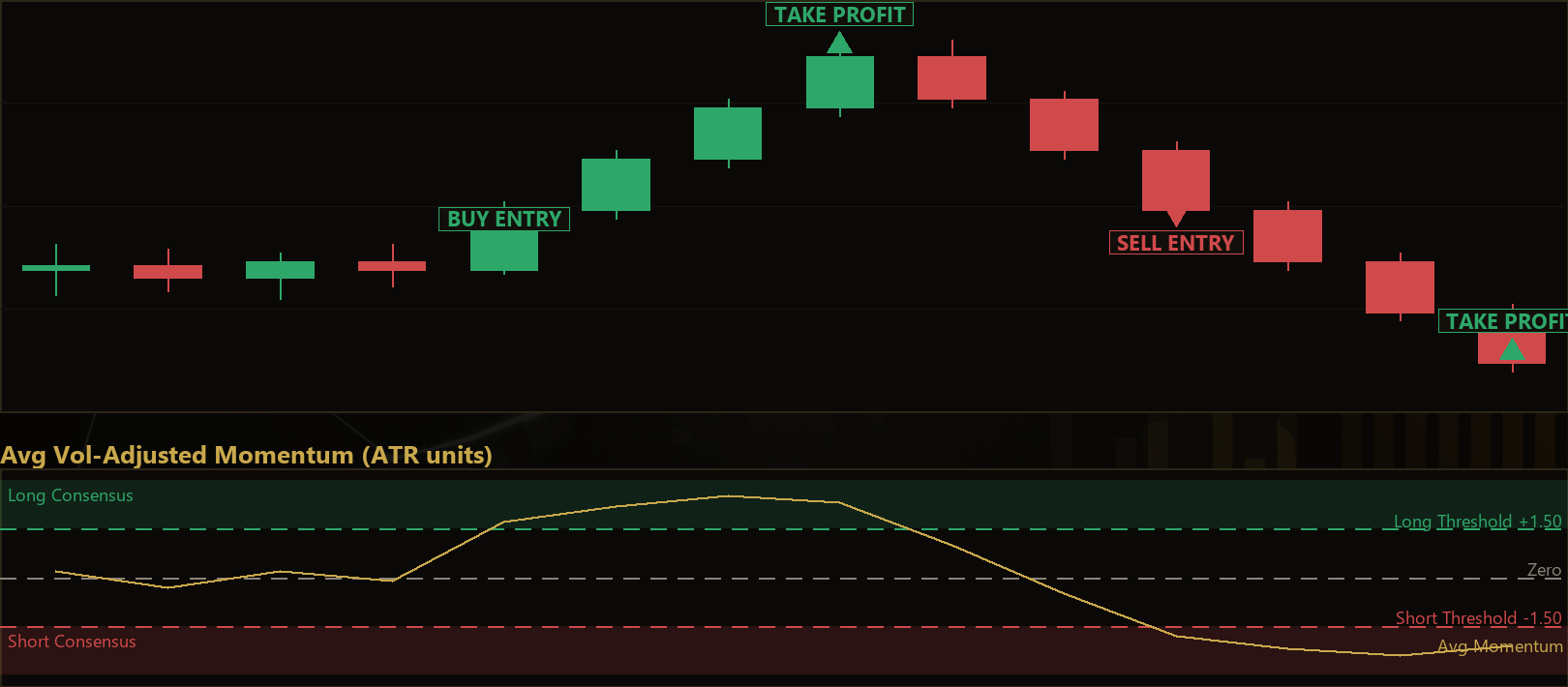
BaseLookback(L), it also computes 2L, 4L, and 8L — a 16:1 span from fastest to slowest. For each horizon it measures(current close − close h bars ago) / ATR, giving momentum in volatility-adjusted units. - Consensus check: The strategy signals a potential long only when all four horizons are positive, and a potential short only when all four are negative. Partial agreement produces no signal.
- Magnitude gate: On top of unanimous direction, the average of the four vol-adjusted momentum readings must exceed the
MomentumThreshold(in ATR units). This filters out weak, barely-positive agreement and isolates readings with real conviction. - Fresh-transition entry (ignition): A trade fires only on the first bar that enters the unanimous consensus state — the moment the market "ignites" into agreement — not on every subsequent bar while it persists. This is designed to avoid entering late into an already-extended move.
- Long entry: When a fresh up-consensus appears and no position is open, the strategy signals a buy at the ask price.
- Short entry: When a fresh down-consensus appears and no position is open, the strategy signals a sell at the bid price. Long and short logic is fully symmetric.
- Reverse-consensus exit: If a position is open and the opposite unanimous consensus forms, the strategy closes the position decisively and allows the next bar to re-arm. This treats a full directional flip as a strong exit signal.
- Stop-loss logic: Every position is bracketed by an ATR-based stop placed
AtrStopMult × ATRaway from entry, so the protective distance automatically widens in volatile conditions and tightens in calm ones. - Take-profit logic: A take-profit is set
AtrTargetMult × ATRfrom entry. With the defaults (2.0 stop, 3.0 target) this frames a reward-to-risk structure of roughly 1.5:1 on each trade. - One position at a time: The strategy never pyramids — it holds a single position and manages it until the stop, target, or reverse-consensus exit resolves it.
Strategy Parameters
| Parameter | Default | Min | Max | Description |
|---|---|---|---|---|
| BaseLookback | 5 | 3 | 15 | Shortest momentum horizon in bars. The four horizons are set to L, 2L, 4L, and 8L, so a value of 5 measures momentum over 5, 10, 20, and 40 bars. |
| MomentumThreshold | 1.50 | 0.50 | 5.00 | Minimum average vol-adjusted momentum (in ATR units) required to call a move a trend. Higher values demand stronger conviction and produce fewer signals. |
| AtrPeriod | 14 | 7 | 30 | ATR period used for volatility normalization and for the stop-loss / take-profit distances. |
| AtrStopMult | 2.00 | 1.00 | 5.00 | Stop-loss distance expressed as a multiple of ATR. |
| AtrTargetMult | 3.00 | 1.00 | 8.00 | Take-profit distance expressed as a multiple of ATR. |
| Lots | 0.10 | 0.01 | 1.00 | Fixed position size in lots for each trade. |
Recommended Chart Settings
Multi Horizon Momentum Consensus is a bar-based trend system, so it is best studied on intraday to swing timeframes such as H1 or H4, where trends have room to develop across the 8L slow horizon without excessive noise. Liquid instruments — major forex pairs like EUR/USD or GBP/USD, or a broad index CFD — tend to suit momentum studies because their trends are less prone to erratic gaps.
Because the deepest horizon plus the ATR window need enough history to compute, make sure the chart has loaded ample bars before evaluating signals. Keep in mind that momentum behavior differs greatly between trending and ranging regimes: the same settings that perform well in one market phase may underperform in another. Always test any symbol-and-timeframe combination on historical data and a demo account before drawing conclusions.
How to Install on MetaTrader 5
- Download the .ex5 file from the link below
- Copy it to your MT5
MQL5\Expertsfolder - Restart MetaTrader 5 or refresh the Navigator panel
- Drag the EA onto a chart matching the recommended symbol and timeframe
- Configure the input parameters and enable Algo Trading
What to Consider Before Using This EA
Every strategy has trade-offs, and understanding them is the point of studying an EA like this one.
Strengths. The multi-horizon consensus filter is genuinely selective — by requiring agreement across a 16:1 span of lookbacks, it discards the bulk of mean-reverting chop, where fast and slow horizons naturally disagree. Volatility normalization via ATR means the strategy adapts to changing market conditions rather than using fixed pip thresholds. The fresh-transition entry gate is a thoughtful touch: it aims to catch trends as they ignite rather than chasing mature, extended moves. ATR-scaled stops and targets keep risk proportional to current volatility.
Limitations. Strict consensus filtering means the strategy trades infrequently and will sit out of many moves — including trends that only appear on some horizons. This is a feature, but it can test a trader's patience and produce long flat periods. Like all trend-following systems, it is vulnerable to whipsaws: sharp reversals immediately after a consensus forms can trigger the stop or a reverse-consensus exit at a loss. In sideways, low-volatility markets the strategy may generate few signals, and the ones it does take may fail as false breakouts. The fixed reward-to-risk framing (default ~1.5:1) also means the strategy relies on a reasonable win rate to remain balanced — it is not a high-reward, low-frequency lottery.
Underperformance conditions. Expect the weakest behavior in choppy ranges, during news-driven volatility spikes that gap through stops, and in markets that trend on one horizon but not the others. No momentum system profits in all conditions, and this one is explicitly designed to trade only a minority of regimes.
Risk Management Tips
Sound risk management matters more than any single indicator setting. Consider these general principles as you study this EA:
- Risk a small, fixed fraction per trade. A common educational guideline is to risk no more than 1–2% of account equity on any single position. Adjust the
Lotssize so that the ATR-based stop distance corresponds to that fraction, rather than choosing a lot size arbitrarily. - Use a demo account first. Run the strategy on a demo or in the MT5 Strategy Tester across multiple market conditions before considering any live use. This helps you understand its trade frequency and behavior without financial exposure.
- Understand drawdown. Even a well-designed trend system endures losing streaks during ranging markets. Know the maximum historical drawdown you are studying and ask whether you could tolerate it emotionally and financially.
- Respect the stop. The ATR stop exists to define your risk on every trade. Disabling it or widening it after entry removes the strategy's core protection.
- Diversify your study. Avoid concentrating everything into one symbol, one timeframe, or one parameter set. Comparing behavior across markets builds a more honest picture.
Risk management is about survival and consistency, not about eliminating risk — which is impossible in trading.
Risk Warning
Trading foreign exchange, CFDs, and other leveraged financial instruments involves substantial risk of loss and is not suitable for all investors. The strategies and tools discussed on this page are provided for educational purposes only and do not constitute financial advice, investment recommendations, or solicitation to trade. Always consult a qualified financial adviser before making trading decisions. Past backtest performance is not indicative of future results.
Downloads
- Expert Advisor: MultiHorizonMomentumConsensus.ex5 (30 downloads)
- Source Code: MultiHorizonMomentumConsensus.mq5 (32 downloads)
- Documentation: MultiHorizonMomentumConsensus.pdf (41 downloads)