Disclaimer: This article is for educational and informational purposes only. It does not constitute financial or investment advice. Trading forex and CFDs carries significant risk of loss. Past performance of any strategy — including backtests — does not guarantee future results. Never trade with money you cannot afford to lose.
What Is This Strategy?
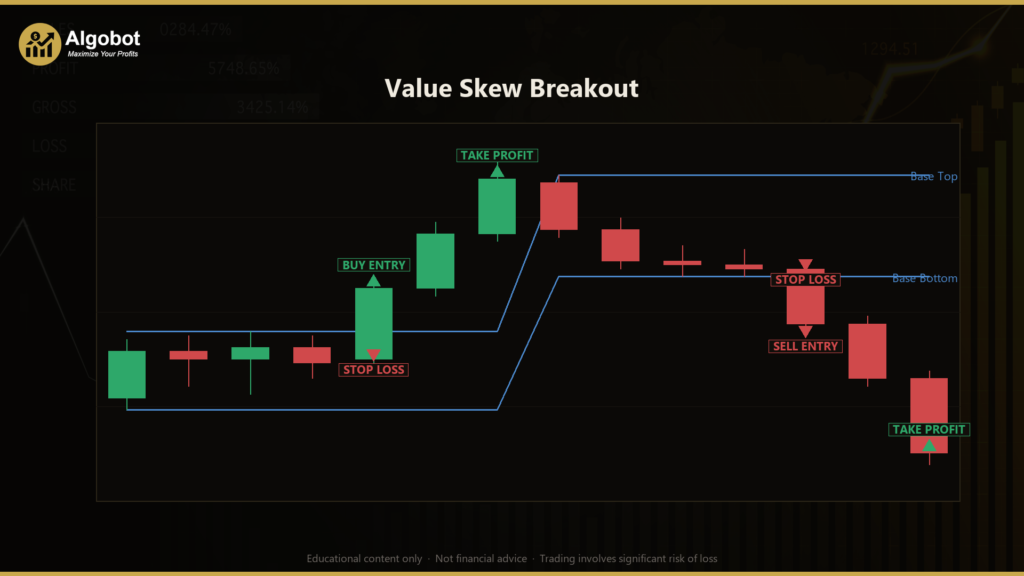
The Value Skew Breakout is a pure price-action breakout strategy that combines a range-consolidation breakout pattern with a "value skew" filter derived entirely from raw OHLC (open, high, low, close) data. Unlike most breakout systems, it does not rely on a traditional oscillator or moving average to generate signals. The Average True Range (ATR) — a volatility indicator that measures the typical size of a bar's price movement — is used only for two supporting jobs: gauging how compressed the base is, and sizing the stop-loss and take-profit. Every actual trade gate comes from where price closes inside a settled trading range.
The core idea is that a consolidation, or "base," carries a footprint of who is quietly winning. If bars keep closing near the top of the range, buyers are absorbing every dip — a condition traders call accumulation. If closes keep pinning to the bottom, sellers are in control, which is distribution. The Value Skew Breakout measures the average location of every base bar's close within the range and only takes a breakout when the break agrees with that footprint. This is designed to filter out the "stop-run" breaks that spike through one edge while genuine value sat on the opposite side.
As a learning tool, this strategy suits traders who want to study how order-flow logic can be approximated using nothing but candle data. It is designed for ranging-then-breaking market conditions on a single timeframe, and it offers a clean example of how a confirmation filter can be layered onto a classic breakout to reduce false signals. It is best viewed as a framework for understanding accumulation and distribution — not as a turnkey system.
How It Works
The strategy evaluates conditions once per completed bar and holds only one position at a time. Here is the step-by-step logic in plain English:
- Build the base window. The strategy looks at the
RangeBarsbars immediately before the most recently closed bar (the "trigger" bar). Across this window it finds the highest high (the base top) and the lowest low (the base bottom). The distance between them is the range height. - Apply the compression gate. The base height must be no larger than
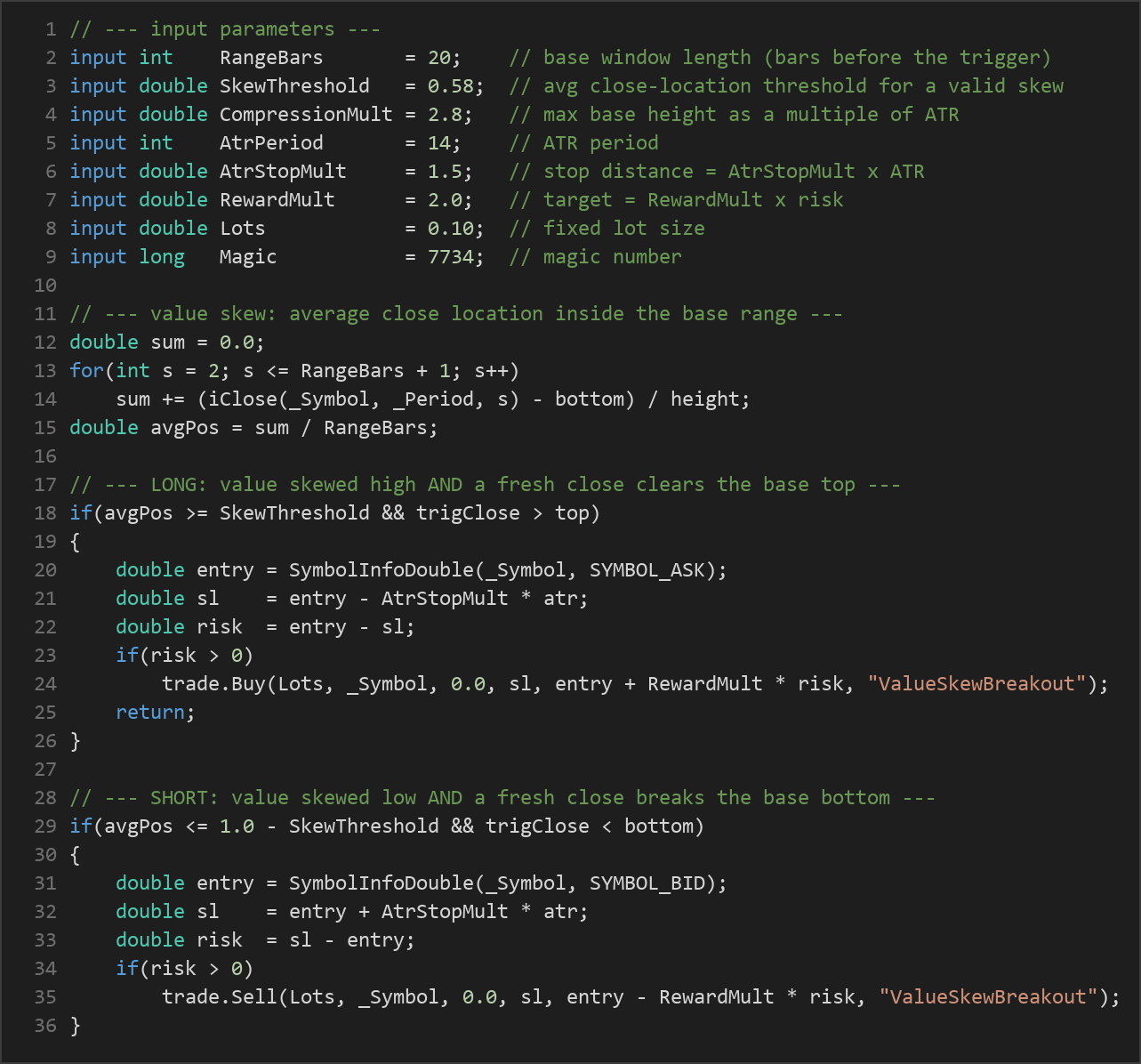
CompressionMult× ATR. This insists the breakout comes from a genuinely tight, coiled base rather than an already-extended, trending "range" that only looks like consolidation. - Measure the value skew. For every bar in the base, the strategy calculates where its close sat within the range, on a 0-to-1 scale (1.0 means the close was pinned to the very top, 0.0 means the very bottom). It then averages these positions. A high average signals accumulation; a low average signals distribution.
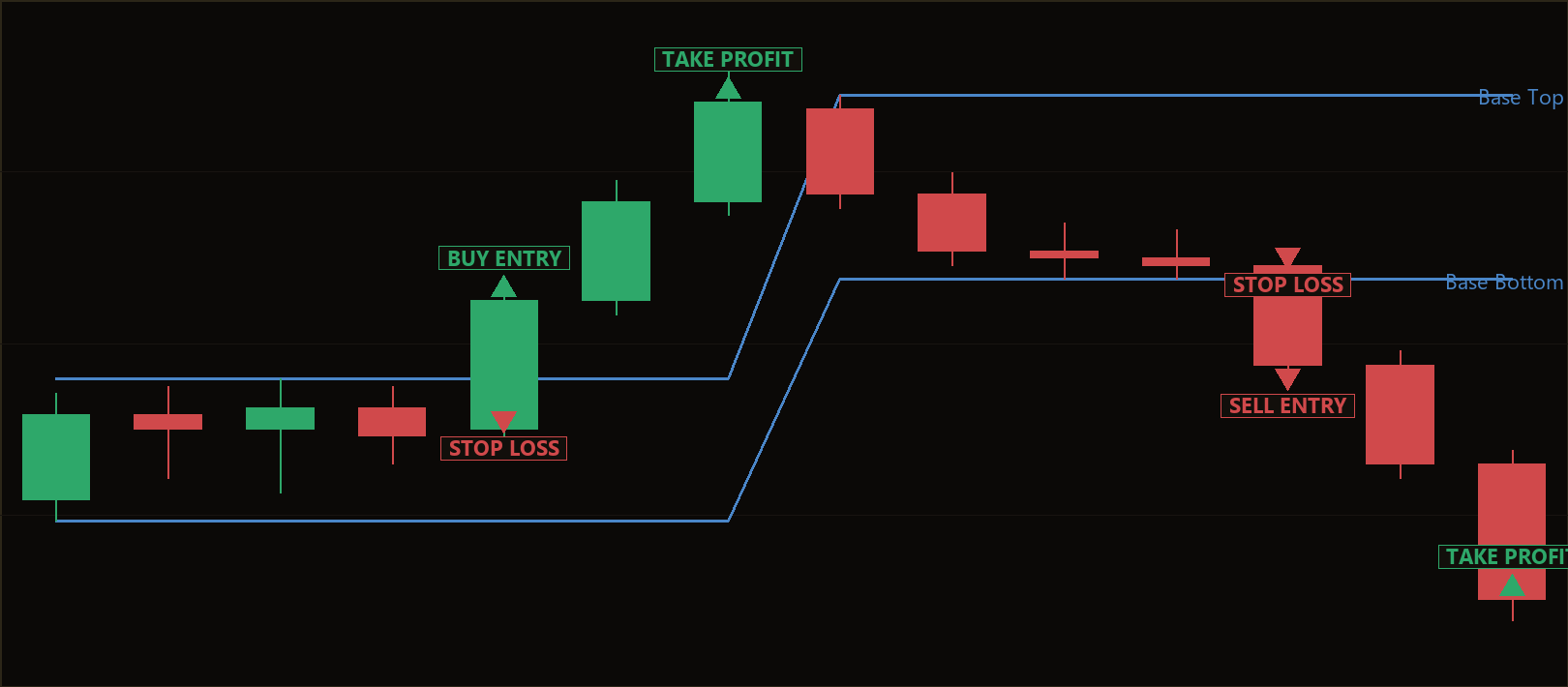
- Long entry signal. The strategy signals a long when the average close location is at or above
SkewThreshold(value skewed high) and the freshly closed trigger bar closes above the base top. The break is considered backed by prior accumulation. - Short entry signal. The strategy signals a short when the average close location is at or below
1 − SkewThreshold(value skewed low) and the trigger bar closes below the base bottom. - Stop-loss logic. For a long, the stop is placed
AtrStopMult× ATR below the entry price; for a short, the same distance above. Because the stop is tied to ATR, risk automatically adapts to current volatility. - Take-profit logic. The target is set at
RewardMulttimes the measured risk (the distance from entry to stop). With the default reward multiple of 2.0, the target sits twice as far from entry as the stop, aiming for a 2:1 reward-to-risk structure. - Trade management. Only one position per magic number is allowed at a time. Once a trade is open, the fixed ATR stop-loss and take-profit manage it to completion — there is no additional trailing or scaling logic.
Strategy Parameters
| Parameter | Default | Min | Max | Description |
|---|---|---|---|---|
| RangeBars | 20 | 8 | 60 | Number of bars in the base window analyzed before the trigger bar. |
| SkewThreshold | 0.58 | 0.52 | 0.80 | Minimum average close-location required to confirm a valid value skew. Higher values demand a more one-sided base. |
| CompressionMult | 2.8 | 1.0 | 6.0 | Maximum allowed base height as a multiple of ATR; the compression filter for a tight base. |
| AtrPeriod | 14 | 5 | 40 | Lookback period for the ATR volatility calculation. |
| AtrStopMult | 1.5 | 0.5 | 4.0 | Stop-loss distance as a multiple of ATR. |
| RewardMult | 2.0 | 0.5 | 6.0 | Take-profit distance as a multiple of the trade's risk (entry-to-stop distance). |
| Lots | 0.10 | 0.01 | 1.0 | Fixed trade size in lots. |
Recommended Chart Settings
Because every gate is derived from raw OHLC and the ATR is self-adjusting, the Value Skew Breakout is designed to run on whatever single timeframe the backtest selects rather than being locked to one specific chart. That said, breakout logic of this type is commonly studied on the H1 (1-hour) timeframe, where bases form clearly and volatility is meaningful without being erratic. Major forex pairs such as EUR/USD tend to produce clean consolidation-then-break structures and are a sensible starting point for study.
You should treat these as starting points, not fixed rules. Results will vary significantly across different symbols, timeframes, and market conditions, and any parameter set that looks appealing on one market may behave very differently on another. Always test on the specific instrument and timeframe you intend to study before drawing conclusions.
How to Install on MetaTrader 5
- Download the .ex5 file from the link below.
- Copy it to your MT5
MQL5\Expertsfolder. - Restart MetaTrader 5 or refresh the Navigator panel.
- Drag the EA onto a chart matching the recommended symbol and timeframe.
- Configure the input parameters and enable Algo Trading.
What to Consider Before Using This EA
The main strength of the Value Skew Breakout is its confirmation layer. A naive range breakout takes every break regardless of context, and it can be repeatedly chopped up by fake-outs. By requiring the break to agree with the prior accumulation or distribution footprint, this approach historically aims to skip some of the lowest-quality signals. The ATR-based compression gate adds a second filter, insisting the base is genuinely tight, and the ATR-scaled stops mean risk adapts to volatility rather than using a fixed pip distance.
There are real limitations to understand. Breakout systems by nature perform best in markets that consolidate and then trend cleanly; in persistently choppy or news-driven conditions, breaks can reverse quickly and the fixed stop may be hit before the target. The skew filter reduces some false signals but also means the strategy will pass on many breaks entirely — it trades selectively, which can lead to long quiet periods. Because there is only a fixed stop and target with no trailing logic, the strategy cannot lock in partial gains if a move stalls midway. Finally, any strategy tuned to look good on historical data may not repeat that behavior going forward, so the value skew concept should be studied and validated, not assumed.
Risk Management Tips
Sound risk management matters more than any single signal. Consider these general principles as part of your education:
- Risk a small fixed percentage per trade. Many educators suggest risking no more than 1–2% of account equity on any single position, so that a string of losses does not threaten your capital.
- Size positions to your stop, not the other way around. Let the ATR-based stop distance and your risk percentage determine the lot size, rather than picking a lot size first.
- Practice on a demo account first. Run the strategy in a risk-free simulated environment until you understand how it behaves across different conditions.
- Understand drawdown. Every strategy experiences losing streaks. Study the depth and duration of drawdown you would be prepared to tolerate before committing any real capital.
- Avoid over-optimization. Curve-fitting parameters to past data can produce results that fall apart in live conditions. Prefer robust settings that work reasonably across a range of values.
Risk Warning
Trading foreign exchange, CFDs, and other leveraged financial instruments involves substantial risk of loss and is not suitable for all investors. The strategies and tools discussed on this page are provided for educational purposes only and do not constitute financial advice, investment recommendations, or solicitation to trade. Always consult a qualified financial adviser before making trading decisions. Past backtest performance is not indicative of future results.
Downloads
- Expert Advisor: ValueSkewBreakout.ex5 (61 downloads)
- Source Code: ValueSkewBreakout.mq5 (58 downloads)
- Documentation: ValueSkewBreakout.pdf (56 downloads)