Disclaimer: This article is for educational and informational purposes only. It does not constitute financial or investment advice. Trading forex and CFDs carries significant risk of loss. Past performance of any strategy — including backtests — does not guarantee future results. Never trade with money you cannot afford to lose.
What Is This Strategy?
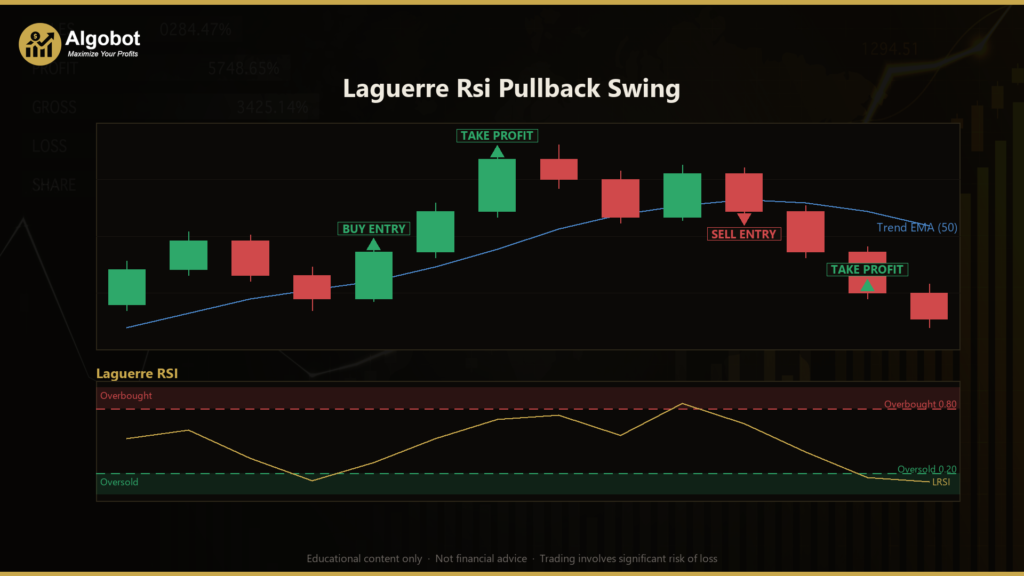
The Laguerre Rsi Pullback Swing strategy is a trend-following swing system that uses John Ehlers' Laguerre RSI — a low-lag momentum oscillator — to time entries during pullbacks. A Laguerre RSI (LRSI) is built from a four-stage Laguerre polynomial filter, a smoothing technique that responds to price turns much faster than the traditional Wilder RSI while producing a clean line that stays bounded between 0 and 1. In this strategy, that fast-reacting oscillator is not used to fade the trend, but to find well-timed re-entry points within an existing trend.
The core idea is to combine two ideas that traders often treat as opposites: trend-following and mean-reversion timing. A longer Exponential Moving Average (EMA) — a moving average that weights recent prices more heavily — defines the prevailing direction of the market. The Laguerre RSI then acts as a "pullback timer," signalling the moment a temporary dip (in an uptrend) or a temporary rally (in a downtrend) appears to be turning back in the direction of the larger trend. In plain terms, the strategy is designed to buy dips in uptrends and sell rallies in downtrends.
This makes the strategy most relevant as a learning tool for traders who want to study swing trading in trending markets and understand how oscillators can be adapted from reversal tools into continuation tools. It is best suited to those who already understand basic order mechanics and want to explore how an adaptive filter, a trend filter, and volatility-based risk framing fit together in a single automated system. It is not designed for choppy, directionless markets, and it should be approached as a study in strategy design rather than a shortcut to results.
How It Works
The strategy processes one completed bar at a time on a single primary timeframe. On each newly closed bar it advances the Laguerre filter, updates its trend and volatility context, and then checks whether an entry condition is met. Here is what happens step by step:
- Trend definition (the context): The strategy calculates an EMA over the
TrendPeriod. If the latest close is above the EMA, the market is treated as an uptrend and only long (buy) setups are considered. If the close is below the EMA, it is treated as a downtrend and only short (sell) setups are considered. - Oscillator calculation: The Laguerre RSI is recomputed on each closed bar using the
Gammadamping factor. A higher gamma makes the filter smoother and slower; a lower gamma makes it more responsive. The result is a value between 0 (deeply oversold) and 1 (deeply overbought). - Long entry signal: In an uptrend, the strategy signals a buy when the Laguerre RSI reclaims the oversold band from below — that is, the previous bar's LRSI was under the
OversoldLeveland the current bar's LRSI has risen back to or above it. This may indicate that a dip has stopped falling and is turning back up in the direction of the uptrend. - Short entry signal: In a downtrend, the strategy signals a sell when the Laguerre RSI rolls over back through the overbought band from above — the previous bar's LRSI was above the
OverboughtLeveland the current bar's LRSI has dropped back to or below it. This may indicate that a counter-trend rally is fading. - Stop-loss logic: Risk is framed with the Average True Range (ATR), a measure of recent volatility. For a long trade, the stop-loss is placed at the entry price minus
ATR × AtrStopMult. For a short trade, it is the entry price plus the same distance. This lets the stop widen in volatile conditions and tighten in calm ones. - Take-profit logic: The target is set as a multiple of the risk distance. The take-profit sits at
ATR × AtrStopMult × RewardRatioaway from entry, so with the defaultRewardRatioof 1.5 the strategy historically aims for 1.5 units of reward for every 1 unit of risk. - One position at a time: The strategy holds only a single open position per magic number at once. It will not stack new trades while an existing one is running, which keeps exposure controlled and the logic easy to study.
Because signals are evaluated only on completed bars, the system avoids reacting to the noise of an unfinished, still-forming candle.

Strategy Parameters
| Parameter | Default | Min | Max | Description |
|---|---|---|---|---|
| Gamma | 0.50 | 0.40 | 0.85 | Laguerre filter damping factor. Higher values smooth the oscillator more but add lag; lower values make it more responsive. |
| OversoldLevel | 0.20 | 0.10 | 0.35 | The LRSI band that defines "oversold." A reclaim of this level in an uptrend triggers a long signal. |
| OverboughtLevel | 0.80 | 0.65 | 0.90 | The LRSI band that defines "overbought." A drop back through this level in a downtrend triggers a short signal. |
| TrendPeriod | 50 | 20 | 120 | Lookback period for the trend EMA that defines up- versus down-trend context. |
| AtrPeriod | 14 | 7 | 30 | Lookback period for the ATR used to size stops and targets. |
| AtrStopMult | 2.0 | 1.0 | 4.0 | Multiplier applied to ATR to set the stop-loss distance from entry. |
| RewardRatio | 1.5 | 1.0 | 3.0 | Reward-to-risk multiple that sets the take-profit distance relative to the stop. |
| Lots | 0.10 | 0.01 | 1.0 | Fixed trade volume in lots for each position. |

Recommended Chart Settings
The Laguerre Rsi Pullback Swing strategy is built for a single primary timeframe and applies its trend and volatility filters to that one chart. As a swing-oriented system, it is generally most coherent on intermediate timeframes such as the H1 or H4 charts, where trends persist long enough for the EMA filter to be meaningful and pullbacks are large enough to time. Liquid instruments with clean trends — such as major forex pairs (for example EUR/USD or GBP/USD) — are a reasonable starting point for study.
That said, the default parameters are just a baseline. The behaviour of the Laguerre RSI, the EMA trend filter, and the ATR stops will all vary considerably across different symbols, timeframes, and market regimes. Always test any configuration on your own data before drawing conclusions, and expect that results will differ from one market condition to the next.
How to Install on MetaTrader 5
- Download the .ex5 file from the link below
- Copy it to your MT5
MQL5\Expertsfolder - Restart MetaTrader 5 or refresh the Navigator panel
- Drag the EA onto a chart matching the recommended symbol and timeframe
- Configure the input parameters and enable Algo Trading
What to Consider Before Using This EA
Every strategy involves trade-offs, and understanding them is more valuable than any single parameter set. Here is a balanced view of the Laguerre Rsi Pullback Swing approach.
Strengths. The Laguerre RSI is genuinely low-lag compared with a classic RSI, so its band crossings tend to arrive earlier and with less whipsaw noise. Pairing it with an EMA trend filter is a sensible design choice: by only buying dips in uptrends and selling rallies in downtrends, the strategy attempts to align its entries with the larger flow of the market rather than fighting it. The ATR-based stop and reward-multiple target give the system a consistent, volatility-aware risk framework instead of fixed pip distances that ignore market conditions.
Known limitations. The greatest weakness of any trend-plus-pullback system is the ranging or choppy market. When price oscillates around the EMA with no real direction, the trend filter can flip back and forth, and the oscillator can generate band crossings that lead nowhere — producing a series of small losses. The Laguerre filter's Gamma setting is also a balance: too smooth and signals arrive late; too responsive and false crossings increase. Because the strategy takes only one position at a time and enters on the close of a bar, it can also miss fast moves that complete within a single candle.
Where it may underperform. Expect weaker behaviour during low-volatility consolidation, around major news releases where ATR-based stops may be jumped by gaps, and in strongly mean-reverting instruments where "trends" are short-lived. The strategy assumes trends persist long enough for a pullback to resolve in the trend's favour — an assumption that does not hold in every market. Treat it as one analytical lens, not a complete trading system.
Risk Management Tips
Sound risk management matters far more than any single indicator setting. Whatever you are studying, keep these general principles in mind:
- Risk a small, fixed fraction per trade. A common educational guideline is to risk no more than 1–2% of account equity on any single position. The
Lotsparameter is a fixed volume, so consider how that translates into real currency risk given your stop distance and account size. - Understand your drawdown tolerance. Even a well-designed strategy will experience losing streaks. Study the maximum peak-to-trough decline (drawdown) a configuration produces historically before committing to it, and ask whether you could sit through that calmly.
- Start on a demo account. Run the strategy on a demo or simulated environment first so you can observe how it behaves across different sessions and market conditions without financial risk.
- Size positions deliberately. Match your lot size to your account, not to your ambitions. Larger positions amplify both gains and losses, and over-sizing is one of the most common ways traders damage an account.
- Respect the stop-loss. The ATR-based stop exists to define your risk before you enter. Avoid the temptation to widen or remove it mid-trade, which converts a planned small loss into an unplanned large one.
- Test before you trust. Backtest and forward-test any parameter changes on your own data. Historical behaviour is a study aid, not a promise about the future.
Risk Warning
Trading foreign exchange, CFDs, and other leveraged financial instruments involves substantial risk of loss and is not suitable for all investors. The strategies and tools discussed on this page are provided for educational purposes only and do not constitute financial advice, investment recommendations, or solicitation to trade. Always consult a qualified financial adviser before making trading decisions. Past backtest performance is not indicative of future results.
Downloads
- Expert Advisor: LaguerreRsiPullbackSwing.ex5 (42 downloads)
- Source Code: LaguerreRsiPullbackSwing.mq5 (45 downloads)
- Documentation: LaguerreRsiPullbackSwing.pdf (58 downloads)