Disclaimer: This article is for educational and informational purposes only. It does not constitute financial or investment advice. Trading forex and CFDs carries significant risk of loss. Past performance of any strategy — including backtests — does not guarantee future results. Never trade with money you cannot afford to lose.
What Is This Strategy?
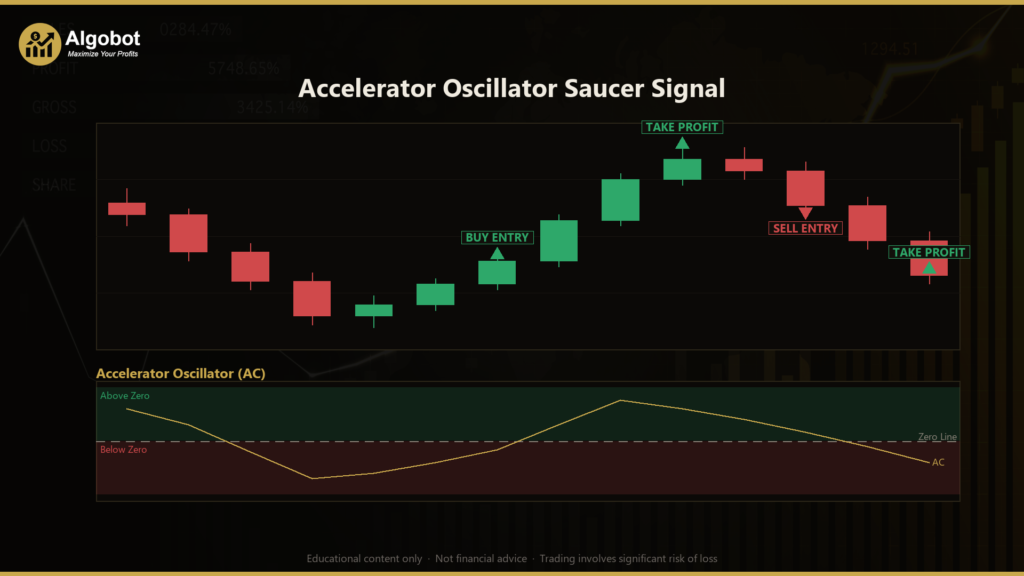
The Accelerator Oscillator Saucer Signal is a momentum-based trading strategy built around Bill Williams' Accelerator Oscillator (AC), traded with its authentic "saucer" entry pattern rather than a simple zero-line crossover. The Accelerator Oscillator is a technical indicator that measures the rate of change of momentum — in other words, whether market momentum is speeding up or slowing down. Because acceleration turns before price and even before momentum itself, the AC is often used to spot a fresh burst of directional energy earlier than trend-following tools.
To understand the AC, you first need the Awesome Oscillator (AO), which measures raw momentum as the difference between a fast and a slow simple moving average of the median price (High + Low) / 2. The Accelerator then takes this one step further: AC = AO − SMA(AO, Signal). Subtracting AO's own recent average leaves you with a reading of how quickly momentum is changing. When the AC begins printing consecutive same-direction bars — the "saucer" — it may indicate that a new acceleration phase is forming.
This strategy is designed as a learning tool for traders who want to study how acceleration-based signals behave in momentum-driven markets. It is best suited to those already familiar with oscillators who want to explore a more nuanced, asymmetric signal model. It is not a shortcut or a profit opportunity — it is a structured, rules-based framework for studying how the market's rate-of-momentum-change can be turned into repeatable entry logic.
How It Works
The strategy evaluates signals only once per newly closed bar, so it never acts on the still-forming candle. On each closed bar it computes the Accelerator Oscillator at the four most recent closed bars (labelled AC0 for the latest, then AC1, AC2, AC3 going back in time) and checks for a saucer pattern. Bill Williams' rule is deliberately asymmetric to whether the AC agrees with the intended trade direction.
Long entry conditions — the strategy signals a potential buy when either:
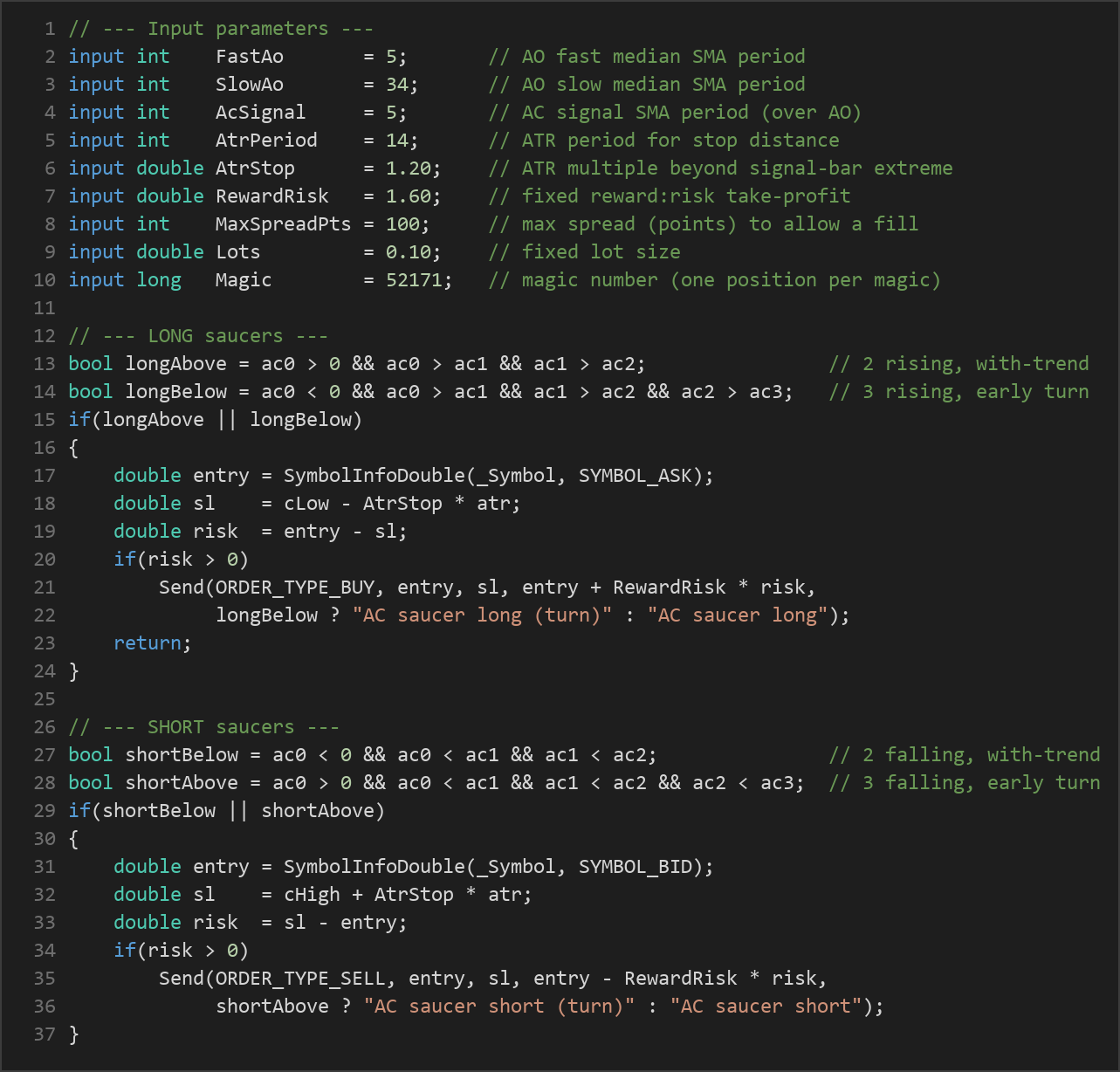
- Above-zero saucer (with-trend): AC is above zero and rising over the last two bars (
AC0 > 0andAC0 > AC1 > AC2). Only two rising bars are needed because momentum is already re-accelerating in the trade's favor. - Below-zero saucer (early turn): AC is still below zero but has risen over three consecutive bars (
AC0 < 0andAC0 > AC1 > AC2 > AC3). Three bars are required here — a deeper saucer — to confirm an early acceleration turn before the zero line is even reclaimed. This extra bar acts as a whipsaw filter for the more speculative counter-trend read.
Short entry conditions mirror this exactly:
- Below-zero saucer (with-trend): AC is below zero and falling over two bars (
AC0 < 0andAC0 < AC1 < AC2). - Above-zero saucer (early turn): AC is above zero but falling over three consecutive bars (
AC0 > 0andAC0 < AC1 < AC2 < AC3).
Stop-loss logic: Once a signal fires, the strategy places a protective stop just beyond the signal bar's extreme. For a long, the stop sits below the signal bar's low by a multiple of the Average True Range (ATR) — a volatility measure of the average bar range. For a short, the stop sits above the signal bar's high by the same ATR multiple. Anchoring the stop to recent volatility helps it adapt to calm and turbulent conditions alike.
Take-profit logic: The take-profit is set at a fixed reward-to-risk multiple of the stop distance. If the risk (entry to stop) is a certain number of pips, the target is placed that many pips times the reward:risk ratio in the profitable direction. The stop-loss and take-profit fully manage the exit — there is no discretionary intervention.
Trade management filters:
- Only one position per Magic number is allowed at a time, so the strategy never stacks trades on the same signal source.
- A spread filter blocks entries when the current spread exceeds a set maximum, keeping simulated and live fills realistic.
Strategy Parameters
| Parameter | Default | Min | Max | Description |
|---|---|---|---|---|
| FastAo | 5 | 3 | 15 | Period of the fast median-price SMA inside the Awesome Oscillator. |
| SlowAo | 34 | 20 | 60 | Period of the slow median-price SMA inside the Awesome Oscillator. |
| AcSignal | 5 | 3 | 15 | Period of the signal SMA applied to AO to derive the Accelerator. |
| AtrPeriod | 14 | 5 | 50 | Lookback period for the ATR used to size the stop distance. |
| AtrStop | 1.20 | 0.30 | 4.00 | ATR multiple placed beyond the signal bar's high/low for the stop. |
| RewardRisk | 1.60 | 0.50 | 4.00 | Fixed reward-to-risk ratio that sets the take-profit distance. |
| MaxSpreadPts | 100 | 5 | 400 | Maximum spread (in points) allowed before a trade is skipped. |
| Lots | 0.10 | 0.01 | 1.00 | Fixed lot size for each position. |
| Magic | 52171 | 0 | 9,999,999 | Unique identifier so the EA manages only its own trades. |
Recommended Chart Settings
The Accelerator Oscillator Saucer Signal was designed with momentum-driven FX majors in mind — pairs such as EUR/USD and GBP/USD — as well as major stock indices. The intended timeframes are M15 to H1, where acceleration signals tend to be frequent enough to study but not so noisy that the saucer pattern loses meaning.
The Expert Advisor reads only the primary timeframe of the chart it is attached to, so it will run on whatever timeframe your backtest or chart selects. As with any oscillator-based approach, results will vary considerably across different symbols, sessions, and market regimes. Trending, momentum-rich conditions are where an acceleration signal is most likely to shine, while quiet, range-bound periods may produce more false starts. Treat the recommended settings as a starting point for study, not a guaranteed configuration.
How to Install on MetaTrader 5
- Download the
.ex5file from the link below. - Copy it to your MT5
MQL5\Expertsfolder. - Restart MetaTrader 5 or refresh the Navigator panel.
- Drag the EA onto a chart matching the recommended symbol and timeframe.
- Configure the input parameters and enable Algo Trading.
What to Consider Before Using This EA
The main strength of this approach is its use of a leading momentum concept. Because acceleration changes before price and before momentum, the saucer can flag a shift earlier than a value-based or zero-cross system. The asymmetric rule — two bars with-trend, three bars counter-trend — is a thoughtful attempt to balance early entry against the whipsaws those early reads usually cost. Anchoring stops to ATR and using a fixed reward:risk target also imposes disciplined, mechanical exits.
That said, the Accelerator Oscillator has well-known limitations. As a derivative of a derivative, it is sensitive to noise and can generate frequent signals in choppy conditions, where saucers form and dissolve without a real move following. Any counter-trend, "early turn" entry is inherently speculative — the three-bar filter reduces but does not eliminate false signals. In sideways or low-volatility markets, the strategy may underperform, giving back small losses as stops are hit before momentum genuinely develops. It also holds only one position at a time and relies entirely on its stop and target, so it does not adapt to news shocks or sudden regime changes beyond the ATR-based stop.
The honest takeaway: this is a well-structured framework for studying acceleration signals, not a set-and-forget system. Its behavior depends heavily on parameter choices and market conditions, and it should be tested thoroughly before any consideration of live use.
Risk Management Tips
Sound risk management matters more than any single indicator. As you study this strategy, keep these general principles in mind:
- Position sizing: Size trades so that a single loss is a small fraction of your account. Many educators suggest risking no more than 1–2% of account equity per trade.
- Test on a demo account first: Run the EA on a demo or in the Strategy Tester for an extended period before risking any real capital, so you can observe how it behaves across varied conditions.
- Understand drawdown: Every strategy experiences losing streaks. Study the historical drawdown so you know what a normal run of losses looks like and can stay disciplined through it.
- Don't over-optimize: Tuning parameters to fit past data ("curve-fitting") often produces results that fail to hold up going forward. Prefer robust settings that work reasonably across ranges.
- Trade only what you can afford to lose: Leverage magnifies both gains and losses. Never commit funds you need for living expenses.
Risk Warning
Trading foreign exchange, CFDs, and other leveraged financial instruments involves substantial risk of loss and is not suitable for all investors. The strategies and tools discussed on this page are provided for educational purposes only and do not constitute financial advice, investment recommendations, or solicitation to trade. Always consult a qualified financial adviser before making trading decisions. Past backtest performance is not indicative of future results.
Downloads
- Expert Advisor: AcceleratorOscillatorSaucerSignal.ex5 (35 downloads)
- Source Code: AcceleratorOscillatorSaucerSignal.mq5 (37 downloads)
- Documentation: AcceleratorOscillatorSaucerSignal.pdf (35 downloads)