Disclaimer: This article is for educational and informational purposes only. It does not constitute financial or investment advice. Trading forex and CFDs carries significant risk of loss. Past performance of any strategy — including backtests — does not guarantee future results. Never trade with money you cannot afford to lose.
What Is This Strategy?
The Traders Dynamic Index Shift is a momentum-shift trading system built on the Traders Dynamic Index (TDI), a compound oscillator designed by Dean Malone. It is a trend-and-momentum style approach, meaning it tries to enter when a fresh burst of directional momentum is beginning rather than when a market is quiet and directionless. What makes this particular expert advisor (EA) distinct is that every calculation is performed on the Relative Strength Index (RSI) series itself — not on raw price. The RSI is a momentum oscillator that measures the speed and size of recent price moves on a 0–100 scale. Here, the strategy smooths the RSI, measures the volatility of the RSI, and even looks for a crossover of one RSI-derived line over another. In short, it is an "indicator-of-an-indicator" system.
The TDI produces four lines, all derived from a single RSI stream: a fast signal line (often shown green), a slow signal line (often shown red), a base line or market baseline (MBL), and a pair of volatility bands. The trade trigger is a crossover between the fast and slow RSI-smoothing lines. The regime filter — the mechanism that decides whether conditions are worth trading at all — is the width of the volatility bands around the base line. When the RSI stream is calm, those bands pinch shut, which historically corresponds to low-conviction, choppy conditions the strategy is designed to sit out.
This EA is best understood as a learning tool for traders who want to study how oscillator smoothing, midline filters, and volatility gating can be combined to reduce false signals. It is intended for educational analysis of momentum-shift logic and is not a shortcut of any kind. It suits students of technical analysis who already understand basic RSI behavior and want to explore how layering conditions changes a system's selectivity.
How It Works
The strategy evaluates its rules once per closed bar on the chart's primary timeframe — it does not react to every tick, which helps avoid acting on incomplete price information. All four TDI lines are computed from the RSI series:
- GREEN (fast signal): a short simple moving average (SMA) of the RSI — the quick, reactive momentum line.
- RED (slow signal): a longer SMA of the RSI — the smoother confirmation line.
- MBL (base line): an SMA of the RSI over the band period — the RSI's own mean, used as a regime anchor.
- BANDS (volatility): the base line plus and minus a standard-deviation multiple of the RSI. The bandwidth equals
2 × BandStdMult × StdDev(RSI).
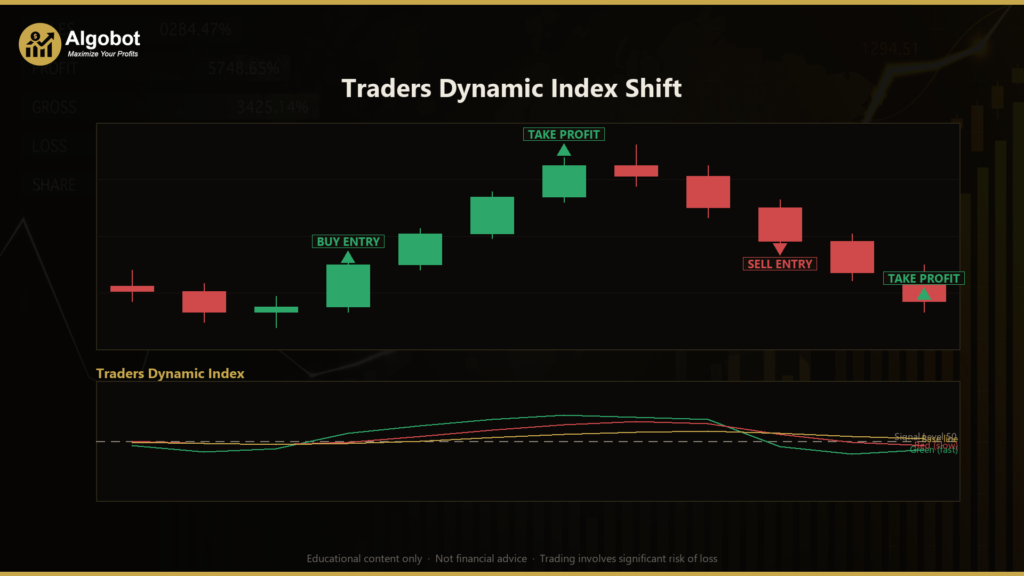
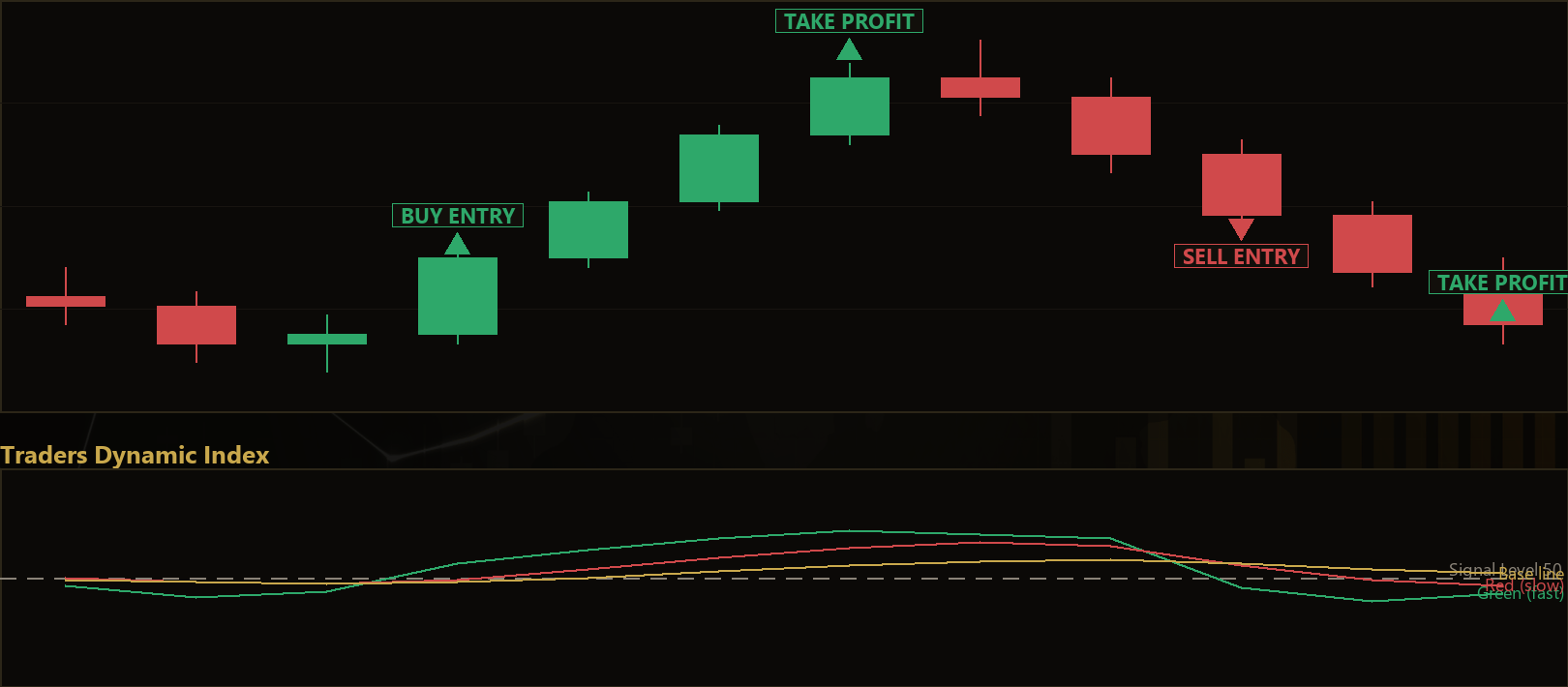
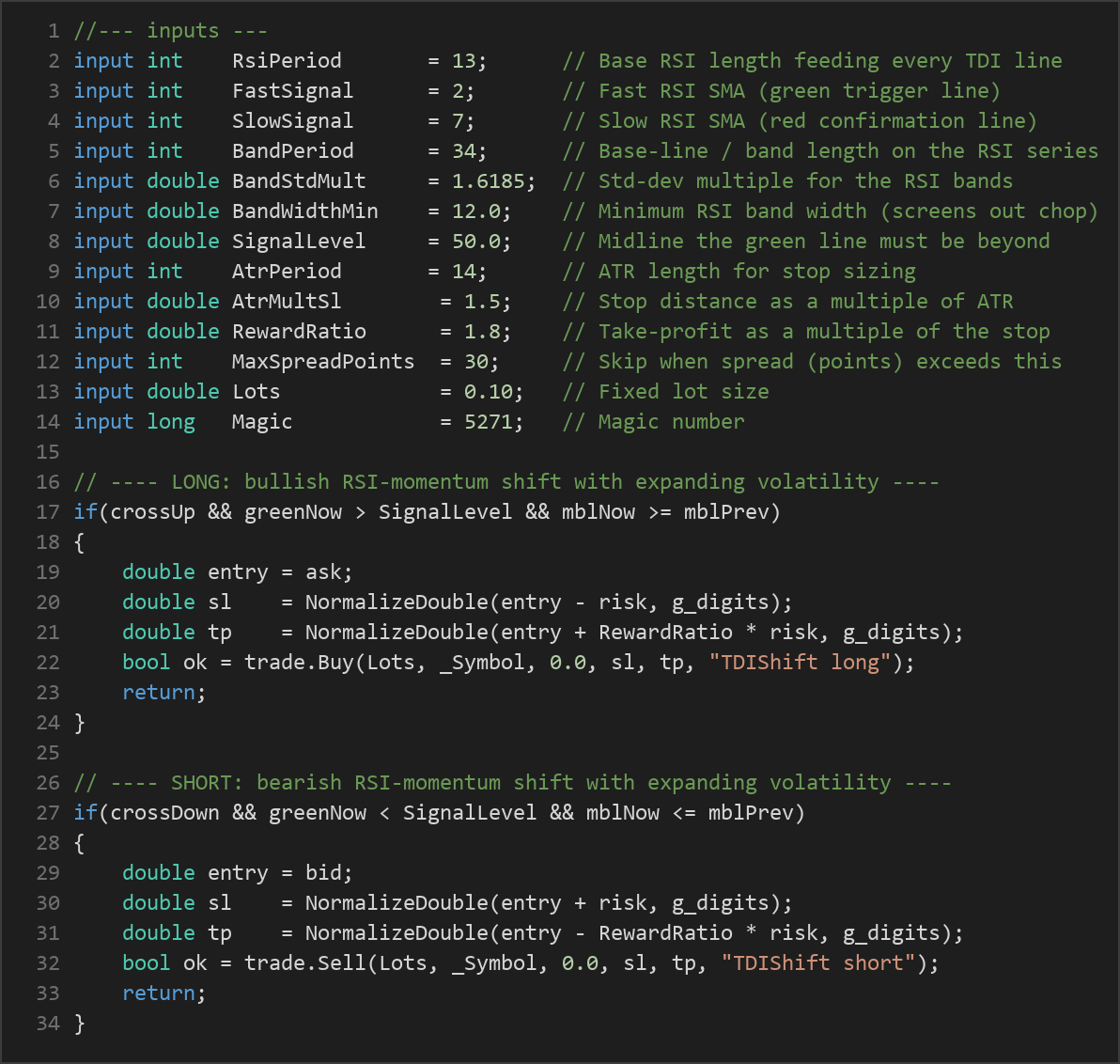
The strategy signals a long trade when all of the following line up on the just-closed bar:
- The green line crosses above the red line (a fresh bullish momentum shift).
- The green line is above the SignalLevel midline (default 50), confirming the momentum sits on the bullish half of the oscillator.
- The base line (MBL) is rising, showing the RSI's own regime agrees with the impulse.
- The bandwidth is at least BandWidthMin, confirming RSI volatility has expanded enough to suggest a real move rather than noise.
The strategy signals a short trade on the mirror image: green crosses below red, green is below the midline, the base line is falling, and the bandwidth still meets the minimum threshold.
Exit, stop-loss, and take-profit logic are all handled by an ATR-based bracket attached at entry. The Average True Range (ATR) measures recent price volatility and lets the risk distance scale automatically to any symbol or timeframe:
- The stop-loss is placed
AtrMultSlATRs away from the entry price. - The take-profit is set at
RewardRatiomultiplied by that stop distance, giving a fixed reward-to-risk ratio. - Only one position per magic number is allowed — the strategy does not stack or add to trades. Once a position is open, the bracket manages the exit and no new entry is taken until it closes.
Two additional gates protect entries: a spread filter skips signals when the current spread exceeds MaxSpreadPoints, and the fast period is always forced to be strictly faster than the slow period so the crossover remains meaningful.
Strategy Parameters
| Parameter | Default | Min | Max | Description |
|---|---|---|---|---|
| RsiPeriod | 13 | 7 | 34 | Base RSI length that feeds every TDI line. |
| FastSignal | 2 | 1 | 9 | Fast RSI moving average — the green trigger line. |
| SlowSignal | 7 | 3 | 21 | Slow RSI moving average — the red confirmation line. |
| BandPeriod | 34 | 14 | 60 | Base-line and band length on the RSI series (the MBL and band midpoint). |
| BandStdMult | 1.6185 | 1.0 | 2.5 | Standard-deviation multiple for the RSI volatility bands. |
| BandWidthMin | 12.0 | 0.0 | 40.0 | Minimum RSI band width required — screens out flat, low-conviction chop. |
| SignalLevel | 50.0 | 40.0 | 60.0 | Midline the green line must be beyond (bullish above, bearish below). |
| AtrPeriod | 14 | 5 | 40 | ATR length used for stop sizing. |
| AtrMultSl | 1.5 | 0.5 | 4.0 | Stop distance as a multiple of ATR. |
| RewardRatio | 1.8 | 0.8 | 4.0 | Take-profit distance as a multiple of the stop distance. |
| MaxSpreadPoints | 30 | 1 | 200 | Skip signals when the current spread (points) exceeds this. |
| Lots | 0.10 | 0.01 | 1.00 | Fixed lot size per trade. |
| Magic | 5271 | 0 | 9,999,999 | Magic number identifying this EA's positions. |
Recommended Chart Settings
This strategy was designed with a trending major currency pair in mind, such as EURUSD or GBPUSD, on the M15 to H1 timeframes, using a momentum trading style. These conditions tend to offer the kind of clean directional impulses the TDI crossover logic is built to detect, along with reasonable spreads that pass the spread filter. That said, every market behaves differently, and results will vary considerably across symbols, timeframes, brokers, and changing market conditions. Treat the recommended settings as a starting point for study and testing — not as a fixed prescription. Always evaluate behavior on a demo account before drawing any conclusions.
How to Install on MetaTrader 5
- Download the
TradersDynamicIndexShift.ex5file from the link below. - Copy it to your MT5
MQL5\Expertsfolder. - Restart MetaTrader 5 or refresh the Navigator panel.
- Drag the EA onto a chart matching the recommended symbol and timeframe.
- Configure the input parameters and enable Algo Trading.
What to Consider Before Using This EA
The core strength of this approach is selectivity. A lone RSI green/red crossover fires constantly and gets chopped to pieces in flat markets. By demanding four independent conditions — the crossover, the correct side of the midline, an agreeing base-line slope, and expanding RSI volatility — on the same closed bar, the strategy filters out a large share of the false flips that make simple oscillator crosses unreliable. The ATR-based bracket is another sensible feature: it self-scales risk to each instrument and enforces a defined reward-to-risk ratio on every trade.
The limitations are equally important to understand. Because the system is deliberately choosy, it will stay out of many moves, and in strongly ranging or slowly grinding markets the bandwidth filter may keep it flat for long stretches. Requiring multiple conditions to align can also mean entries arrive after the first leg of a move has already occurred, since confirmation takes time. Like all crossover systems, it can suffer whipsaws when momentum stalls right after a signal, and a fixed take-profit ratio may cut winners short during extended trends. This EA is best viewed as a framework for understanding how filters interact — not as a finished, market-ready product.
Risk Management Tips
Sound risk management matters far more than any single entry rule. Consider these general principles as you study this strategy:
- Position sizing: Keep each position small relative to your account. A common educational guideline is to risk no more than 1–2% of account equity per trade.
- Use a demo account first: Test the EA thoroughly in a risk-free demo environment until you understand how it behaves across different conditions before considering any live use.
- Understand drawdown: Every strategy experiences losing streaks. Study the depth and length of drawdowns so you know what you may need to tolerate emotionally and financially.
- Respect the stop-loss: The ATR-based stop is central to this system's design. Disabling or widening it removes the very mechanism that caps risk on each trade.
- Diversify your study: Avoid concentrating all of your testing and capital on a single symbol or setting.
Risk Warning
Trading foreign exchange, CFDs, and other leveraged financial instruments involves substantial risk of loss and is not suitable for all investors. The strategies and tools discussed on this page are provided for educational purposes only and do not constitute financial advice, investment recommendations, or solicitation to trade. Always consult a qualified financial adviser before making trading decisions. Past backtest performance is not indicative of future results.
Downloads
- Expert Advisor: TradersDynamicIndexShift.ex5 (50 downloads)
- Source Code: TradersDynamicIndexShift.mq5 (47 downloads)
- Documentation: TradersDynamicIndexShift.pdf (58 downloads)