Disclaimer: This article is for educational and informational purposes only. It does not constitute financial or investment advice. Trading forex and CFDs carries significant risk of loss. Past performance of any strategy — including backtests — does not guarantee future results. Never trade with money you cannot afford to lose.
What Is This Strategy?
The Wave Trend Cross Reversion strategy is a mean-reversion trading system built around the WaveTrend oscillator, a momentum indicator popularized by the TradingView author "LazyBear." A mean-reversion approach assumes that when price stretches too far from its recent average, it tends to snap back — and the WaveTrend oscillator is used here to measure how stretched, or "exhausted," momentum has become. Rather than relying on a stock indicator library, this strategy hand-builds WaveTrend from raw price bars using a chain of exponential moving averages (EMAs) and a mean-absolute-deviation normalization, which makes it mathematically distinct from more familiar oscillators such as RSI, CCI, or Stochastic.
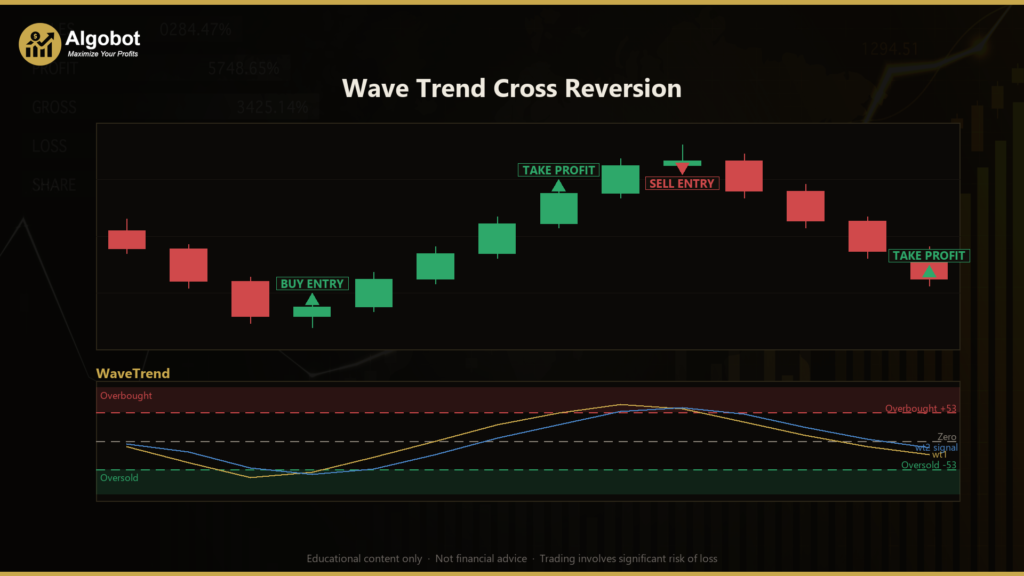
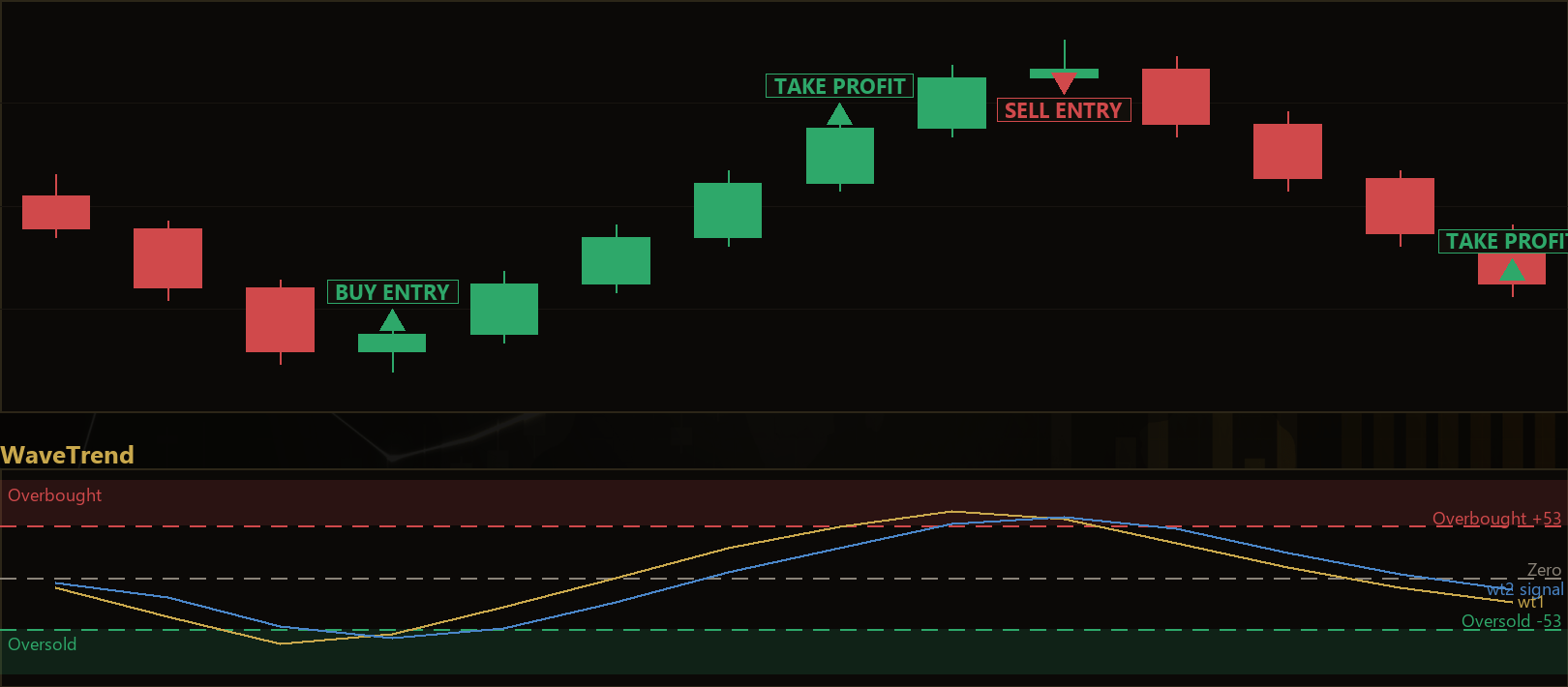
The oscillator swings above and below a zero line. When it pushes into deeply positive territory, buying pressure may be overextended (overbought); when it plunges into deeply negative territory, selling may be exhausted (oversold). The tradable event is a cross of two WaveTrend lines while price is inside one of these extreme zones — the classic WaveTrend "dot." In plain terms, the strategy looks for moments where a strong move appears to be running out of steam and momentum begins to turn the other way.
This system is designed for liquid, intraday reversion markets — think forex majors like EURUSD or an index such as US500 — on intermediate timeframes (roughly M5 to H1). It is best understood as a learning tool for traders who want to study oscillator construction, extreme-zone signals, and ATR-based risk brackets. It is not a shortcut of any kind, and this article frames it strictly as a strategy analysis rather than a profit opportunity.
How It Works
The strategy updates its calculations once per closed primary-timeframe bar, so signals are evaluated on completed candles rather than flickering mid-bar. The WaveTrend oscillator is rebuilt step by step as follows:
- Typical price:
ap = (High + Low + Close) / 3for the just-closed bar. - Channel centre (esa): an EMA of the typical price over
ChannelLength. - Mean absolute deviation (d): an EMA of the absolute distance between typical price and the centre line.
- Channel index (ci):
(ap − esa) / (0.015 × d)— a CCI-style normalization that scales the deviation. - WaveTrend line (wt1): an EMA of the channel index over
AverageLength. - Signal line (wt2): a simple moving average (SMA) of
wt1overSignalLength.
Once the oscillator lines are settled and warmed up, the strategy watches for crosses inside the extreme zones:
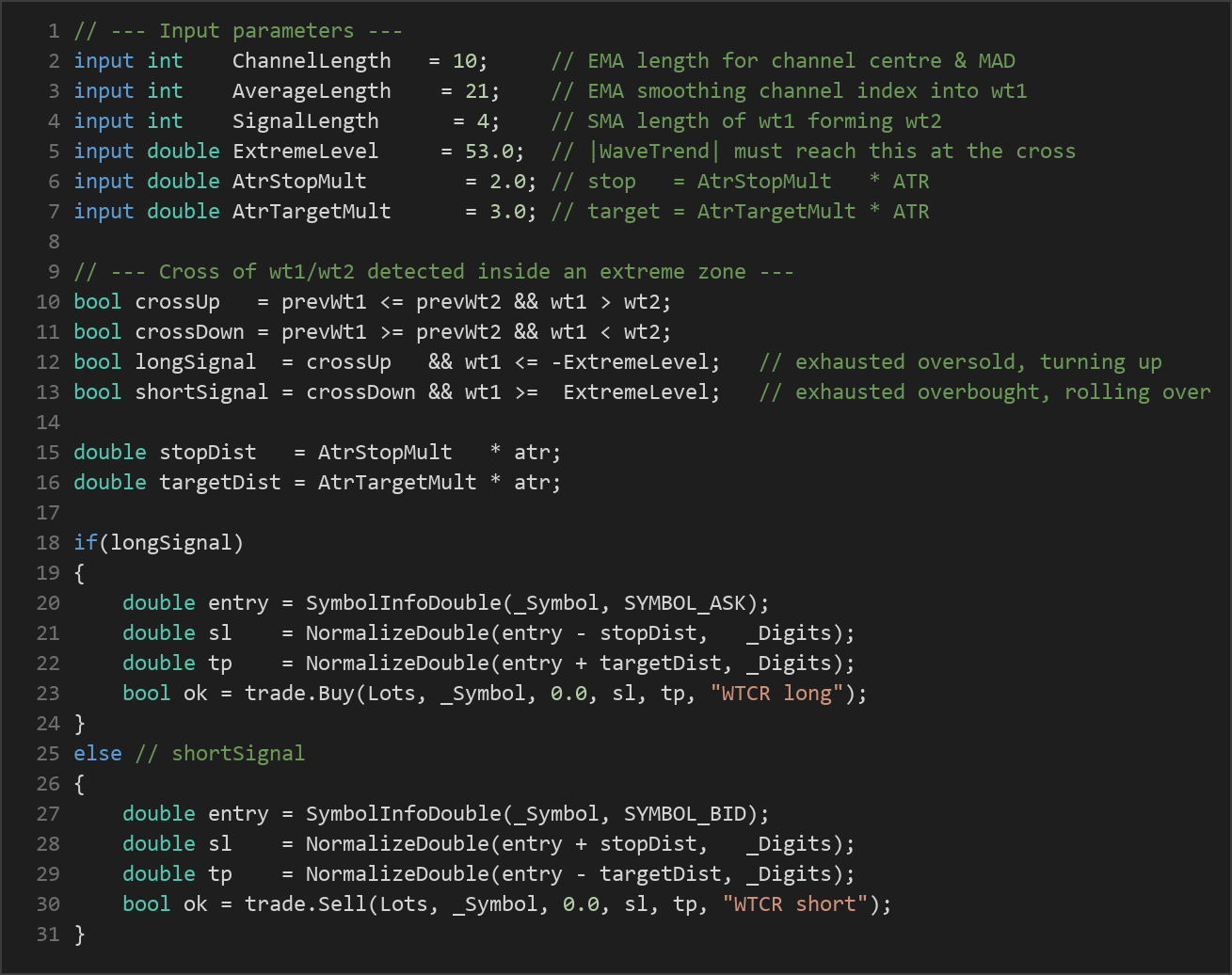
- Long signal: the strategy signals a potential buy when
wt1crosses up throughwt2whilewt1is at or below−ExtremeLevel. This may indicate that selling has become exhausted deep in oversold territory and momentum is turning up. - Short signal: the strategy signals a potential sell when
wt1crosses down throughwt2whilewt1is at or above+ExtremeLevel. This may indicate that buying has become exhausted high in overbought territory and momentum is rolling over.
The two rules are fully symmetric, with distinct long and short logic. Trade management works like this:
- One position at a time: only a single position per magic number is held. The strategy does not stack or pyramid entries.
- Stop-loss: placed at
AtrStopMult × ATRaway from entry, so the protective stop adapts to current volatility rather than using a fixed pip distance. ATR (Average True Range) measures the typical size of recent bars. - Take-profit: placed at
AtrTargetMult × ATRfrom entry, giving a volatility-scaled reward target. - Early exit on reversal: if an opposite extreme cross appears before either the stop or target is hit, the open position is closed. This treats a fresh momentum flip as a reason to step aside.
- Spread filter: new entries are skipped when the current spread is wider than
MaxSpreadPoints, helping avoid trading in poor liquidity conditions.
Strategy Parameters
| Parameter | Default | Min | Max | Description |
|---|---|---|---|---|
| ChannelLength | 10 | 5 | 21 | EMA length for the channel centre line (esa) and its mean-absolute-deviation (d). Shorter values react faster; longer values smooth more. |
| AverageLength | 21 | 8 | 40 | EMA length that smooths the channel index into the main WaveTrend line (wt1). |
| SignalLength | 4 | 2 | 8 | SMA length of wt1 that forms the signal line (wt2) used for cross detection. |
| ExtremeLevel | 53.0 | 30.0 | 80.0 | The absolute WaveTrend reading required at the cross for a signal to count. Higher values demand more extreme exhaustion. |
| AtrPeriod | 14 | 7 | 30 | Lookback length for the ATR used to size stops and targets. |
| AtrStopMult | 2.0 | 1.0 | 4.0 | Stop-loss distance as a multiple of ATR. |
| AtrTargetMult | 3.0 | 1.0 | 6.0 | Take-profit distance as a multiple of ATR. |
| MaxSpreadPoints | 60 | 5 | 300 | Maximum allowed spread (in points) for opening a new position. |
| Lots | 0.10 | 0.01 | 1.0 | Fixed order volume in lots. |
| Magic | 8821 | 0 | 9,999,999 | Unique identifier so the EA can track only its own positions. |
Recommended Chart Settings
The Wave Trend Cross Reversion strategy was designed for liquid intraday reversion markets, such as forex majors (for example, EURUSD) or a major index (for example, US500), on intermediate timeframes from M5 to H1. The timeframe is never hardcoded — the EA runs on whatever chart timeframe you attach it to, using that timeframe for all its bar and ATR calculations.
Because mean-reversion behavior differs from one instrument and session to another, results will vary across different market conditions. Ranging or choppy markets tend to suit reversion logic, while strong sustained trends can work against it. Always test any combination of symbol and timeframe thoroughly on historical data and on a demo account before considering live use.
How to Install on MetaTrader 5
- Download the .ex5 file from the link below
- Copy it to your MT5
MQL5\Expertsfolder - Restart MetaTrader 5 or refresh the Navigator panel
- Drag the EA onto a chart matching the recommended symbol and timeframe
- Configure the input parameters and enable Algo Trading
What to Consider Before Using This EA
Every strategy has strengths and limitations, and an honest assessment matters more than optimism.
Strengths of this approach:
- The hand-built WaveTrend oscillator combines a CCI-style normalization with EMA smoothing, which can produce a cleaner, less noisy exhaustion signal than a single raw oscillator.
- Requiring a cross inside an extreme zone filters out many low-conviction signals that occur near the zero line.
- ATR-based stops and targets adapt automatically to changing volatility, and the spread filter helps avoid poor execution conditions.
- The early-exit-on-reversal rule provides a structured way to leave a trade when momentum flips.
Known limitations:
- Mean-reversion systems are, by design, vulnerable to strong trends. When a market keeps pushing in one direction, "overbought" and "oversold" can stay extreme far longer than expected, and counter-trend entries may be stopped out repeatedly.
- The strategy takes only one position at a time and does not add to winners, so it will not capture extended moves the way a trend-following system might.
- Signals depend on several interacting parameters (channel length, average length, extreme level). Poorly chosen values can produce too few signals or too many weak ones.
- Because signals are evaluated on closed bars, entries occur after the exhaustion has already partly formed, which is a deliberate trade-off between confirmation and timeliness.
This EA is a study tool for understanding oscillator-based reversion, not a finished trading system. Treat it as a starting point for research and experimentation.
Risk Management Tips
Sound risk management is what separates disciplined study from reckless speculation. Consider these general principles:
- Position sizing: Keep individual trade risk small. Many educators suggest risking no more than 1–2% of account equity on any single trade. Adjust the
Lotsvalue and stop distance so that a stop-out stays within that limit for your account size. - Use a demo account first: Test the strategy in a risk-free simulated environment until you understand how it behaves across different sessions and market conditions.
- Understand drawdown: Even a well-constructed strategy will experience losing streaks. Know the maximum peak-to-trough decline you are willing to tolerate before you deploy any capital.
- Avoid over-optimization: Tuning parameters to fit past data perfectly ("curve fitting") often produces results that fail to hold up going forward. Favor robust settings that perform reasonably across a range of conditions.
- Never risk what you cannot afford to lose: Leverage magnifies both gains and losses. Only commit capital whose loss would not affect your financial wellbeing.
Risk Warning
Trading foreign exchange, CFDs, and other leveraged financial instruments involves substantial risk of loss and is not suitable for all investors. The strategies and tools discussed on this page are provided for educational purposes only and do not constitute financial advice, investment recommendations, or solicitation to trade. Always consult a qualified financial adviser before making trading decisions. Past backtest performance is not indicative of future results.
Downloads
- Expert Advisor: WaveTrendCrossReversion.ex5 (45 downloads)
- Source Code: WaveTrendCrossReversion.mq5 (48 downloads)
- Documentation: WaveTrendCrossReversion.pdf (49 downloads)