
Disclaimer: This article is for educational and informational purposes only. It does not constitute financial or investment advice. Trading forex and CFDs carries significant risk of loss. Past performance of any strategy — including backtests — does not guarantee future results. Never trade with money you cannot afford to lose.
What Is This Strategy?
The Chande Kroll Stop Trend Breakout is a trend-regime breakout system built around the Chande Kroll Stop, a volatility-based stop channel first described by Tushar Chande and Stanley Kroll in The New Technical Trader. Rather than trying to predict every wiggle of price, this Expert Advisor (EA) waits for the market to decisively escape a volatility band before committing to a directional bias. That patience-first design places it firmly in the trend-following / breakout family of trading styles.
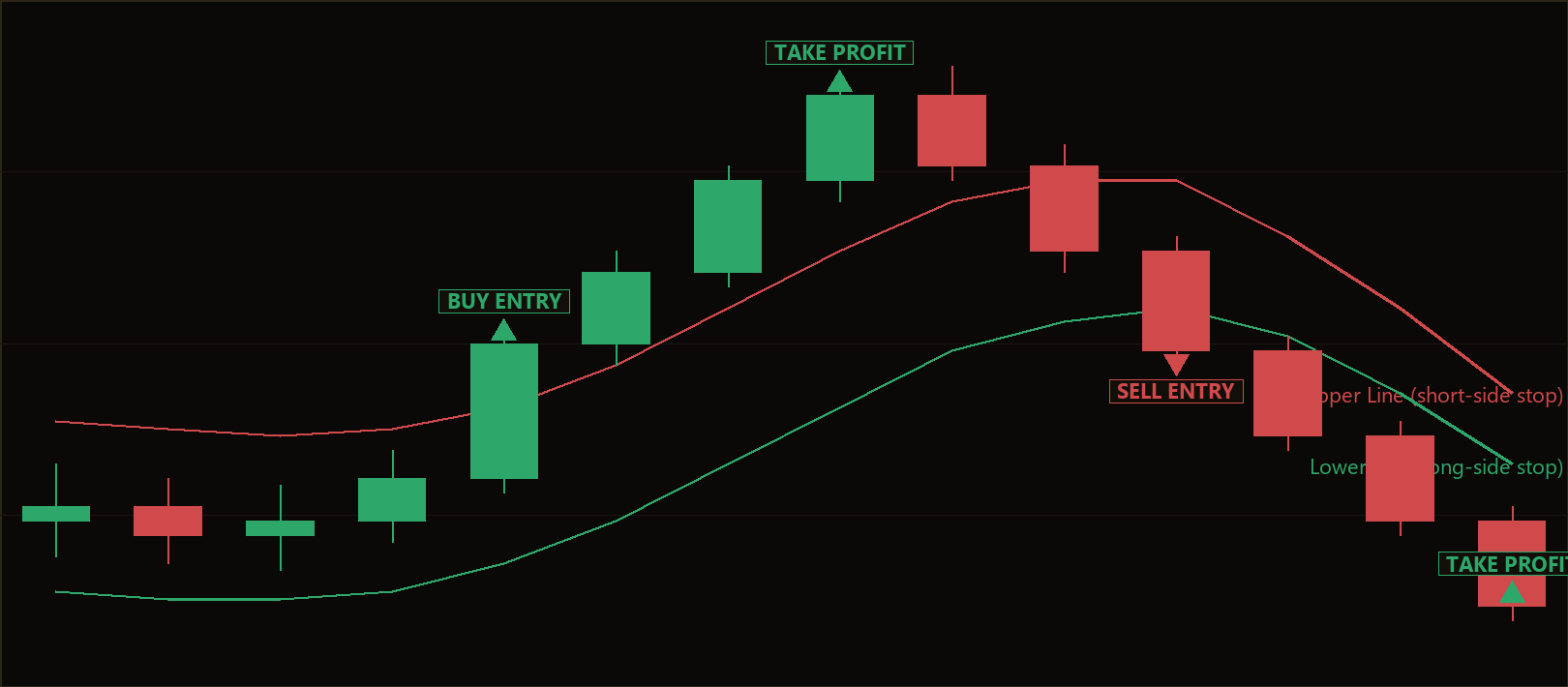
The Chande Kroll Stop is not a single line but a channel made of two stop lines — an upper line (the short-side stop) and a lower line (the long-side stop). Price normally drifts back and forth between these two lines during choppy, range-bound conditions. The strategy treats that in-between zone as "no man's land" and simply holds whatever bias it last had. Only when a candle closes cleanly beyond a line — with an extra buffer measured in Average True Range (ATR), a common gauge of market volatility — does the EA declare a new trend regime and act on it.
As a learning tool, the Chande Kroll Stop Trend Breakout is well suited to traders who want to study how volatility-adaptive stops and regime-flip logic work together. Because entries are infrequent and rule-based, the strategy is a clean example of how a breakout system tries to avoid the churn that catches many trend followers in sideways markets. It is best viewed as an educational study of a classic indicator rather than a shortcut to trading success.
How It Works
The strategy processes one completed bar at a time. On each new bar it rebuilds the two-stage Chande Kroll Stop and checks whether price has escaped the channel. Here is the logic in plain English:
- Stage 1 — preliminary stops. For a lookback window of
AtrPeriodbars, the strategy finds the highest high and the lowest low, then offsets them byAtrMult × ATR. This produces a preliminary high stop sitting below the recent highs and a preliminary low stop sitting above the recent lows. - Stage 2 — final stop lines. Over a second window of
StopPeriodbars, the strategy takes the highest preliminary high (the upper line, or short-side stop) and the lowest preliminary low (the lower line, or long-side stop). These two lines form the volatility channel. - Long signal. The strategy signals a long when the last completed candle closes above the upper line plus a buffer of
ConfirmMult × ATR. This is read as the trend turning up. - Short signal. The strategy signals a short when the candle closes below the lower line minus the same buffer. This is read as the trend turning down.
- Holding the regime. While price stays inside the band, no new signal is generated — the last regime is simply held. This "no churn" behaviour is what keeps entries infrequent and decisive.
- Regime flip = action. A trade is only opened when the newly detected regime differs from the previous one. On a flip, any opposite-side position is closed first, and a fresh position is opened in the new direction (one position per magic number at a time).
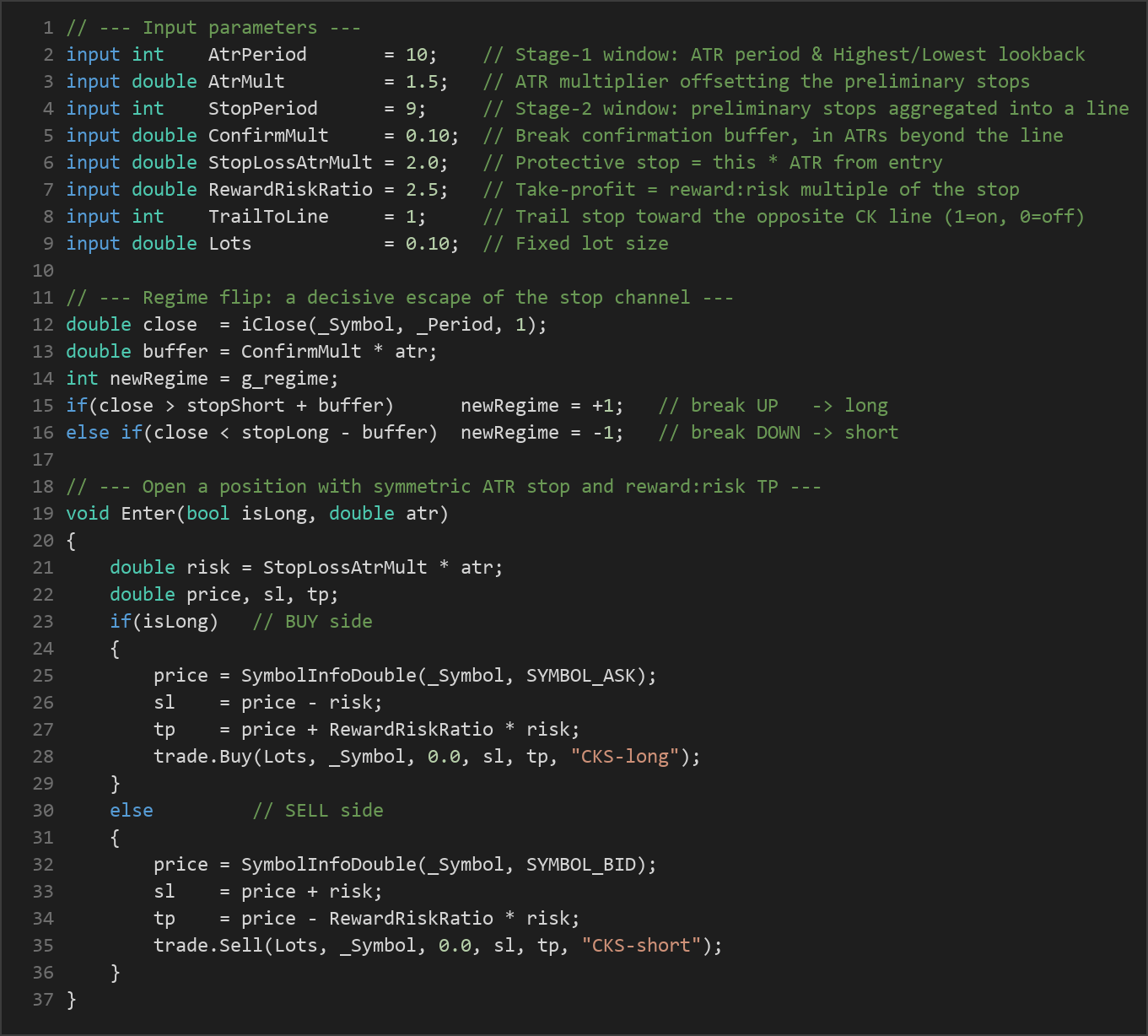
Stop-loss logic. Every entry is protected by a symmetric ATR stop. The protective stop is placed StopLossAtrMult × ATR away from the entry price — below entry for longs, above entry for shorts. Sizing the stop in ATR units means the risk distance automatically widens in volatile conditions and tightens in calm ones.
Take-profit logic. The take-profit is set as a reward-to-risk multiple of the stop distance, controlled by RewardRiskRatio. With the default 2.5, the target sits 2.5 times further from entry than the stop.
The trailing twist. When TrailToLine is enabled, the protective stop is trailed toward the opposite Chande Kroll line as the trade develops — a long's stop is pulled up toward the lower line, and a short's stop is pulled down toward the upper line. The stop only ever moves in the favourable direction and only while it stays on the correct side of the current price. This lets a trend run while the volatility channel tightens behind it. A flip to the opposite regime closes the trade and reverses.
Strategy Parameters
| Parameter | Default | Min | Max | Description |
|---|---|---|---|---|
| AtrPeriod | 10 | 5 | 30 | Stage-1 window: the ATR period and the Highest/Lowest lookback used to build the preliminary stops. |
| AtrMult | 1.5 | 0.5 | 4.0 | ATR multiplier that offsets the preliminary stops away from price. Larger values widen the channel. |
| StopPeriod | 9 | 3 | 25 | Stage-2 window: how many preliminary stops are aggregated into each final stop line. |
| ConfirmMult | 0.10 | 0.0 | 1.0 | Break-confirmation buffer, expressed in ATRs beyond the channel line. Higher values demand a cleaner break. |
| StopLossAtrMult | 2.0 | 1.0 | 5.0 | Protective stop distance as a multiple of ATR from the entry price. |
| RewardRiskRatio | 2.5 | 1.0 | 5.0 | Take-profit distance as a reward:risk multiple of the stop distance. |
| TrailToLine | 1 | 0 | 1 | Trail the stop toward the opposite Chande Kroll line (1 = on, 0 = off). |
| Lots | 0.10 | 0.01 | 1.0 | Fixed lot size for each position. |
Recommended Chart Settings
The Chande Kroll Stop Trend Breakout is a single-timeframe system: every calculation uses whatever timeframe the chart is set to when you attach the EA. This makes it flexible, but it also means you should choose a timeframe deliberately rather than assuming a default.
As a breakout strategy, it tends to be studied most naturally on higher intraday and swing timeframes — for example H1, H4, or D1 — where trends have room to develop and the "no churn" logic can avoid the noise typical of very short timeframes. Major, liquid instruments such as EUR/USD, GBP/USD, or gold (XAU/USD) are common testing grounds because their volatility tends to be well behaved.
Whatever you choose, remember that results will vary significantly across symbols, timeframes, and market conditions. A setting that behaves well in a trending period may behave very differently in a prolonged range. Always test on historical data and a demo account before drawing conclusions.
How to Install on MetaTrader 5
- Download the .ex5 file from the link below
- Copy it to your MT5
MQL5\Expertsfolder - Restart MetaTrader 5 or refresh the Navigator panel
- Drag the EA onto a chart matching the recommended symbol and timeframe
- Configure the input parameters and enable Algo Trading
What to Consider Before Using This EA
Strengths. The Chande Kroll Stop is a well-established, volatility-aware construction. Because it adapts to ATR, the channel naturally widens in fast markets and narrows in quiet ones, which can help filter out marginal pokes through the band. The regime-hold logic keeps the strategy from flip-flopping while price meanders inside the channel, and the trail-to-line exit is an elegant way to let winners run while volatility contracts.
Known limitations. Like all breakout systems, this approach is vulnerable to false breakouts — moves that push just past a line, trigger an entry, and then reverse back into the range. Choppy, directionless markets are its natural enemy: price can repeatedly nudge the edges of the band and hand back a series of small losing trades. Trend-following systems also tend to give back a portion of open profit when a trend finally rolls over, since the exit is reactive rather than predictive.
Where it may underperform. Expect the strategy to struggle in tight, low-volatility ranges and during news-driven whipsaws where price spikes both directions. The ConfirmMult buffer is designed to reduce marginal breaks, but no buffer can eliminate false signals entirely. Treat every parameter as something to study and stress-test, not as a fixed recipe.
Risk Management Tips
Sound risk management matters far more than any single indicator setting. A few general principles worth studying:
- Risk a small, fixed fraction per trade. Many educational sources suggest limiting exposure to 1–2% of account equity on any single position, so that a losing streak does not do lasting damage.
- Size positions to the stop, not the other way around. Because this strategy sets its stop in ATR units, your lot size should be chosen so that the ATR-based stop distance equals your intended monetary risk.
- Always practise on a demo account first. Use a demo to understand how the regime flips, trailing stops, and reversals behave in real time before considering any live capital.
- Understand drawdown. Even a well-built trend strategy will endure losing streaks. Study the depth and duration of drawdown you would be willing to tolerate before trading, not during a rough patch.
- Keep leverage modest. Leverage magnifies both gains and losses; conservative use gives a strategy room to breathe.
Risk Warning
Trading foreign exchange, CFDs, and other leveraged financial instruments involves substantial risk of loss and is not suitable for all investors. The strategies and tools discussed on this page are provided for educational purposes only and do not constitute financial advice, investment recommendations, or solicitation to trade. Always consult a qualified financial adviser before making trading decisions. Past backtest performance is not indicative of future results.
Downloads
- Expert Advisor: ChandeKrollStopTrendBreakout.ex5 (49 downloads)
- Source Code: ChandeKrollStopTrendBreakout.mq5 (50 downloads)
- Documentation: ChandeKrollStopTrendBreakout.pdf (60 downloads)