Disclaimer: This article is for educational and informational purposes only. It does not constitute financial or investment advice. Trading forex and CFDs carries significant risk of loss. Past performance of any strategy — including backtests — does not guarantee future results. Never trade with money you cannot afford to lose.
What Is This Strategy?
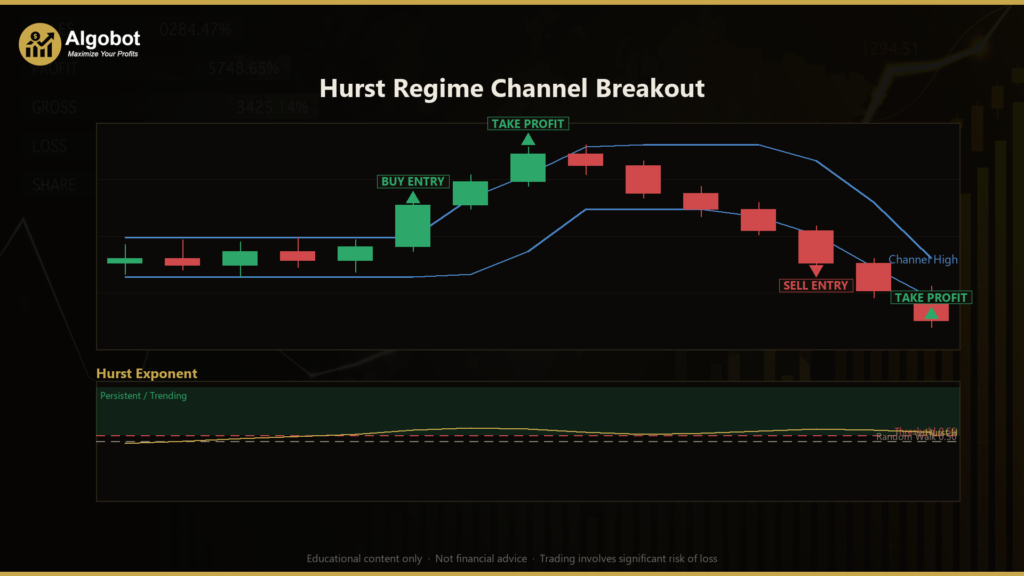
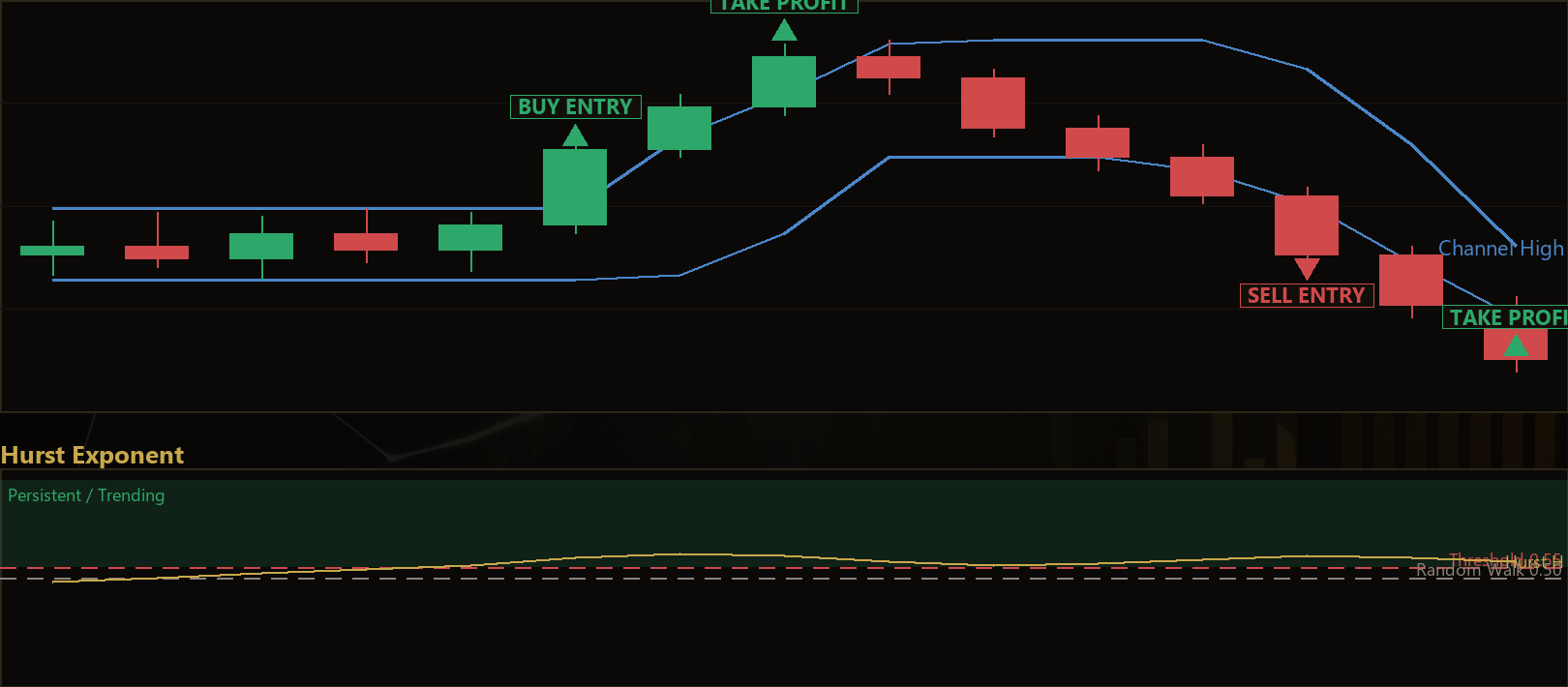
The Hurst Regime Channel Breakout is a Donchian channel breakout system that adds a statistical "regime filter" built from the Hurst exponent, a measure of whether a price series is trending (persistent) or choppy (mean-reverting). In plain terms, it is a breakout strategy that first asks a simple question — is the market actually in a state where breakouts tend to follow through? — and only trades when the answer appears to be yes.
Most channel breakout systems struggle for a well-known reason: a large share of breakouts fail not because the price level was wrong, but because the market was ranging. In a choppy, mean-reverting environment, every poke beyond the recent range tends to snap straight back. The Hurst Regime Channel Breakout is designed to sidestep exactly those conditions. It uses rescaled-range (R/S) analysis to estimate the Hurst exponent over a rolling window of returns, and it treats that value as a gate: a Hurst reading above 0.5 historically suggests a persistent, trend-following regime, while a reading below 0.5 suggests an anti-persistent, mean-reverting one.
As a learning tool, this strategy is well suited to intermediate traders who already understand basic breakout logic and want to explore how a quantitative regime filter can be layered on top of it. It is a good case study in combining a classical price pattern (the channel breakout) with a statistical concept (fractal persistence) and disciplined risk control. Frame your study of it as an exercise in understanding market-state filtering — not as a shortcut to any particular outcome.
How It Works
The strategy evaluates its logic once per completed bar (it uses new-bar detection so it never acts multiple times on the same candle). On each new bar, it walks through the following checks:
- Build the return series. It collects the most recent
HurstWindowlog returns from closing prices, in chronological order. Log returns are simply the natural log of each close divided by the previous close. - Estimate the Hurst exponent (the regime gate). Using multi-scale rescaled-range (R/S) analysis, it splits the return window into non-overlapping chunks at several scales (8, 16, 32, and so on up to half the window). For each scale it measures the average rescaled range, then fits a least-squares line through the log-log points. The slope of that line is the Hurst estimate
H. H > 0.5may indicate a persistent / trending regime where breakouts historically tend to continue.H < 0.5may indicate an anti-persistent / mean-reverting regime where breakouts historically tend to fail.H ≈ 0.5suggests a random walk with no directional edge.- Apply the gate. If
His belowHurstThreshold, the strategy stands aside and takes no trade, regardless of price action. This regime filter is the defining feature of the design. - Check the Donchian breakout. When the gate passes, it measures the highest high and lowest low of the prior
ChannelPeriodbars (excluding the just-completed candle). The strategy signals: - a long setup if the just-completed candle's close prints above the highest high of the channel, or
- a short setup if its close prints below the lowest low.
- Size the stop and target with ATR. It reads the Average True Range (ATR) — a volatility measure — over
AtrPeriodbars and uses it to place adaptive exits.
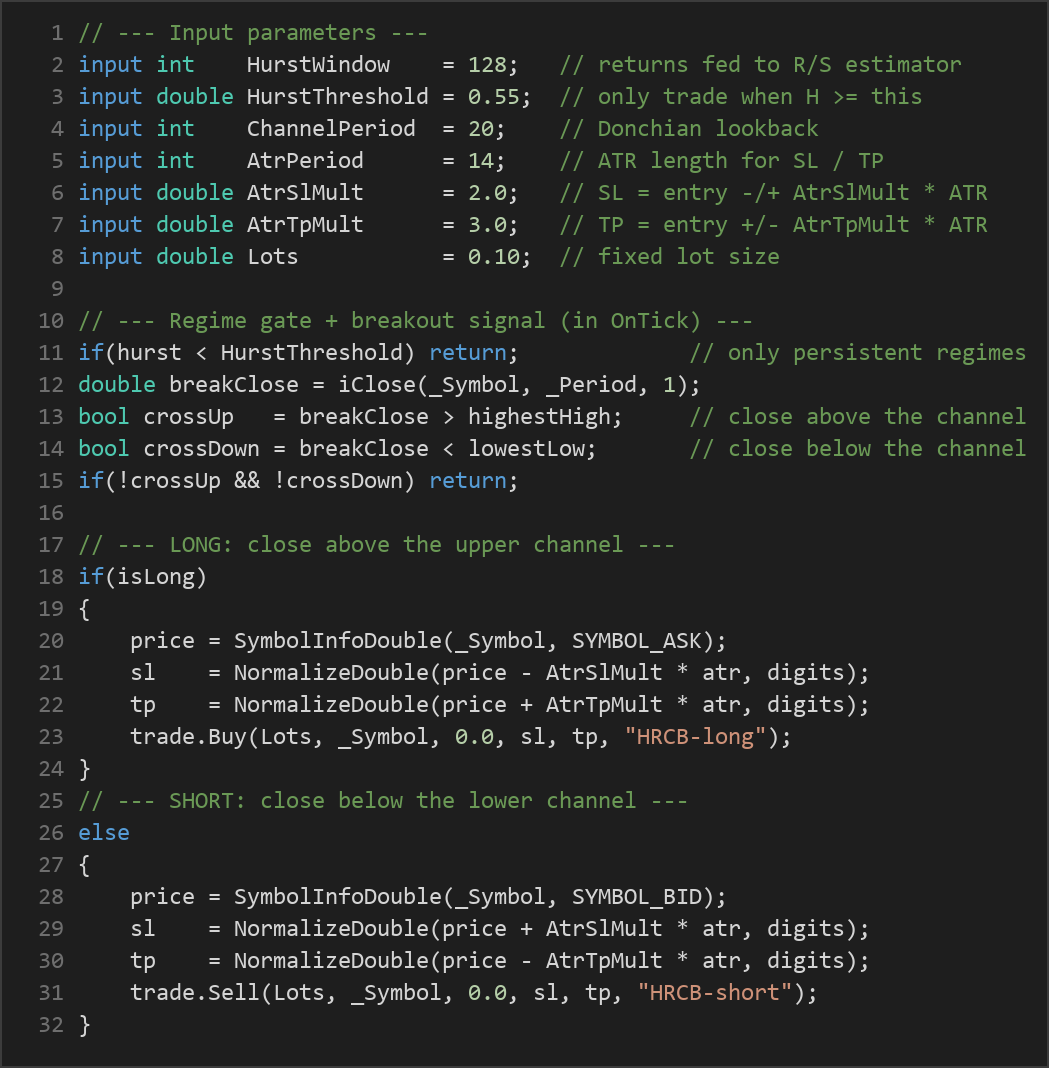
Entry logic: A market order is placed in the direction of the confirmed breakout, but only when both the regime gate and the channel condition agree. Only one position per magic number is allowed open at a time, so the strategy will not stack multiple trades on the same signal.
Stop-loss logic: For a long, the stop is set at entry − AtrSlMult × ATR; for a short, at entry + AtrSlMult × ATR. Because it scales with ATR, the stop automatically widens in volatile conditions and tightens in calm ones.
Take-profit logic: For a long, the target is entry + AtrTpMult × ATR; for a short, entry − AtrTpMult × ATR. With the default multipliers, the target distance is larger than the stop distance, giving the design a reward-to-risk ratio greater than one on each individual trade.
Strategy Parameters
| Parameter | Default | Min | Max | Description |
|---|---|---|---|---|
| HurstWindow | 128 | 32 | 256 | Number of most-recent log returns fed to the R/S Hurst estimator. Larger windows smooth the regime reading; smaller ones react faster. |
| HurstThreshold | 0.55 | 0.50 | 0.70 | Persistence gate. A breakout is only taken when the estimated Hurst exponent is at or above this value (0.50 = random walk). |
| ChannelPeriod | 20 | 10 | 60 | Donchian lookback: how many prior bars define the breakout high/low level. |
| AtrPeriod | 14 | 7 | 30 | Number of bars used to compute the ATR that sets stop and target distances. |
| AtrSlMult | 2.0 | 1.0 | 4.0 | Stop-loss distance as a multiple of ATR from the entry price. |
| AtrTpMult | 3.0 | 1.0 | 6.0 | Take-profit distance as a multiple of ATR from the entry price. |
| Lots | 0.10 | 0.01 | 1.0 | Fixed lot size used for each order. |
Recommended Chart Settings
The Hurst Regime Channel Breakout is written to run on whatever timeframe the chart is set to — every calculation uses the chart's primary timeframe rather than a hard-coded one. In practice, breakout-and-regime systems like this are most commonly studied on the H1 (1-hour) or H4 (4-hour) timeframes, where there is enough data for a stable Hurst estimate (the default HurstWindow of 128 needs at least that many completed bars plus buffer) without the noise of very short intraday charts.
For the symbol, major forex pairs such as EUR/USD or GBP/USD, or a liquid index CFD, are reasonable starting points for study because their spreads are tight and their price series are relatively clean. Whatever you choose, remember that results will vary considerably across different symbols, timeframes, and market conditions. Always evaluate the strategy on the specific instrument and timeframe you intend to study before drawing any conclusions.
How to Install on MetaTrader 5
- Download the
HurstRegimeChannelBreakout.ex5file from the link below. - Copy it to your MT5
MQL5\Expertsfolder. - Restart MetaTrader 5 or refresh the Navigator panel.
- Drag the EA onto a chart matching the recommended symbol and timeframe.
- Configure the input parameters and enable Algo Trading.
What to Consider Before Using This EA
Strengths of the approach. The core idea — filtering breakouts by market regime — addresses a genuine, well-documented weakness of plain channel systems. By standing aside when the Hurst exponent suggests a mean-reverting tape, the strategy aims to avoid the whipsaw environment where breakouts historically perform worst. Its ATR-based exits are adaptive, and its symmetric long/short rules mean it can engage trends in either direction.
Known limitations. The Hurst exponent is an estimate, not a certainty. R/S analysis needs a sizable window to be stable, which introduces lag: by the time H climbs above the threshold, part of a trend may already have unfolded. The estimator can also be sensitive to the window length and to outlier bars. Like all breakout systems, it can suffer from false breakouts and from slippage on fast moves, and it takes only one position at a time, so it can sit idle for long stretches when the regime gate stays closed.
Where it may underperform. In persistently ranging markets the gate should keep it out — but in markets that alternate rapidly between trending and choppy states, the Hurst reading may lag the transition and permit entries just as a trend exhausts. Very low-volatility regimes can also produce ATR-based stops that are too tight relative to normal noise. Treat every parameter as something to study and stress-test, not as a fixed recipe.
Risk Management Tips
Sound risk management matters far more than any single indicator. As you study this strategy, keep these general principles in mind:
- Risk a small fraction per trade. A common educational guideline is to risk no more than 1–2% of account equity on any single position. The fixed
Lotsinput does not do this automatically, so size it deliberately relative to your stop distance and account. - Start on a demo account. Test the EA thoroughly in a risk-free simulated environment before considering any live use, so you can observe how the regime gate behaves in real time.
- Understand drawdown. Even a well-designed system experiences losing streaks. Know the maximum drawdown you are willing to tolerate before you begin, and study how the strategy behaves through adverse periods.
- Diversify and avoid over-optimization. Tuning parameters until a backtest looks perfect (curve-fitting) rarely holds up on new data. Favor robust settings that work reasonably across a range of conditions.
- Keep leverage modest. Leverage magnifies losses as much as gains; conservative sizing gives a strategy room to survive normal variance.
Risk Warning
Trading foreign exchange, CFDs, and other leveraged financial instruments involves substantial risk of loss and is not suitable for all investors. The strategies and tools discussed on this page are provided for educational purposes only and do not constitute financial advice, investment recommendations, or solicitation to trade. Always consult a qualified financial adviser before making trading decisions. Past backtest performance is not indicative of future results.
Downloads
- Expert Advisor: HurstRegimeChannelBreakout.ex5 (53 downloads)
- Source Code: HurstRegimeChannelBreakout.mq5 (63 downloads)
- Documentation: HurstRegimeChannelBreakout.pdf (55 downloads)