Disclaimer: This article is for educational and informational purposes only. It does not constitute financial or investment advice. Trading forex and CFDs carries significant risk of loss. Past performance of any strategy — including backtests — does not guarantee future results. Never trade with money you cannot afford to lose.
What Is This Strategy?
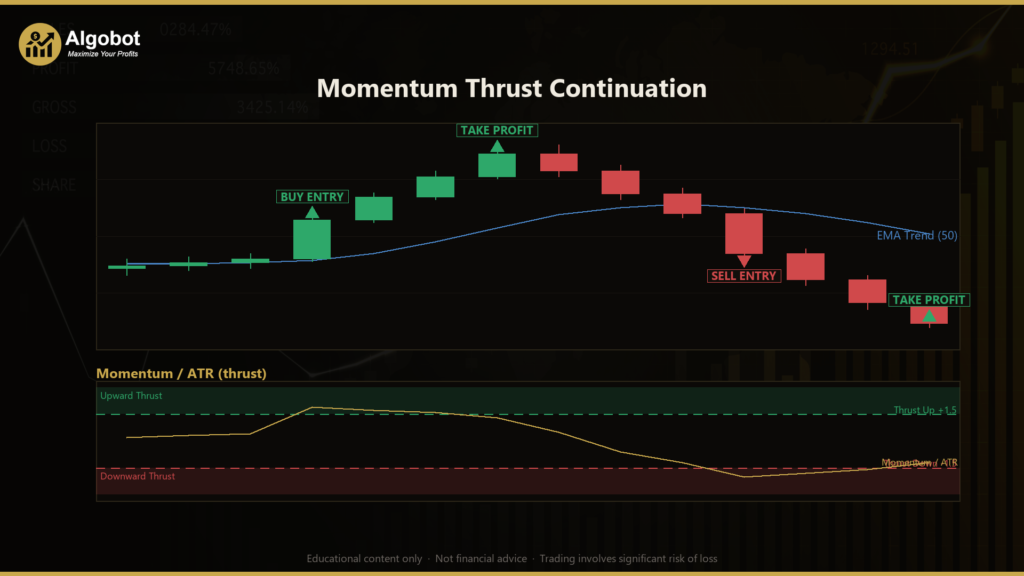
The Momentum Thrust Continuation strategy is a trend-following Expert Advisor (EA) that combines an Exponential Moving Average (EMA) — a trend filter that weights recent prices more heavily than older ones — with a volatility-scaled momentum "thrust" measurement built on the Average True Range (ATR). In plain terms, it is a momentum continuation system: it only looks to join a move that is already trending and is pushing forward with genuine conviction.
The core idea is simple but disciplined. Many trends drift sideways or crawl higher on thin, indecisive candles. This strategy tries to ignore that noise. It measures how far price has travelled over the last few bars (the "momentum") and compares that distance to the current level of volatility (the ATR). Only when price has thrust further than a defined multiple of ATR — in the same direction as the EMA trend — and the signal bar closes in that direction, does the strategy consider a trade. This is a filter designed to separate a convincing breakout-style move from ordinary chop.
As a learning tool, Momentum Thrust Continuation is well suited to traders who want to study how trend, momentum, and volatility can be combined into a single rules-based framework. It was designed with fast-moving instruments such as GBPJPY and XAUUSD (gold) on the M15 timeframe in mind, but the code is fully symbol- and timeframe-agnostic. This article frames the strategy as an object of analysis — a way to understand momentum-continuation logic — rather than as a profit opportunity.
How It Works
The strategy evaluates its rules once per completed bar, acting only on the freshly-closed candle rather than the still-forming one. This "closed bar" approach avoids reacting to intrabar flicker that can later reverse. Here is what happens on each new bar:
- Trend filter (EMA): The strategy computes an EMA over the
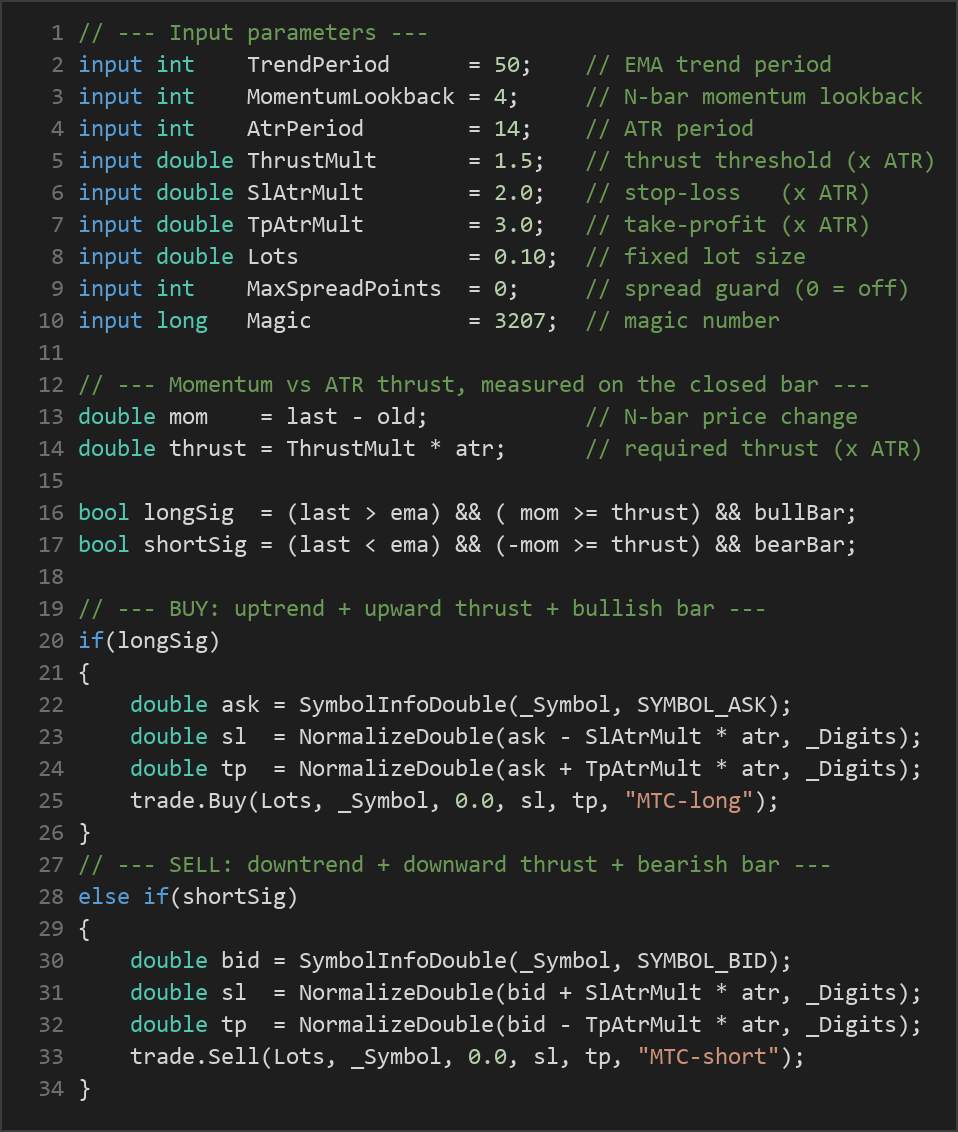
TrendPeriodnumber of bars. Price closing above the EMA defines a bullish trend context; closing below it defines a bearish context. - Momentum measurement: It calculates the price change over the last
MomentumLookbackbars — the difference between the most recent close and the close several bars ago. This is the raw "thrust." - Volatility scaling (ATR): It computes the ATR over
AtrPeriodbars to gauge how much the market is currently moving. The thrust threshold isThrustMult × ATR, so the bar for entry rises and falls with volatility. - Signal-bar confirmation: The closed signal bar must agree directionally — bullish (close above open) for longs, bearish (close below open) for shorts.
The strategy signals a long entry when all three conditions align: price is above the EMA, upward momentum is greater than or equal to the thrust threshold, and the signal bar closed bullish. It signals a short entry under the mirror-image conditions: price below the EMA, downward momentum meeting the threshold, and a bearish signal bar.
Risk handling is built directly into every order:
- Stop-loss: Placed at
SlAtrMult × ATRaway from the entry price. Because it is ATR-scaled, the stop automatically widens in volatile conditions and tightens in calm ones. - Take-profit: Placed at
TpAtrMult × ATRfrom entry. With the default settings, the take-profit distance is larger than the stop distance, reflecting a reward-to-risk structure greater than 1:1. - One position per magic number: The EA holds only a single open position at a time, so it will not stack multiple trades on the same signal.
- Optional spread guard: If
MaxSpreadPointsis set above zero, the strategy skips new entries whenever the current spread exceeds that limit — useful during thin or fast markets.
Strategy Parameters
| Parameter | Default | Min | Max | Description |
|---|---|---|---|---|
| TrendPeriod | 50 | 20 | 200 | Number of bars used for the EMA trend filter. Higher values define a slower, longer-term trend. |
| MomentumLookback | 4 | 2 | 20 | How many bars back the momentum (price change) is measured over. |
| AtrPeriod | 14 | 5 | 30 | Number of bars used to calculate ATR, the volatility gauge for the thrust and risk levels. |
| ThrustMult | 1.5 | 0.5 | 4.0 | Momentum must exceed this multiple of ATR to qualify as a valid thrust. Higher values demand stronger moves. |
| SlAtrMult | 2.0 | 0.5 | 5.0 | Stop-loss distance expressed as a multiple of ATR. |
| TpAtrMult | 3.0 | 1.0 | 8.0 | Take-profit distance expressed as a multiple of ATR. |
| Lots | 0.10 | 0.01 | 1.0 | Fixed trade size in lots for each position. |
| MaxSpreadPoints | 0 | 0 | 200 | Maximum allowed spread (in points) before an entry is skipped. Zero disables the guard. |
Recommended Chart Settings
Momentum Thrust Continuation was designed with GBPJPY and XAUUSD (gold) on the M15 (15-minute) timeframe in mind. These instruments are known for producing extended, momentum-driven moves that suit a thrust-continuation approach. That said, the underlying code is symbol- and timeframe-agnostic, so you can study it on any market your broker offers.
Keep in mind that behaviour will vary considerably across different symbols, timeframes, and market conditions. A parameter set that looks well-balanced on M15 gold may behave very differently on a slower, range-bound currency pair. Always test any configuration thoroughly on historical and demo data before drawing conclusions.
How to Install on MetaTrader 5
- Download the .ex5 file from the link below
- Copy it to your MT5
MQL5\Expertsfolder - Restart MetaTrader 5 or refresh the Navigator panel
- Drag the EA onto a chart matching the recommended symbol and timeframe
- Configure the input parameters and enable Algo Trading
What to Consider Before Using This EA
Like any single strategy, Momentum Thrust Continuation has strengths and clear limitations that are worth understanding before you rely on it.
Strengths. The design is coherent and each component has a purpose: the EMA keeps trades aligned with the prevailing trend, the ATR-scaled thrust filter demands genuine momentum, and the signal-bar check adds a final directional confirmation. Because both the entry threshold and the stop/target distances are ATR-based, the strategy adapts to changing volatility instead of using fixed pip values that quickly become stale. The one-position-per-magic rule and optional spread guard also reflect sensible, defensive engineering.
Known limitations. Trend-continuation systems tend to perform best in clean, directional markets and can struggle in choppy, range-bound conditions — precisely where a "thrust" may be a false start that immediately reverses. Because the strategy only enters after a strong move has already occurred, entries can arrive late, occasionally near a short-term exhaustion point. During periods of sharp mean reversion, a strategy like this may historically experience a series of losing trades as thrusts fail to follow through. There is also no trailing stop or breakeven logic in the base design, so an open trade runs to either its fixed ATR stop or ATR target.
The honest takeaway is that this is a focused momentum tool, not an all-weather system. Studying when it underperforms is just as instructive as studying when it signals cleanly.
Risk Management Tips
Regardless of the strategy, sound risk management is what keeps a trading account intact long enough to learn. Consider these general principles:
- Risk only a small fraction per trade. A common guideline is to risk no more than 1–2% of your account on any single position. Size your lots so that hitting the ATR stop-loss stays within that limit.
- Understand position sizing. The default
Lotsvalue is fixed; it does not automatically scale to your balance. Make sure the fixed size is appropriate for your account and the instrument's volatility. - Test on a demo account first. Run the EA on a demo or historical data across varied market conditions before considering any live use. This helps you understand its drawdown behaviour — the peak-to-trough decline in equity.
- Respect drawdown. Every strategy has losing streaks. Decide in advance how much drawdown you are willing to tolerate, and treat that limit as non-negotiable.
- Never over-leverage. Leverage magnifies both gains and losses. Keep it conservative, especially on volatile instruments like GBPJPY and gold.
Treat this EA as a structured way to learn how trend, momentum, and volatility interact — not as a substitute for your own research and judgment.
Risk Warning
Trading foreign exchange, CFDs, and other leveraged financial instruments involves substantial risk of loss and is not suitable for all investors. The strategies and tools discussed on this page are provided for educational purposes only and do not constitute financial advice, investment recommendations, or solicitation to trade. Always consult a qualified financial adviser before making trading decisions. Past backtest performance is not indicative of future results.
Downloads
- Expert Advisor: MomentumThrustContinuation.ex5 (47 downloads)
- Source Code: MomentumThrustContinuation.mq5 (52 downloads)
- Documentation: MomentumThrustContinuation.pdf (52 downloads)