Disclaimer: This article is for educational and informational purposes only. It does not constitute financial or investment advice. Trading forex and CFDs carries significant risk of loss. Past performance of any strategy — including backtests — does not guarantee future results. Never trade with money you cannot afford to lose.
What Is This Strategy?
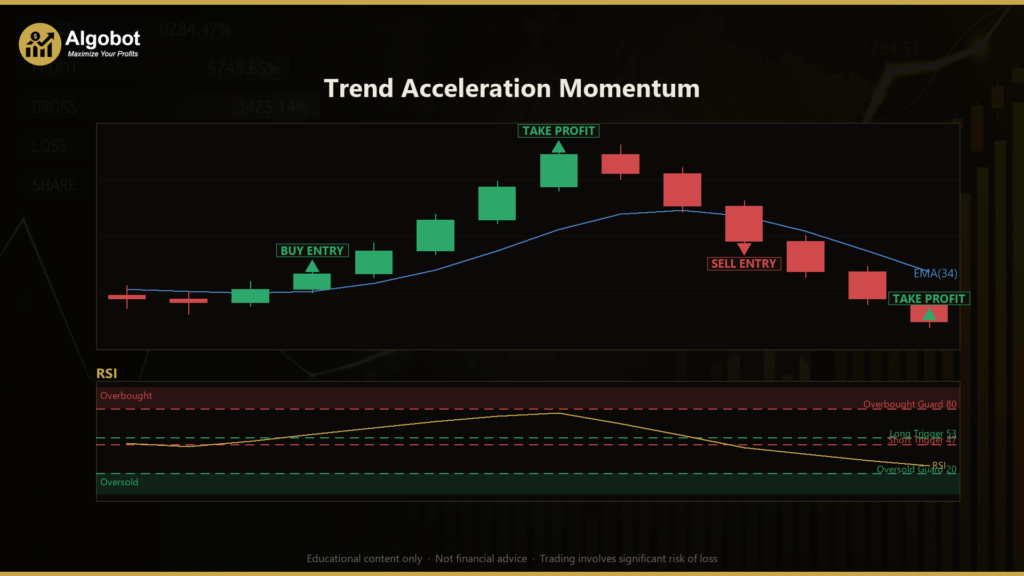
Trend Acceleration Momentum is a trend-following, momentum-ignition system built around an Exponential Moving Average (EMA) — a moving average that gives more weight to recent prices so it reacts faster than a simple average. What sets this strategy apart is that it does not merely check whether the EMA is sloping the right way. Most trend filters stop at the first derivative of trend: is the average rising or falling? This strategy looks one layer deeper and measures whether that slope is itself increasing — the second derivative, or acceleration. In plain terms, it asks not just "is the trend up?" but "is the trend still speeding up?"
The logic behind that question is straightforward. Trends historically tend to offer their cleanest moves while momentum is still building. Once the slope of the average flattens out, the easy part of the move is often already gone and the market is more prone to chop or reversal. By requiring positive acceleration, Trend Acceleration Momentum aims to engage early in the impulsive leg of a move and sit out the exhausted, decelerating tail. A Relative Strength Index (RSI) filter — a momentum oscillator that measures the speed of recent price changes on a 0–100 scale — confirms that price momentum agrees with the direction, while an over-extension guard keeps the strategy from chasing a climax bar.
As a learning tool, this strategy is well suited to traders who want to study how derivative-based trend measurement, oscillator confirmation, and volatility-scaled risk can be combined into one rule set. It is designed with liquid, trending markets in mind and uses a small number of broadly ranged parameters to reduce the temptation of curve-fitting. Treat it as a framework for understanding acceleration-based entries — not as a shortcut of any kind.
How It Works
The strategy evaluates its rules only on completed bars, acting once per new bar rather than reacting to every tick. This avoids signals that flicker and vanish while a candle is still forming. Here is how each piece fits together:
- Sampling the EMA at three points. The strategy reads the EMA at the just-closed bar (
emaNow), thenSlopeBarsago (emaMid), then2 × SlopeBarsago (emaFar). These three equally spaced samples let it measure how the trend's speed is changing. - Measuring speed and acceleration. It computes
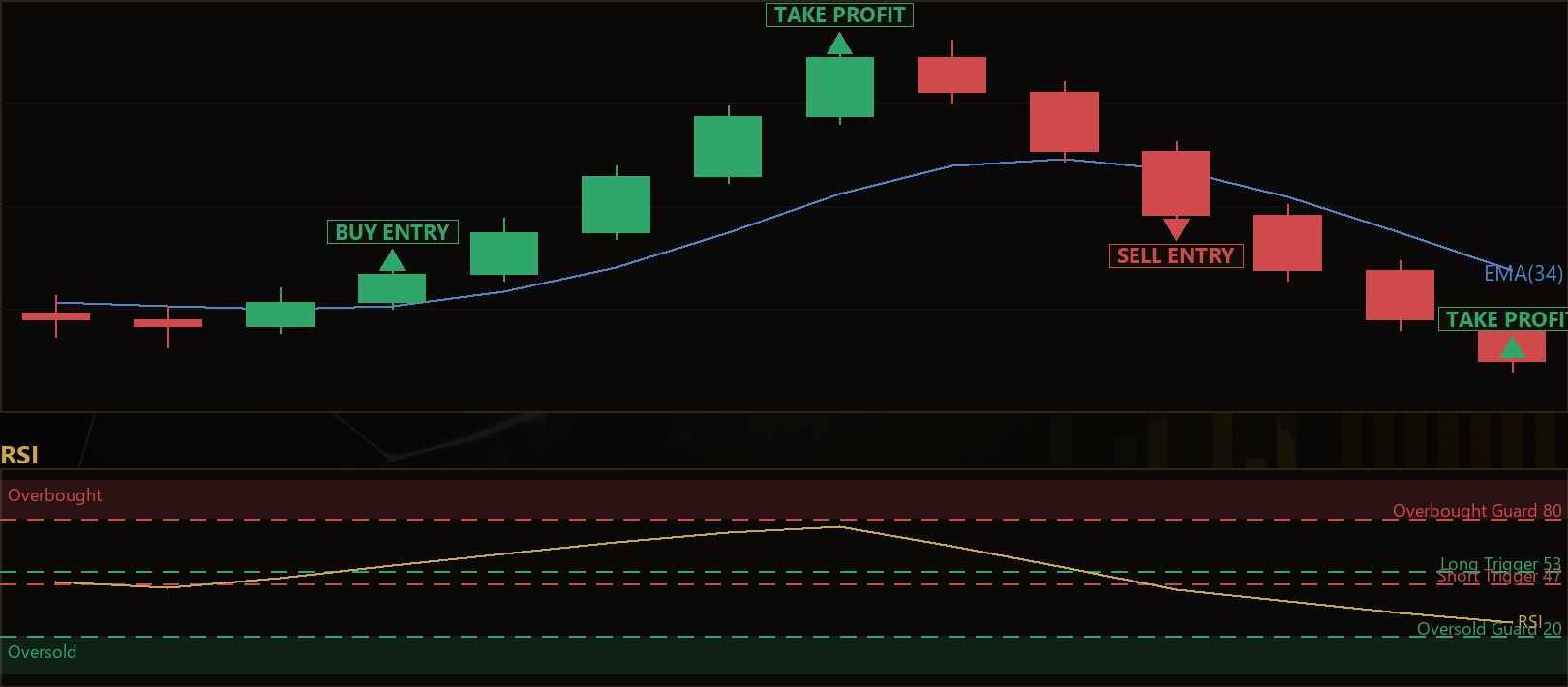
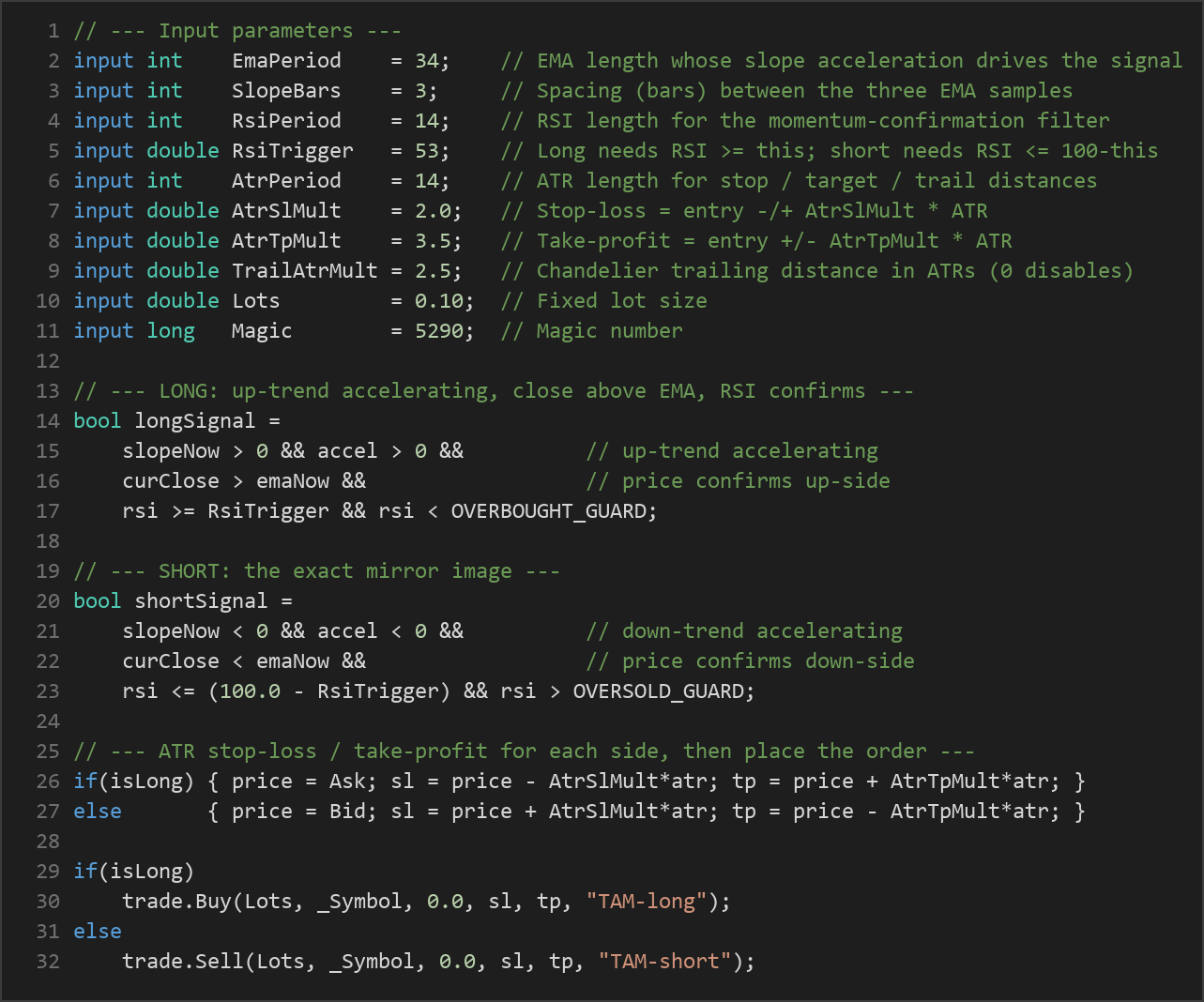
slopeNow = emaNow − emaMid(recent trend speed) andslopePrev = emaMid − emaFar(earlier trend speed). Acceleration is simplyaccel = slopeNow − slopePrev. A positive value means the up-trend is gaining pace; a negative value means a down-trend is gaining pace. - Long entry signal. The strategy signals a long when the up-trend is accelerating (
slopeNow > 0andaccel > 0), the just-closed candle closes above the EMA, and RSI confirms up-momentum by reading at or above theRsiTriggerlevel — but is still below the overbought guard of 80. - Short entry signal. The short rule is the exact mirror: the down-trend is accelerating (
slopeNow < 0andaccel < 0), the candle closes below the EMA, and RSI sits at or below100 − RsiTriggerwhile remaining above the oversold guard of 20. - Over-extension guard. By refusing entries when RSI is already at an extreme (80 or above for longs, 20 or below for shorts), the strategy avoids igniting a position at the top or bottom of an exhausted, climactic move.
- Stop-loss logic. Risk is defined by the Average True Range (ATR) — a volatility measure of a bar's typical range. The stop is placed
AtrSlMult × ATRaway from entry, so the stop distance automatically widens in volatile conditions and tightens in quiet ones. - Take-profit logic. The target is set
AtrTpMult × ATRfrom entry, producing a fixed, volatility-scaled reward-to-risk ratio that adapts to any market or timeframe. - Trailing stop. An optional chandelier-style ATR trailing stop, set
TrailAtrMult × ATRbehind price, can lock in open profit. It only ever tightens toward price and never loosens, so it protects gains while giving a winning trade room to continue. - Position handling. The strategy holds one position per magic number at a time and uses fixed-lot sizing. When a position is open, it manages the trailing stop and does not stack additional trades.
Strategy Parameters
| Parameter | Default | Min | Max | Description |
|---|---|---|---|---|
| EmaPeriod | 34 | 10 | 80 | Length of the EMA whose slope acceleration drives the signal. Longer values smooth the trend; shorter values react faster. |
| SlopeBars | 3 | 1 | 10 | Spacing, in bars, between the three EMA samples used to measure slope and acceleration. |
| RsiPeriod | 14 | 5 | 30 | Length of the RSI used for momentum confirmation. |
| RsiTrigger | 53 | 50 | 65 | Momentum threshold: a long needs RSI at or above this; a short needs RSI at or below 100 − this. |
| AtrPeriod | 14 | 7 | 30 | Length of the ATR used to size the stop, target, and trailing distances. |
| AtrSlMult | 2.0 | 1.0 | 4.0 | Stop-loss distance as a multiple of ATR (entry −/+ AtrSlMult × ATR). |
| AtrTpMult | 3.5 | 1.5 | 7.0 | Take-profit distance as a multiple of ATR (entry +/− AtrTpMult × ATR). |
| TrailAtrMult | 2.5 | 0.0 | 5.0 | Chandelier trailing-stop distance in ATRs. Set to 0 to disable trailing. |
| Lots | 0.10 | 0.01 | 1.0 | Fixed lot size for each position. |
Recommended Chart Settings
Trend Acceleration Momentum was designed with liquid, trend-prone markets in mind — for example EUR/USD or XAU/USD (gold) — on the M15 to H1 timeframes. It is a single-timeframe strategy: every calculation uses the chart's own timeframe, so it will run on whatever period you attach it to. The default parameters lean toward the intraday-to-swing range, where the EMA has enough bars to define a meaningful trend and ATR-based stops have room to breathe.
Keep in mind that these are starting points, not fixed rules. Different symbols, sessions, and volatility regimes behave differently, and results will vary across market conditions. Always study the strategy's behavior on your chosen instrument and timeframe in a testing environment before considering any live use.
How to Install on MetaTrader 5
- Download the
TrendAccelerationMomentum.ex5file from the link below. - Copy it to your MT5
MQL5\Expertsfolder. - Restart MetaTrader 5 or refresh the Navigator panel.
- Drag the EA onto a chart matching the recommended symbol and timeframe.
- Configure the input parameters and enable Algo Trading.
What to Consider Before Using This EA
Every approach has strengths and trade-offs, and understanding both is part of learning to evaluate a strategy critically.
Strengths. The acceleration filter is the core idea worth studying: by demanding that the trend is still speeding up, the strategy tries to be selective about when in a trend it engages, rather than entering any time the average points the right way. The RSI confirmation and over-extension guard add a second, independent check so signals are not driven by the EMA alone. Volatility-scaled ATR stops and targets give a consistent reward-to-risk structure that adapts across instruments, and the optional trailing stop offers a mechanical way to manage open trades. The small, broadly ranged parameter set is a deliberate design choice to resist over-optimization.
Limitations. Like all trend-following systems, this one depends on trends actually developing. In range-bound, choppy, or news-whipsawed markets, an accelerating slope can appear and then immediately fade, producing entries that get stopped out — a common weakness of momentum-ignition logic. Because it acts only on completed bars, it accepts some lag in exchange for cleaner signals. Fixed-lot sizing does not adjust risk to account balance, and a single position per magic means it will not pyramid into a strong run. The over-extension guard reduces climax entries but cannot prevent every poorly timed one. As always, no combination of indicators can anticipate every market condition.
Risk Management Tips
Sound risk management matters more than any single entry rule. Consider these general principles as part of your education:
- Position sizing. Size each trade so that a full stop-loss loss is a small, survivable fraction of your account rather than a threat to it.
- Risk a small percentage per trade. Many educational sources suggest risking no more than 1–2% of account equity on any single position, so that a string of losses does not do lasting damage.
- Test on a demo account first. Use a demo or simulated environment to understand how the strategy behaves across different conditions before risking real capital.
- Understand drawdown. Every strategy experiences losing streaks and equity declines. Study the depth and duration of drawdown you would need to tolerate, and be honest about whether you could stick with the plan through it.
- Plan before you trade. Decide your parameters, instrument, and risk limits in advance, and avoid changing them impulsively mid-trade.
Risk Warning
Trading foreign exchange, CFDs, and other leveraged financial instruments involves substantial risk of loss and is not suitable for all investors. The strategies and tools discussed on this page are provided for educational purposes only and do not constitute financial advice, investment recommendations, or solicitation to trade. Always consult a qualified financial adviser before making trading decisions. Past backtest performance is not indicative of future results.
Downloads
- Expert Advisor: TrendAccelerationMomentum.ex5 (63 downloads)
- Source Code: TrendAccelerationMomentum.mq5 (68 downloads)
- Documentation: TrendAccelerationMomentum.pdf (71 downloads)