Disclaimer: This article is for educational and informational purposes only. It does not constitute financial or investment advice. Trading forex and CFDs carries significant risk of loss. Past performance of any strategy — including backtests — does not guarantee future results. Never trade with money you cannot afford to lose.
What Is This Strategy?
Trend Resumption Momentum is a trend-following, pullback-continuation strategy for MetaTrader 5 that combines three classic technical tools — the Exponential Moving Average (EMA), the Relative Strength Index (RSI), and the Average True Range (ATR) — into a single confluence-based entry model. An EMA is a moving average that weights recent prices more heavily; the RSI is a momentum oscillator that measures the speed of price changes on a 0–100 scale; and the ATR is a gauge of how much an instrument typically moves, i.e. its volatility. The strategy only acts when all three of these filters agree, which is the core idea behind its design.
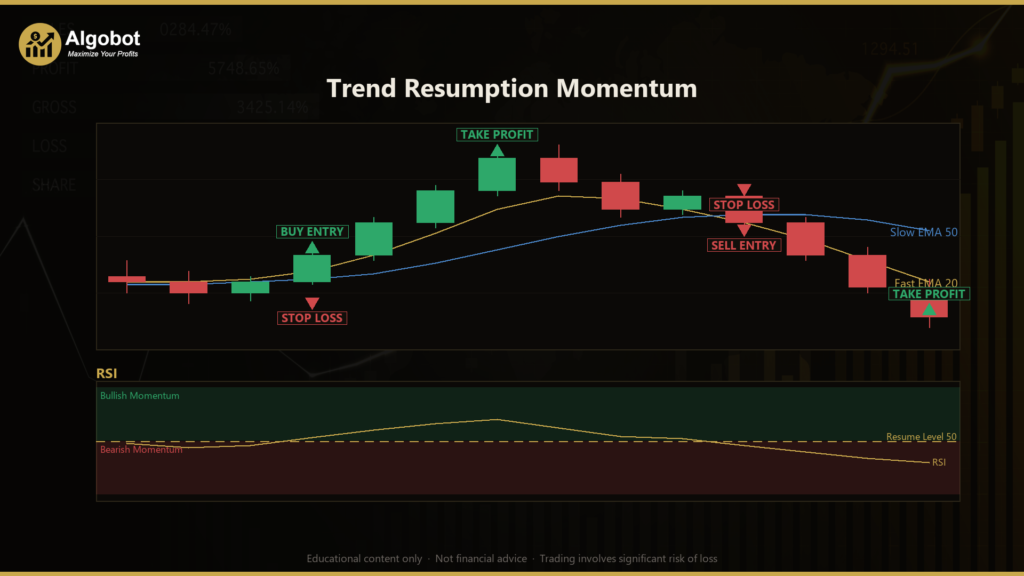
Rather than trying to catch tops and bottoms, this approach is built for markets that are already trending and then briefly pause. In an uptrend, price often rises, rests in a shallow pullback, and then resumes. Trend Resumption Momentum is designed to identify that "resume" moment — the point where momentum re-ignites after a rest — while confirming that the broader trend is intact and that volatility is expanding rather than fading.
As a learning tool, this strategy is well suited to traders who want to study how multi-filter confluence works in practice. It demonstrates how a trend filter, a momentum trigger, and a volatility gate can be layered so that each one screens out a different type of low-quality condition. This is a strategy analysis for educational study, not a profit opportunity, and it is best explored on a demo account where you can watch each condition form in real time.
How It Works
The strategy evaluates its rules on closed bars only, meaning it waits for a candle to fully complete before making a decision. This avoids reacting to the noise of a still-forming bar. When all conditions align, the strategy signals an entry.
Entry conditions (all must be true):
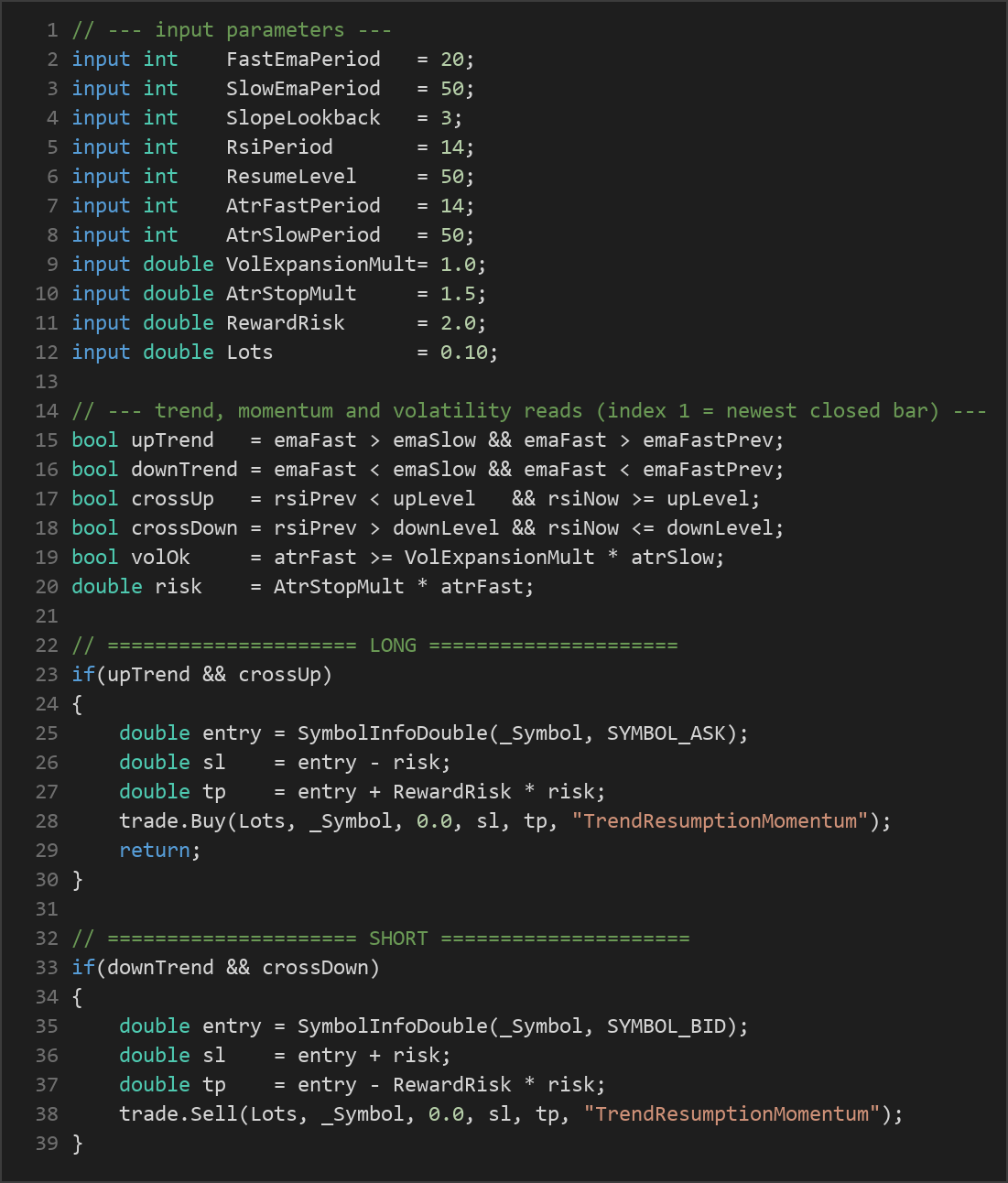
- Trend direction and slope. For a long setup, the fast EMA must be above the slow EMA and the fast EMA must be higher than it was a set number of bars ago (its slope must be rising). This demands not just a bullish ordering of the averages but active upward drift. For a short setup, the mirror image applies: the fast EMA is below the slow EMA and sloping down.
- Momentum resumption (the trigger). During a healthy trend, RSI typically dips toward its midline on a pullback and then turns back up. The strategy signals a long when RSI crosses up through the ResumeLevel (default 50) — momentum re-igniting after resting. For shorts, it signals when RSI crosses down through the mirrored level (100 minus ResumeLevel).
- Volatility expansion (the gate). A fast ATR must be greater than or equal to
VolExpansionMulttimes a slow ATR. This condition ensures the strategy only trades continuation while range is expanding, filtering out dead or choppy markets where pullback signals tend to whipsaw.
Stop-loss logic:
- When a trade opens, the strategy calculates risk as
AtrStopMult × fast ATR. For a long, the stop-loss is placed that distance below the entry price; for a short, that distance above. Because the stop is scaled to current volatility, it automatically widens in fast markets and tightens in calm ones.
Take-profit logic:
- The take-profit is set at a fixed reward-to-risk multiple of the stop distance. With the default
RewardRiskof 2.0, the target sits twice as far from entry as the stop — so a winning trade is designed to aim for roughly double the distance risked.
Exit conditions:
- Fixed stop or target. A position closes when price reaches either the protective stop or the take-profit.
- Active trend-flip exit. The strategy also monitors the EMA structure while a trade is open. If the fast EMA crosses to the wrong side of the slow EMA — signalling the trend may have reversed — it closes the position early, before the stop or target is hit.
- One position at a time. Only a single position per magic number is held, so the strategy never stacks trades on the same signal.
Strategy Parameters
| Parameter | Default | Min | Max | Description |
|---|---|---|---|---|
| FastEmaPeriod | 20 | 8 | 60 | Lookback of the fast EMA that defines the near-term trend direction. |
| SlowEmaPeriod | 50 | 20 | 150 | Lookback of the slow EMA used as the baseline trend reference. |
| SlopeLookback | 3 | 1 | 12 | Number of bars back used to measure whether the fast EMA is rising or falling. |
| RsiPeriod | 14 | 6 | 30 | Lookback of the RSI momentum oscillator. |
| ResumeLevel | 50 | 40 | 60 | The RSI level that price must cross back through to trigger a resumption entry. |
| AtrFastPeriod | 14 | 7 | 30 | Lookback of the fast ATR used for the volatility gate and stop sizing. |
| AtrSlowPeriod | 50 | 20 | 120 | Lookback of the slow ATR used as the baseline volatility reference. |
| VolExpansionMult | 1.0 | 0.0 | 2.0 | Multiplier the fast ATR must exceed (times the slow ATR) for a trade to be allowed. |
| AtrStopMult | 1.5 | 0.5 | 4.0 | Multiple of the fast ATR used to set the protective stop-loss distance. |
| RewardRisk | 2.0 | 1.0 | 4.0 | Reward-to-risk ratio that sets the take-profit distance relative to the stop. |
| Lots | 0.10 | 0.01 | 1.0 | Fixed position size in lots for each trade. |
Recommended Chart Settings
Trend Resumption Momentum is designed to be timeframe-agnostic — all of its calculations read from whatever chart it is attached to. That said, its natural home is an intraday major FX pair (for example EUR/USD or GBP/USD) or a metal such as gold on the M15 or H1 timeframe, where clean impulse–pullback–resume cycles tend to appear most often.
Because the strategy relies on trending conditions with expanding volatility, its behaviour will vary meaningfully across different instruments and market regimes. Results will differ across ranging markets, news-driven spikes, and low-liquidity sessions. Always test on your chosen symbol and timeframe before drawing any conclusions.
How to Install on MetaTrader 5
- Download the .ex5 file from the link below
- Copy it to your MT5
MQL5\Expertsfolder - Restart MetaTrader 5 or refresh the Navigator panel
- Drag the EA onto a chart matching the recommended symbol and timeframe
- Configure the input parameters and enable Algo Trading
What to Consider Before Using This EA
Strengths of the approach. The main educational strength here is confluence. By requiring trend, momentum, and volatility to agree simultaneously, the strategy is structurally selective — it stays out of many low-quality conditions. The ATR-scaled stop adapts to current volatility instead of using a fixed distance, and the active trend-flip exit is a thoughtful touch that can cut losers before they reach the full stop. The fixed reward-to-risk framework also enforces a disciplined, pre-defined target on every trade.
Known limitations. Trend-following pullback systems, by their nature, underperform in sideways, range-bound markets, where EMAs cross back and forth and RSI oscillates without follow-through. In such conditions the strategy may take signals that quickly reverse, or it may sit idle for long stretches. The RSI-cross trigger can also fire on shallow, unconvincing pullbacks. Because only one position is held at a time and there is no trailing stop, strong trends may not be fully captured — the trade exits at a fixed target while the move continues.
Where it may struggle. Expect weaker behaviour during quiet, low-volatility periods (the volatility gate may keep it flat), around high-impact news that produces sudden gaps, and on instruments with wide spreads that erode the ATR-based stop and target math. No single set of parameters performs well across every market, so treat the defaults as a starting point for study rather than a finished configuration.
Risk Management Tips
Sound risk management matters far more than any single entry signal. Consider these general principles as you study this strategy:
- Risk a small, fixed fraction per trade. Many educational sources suggest risking no more than 1–2% of account equity on any single position. The fixed
Lotsinput in this EA does not automatically scale to your account size, so size positions deliberately. - Understand drawdown. Every strategy experiences losing streaks. Study how deep and how long historical drawdowns can run so you are mentally and financially prepared for them.
- Use a demo account first. Run the strategy on a demo or paper account until you fully understand how it behaves across different market conditions before considering any live use.
- Account for costs. Spreads, commissions, and slippage all reduce real-world outcomes compared with idealised backtests. These matter especially on lower timeframes.
- Never over-leverage. Leverage magnifies both gains and losses. Keep total exposure at a level you could comfortably withstand during a worst-case stretch.
Treat this EA as a framework for learning how multi-filter systems are constructed, not as a set-and-forget solution.
Risk Warning
Trading foreign exchange, CFDs, and other leveraged financial instruments involves substantial risk of loss and is not suitable for all investors. The strategies and tools discussed on this page are provided for educational purposes only and do not constitute financial advice, investment recommendations, or solicitation to trade. Always consult a qualified financial adviser before making trading decisions. Past backtest performance is not indicative of future results.
Downloads
- Expert Advisor: TrendResumptionMomentum.ex5 (39 downloads)
- Source Code: TrendResumptionMomentum.mq5 (45 downloads)
- Documentation: TrendResumptionMomentum.pdf (47 downloads)