Disclaimer: This article is for educational and informational purposes only. It does not constitute financial or investment advice. Trading forex and CFDs carries significant risk of loss. Past performance of any strategy — including backtests — does not guarantee future results. Never trade with money you cannot afford to lose.
What Is This Strategy?
Vortex Trend Shift is a trend-following momentum strategy built on the Vortex Indicator, a directional-movement oscillator developed by Etienne Botes and Douglas Siepman. Unlike a simple moving-average crossover, the Vortex Indicator measures the two opposing "rotational" pressures inside a window of price bars — an upward pull and a downward pull — and normalizes each by the true range so the reading is scale-free and comparable across any symbol or timeframe. Because it reacts to directional movement rather than smoothing price after the fact, the indicator is designed to catch the start of a directional leg instead of lagging behind it.
The strategy is intended for trending market conditions. It looks for the moment when one directional pressure genuinely overtakes the other, then confirms that shift against a longer-term trend filter before committing to a trade. This makes it a poor fit for tight, sideways ranges — where directional indicators tend to whipsaw — and a more natural fit for instruments and periods that develop sustained moves, such as a trending FX major or a metal.
As a learning tool, Vortex Trend Shift is well suited to traders who want to study how directional-movement indicators behave, how confirmation filters reduce false signals, and how volatility-based risk brackets adapt to different instruments. Think of it as a structured case study in signal gating — not a shortcut. Everything below is framed as strategy analysis so you can understand the mechanics, not as a promise of any particular outcome.
How It Works
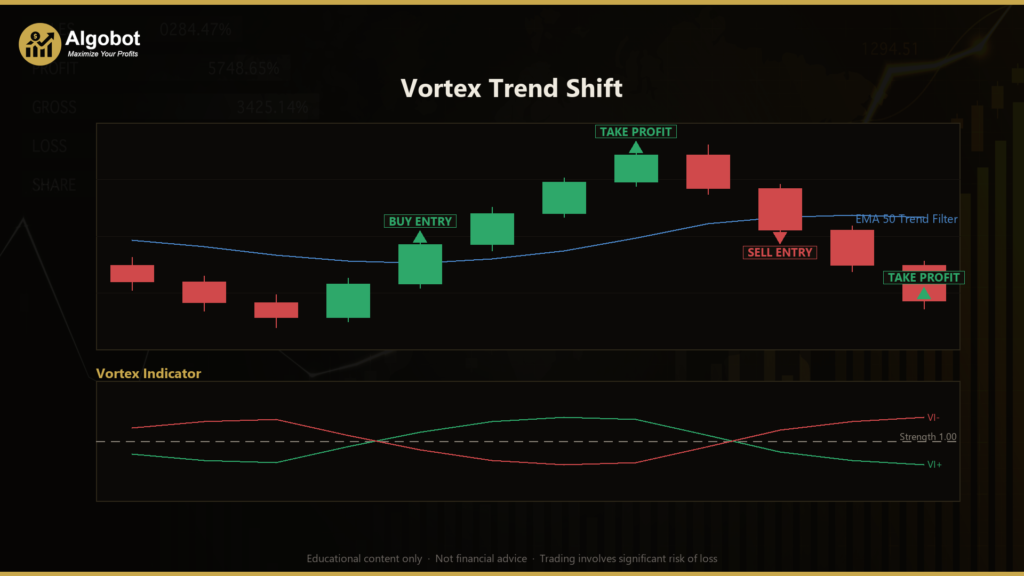
The strategy acts only once per closed bar and uses only confirmed, completed bars in its calculations, so its signals do not repaint (they will not change after the fact). Entries are "triple-gated," meaning three separate conditions must all agree before a position is opened.
Entry conditions (long):
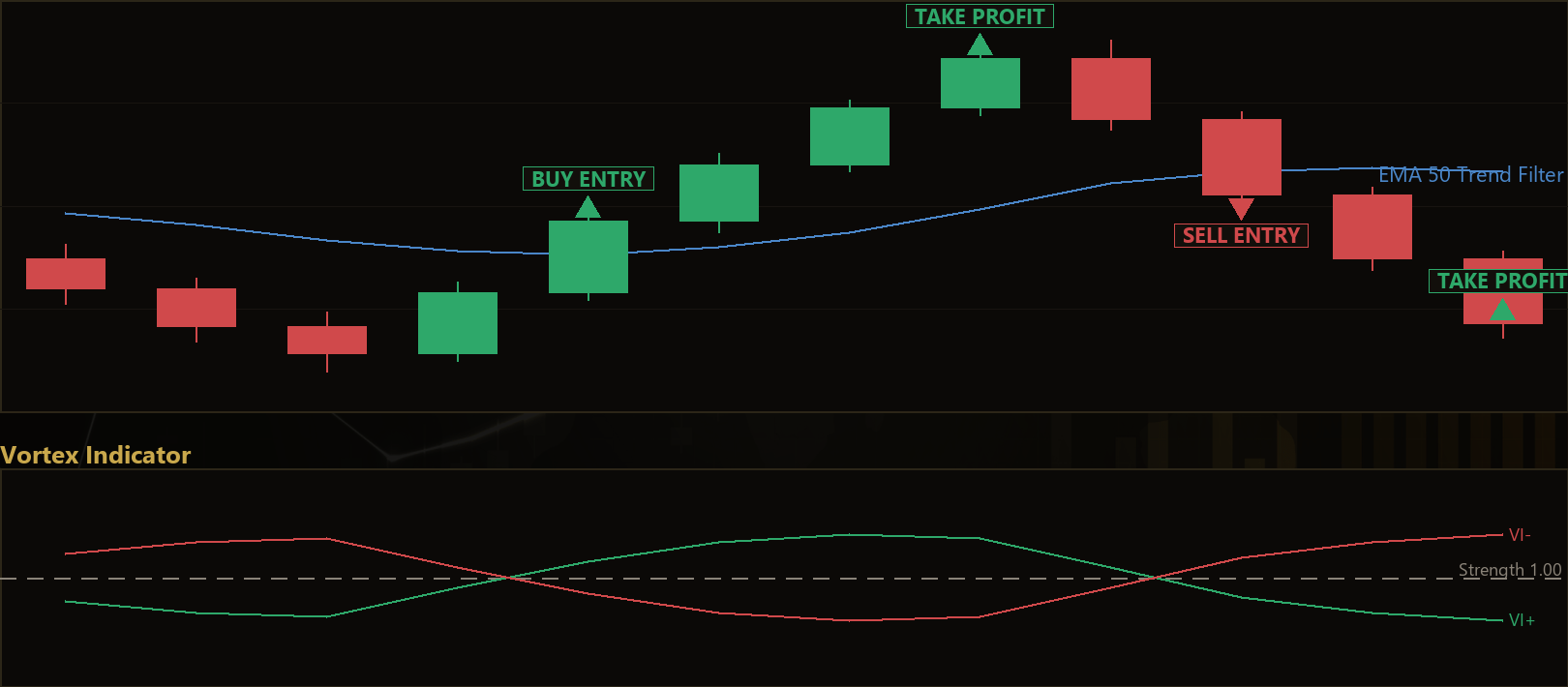
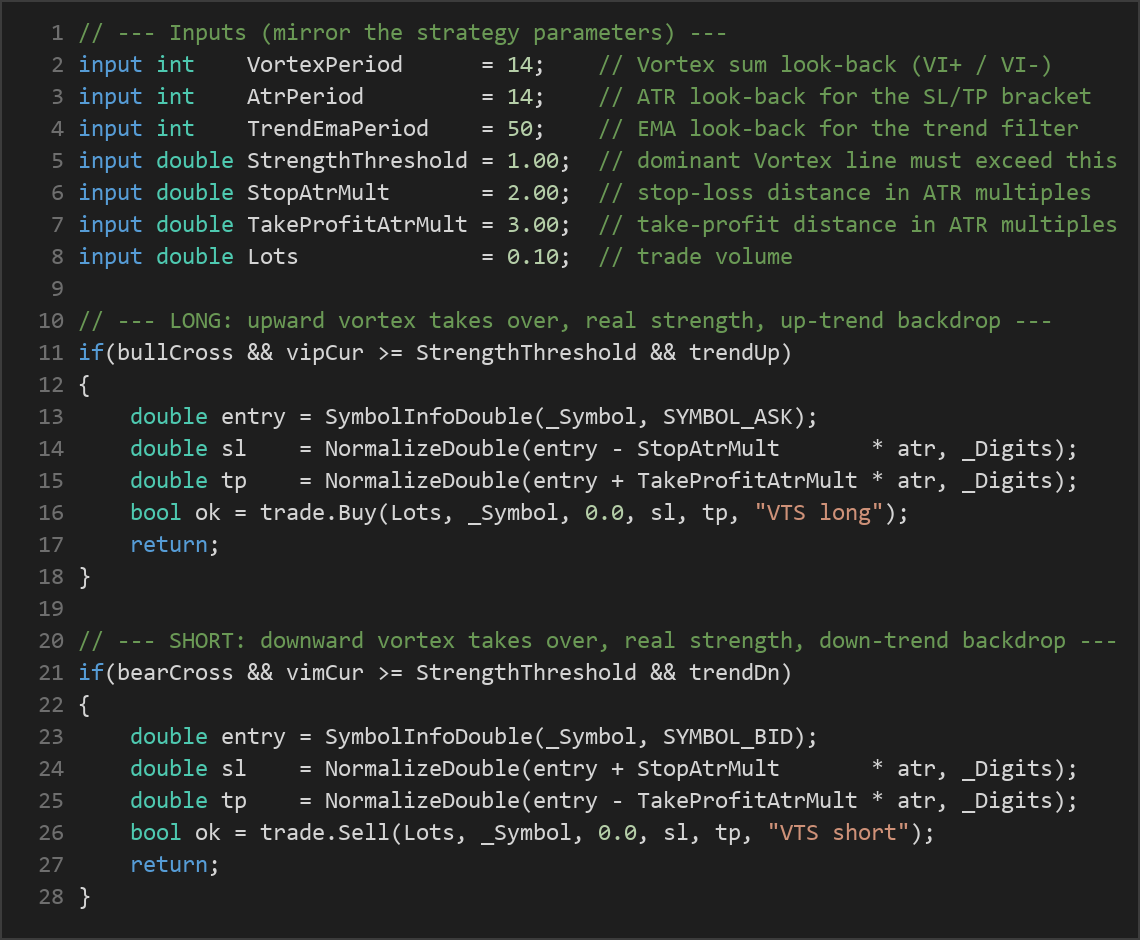
- Confirmed cross — On the just-closed bar, the upward Vortex line (VI+) crosses above the downward Vortex line (VI−). This signals that upward directional pressure has just taken over.
- Strength — The newly dominant VI+ line must be at or above the
StrengthThreshold. A reading above 1.0 indicates genuine directional pressure rather than a flat-market brush. - Trend backdrop — The closing price must be above a longer exponential moving average (EMA), confirming the trade agrees with the broader uptrend.
Entry conditions (short): the mirror image — VI− crosses above VI+, VI− clears the strength threshold, and price is below the EMA.
Exit logic:
- Momentum flip — If an opposing confirmed cross occurs while a position is open (for example, a bearish cross while long), the strategy closes the trade early because directional momentum has reversed.
- Volatility bracket — If no flip occurs, the trade is managed by its stop-loss and take-profit levels, described below.
Stop-loss logic: When a trade opens, the stop is placed a multiple of the Average True Range (ATR) away from entry (StopAtrMult × ATR). ATR measures recent volatility, so the stop automatically widens in fast markets and tightens in calm ones — no fixed point size is hard-coded.
Take-profit logic: The target is set at TakeProfitAtrMult × ATR from entry. With the default settings, the target distance is larger than the stop distance, giving the bracket a reward-to-risk ratio greater than one.
The strategy holds one trade at a time. Once a position closes, it re-arms and waits for the next qualifying signal on a following bar.
Strategy Parameters
| Parameter | Default | Min | Max | Description |
|---|---|---|---|---|
| VortexPeriod | 14 | 7 | 30 | Look-back window for the Vortex sums (VI+ / VI−). Shorter values react faster but are noisier. |
| AtrPeriod | 14 | 7 | 30 | Look-back for the ATR used to size the stop-loss and take-profit bracket. |
| TrendEmaPeriod | 50 | 20 | 200 | Look-back for the EMA trend filter. Larger values demand a stronger, longer backdrop. |
| StrengthThreshold | 1.00 | 0.90 | 1.30 | Minimum value the newly dominant Vortex line must reach to confirm real directional pressure. |
| StopAtrMult | 2.00 | 1.00 | 5.00 | Stop-loss distance as a multiple of ATR. |
| TakeProfitAtrMult | 3.00 | 1.00 | 8.00 | Take-profit distance as a multiple of ATR. |
| Lots | 0.10 | 0.01 | 1.00 | Trade volume in lots. |
| Magic | 7314 | 0 | 9,999,999 | Unique identifier so the EA manages only its own trades. |
Recommended Chart Settings
Vortex Trend Shift was designed with a trending FX major or metal — for example EURUSD or XAUUSD — on the H1 (1-hour) timeframe in mind. That said, the logic is fully timeframe-agnostic: because every calculation is normalized by true range and the risk bracket is scaled by ATR, the strategy runs on whatever symbol and timeframe you attach it to.
Different instruments and periods behave very differently, so treat the H1 setting as a starting point for study rather than a fixed recommendation. Results will vary across market conditions, and a configuration that historically suited one instrument may behave quite differently on another. Always test any change on the specific symbol and timeframe you intend to study before drawing conclusions.
How to Install on MetaTrader 5
- Download the
.ex5file from the link below. - Copy it to your MT5
MQL5\Expertsfolder. - Restart MetaTrader 5 or refresh the Navigator panel.
- Drag the EA onto a chart matching the recommended symbol and timeframe.
- Configure the input parameters and enable Algo Trading.
What to Consider Before Using This EA
Strengths. The Vortex Indicator is a genuine directional-movement tool, not a lagging average, so it can flag a shift in control relatively early. The triple gate — cross, strength, and trend agreement — is designed to filter out many of the low-quality crossovers that a raw Vortex signal would generate on its own. The ATR-based bracket means the risk logic adapts to each instrument's volatility automatically, and the "never repaint" design (using only closed bars) makes the signals honest to backtest.
Known limitations. Like all trend-following systems, Vortex Trend Shift is vulnerable in choppy, range-bound markets. When price oscillates without direction, VI+ and VI− can cross back and forth, and even with the strength and EMA filters some whipsaw losses are likely. The EMA trend filter also introduces lag: in a sharp reversal, price may already be moving against the prevailing trend before the filter allows an entry in the new direction. Because the system takes only one trade at a time, it can also sit out extended periods while a single position runs its course.
Where it may underperform. Expect weaker behavior during low-volatility consolidation, around major news spikes that produce erratic bars, and on instruments that mean-revert rather than trend. No single parameter set is optimal across all regimes — a setting that historically handled trending conditions well may struggle when the market turns sideways. Understanding why a signal fired (or failed) matters more than chasing a "perfect" configuration.
Risk Management Tips
Sound risk management matters more than any single indicator. Consider the following general principles as part of your education:
- Risk a small, fixed fraction per trade. Many educational sources suggest risking no more than 1–2% of account equity on any single position, so that a string of losses does not deplete the account.
- Size positions to the stop, not the other way around. Because the stop distance here is driven by ATR, your lot size should follow from how much you are willing to risk relative to that stop — not from a habit of always trading the same volume.
- Test on a demo account first. Study the strategy in a risk-free simulated environment until you understand its behavior across different market conditions before considering any live use.
- Understand drawdown. Every strategy experiences losing streaks. Know the historical drawdown of your test configuration and ask yourself whether you could tolerate it emotionally and financially.
- Diversify and avoid over-leverage. Concentrating risk in one instrument or using excessive leverage magnifies both losses and the psychological pressure that leads to mistakes.
The goal of studying a system like this is to learn how structured entries, filters, and volatility-scaled risk fit together — not to seek a shortcut.
Risk Warning
Trading foreign exchange, CFDs, and other leveraged financial instruments involves substantial risk of loss and is not suitable for all investors. The strategies and tools discussed on this page are provided for educational purposes only and do not constitute financial advice, investment recommendations, or solicitation to trade. Always consult a qualified financial adviser before making trading decisions. Past backtest performance is not indicative of future results.
Downloads
- Expert Advisor: VortexTrendShift.ex5 (2 downloads)
- Source Code: VortexTrendShift.mq5 (2 downloads)
- Documentation: VortexTrendShift.pdf (3 downloads)