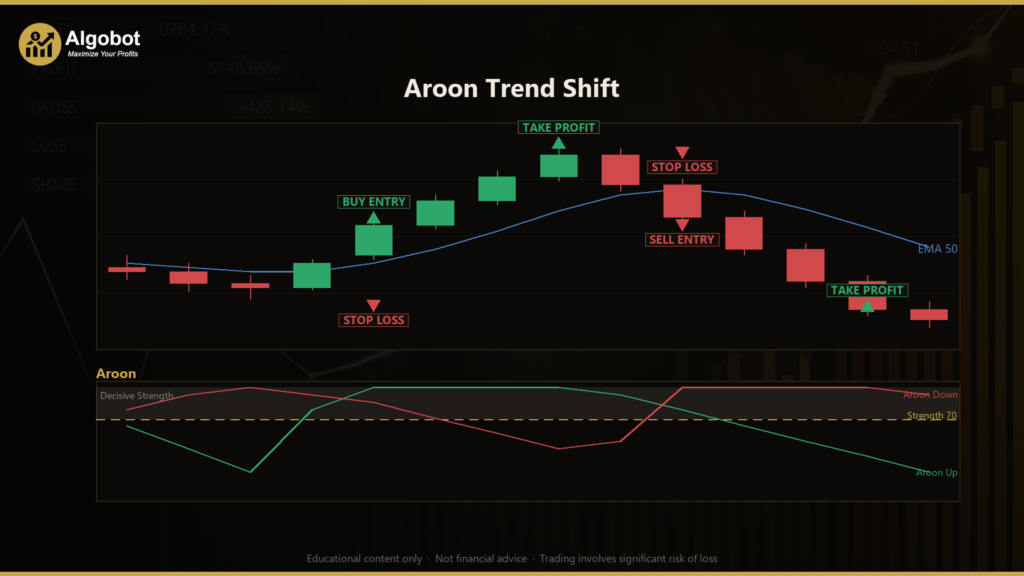
Disclaimer: This article is for educational and informational purposes only. It does not constitute financial or investment advice. Trading forex and CFDs carries significant risk of loss. Past performance of any strategy — including backtests — does not guarantee future results. Never trade with money you cannot afford to lose.
What Is This Strategy?
Aroon Trend Shift is a trend-following expert advisor built around the Aroon indicator, a tool developed by Tushar Chande in 1995 that measures how recently a market printed a new high or low rather than how far price has moved. The Aroon indicator produces two lines — Aroon Up and Aroon Down — each scaled from 0 to 100. A reading near 100 means a fresh extreme was just made, while a reading near 0 means the last extreme is old and the current move may be losing energy. Aroon Trend Shift uses the relationship between these two lines to identify the moment when directional control appears to change hands.
The strategy is designed for trending market conditions on liquid instruments — think major currency pairs or metals such as gold — on higher timeframes like the H1 chart and above. It is not a scalping system and it is not intended for tight, range-bound markets where price chops sideways without committing to a direction. Instead, it waits for evidence that one side of the market is consistently making the more recent extreme, then layers additional filters on top of that signal before it acts.
As a learning tool, Aroon Trend Shift is useful for traders who want to study multi-condition confirmation logic: how combining an indicator crossover with a strength threshold and an independent trend filter can reduce the number of low-quality signals. This article analyzes how the strategy is constructed and what its behavior implies — it is a structural walkthrough, not a promise of results.
How It Works
Aroon Trend Shift only evaluates its logic on completed bars, ignoring the still-forming candle to avoid acting on prices that can still change. On each new bar it recalculates the Aroon lines, an Exponential Moving Average (EMA), and the Average True Range (ATR), then checks the following conditions.
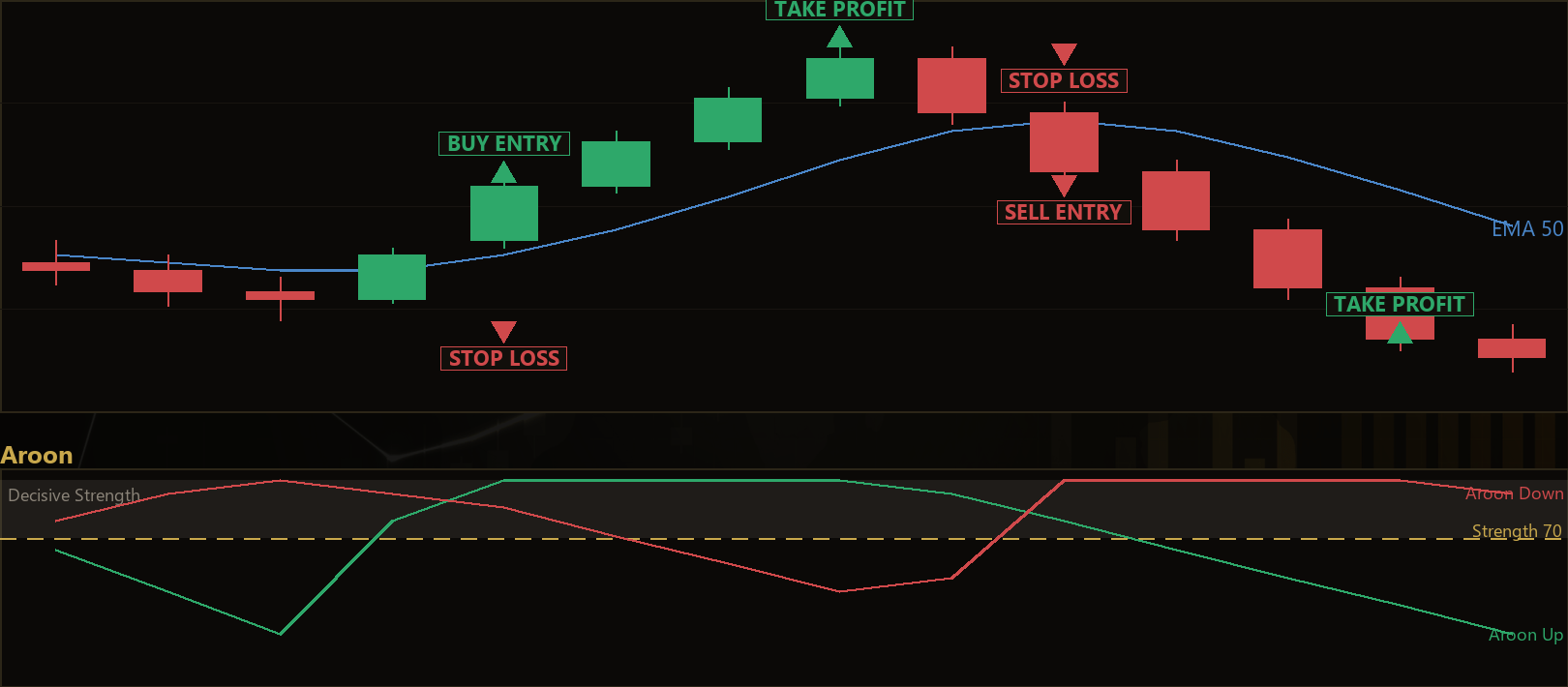
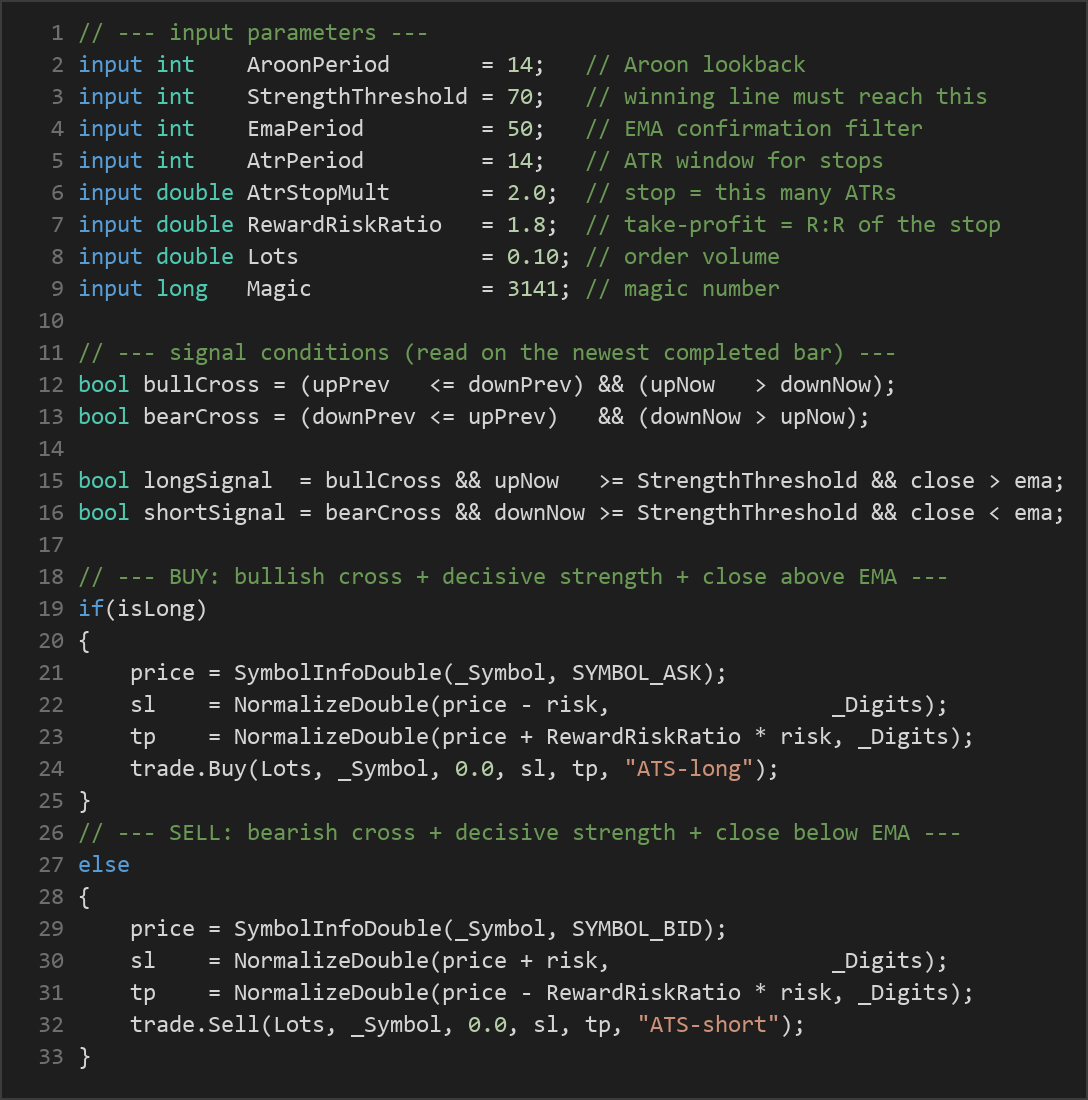
Entry — the strategy signals a long when all three of these agree:
- A bullish cross: Aroon Up crosses from at or below Aroon Down to above it. This is the "shift" — bulls are now making the more recent extreme.
- A decisive shift: Aroon Up must reach or exceed the strength threshold (default 70). This filters out marginal crossovers that happen inside noisy, directionless price action.
- Trend agreement: the completed bar must close above the EMA. This is a second, independent confirmation — price is on the bullish side of its own moving average.
A short signal is the exact mirror: a bearish cross (Aroon Down crossing above Aroon Up), Aroon Down at or above the threshold, and the bar closing below the EMA.
Exit and position handling:
- Stop-loss: placed a volatility-scaled distance from entry, equal to the ATR multiplied by the stop multiplier (default 2.0 ATRs). Using ATR means the stop automatically widens in volatile conditions and tightens in calm ones.
- Take-profit: set at a reward-to-risk multiple of that stop distance (default 1.8), so the target sits farther from entry than the stop.
- Breakeven lock: once price has travelled one full stop-distance (1R) in the trade's favour, the stop is pulled up (or down, for shorts) to the entry price. This is designed so that a trade which moved well before reversing does not turn a former gain into a loss.
- Opposite-shift close: if a confirmed opposite signal appears while a position is open, the strategy closes the current position. It stays flat for that bar, and a later confirmed bar may open a trade in the new direction. The system never stacks multiple positions in the same direction.
Strategy Parameters
| Parameter | Default | Min | Max | Description |
|---|---|---|---|---|
| AroonPeriod | 14 | 8 | 40 | Number of bars used to locate the most recent high and low for the Aroon calculation. Larger values react more slowly. |
| StrengthThreshold | 70 | 50 | 90 | The level the winning Aroon line must reach for the shift to count as "decisive." Higher values demand stronger, fresher extremes. |
| EmaPeriod | 50 | 20 | 120 | Length of the EMA trend filter. Price must close on the trade's side of this average for a signal to be valid. |
| AtrPeriod | 14 | 7 | 28 | Lookback window for the ATR used to size the stop-loss to current volatility. |
| AtrStopMult | 2.0 | 1.0 | 4.0 | Stop distance expressed as this many ATRs from the entry price. |
| RewardRiskRatio | 1.8 | 1.0 | 3.5 | Take-profit distance as a multiple of the stop distance (the reward-to-risk target). |
| Lots | 0.10 | 0.01 | 1.0 | Fixed order volume, in lots, for each trade. |
Recommended Chart Settings
Aroon Trend Shift was designed with liquid, trending instruments in mind — major forex pairs (such as EUR/USD or GBP/USD) and metals like gold — on the H1 timeframe or higher. Higher timeframes tend to produce cleaner Aroon crossovers and fewer false shifts than very short intraday charts, which suits a trend-following approach.
The expert advisor runs on whatever single timeframe you attach it to, so the chart period you choose directly shapes its behavior. Bear in mind that results will vary considerably across different symbols, timeframes, and market regimes. A setting that behaves well on a trending pair may struggle on a range-bound one, so treat any configuration as a starting point for your own study rather than a fixed recipe.
How to Install on MetaTrader 5
- Download the
.ex5file from the link below. - Copy it to your MT5
MQL5\Expertsfolder. - Restart MetaTrader 5 or refresh the Navigator panel.
- Drag the EA onto a chart matching the recommended symbol and timeframe.
- Configure the input parameters and enable Algo Trading.
What to Consider Before Using This EA
Strengths of the approach. The core idea behind Aroon Trend Shift is layered confirmation. Requiring a crossover, a strength threshold, and an EMA agreement means the strategy is deliberately selective — it is built to sit out marginal, noisy signals. The volatility-scaled stop adapts to changing market conditions, and the breakeven-lock rule is a sensible mechanism for protecting a trade once it has moved in your favour. The opposite-shift exit also gives the system a defined way to leave a trade when the market's character changes, rather than waiting only for a fixed stop or target.
Known limitations. Aroon, like all trend indicators, can whipsaw in sideways or choppy markets, where Aroon Up and Aroon Down cross back and forth without a durable trend forming. The EMA and strength filters reduce but do not eliminate this. Because the strategy only acts on completed bars, it inherently enters after a move has begun, so some of the initial thrust is missed by design. A fixed reward-to-risk target can also cut a strong trend short, while the fixed lot size means position risk in currency terms changes as your account balance and the instrument's volatility change.
Where it may underperform. Expect more false signals during low-volatility consolidations, around major news events that produce erratic spikes, and on instruments that trend poorly. The strategy is at its most coherent when a market is genuinely trending — which no market does all the time.
Risk Management Tips
Sound risk management matters more than any single indicator setting. Consider the following general principles as part of your education:
- Risk a small, fixed fraction per trade. Many educational resources suggest risking no more than 1–2% of account equity on any single position. Because Aroon Trend Shift uses a fixed lot size, you may need to adjust the
Lotsinput to keep your per-trade risk within that band as your balance or the instrument's volatility changes. - Test on a demo account first. Run the strategy on a demo or simulated account until you understand how it behaves across different conditions before considering any live capital.
- Understand drawdown. Every strategy experiences losing streaks. Study how deep and how long historical drawdowns can run so that a normal string of losses does not surprise you into abandoning your plan.
- Size for the worst case, not the best. Position sizing should assume that stops will be hit regularly, because in trend-following systems the majority of trades can be small losers offset by fewer, larger winners.
- Keep records. Logging your trades and reviewing them helps you learn far more than watching the equity curve alone.
Risk Warning
Trading foreign exchange, CFDs, and other leveraged financial instruments involves substantial risk of loss and is not suitable for all investors. The strategies and tools discussed on this page are provided for educational purposes only and do not constitute financial advice, investment recommendations, or solicitation to trade. Always consult a qualified financial adviser before making trading decisions. Past backtest performance is not indicative of future results.
Downloads
- Expert Advisor: AroonTrendShift.ex5 (45 downloads)
- Source Code: AroonTrendShift.mq5 (44 downloads)
- Documentation: AroonTrendShift.pdf (43 downloads)