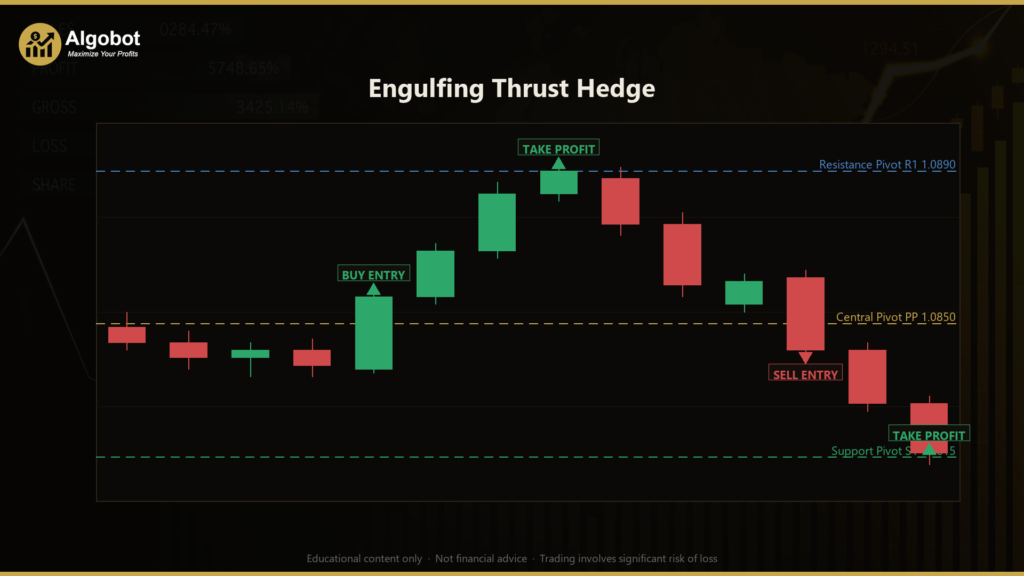
Disclaimer: This article is for educational and informational purposes only. It does not constitute financial or investment advice. Trading forex and CFDs carries significant risk of loss. Past performance of any strategy — including backtests — does not guarantee future results. Never trade with money you cannot afford to lose.
What Is This Strategy?
The Engulfing Thrust Hedge is a pure price-action scalping strategy that combines the engulfing candlestick pattern with floor pivot points to trade momentum breakouts on the MetaTrader 5 platform. An engulfing candle is a single bar whose body completely "swallows" the body of the candle before it, signalling that one side of the market has suddenly taken control. A floor pivot is a reference price — calculated from a recent high, low, and close — that traders historically use to separate bullish from bearish territory. This strategy uses no traditional indicators at all: there is no moving average, RSI, ATR, or Bollinger Band anywhere in its logic. Every decision is derived directly from raw candle prices.
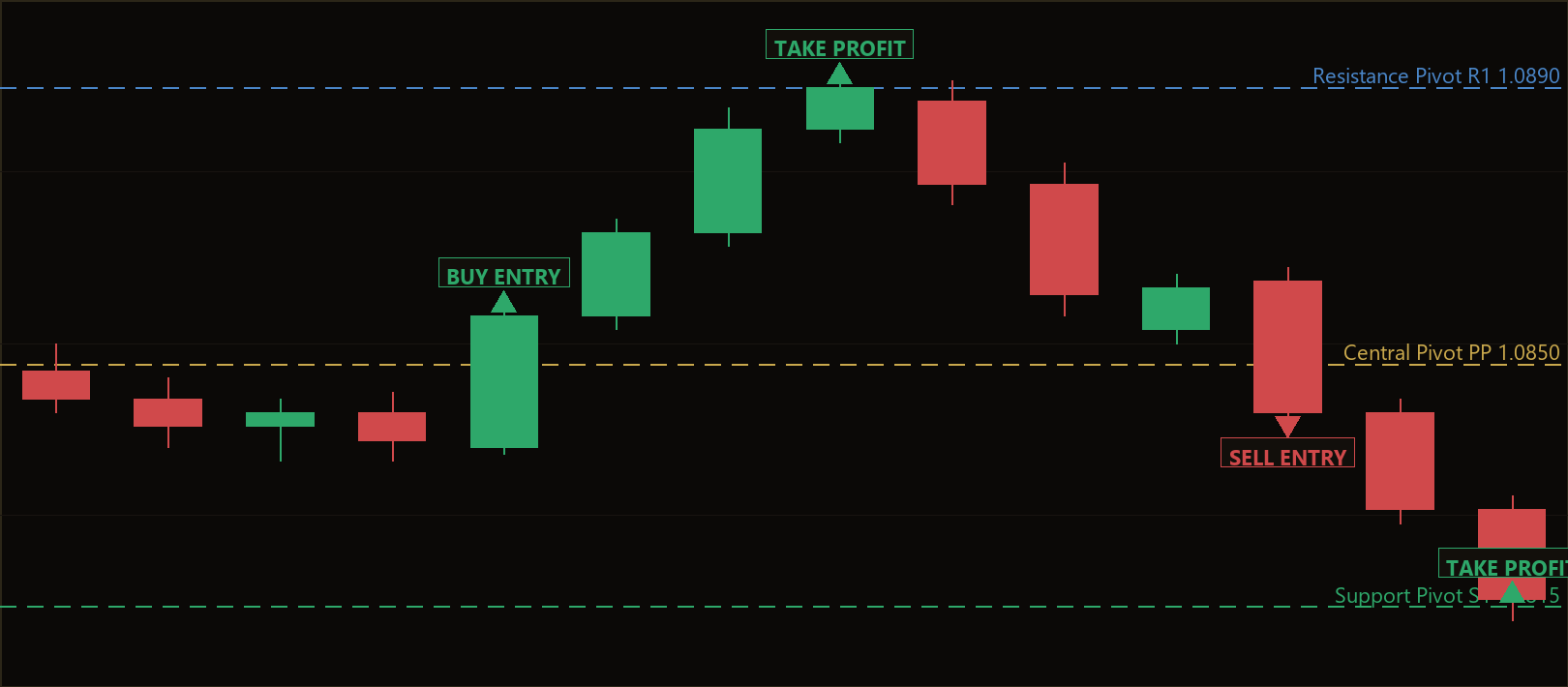
The strategy is designed for liquid, momentum-prone markets where decisive moves and occasional false breaks alternate. Think of major forex pairs such as EUR/USD or GBP/USD, or gold (XAU/USD), traded on intraday timeframes like M5, M15, or M30. The core idea is that the central pivot (called PP) acts as an intraday battle line. When a strong engulfing candle closes cleanly across that line, it may indicate that a genuine thrust has begun — and the strategy scalps the continuation toward the next pivot level.
As a learning tool, the Engulfing Thrust Hedge is best suited to traders who already understand basic candlestick reading and want to study how breakout entries, false-break protection, and basket-level money management can be combined into a single rule set. It is most valuable as a study of mechanics — how a thrust is defined, what makes a break "false," and how a hedge can convert a trapped position into a managed one. This article frames the strategy as an analysis of those mechanics, not as a profit opportunity.
How It Works
The strategy recomputes its floor pivots on every newly closed bar, then looks for one specific setup. Here is the logic in plain English.
Calculating the levels:
- Over the most recent closed bars (set by
PivotLookback), ending one bar before the signal candle, the strategy records the highest high (H), the lowest low (L), and the window's last close (C). - It then computes the classic floor pivots: PP = (H + L + C) / 3, R1 = 2 × PP − L (resistance above), and S1 = 2 × PP − H (support below).
- The pivot "range" (R1 − S1, which equals H − L) is used to size every buffer, so the strategy automatically scales to any symbol or timeframe without hard-coded pip values.
Entry conditions (the strategy only enters when completely flat):
- Long signal: the prior window sat at or under PP, and the just-closed candle is a bullish engulfing bar whose body is large enough (set by
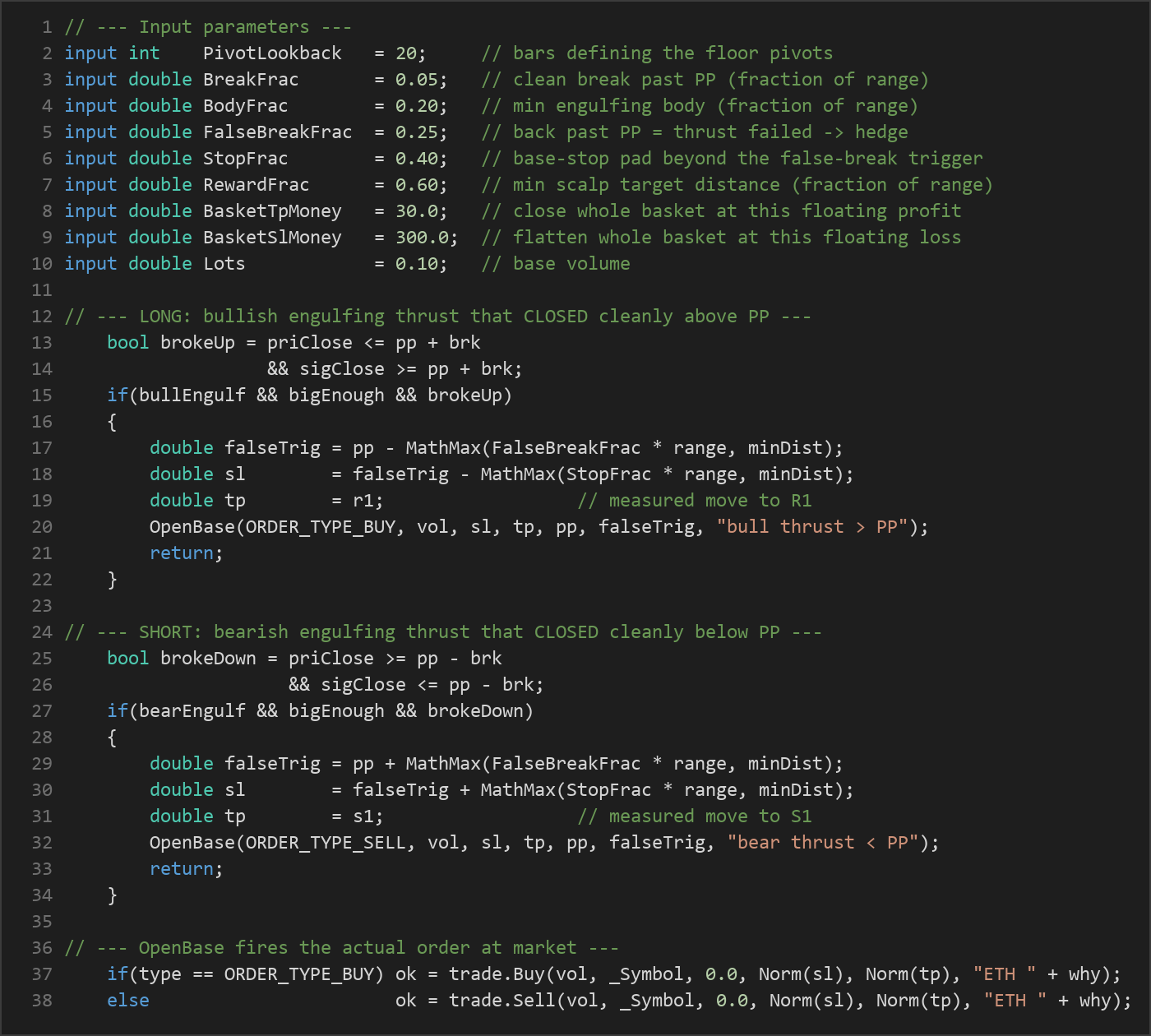
BodyFrac) and that closes a clean fraction of a range above PP (set byBreakFrac). This signals that buyers seized control through the pivot. - Short signal: the just-closed candle is a bearish engulfing bar that closes a clean fraction of a range below PP. This signals that sellers seized control through the pivot.
- The strategy will skip new entries if the spread (in points) is wider than
MaxSpreadPoints.
Stop-loss logic:
- The base stop is placed a structural pad beyond the false-break trigger, so that the hedge mechanic always engages first if price reverses. The pad distance is controlled by
StopFrac, with a minimum-distance floor enforced by the broker's stop level.
Take-profit logic:
- The base target is the outer pivot — R1 for longs, S1 for shorts — representing a measured move toward the next level.
- A minimum reward floor (
RewardFrac) guarantees the target is never placed unreasonably close to entry.
The hedge — the signature mechanic:
- While the single base leg is open, if price travels back beyond PP by
FalseBreakFracof a range, the thrust is treated as a false break. The strategy then opens an opposite market leg, so it now holds both directions at once — a genuine locked hedge that rides the rejection the other way and offsets the trapped base leg. - The hedge leg's own stop is placed where price would reclaim PP (set by
ReclaimFrac), invalidating the reversal idea.
Basket money management (the dominant exit):
- Once any exposure is held, net floating profit and loss across all legs is monitored on every tick.
- If net floating profit reaches
BasketTpMoney, the strategy closes everything. - If net floating loss reaches
BasketSlMoney, the strategy flattens everything — a hard ceiling on hedge risk, because the failure mode is a strong one-way trend after the hedge locks.
Strategy Parameters
| Parameter | Default | Min | Max | Description |
|---|---|---|---|---|
| PivotLookback | 20 | 5 | 150 | Number of closed bars whose high/low/close define the floor pivots; the window ends one bar before the signal candle. |
| BreakFrac | 0.05 | 0.00 | 0.60 | How far past PP the engulfing close must land (as a fraction of the pivot range) to count as a clean break. |
| BodyFrac | 0.20 | 0.02 | 1.50 | Minimum engulfing body size (as a fraction of the pivot range) so the thrust is real, not noise. |
| FalseBreakFrac | 0.25 | 0.05 | 1.50 | Distance back beyond PP that confirms the thrust failed and triggers the reversal hedge. |
| StopFrac | 0.40 | 0.05 | 2.50 | Extra base-stop pad placed beyond the false-break trigger (fraction of the pivot range). |
| RewardFrac | 0.60 | 0.20 | 4.00 | Minimum reward distance for the base scalp target (fraction of the pivot range). |
| ReclaimFrac | 0.35 | 0.05 | 1.50 | Hedge invalidation pad: if price reclaims PP by this amount, the reversal hedge is deemed wrong. |
| BasketTpMoney | 30.0 | 5.0 | 2000.0 | Net floating profit (in account currency) at which the whole basket is closed. |
| BasketSlMoney | 300.0 | 50.0 | 100000.0 | Net floating loss (in account currency) at which the whole basket is flattened. |
| MaxSpreadPoints | 50 | 0 | 500 | Skip new entries while the spread (in points) exceeds this value; 0 disables the filter. |
| Lots | 0.10 | 0.01 | 1.00 | Trade volume in lots for each leg. |
| Magic | 8310 | 0 | 9999999 | Unique identifier so the EA manages only its own positions. |
Recommended Chart Settings
The Engulfing Thrust Hedge was designed for liquid, momentum-prone FX majors such as EUR/USD or GBP/USD, as well as gold (XAU/USD), on intraday timeframes of M5, M15, or M30. These are markets where decisive pivot thrusts and the occasional fakeout tend to alternate, which is the behaviour the strategy's rules are built around.
Because the strategy uses a locked hedge — holding both a long and a short leg at the same time — it requires a hedging account, not a netting account. On a netting account the opposite leg would simply cancel the first, and the signature mechanic would not function as intended. Remember that results will vary considerably across different symbols, brokers, and market conditions, so any settings should be studied carefully on historical data and a demo account before drawing conclusions.
How to Install on MetaTrader 5
- Download the .ex5 file from the link below
- Copy it to your MT5
MQL5\Expertsfolder - Restart MetaTrader 5 or refresh the Navigator panel
- Drag the EA onto a chart matching the recommended symbol and timeframe
- Configure the input parameters and enable Algo Trading
What to Consider Before Using This EA
Every strategy involves trade-offs, and an honest study of this one should weigh both sides.
Strengths of this approach:
- It is fully rules-based and uses only raw price action, which makes it transparent and easy to reason about — there are no lagging indicator calculations to second-guess.
- The pivot-range scaling means buffers adapt to each symbol and timeframe automatically, avoiding brittle pip hard-coding.
- The false-break hedge is a thoughtful attempt to address the single biggest weakness of breakout systems: the fakeout that traps the breakout crowd.
Known limitations:
- Engulfing patterns and pivot breaks are common, but not every one leads to a clean continuation. In choppy, range-bound conditions the strategy may take repeated losing entries around the pivot.
- The hedge converts a trapped position into a locked pair, but a locked hedge is not free protection. Its true risk is a strong one-way trend that develops after the hedge engages — both legs can move against the basket's profit target, and the only backstop is the
BasketSlMoneyflatten. - Basket money targets are expressed in fixed account-currency amounts. These must be matched sensibly to your lot size and account; defaults that suit one account may be far too large or small for another.
- Holding two legs at once means paying spread and potentially swap on both, which adds friction.
This strategy is best treated as an educational framework for studying breakout-versus-fade dynamics — not as a finished, hands-off system.
Risk Management Tips
Sound risk management matters more than any single entry rule. Whatever strategy you study, consider these widely taught principles:
- Size positions conservatively. A common guideline is to risk no more than 1–2% of account equity on any single idea, including the combined exposure of both hedge legs.
- Test on a demo account first. Run the EA on a demo or historical data for an extended period before considering real capital, so you can observe how it behaves through different market conditions.
- Understand drawdown. Even a well-constructed strategy will have losing streaks. Know the maximum drawdown you are willing to tolerate, and set
BasketSlMoneyin line with it. - Match parameters to your account. Ensure the basket money targets and lot size are appropriate for your balance, not left at defaults out of convenience.
- Never rely on a single strategy. Diversification across approaches and instruments can reduce the impact of any one system underperforming.
Risk Warning
Trading foreign exchange, CFDs, and other leveraged financial instruments involves substantial risk of loss and is not suitable for all investors. The strategies and tools discussed on this page are provided for educational purposes only and do not constitute financial advice, investment recommendations, or solicitation to trade. Always consult a qualified financial adviser before making trading decisions. Past backtest performance is not indicative of future results.
Downloads
- Expert Advisor: EngulfingThrustHedge.ex5 (40 downloads)
- Source Code: EngulfingThrustHedge.mq5 (44 downloads)
- Documentation: EngulfingThrustHedge.pdf (49 downloads)