Disclaimer: This article is for educational and informational purposes only. It does not constitute financial or investment advice. Trading forex and CFDs carries significant risk of loss. Past performance of any strategy — including backtests — does not guarantee future results. Never trade with money you cannot afford to lose.
What Is This Strategy?
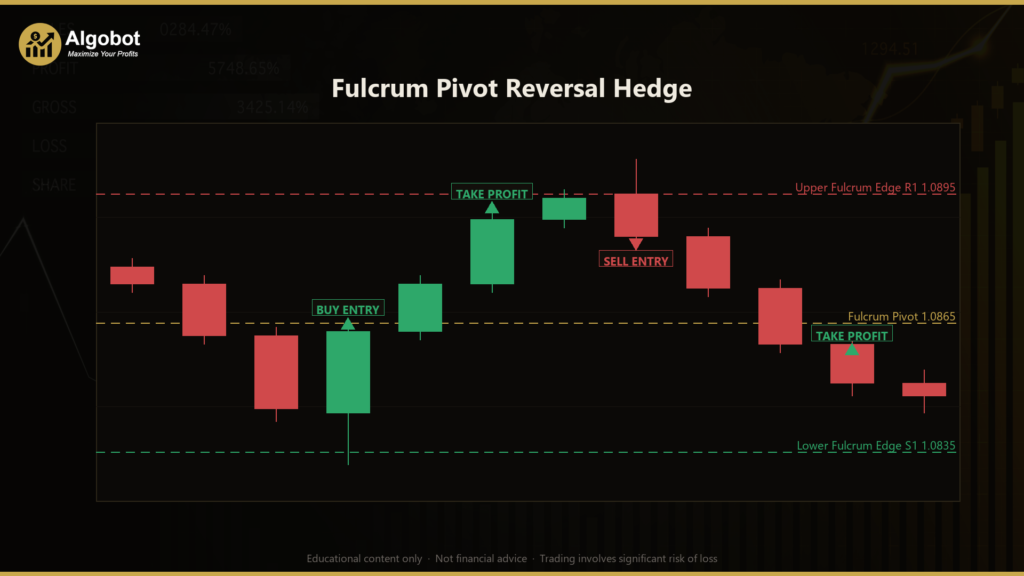
The Fulcrum Pivot Reversal Hedge is a pure price-action reversal scalping strategy that combines a rolling floor pivot (a classic support/resistance calculation derived from recent highs, lows, and closes) with the bullish and bearish engulfing candlestick pattern (a two-candle reversal signal where one candle's body fully covers the previous candle's body). It is built for short-term, intraday trading where price tends to swing back and forth around a central value rather than trend strongly in one direction.
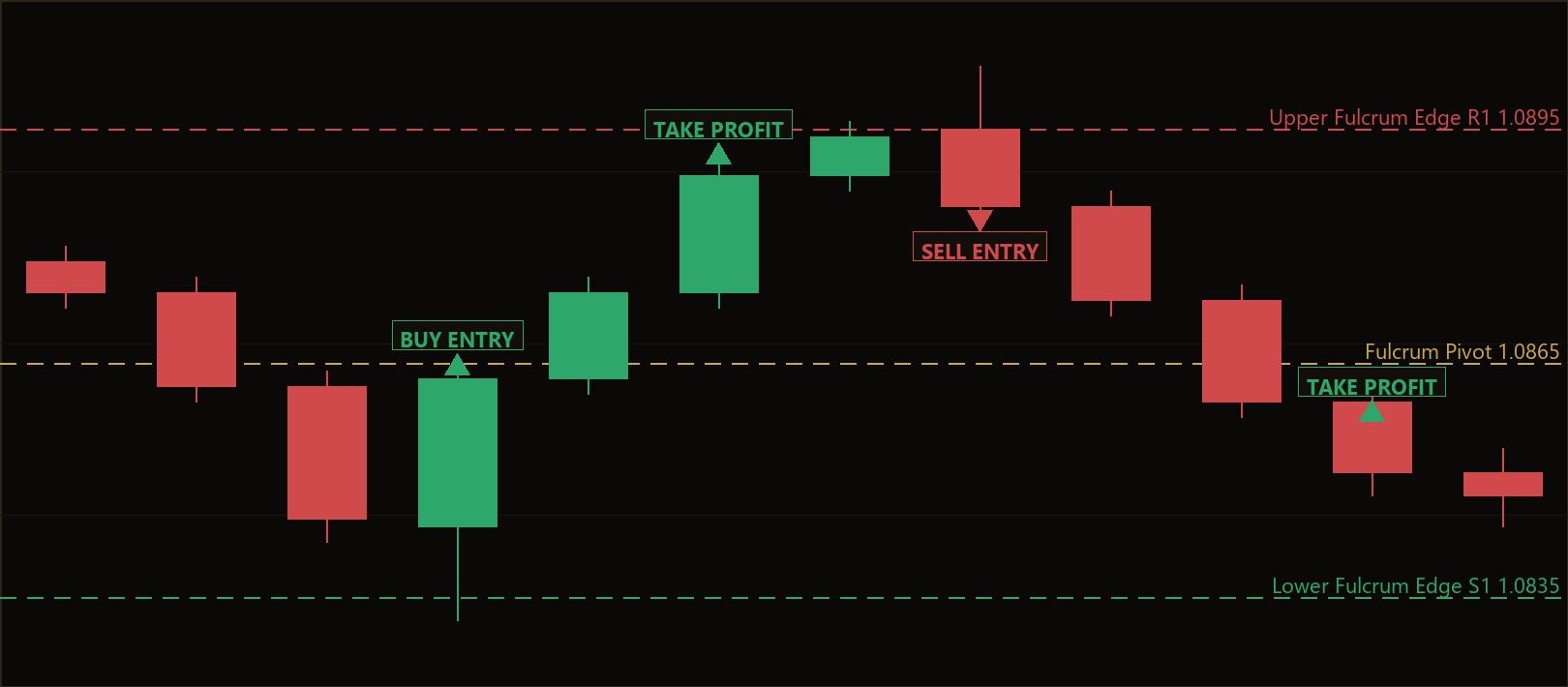
Instead of reading a separate higher timeframe to find "session" pivots, the strategy approximates a session by looking back over the last N completed bars on the chart you attach it to. From that window it derives a central pivot point (PP) and two outer edges — an upper resistance edge (R1) and a lower support edge (S1). Think of the pivot as a fulcrum: price is expected to lean toward one edge, get rejected, and rotate back toward the center. The engulfing pattern is the trigger that confirms a rejection has actually occurred before any order is placed.
This strategy is best suited to traders who want to study how pivot levels and candlestick reversals can be combined into a rules-based system, and who are curious about hedging logic. It is a learning tool, not a shortcut — the value is in understanding why each condition exists and how the pieces interact, so you can critique and stress-test the approach on your own.
How It Works
The strategy recalculates its pivot levels once per completed bar and manages any open hedge on every tick. Here is the full logic in plain English:
- Building the fulcrum pivot: On each new bar, the strategy scans the last PivotLookback completed bars to find the highest high (HH) and lowest low (LL). It then computes the central pivot
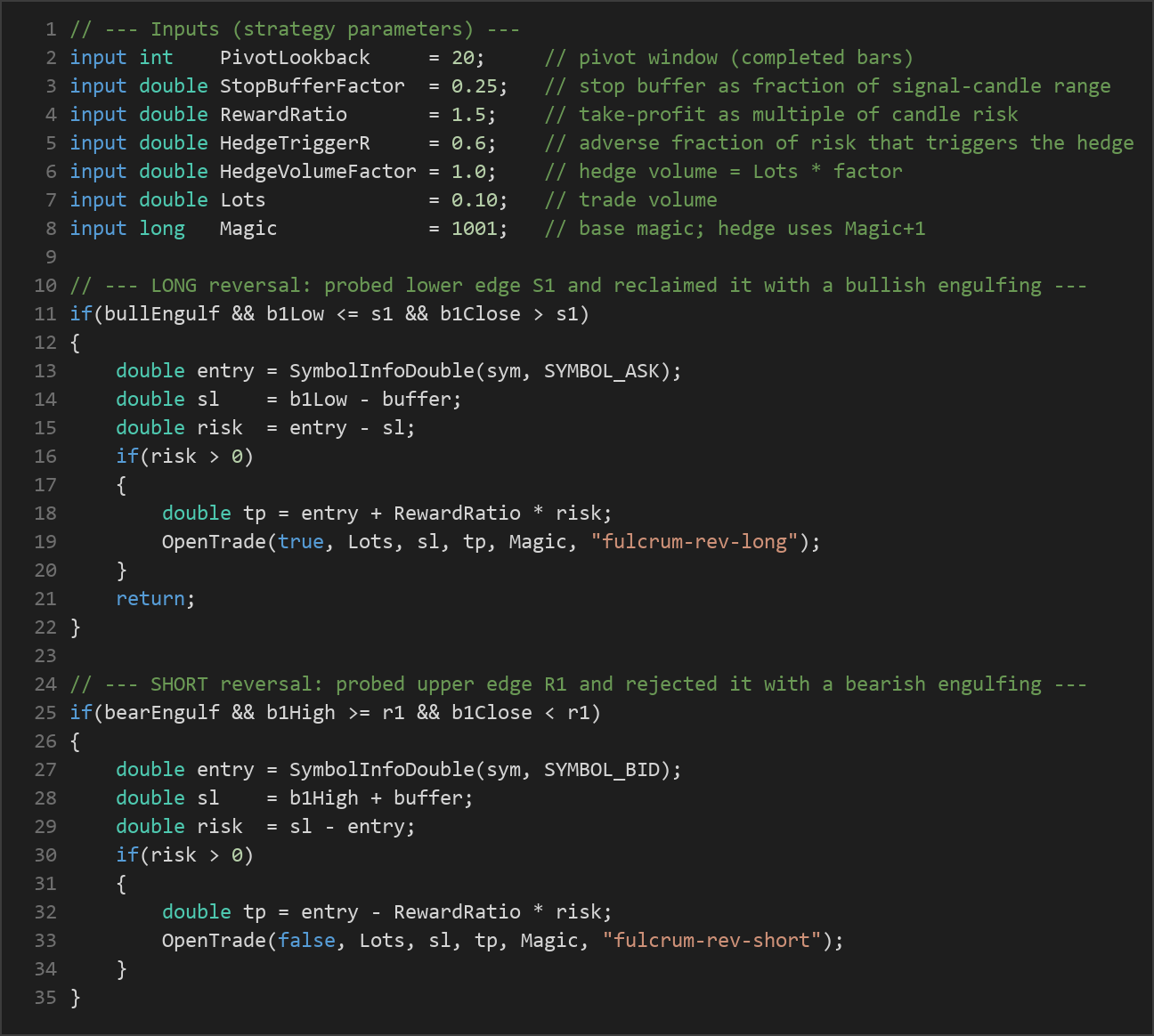
PP = (HH + LL + Close) / 3, the upper edgeR1 = 2 × PP − LL, and the lower edgeS1 = 2 × PP − HH. - The long (buy) signal: The strategy signals a reversal long when the most recent completed candle (the "signal candle") prints a bullish engulfing pattern, dips down to probe the lower edge S1, and then closes back above S1. This is read as the market testing support and being rejected upward, back toward the fulcrum.
- The short (sell) signal: The mirror image applies for shorts. The strategy signals a reversal short when the signal candle prints a bearish engulfing pattern, pushes up to probe the upper edge R1, and then closes back below R1 — a rejection of resistance.
- Stop-loss logic: Stops are taken directly from the signal candle's range, with no indicators involved. For a long, the stop sits a buffer below the candle's low (
signal low − StopBufferFactor × candle range). For a short, it sits a buffer above the candle's high. The buffer gives the trade a little breathing room beyond the raw pattern. - Take-profit logic: The take-profit is a reward multiple of the measured candle risk. The strategy measures the distance from entry to stop (the "risk"), then projects the target at
RewardRatio × riskin the trade's favor. A RewardRatio of 1.5, for example, aims for 1.5 units of reward per unit of risk. - One scalp at a time: The strategy only allows a single primary scalp open per symbol. It will not stack new reversal entries while one is already running — adverse moves are handled by the hedge engine instead.
The Hedge Mechanism
The "Hedge" in the name refers to a secondary, opposite-side position that activates only under specific conditions:
- When it triggers: If an open scalp drifts against you by a fraction of its initial risk (set by HedgeTriggerR) without being stopped out, the strategy interprets this as a possible breakout straight through the pivot rather than a clean reversal.
- What it does: It opens an opposite-side position on a separate magic number (the base Magic + 1), sized by HedgeVolumeFactor. This hedge is framed as a breakout-continuation trade: its take-profit extends in the breakout direction (two times the original risk), while its stop sits back at the original scalp's open price.
- The intended logic: If price genuinely recovers, the hedge closes cheaply near the scalp's open. If a real breakout follows, the hedge is positioned to offset the losing scalp. Only one hedge is opened per scalp cycle, and the hedge state resets once the primary position closes.
Strategy Parameters
| Parameter | Default | Min | Max | Description |
|---|---|---|---|---|
| PivotLookback | 20 | 10 | 60 | Number of completed bars used to compute the rolling fulcrum pivot (HH, LL, and pivot edges). |
| StopBufferFactor | 0.25 | 0.00 | 1.0 | Stop-loss buffer expressed as a fraction of the signal candle's range, added beyond the candle's high/low. |
| RewardRatio | 1.5 | 0.5 | 4.0 | Take-profit distance as a multiple of the measured candle risk (reward-to-risk target). |
| HedgeTriggerR | 0.6 | 0.2 | 1.0 | Adverse fraction of the scalp's initial risk that must be reached before the hedge is opened. |
| HedgeVolumeFactor | 1.0 | 0.5 | 2.0 | Hedge volume as a multiple of the scalp lot size (Lots × factor). |
| Lots | 0.10 | 0.01 | 1.0 | Base trade volume in lots for each reversal scalp. |
Recommended Chart Settings
The Fulcrum Pivot Reversal Hedge is designed as a single-timeframe strategy — every bar read uses the chart's own symbol and period, so there is no second timeframe to configure. Because it is a scalping/reversal approach that relies on a session-like lookback window, it is typically studied on lower intraday timeframes such as M5, M15, or M30, where pivot rotations and engulfing patterns occur frequently.
For the symbol, major forex pairs with tight spreads (for example EUR/USD or GBP/USD) are a common starting point for analysis, since wide spreads can erode the small targets a scalper aims for. That said, results will vary significantly across different symbols, brokers, spreads, and market conditions. Always test any timeframe and symbol combination thoroughly on historical data and a demo account before drawing conclusions.
How to Install on MetaTrader 5
- Download the .ex5 file from the link below
- Copy it to your MT5
MQL5\Expertsfolder - Restart MetaTrader 5 or refresh the Navigator panel
- Drag the EA onto a chart matching the recommended symbol and timeframe
- Configure the input parameters and enable Algo Trading
What to Consider Before Using This EA
A balanced look at the approach will serve you far better than any single backtest.
Strengths of this approach:
- Transparent, indicator-free logic. The pivot math and engulfing rules are simple to read and reason about, which makes the strategy an excellent teaching example of how price-action concepts translate into code.
- Defined risk per scalp. Every entry has a stop and target derived from the signal candle, so the intended risk is known before the trade is placed.
- Mean-reversion focus. In ranging or rotational markets, levels like S1 and R1 can act as natural turning points, and the engulfing filter helps avoid entering on weak touches.
Known limitations:
- Reversal strategies struggle in strong trends. When price breaks through a pivot and keeps going, repeated reversal entries can be caught on the wrong side. The hedge is an attempt to address this, but hedging adds complexity and is not a cure-all.
- Hedging is widely restricted. Some brokers and jurisdictions (notably US-regulated accounts under FIFO rules) do not permit holding opposite positions on the same symbol. Confirm your broker supports hedging before relying on this logic.
- Scalping is spread- and cost-sensitive. Small targets mean spread, commission, and slippage can have an outsized impact on outcomes.
- Engulfing patterns are common but not predictive. A pattern forming at a level may indicate a possible rejection, but historically many such patterns fail to follow through.
The honest takeaway: this is a useful framework for studying pivots, candlesticks, and hedging — not a finished system you should run unattended with real capital.
Risk Management Tips
Sound risk management matters more than any single entry rule. As you study this strategy, keep these principles in mind:
- Risk only a small fraction per trade. A common educational guideline is to risk no more than 1–2% of account equity on any single position. Adjust the Lots parameter so the distance to your stop reflects that limit.
- Account for the hedge's added exposure. Because the hedge opens a second position, your total exposure during an adverse move can exceed a single scalp. Factor that into your sizing.
- Always start on a demo account. Test the strategy in simulated conditions until you understand its behavior across trending and ranging markets before considering live capital.
- Understand drawdown. Even a well-designed strategy will have losing streaks. Know the largest equity decline you could tolerate, and how a sequence of losses (and hedges) would affect your balance.
- Never trade money you cannot afford to lose, and keep position sizes consistent rather than increasing them to recover losses.
Risk Warning
Trading foreign exchange, CFDs, and other leveraged financial instruments involves substantial risk of loss and is not suitable for all investors. The strategies and tools discussed on this page are provided for educational purposes only and do not constitute financial advice, investment recommendations, or solicitation to trade. Always consult a qualified financial adviser before making trading decisions. Past backtest performance is not indicative of future results.
Downloads
- Expert Advisor: FulcrumPivotReversalHedge.ex5 (50 downloads)
- Source Code: FulcrumPivotReversalHedge.mq5 (26 downloads)
- Documentation: FulcrumPivotReversalHedge.pdf (58 downloads)