Disclaimer: This article is for educational and informational purposes only. It does not constitute financial or investment advice. Trading forex and CFDs carries significant risk of loss. Past performance of any strategy — including backtests — does not guarantee future results. Never trade with money you cannot afford to lose.
What Is This Strategy?
The Wick Sweep Reversal Hedge is a pure price-action liquidity-sweep reversal strategy that uses candlestick structure and rejection wicks — not a traditional indicator — to time entries, paired with a built-in breakout hedge order. Instead of relying on moving averages, oscillators, or any calculated indicator, it reads raw candle anatomy: swing highs, swing lows, wick length, and body size. This makes it a useful teaching example for traders who want to understand how the market's "smart money" concept of a liquidity sweep can be expressed in objective, rule-based code.
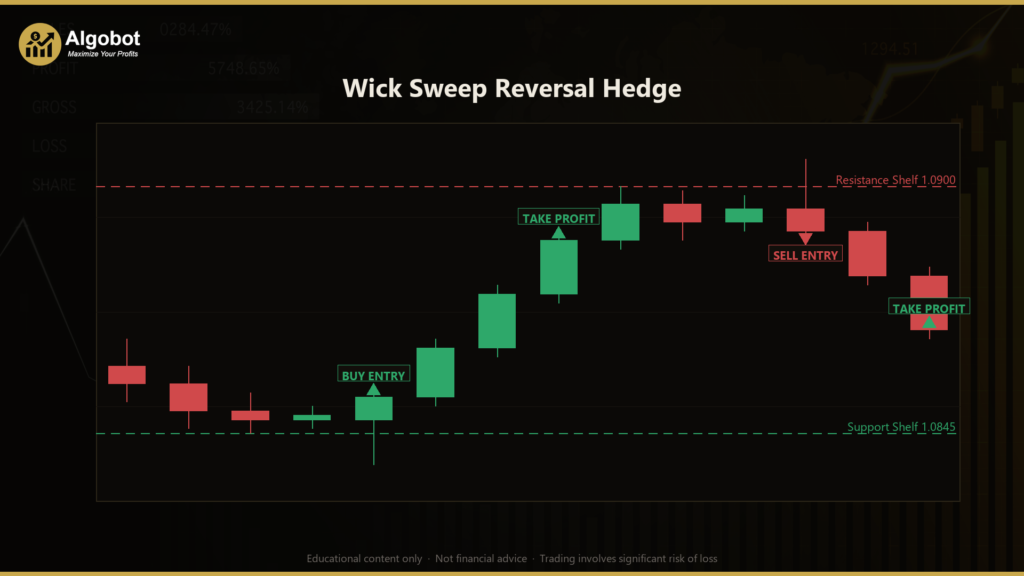
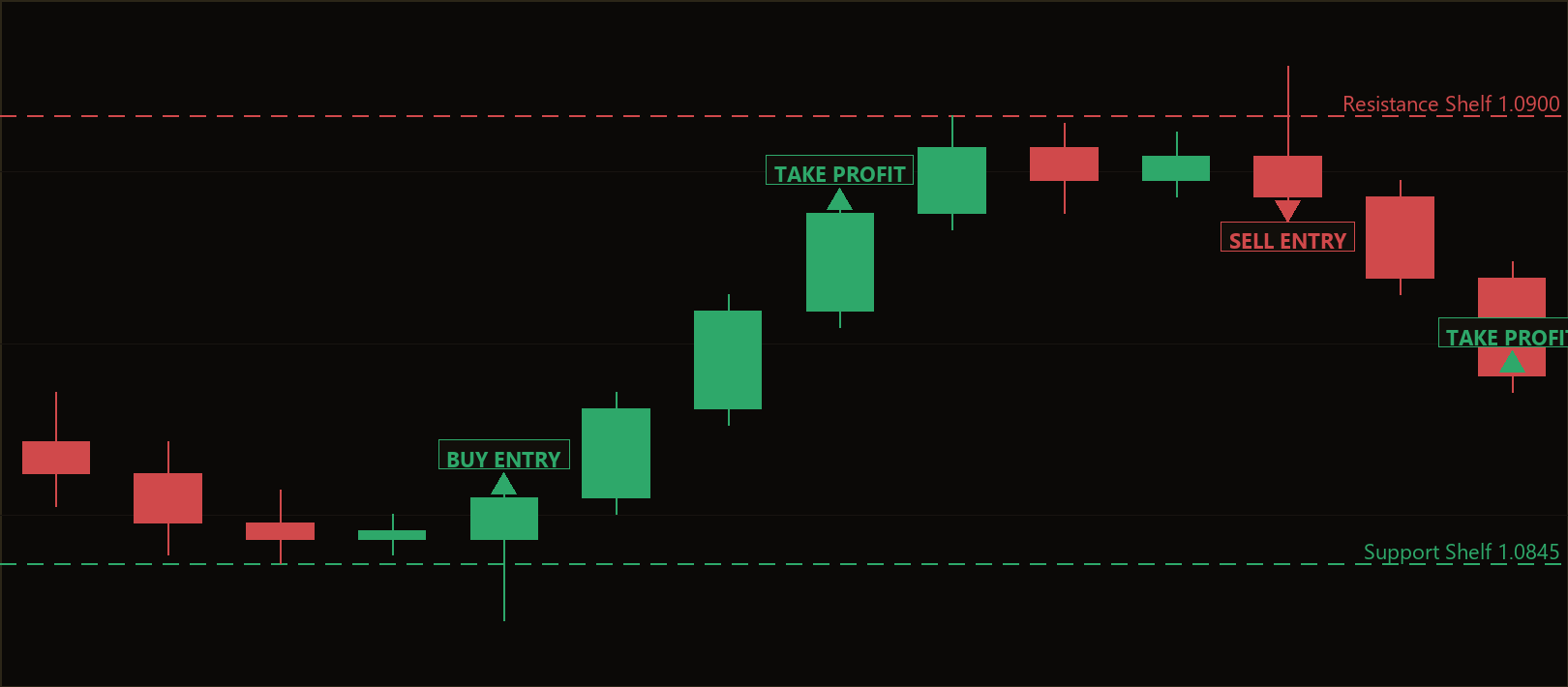
A liquidity sweep (sometimes called a stop hunt) happens when price briefly pokes beyond an obvious support or resistance level — triggering the stop-loss orders resting there — and then snaps back inside the range. The Wick Sweep Reversal Hedge is designed for markets that respect horizontal structure and frequently produce these false breakouts: ranging or rotational conditions where price repeatedly tests the edges of a band before reversing. It looks for a single candle that sweeps a recent swing extreme, rejects it with a dominant wick, and closes back inside with conviction.
As a learning tool, this strategy suits intermediate traders who already grasp basic candlestick reading and want to study how reversal logic, structure-based stops, and a hedging mechanism fit together in one automated system. It is not a "set and forget" money machine — it is a transparent, indicator-free framework for studying how false-breakout reversals can be defined and risk-managed mechanically.
How It Works
The strategy evaluates only closed candles on its chart timeframe, acting once per finished bar. When it is flat (no open position and no live order of its own), it scans for a fresh setup using the following logic.
Mapping the structure
- The strategy looks back over a window of recent candles (the
Lookbackparameter) and records the highest swing High and the lowest swing Low. These act as the resistance and support "shelves" where resting liquidity tends to sit. - It also averages the candle bodies across that same window to measure normal momentum.
Entry conditions — the strategy signals a long when:
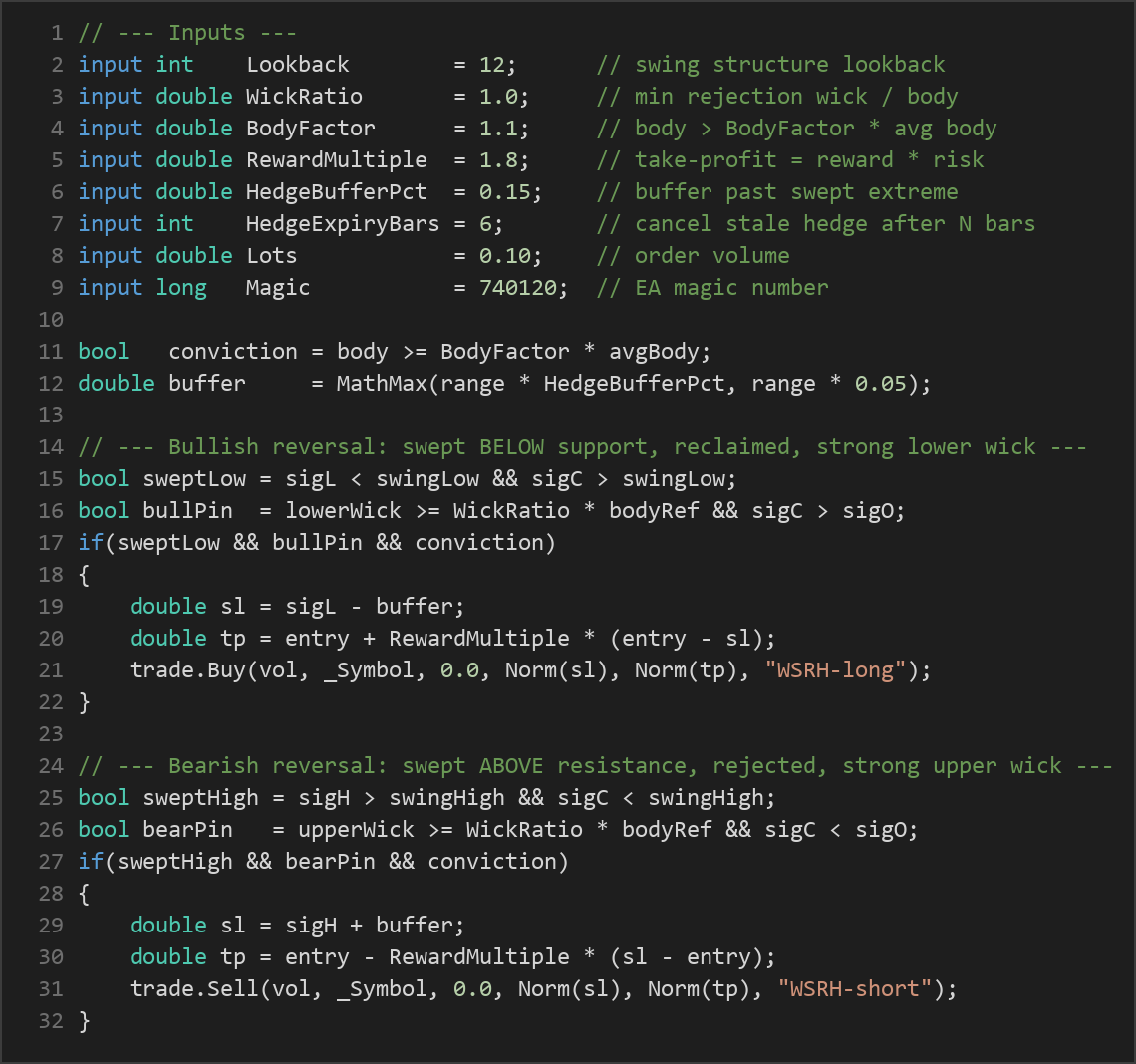
- The most recent closed candle (the "signal candle") dips its Low below the swing low (sweeping support) but closes back above it — a failed breakdown.
- The candle shows a dominant lower rejection wick at least
WickRatiotimes the size of its body, and it closes higher than it opened (a bullish reclaim). - The candle body shows conviction — it exceeds
BodyFactortimes the recent average body, signalling a decisive reclaim rather than a slow drift.
The strategy signals a short under the mirror conditions:
- The signal candle pushes its High above the swing high (sweeping resistance) but closes back below it — a failed breakout.
- It shows a dominant upper rejection wick of at least
WickRatiotimes the body and closes lower than it opened. - The body again exceeds
BodyFactortimes the average body for conviction.
Stop-loss logic
- For a long, the stop is placed just below the swept low, offset by a small buffer derived from the candle's range (
HedgeBufferPct). For a short, it sits just above the swept high. This is a structure-based stop: if price trades back beyond the swept extreme, the reversal idea is invalidated.
Take-profit logic
- The target is set at
RewardMultipletimes the measured risk (the distance from entry to stop). With the default of 1.8, the strategy seeks 1.8 units of reward for every 1 unit risked.
The hedge mechanism
- At the same time as the reversal entry, a stop order is parked just past the swept extreme — at the same price as the protective stop. If the "reversal" turns out to be a genuine breakout, the fade position stops out and the hedge order triggers, riding the continuation in the other direction to help recover the loss.
- If the reversal resolves normally without a breakout, the resting hedge becomes stale. The strategy cancels it automatically once it has aged past
HedgeExpiryBarsbars.
Because each order's price is validated against the broker's minimum stop distance, setups that would place a stop too tight for a given symbol are skipped rather than forced through.
Strategy Parameters
| Parameter | Default | Min | Max | Description |
|---|---|---|---|---|
| Lookback | 12 | 5 | 40 | Number of candles used to map the swing high/low structure and average body size. |
| WickRatio | 1.0 | 0.4 | 3.0 | Minimum size of the rejection wick relative to the candle body. Higher values demand a more dominant wick. |
| BodyFactor | 1.1 | 0.6 | 3.0 | The signal candle's body must exceed this multiple of the recent average body to confirm conviction. |
| RewardMultiple | 1.8 | 1.0 | 4.0 | Take-profit distance as a multiple of the risk (entry-to-stop distance). |
| HedgeBufferPct | 0.15 | 0.02 | 0.6 | Buffer placed beyond the swept extreme (as a fraction of the signal candle's range) for the stop and hedge. |
| HedgeExpiryBars | 6 | 1 | 30 | Number of bars after which an untriggered, stale hedge order is cancelled. |
| Lots | 0.10 | 0.01 | 1.0 | Fixed order volume in lots for both the reversal entry and the hedge. |
Recommended Chart Settings
The Wick Sweep Reversal Hedge was designed as a single-symbol, single-timeframe price-action study. Because liquidity sweeps are most readable on liquid instruments with clean structure, it is commonly explored on major forex pairs such as EUR/USD or GBP/USD. Intraday timeframes like the M15 or H1 tend to produce enough swing structure and false breakouts to study, while keeping the candle bodies meaningful relative to spread.
These are starting points for learning, not prescriptions. The behaviour of any sweep-based strategy will vary significantly across symbols, sessions, and market regimes. Trending markets, low-liquidity hours, and high-spread instruments can all change how often valid setups appear and how they resolve. Always test on the specific symbol and timeframe you intend to study before drawing conclusions.
How to Install on MetaTrader 5
- Download the .ex5 file from the link below
- Copy it to your MT5
MQL5\Expertsfolder - Restart MetaTrader 5 or refresh the Navigator panel
- Drag the EA onto a chart matching the recommended symbol and timeframe
- Configure the input parameters and enable Algo Trading
What to Consider Before Using This EA
Like every approach, the Wick Sweep Reversal Hedge has clear strengths and equally clear limitations, and understanding both is the point of studying it.
Strengths of this approach
- It is indicator-free and transparent: every decision traces back to candle structure you can see on the chart, which makes it an excellent tool for learning how reversal logic is defined objectively.
- The structure-based stop keeps risk tied to a logical invalidation point rather than an arbitrary distance.
- The breakout hedge is a thoughtful attempt to address the biggest weakness of any fade strategy — being wrong because the breakout was real. By parking a continuation order at the invalidation level, it tries to convert a clean stop-out into a recovery opportunity.
Known limitations
- False-breakout fades are inherently counter-trend. In strong, sustained trends, what looks like a sweep can simply be the market continuing, producing repeated losing fades.
- The hedge is not a guarantee. If price stops out the fade and then reverses again before the hedge can profit (a "whipsaw"), both legs can lose. The strategy can underperform in choppy, directionless conditions where neither the reversal nor the breakout follows through.
- Spread and slippage matter. Because entries occur right at structure extremes where volatility spikes, fills may differ from the idealized levels, especially on lower-liquidity symbols or during news.
- Results are highly parameter-sensitive. Small changes to
WickRatio,BodyFactor, orLookbackcan meaningfully change which candles qualify as setups.
This is a framework for studying false-breakout reversals — not a turnkey solution. Treat it as a lens for understanding market mechanics, and validate every assumption yourself.
Risk Management Tips
Sound risk management matters more than any single entry rule. As you study this strategy, keep these general principles in mind:
- Risk a small, fixed percentage per trade. Many educators suggest never risking more than 1–2% of account equity on any single position. Size your
Lotsso the structure stop stays within that limit. - Account for the hedge. Because the hedge adds a second order, consider the combined exposure of both legs when planning your risk, not just the reversal entry.
- Start on a demo account. Run the strategy in a risk-free simulated environment until you understand how often it trades and how the hedge behaves before considering any live capital.
- Understand drawdown. Every strategy has losing streaks. Study how deep and how long historical drawdowns can run so you are mentally and financially prepared for them.
- Mind correlation and exposure. Avoid running the same logic across many correlated symbols simultaneously, which can quietly multiply your real risk.
Risk Warning
Trading foreign exchange, CFDs, and other leveraged financial instruments involves substantial risk of loss and is not suitable for all investors. The strategies and tools discussed on this page are provided for educational purposes only and do not constitute financial advice, investment recommendations, or solicitation to trade. Always consult a qualified financial adviser before making trading decisions. Past backtest performance is not indicative of future results.
Downloads
- Expert Advisor: WickSweepReversalHedge.ex5 (37 downloads)
- Source Code: WickSweepReversalHedge.mq5 (41 downloads)
- Documentation: WickSweepReversalHedge.pdf (34 downloads)