Disclaimer: This article is for educational and informational purposes only. It does not constitute financial or investment advice. Trading forex and CFDs carries significant risk of loss. Past performance of any strategy — including backtests — does not guarantee future results. Never trade with money you cannot afford to lose.
What Is This Strategy?
The Three Methods Continuation strategy is a pure price-action, trend-following expert advisor (EA) for MetaTrader 5 built around the classic "rising and falling three methods" candlestick formation. A candlestick is simply the visual representation of an instrument's open, high, low, and close over a single bar, and the "three methods" pattern is one of the few multi-bar formations that signals a pause inside an existing trend rather than a reversal. Because the strategy reads raw candle geometry alone — bodies, ranges, containment, and closing prices — it uses no moving averages, oscillators, or any other indicator.
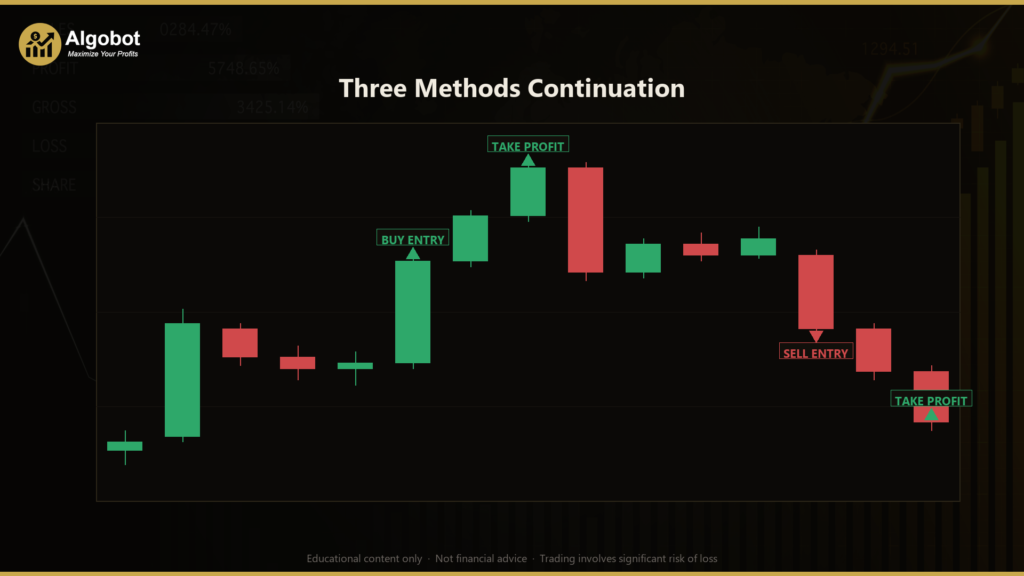
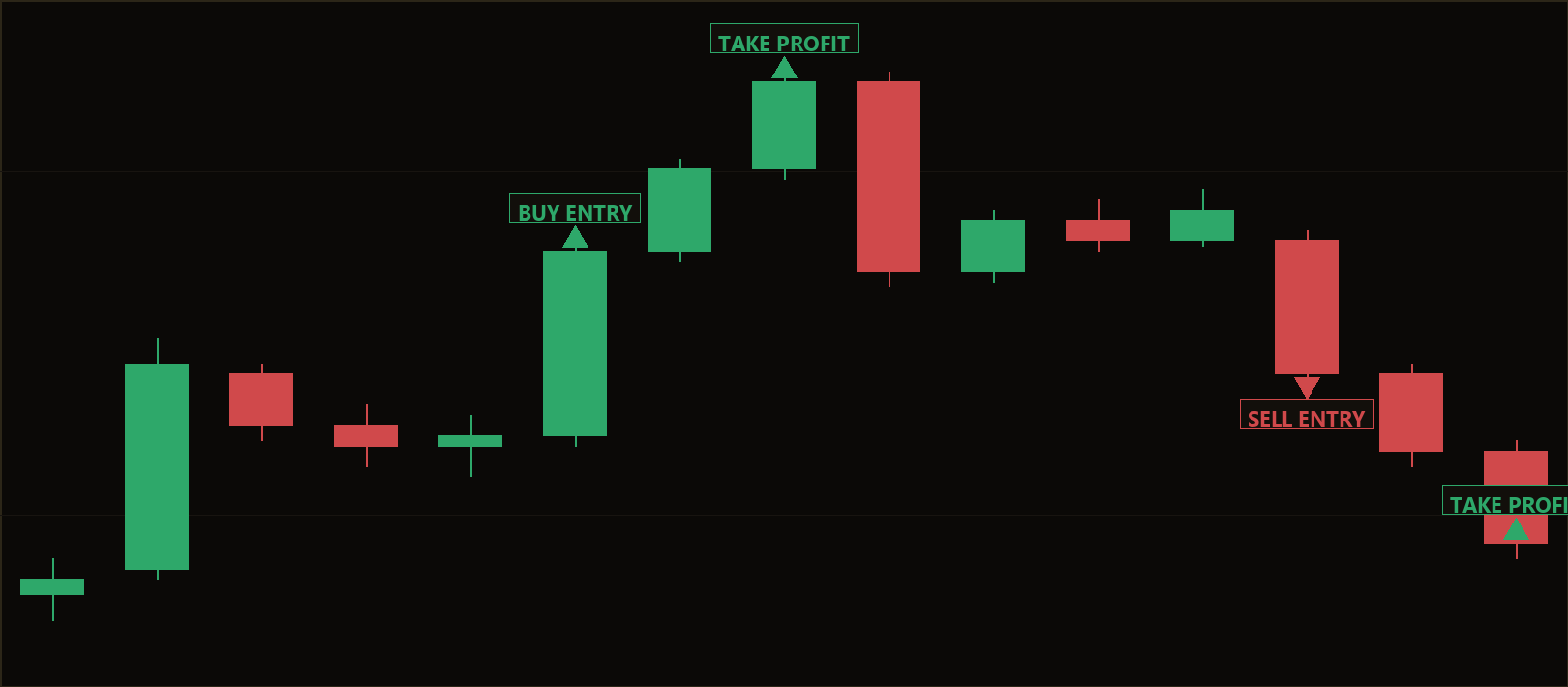
In plain terms, the pattern has three parts: a decisive thrust candle that drives the trend, a short rest of small candles that drift gently against the thrust while staying inside its range, and a fresh resume candle that closes beyond the whole cluster in the original direction. The idea is that a shallow, contained pullback represents profit-taking rather than a genuine change of heart, and when price resumes on a strong close, the trend is likely to continue its leg.
This EA is designed as a learning tool for traders who want to study how a continuation pattern can be encoded into objective, repeatable rules. It is best suited to those exploring trend-following and price-action concepts, and to anyone curious about how candlestick logic translates into mechanical entry and exit conditions. It is not a shortcut to results, and it should be treated as an educational example of a continuation system, not a finished commercial product.
How It Works
The strategy evaluates the market once per freshly-closed bar and considers a new trade only when no position from this EA is already open. It then inspects a fixed window of candles arranged from newest to oldest: the resume candle, the rest cluster, and the thrust candle behind them. Here is what the strategy looks for.
For a long (rising three methods) signal, the strategy requires:
- A decisive bullish thrust candle — its body (the distance from open to close) must be at least
MinBodyFracof its full high-to-low range, and it must close higher than it opened. - A contained rest cluster — each of the small pullback candles must stay inside the thrust candle's high-low range, within a small tolerance set by
ContainTol. If any rest candle breaks meaningfully above or below the thrust, the setup is rejected. - A genuine drift against the thrust — the most recent rest candle must close below the thrust's close, confirming the pause leaned gently against the trend rather than racing ahead.
- A decisive bullish resume candle — it must have a strong body (again at least
MinBodyFracof its range) and must close above the highest high of the entire thrust-plus-rest cluster, signalling the leg has reloaded.
For a short (falling three methods) signal, every condition is mirrored: a decisive bearish thrust, a contained rest that drifts upward, and a decisive bearish resume candle that closes below the cluster's lowest low.
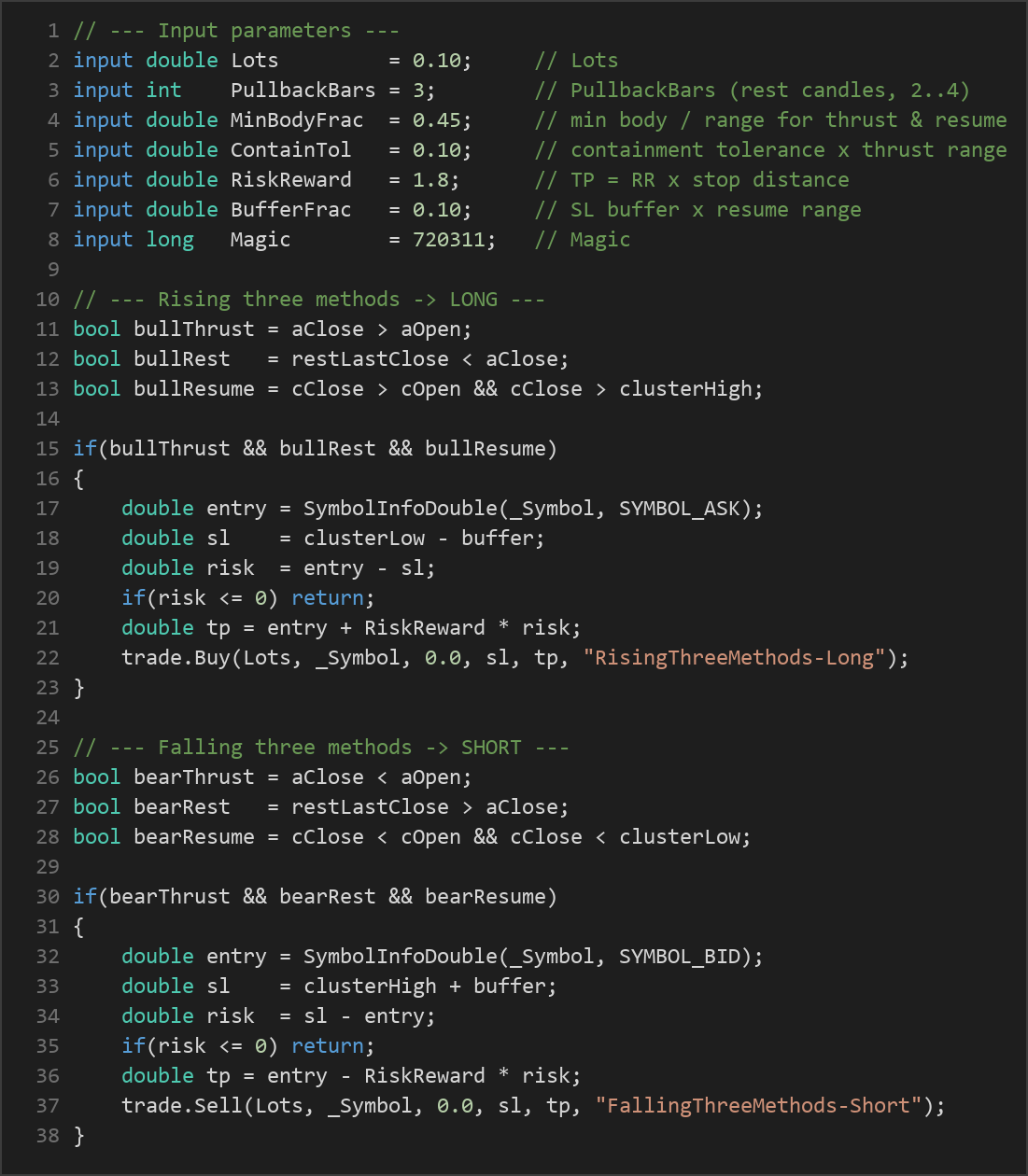
Stop-loss logic: When a long signals, the stop-loss is placed just below the cluster's lowest low, offset by a small buffer equal to BufferFrac of the resume candle's range. This sits past the point where the continuation thesis would be considered broken. For shorts, the stop is placed just above the cluster's highest high plus the same buffer.
Take-profit logic: The target is a fixed risk-to-reward multiple. The strategy measures the distance from entry to stop-loss (the "risk") and projects the take-profit that same distance multiplied by RiskReward in the trade's direction. If the calculated risk is zero or negative, the trade is skipped.
This produces a self-contained setup: every trade carries a predefined stop and target the moment it opens, with no indicator smoothing or lag between the signal and the geometry that triggered it.
Strategy Parameters
| Parameter | Default | Min | Max | Description |
|---|---|---|---|---|
| Lots | 0.10 | 0.01 | 1.00 | Fixed trade size in lots for each position the strategy opens. |
| PullbackBars | 3 | 2 | 4 | Number of small "rest" candles expected between the thrust and resume candles. |
| MinBodyFrac | 0.45 | 0.20 | 0.80 | Minimum body-to-range ratio a thrust or resume candle must have to count as decisive. |
| ContainTol | 0.10 | 0.00 | 0.50 | Containment tolerance, as a fraction of the thrust's range, allowed when checking the rest candles stay inside the thrust. |
| RiskReward | 1.8 | 1.0 | 5.0 | Take-profit multiple — the target distance is this number times the stop distance. |
| BufferFrac | 0.10 | 0.00 | 1.00 | Stop-loss buffer, as a fraction of the resume candle's range, added beyond the cluster extreme. |
Recommended Chart Settings
This strategy was designed with EUR/USD and XAU/USD (gold) in mind, on the M15 or M30 timeframes, although the logic is symbol-agnostic and can run on any liquid instrument and timeframe. These markets and timeframes tend to produce clean, readable candle structures that suit a geometry-based continuation pattern.
Keep in mind that candlestick patterns behave differently across instruments, sessions, and volatility regimes. A setting that produces frequent, well-formed setups on one symbol may produce very few — or noisier — signals on another. Always test any combination of symbol and timeframe on historical data and a demo account before drawing conclusions, and expect results to vary as market conditions change.
How to Install on MetaTrader 5
- Download the .ex5 file from the link below
- Copy it to your MT5
MQL5\Expertsfolder - Restart MetaTrader 5 or refresh the Navigator panel
- Drag the EA onto a chart matching the recommended symbol and timeframe
- Configure the input parameters and enable Algo Trading
What to Consider Before Using This EA
Strengths of this approach. Because the Three Methods Continuation strategy relies only on price geometry, it has no indicator lag and its rules are fully transparent — you can look at any chart and see exactly why a trade did or did not trigger. The contained-pullback requirement filters out many weak or sideways setups, and every trade ships with a predefined stop and a fixed risk-to-reward target, which encourages disciplined, repeatable trade management. As a teaching example, it cleanly demonstrates how a well-known candlestick pattern can be turned into objective code.
Known limitations. Continuation patterns assume a trend already exists; in choppy, range-bound, or directionless markets, the "thrust → rest → resume" structure may form by chance and resolve against the trade. The strategy takes one position at a time and waits for a fully-formed pattern, so it can sit idle for long stretches and miss moves that do not fit the template. A fixed risk-to-reward target does not adapt to changing volatility, meaning the same multiple may be too ambitious in quiet conditions and too conservative in fast ones. The strict containment and body-fraction gates also mean small parameter changes can noticeably alter how many signals appear.
Where it may underperform. News-driven spikes, low-liquidity sessions, and instruments with wide or erratic spreads can distort candle ranges and undermine the geometry the strategy depends on. Treat this EA as a framework for studying continuation behaviour, not as a system to deploy unexamined.
Risk Management Tips
Sound risk management matters far more than any single entry signal. The following are general educational principles, not personalised advice:
- Risk a small, fixed fraction per trade. Many educators suggest risking no more than 1–2% of account equity on any single position, so that a string of losses does not threaten your capital.
- Size positions to your stop, not to a habit. The
Lotsinput here is fixed, so adjust it deliberately to match your account size and the stop distance each setup implies. - Always test on a demo account first. Run the strategy on a demo or historical data long enough to understand how often it trades and how it behaves in different conditions before committing real funds.
- Understand drawdown. Even a sound continuation method will experience losing streaks and equity dips. Know the maximum drawdown you are willing to tolerate in advance, and accept that drawdown is a normal part of any strategy.
- Account for trading costs. Spreads, commissions, and slippage all eat into outcomes, especially on shorter timeframes — factor them into any evaluation.
Risk Warning
Trading foreign exchange, CFDs, and other leveraged financial instruments involves substantial risk of loss and is not suitable for all investors. The strategies and tools discussed on this page are provided for educational purposes only and do not constitute financial advice, investment recommendations, or solicitation to trade. Always consult a qualified financial adviser before making trading decisions. Past backtest performance is not indicative of future results.
Downloads
- Expert Advisor: ThreeMethodsContinuation.ex5 (5 downloads)
- Source Code: ThreeMethodsContinuation.mq5 (3 downloads)
- Documentation: ThreeMethodsContinuation.pdf (4 downloads)