Disclaimer: This article is for educational and informational purposes only. It does not constitute financial or investment advice. Trading forex and CFDs carries significant risk of loss. Past performance of any strategy — including backtests — does not guarantee future results. Never trade with money you cannot afford to lose.
What Is This Strategy?
The Thrust Origin Pullback strategy is a pure price-action continuation system that combines two classic concepts — a momentum range-expansion thrust and an origin (open) retest — into a single passive limit-order entry. Unlike most expert advisors, it uses no technical indicators at all: there is no moving average, RSI, MACD, or oscillator anywhere in its logic. Every level, filter, stop, and target is derived from raw candle geometry. The only average involved is a plain mean of recent candle ranges, computed inline to measure whether the current bar is genuinely "expanding" relative to recent volatility — and that is simply candle geometry, not an indicator.
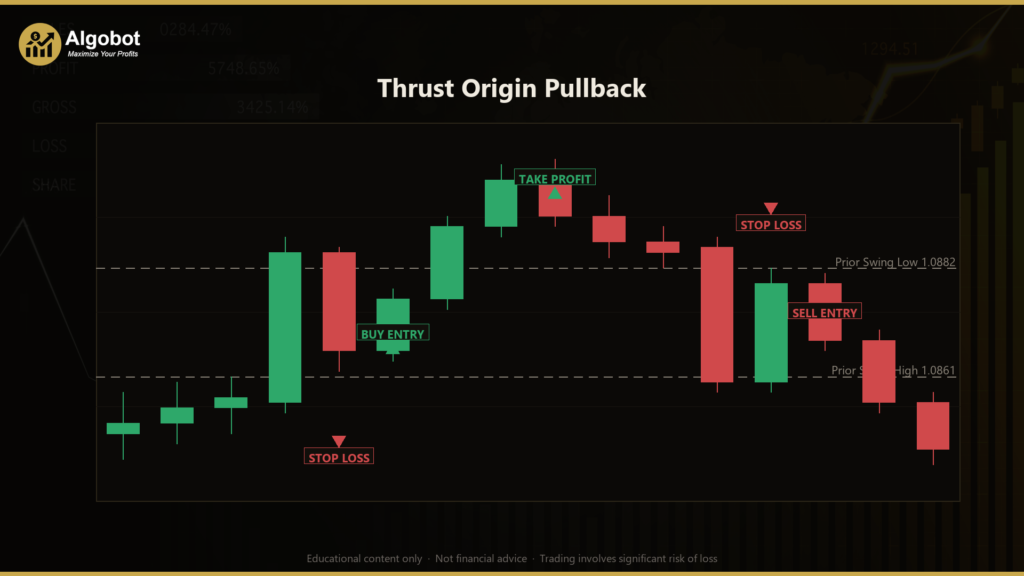
In plain English, a "thrust" candle is an aggressive, one-sided push: a large body, little opposing wick, and a range that dwarfs the recent norm, closing through the prior swing structure. That candle is the footprint of a real order-flow imbalance — someone lifting or hitting the order book in size. Chasing the close of such a candle usually means a poor risk-to-reward ratio (R:R), so the strategy instead marks the candle's origin — its open, the price where the impulse ignited — and rests a passive limit order there. Trend pushes routinely retrace toward the origin of the last impulse before continuing, so the idea is to let price come back rather than chase it.
This strategy is best suited as a learning tool for traders who want to understand momentum continuation, structure breaks, and passive limit entries without relying on lagging indicators. It is designed with FX majors, gold (XAU), and indices in mind, and it is deliberately not locked to any single timeframe — it runs on whatever primary timeframe a backtest or chart selects. Treat it as a framework for studying how impulse-and-pullback behaviour can be expressed in rules, not as a shortcut to returns.
How It Works
The strategy evaluates only the most recently closed candle once per new bar, and it keeps at most one position or one resting limit order live at any time. Here is how the logic flows:
- New-bar gating: The strategy acts only once per freshly closed bar. The still-forming candle is ignored so that decisions are made on completed price data.
- One trade at a time: If a position is already open, it runs on its own stop-loss and take-profit, and any stray pending order is cancelled. If a resting limit order already exists, the strategy ages it and never stacks a second order.
- Order expiry: A resting limit order that goes unfilled is cancelled after
ExpiryBarsbars, so a stale level does not linger after the setup has gone cold.
When flat and idle, the strategy tests the last closed candle as a thrust candidate:
- Conviction filter: The candle's body (open-to-close distance) must be at least
BodyFracof its full high-to-low range. This screens out indecisive dojis and demands a decisive, one-sided candle. - Expansion filter: The candle's range must be at least
RangeFactortimes the average range of the precedingLookbackcandles. This is the "thrust must dwarf the recent norm" test that signals genuine volatility expansion. - Structure break: For a long setup, the candle must be bullish and close above the highest high of the preceding window. For a short setup, it must be bearish and close below the lowest low of that window. This confirms the impulse cleared established structure.
When a valid bullish thrust is found, the strategy signals a buy-limit order:
- Entry: Placed
EntryFracof the body back from the close toward the open (the origin). A higherEntryFracrests the order deeper toward the open; a value of 1.00 places it right at the candle's open. - Stop-loss: Set below the thrust candle's low, minus
StopBuffermultiplied by the candle range — just beyond the far wick, where the continuation thesis would be invalidated. - Take-profit: Set at
RiskRewardmultiplied by the measured risk (the entry-to-stop distance), giving a fixed-R target.
A valid bearish thrust is the exact mirror: a sell-limit order rests near the down-thrust's origin, with the stop above the candle's high plus the buffer and the target a fixed-R distance below entry. Before any order is placed, the strategy also checks the broker's minimum stop and limit distance so the entry, stop, and target are all valid.
Strategy Parameters
| Parameter | Default | Min | Max | Description |
|---|---|---|---|---|
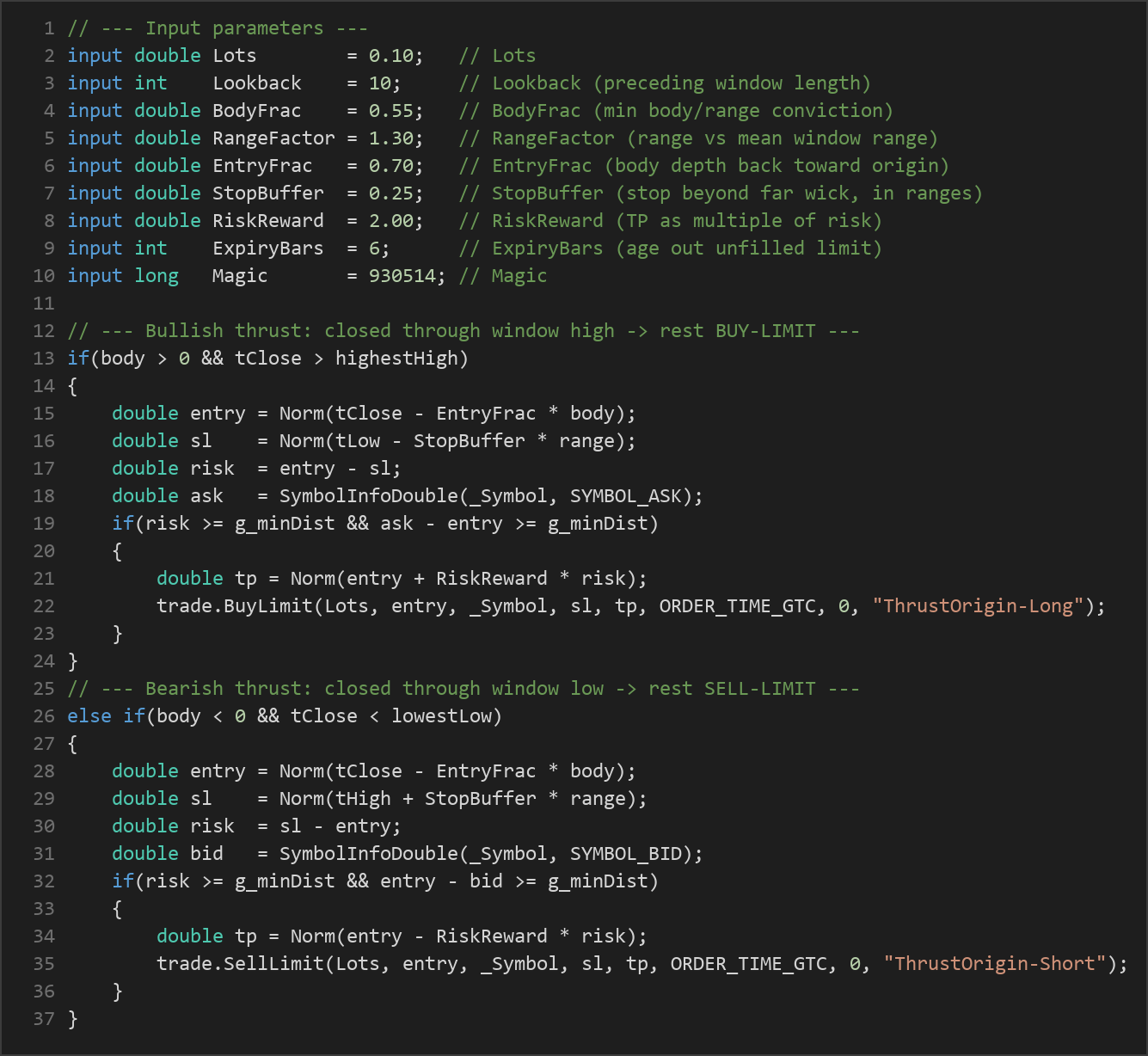
| Lots | 0.10 | 0.01 | 1.00 | Fixed trade size in lots for each order placed. |
| Lookback | 10 | 4 | 40 | Number of candles in the window preceding the thrust, used to measure structure and average range. |
| BodyFrac | 0.55 | 0.30 | 0.90 | Minimum body-to-range ratio; how much of the candle must be body (conviction) rather than wick. |
| RangeFactor | 1.30 | 1.00 | 3.00 | How many times larger than the average window range the thrust candle must be to qualify as an expansion. |
| EntryFrac | 0.70 | 0.30 | 1.00 | How deep the limit order rests back toward the candle's open (origin); higher means closer to the open. |
| StopBuffer | 0.25 | 0.00 | 1.50 | Extra stop distance beyond the thrust's far wick, expressed in multiples of the candle range. |
| RiskReward | 2.00 | 1.00 | 6.00 | Take-profit distance as a multiple of the entry-to-stop risk. |
| ExpiryBars | 6 | 1 | 30 | Number of bars an unfilled limit order is allowed to rest before it is cancelled. |
Recommended Chart Settings
This strategy was built with FX majors, gold (XAU), and indices in mind, and it is intentionally not locked to any timeframe — it runs on whatever primary timeframe you attach it to. Because the expansion filter scales to recent volatility automatically, the same rules can be studied across higher timeframes (such as H1 or H4) for fewer, cleaner signals, or lower timeframes for more frequent setups. Keep in mind that results will vary considerably across different symbols, sessions, and market conditions, and a setting that historically suited one instrument may behave very differently on another. Always test any combination of symbol and timeframe thoroughly before drawing conclusions.
How to Install on MetaTrader 5
- Download the
.ex5file from the link below - Copy it to your MT5
MQL5\Expertsfolder - Restart MetaTrader 5 or refresh the Navigator panel
- Drag the EA onto a chart matching the recommended symbol and timeframe
- Configure the input parameters and enable Algo Trading
What to Consider Before Using This EA
The Thrust Origin Pullback approach has some genuine educational strengths. Because it uses no indicators, it is transparent: every decision can be traced back to a candle's open, high, low, and close. The passive limit entry at the impulse origin is designed to turn a chase into a measured, tightly stopped continuation, which historically can improve the risk-to-reward profile compared with entering at the thrust's close. The single-order discipline and automatic order expiry also help keep exposure controlled.
That said, this is a momentum-continuation method, and continuation methods have well-known limitations. The biggest is that not every pullback continues — price may retrace to the origin and then reverse entirely, hitting the stop. In choppy, range-bound, or low-volatility conditions, the expansion filter may either screen out most candles (leaving few signals) or trigger on false breakouts that immediately fail. Because entries are passive limit orders, valid-looking setups may also simply never fill if price continues without retracing, which is the trade-off for waiting for a better price. News-driven spikes can produce "thrust" candles that are noise rather than genuine order-flow imbalance. None of these limitations make the strategy poor — they are simply the conditions under which it may underperform, and understanding them is part of using it responsibly.
Risk Management Tips
Sound risk management matters far more than any single entry rule. As a general educational guideline:
- Risk a small, fixed fraction per trade. Many educators suggest risking no more than 1–2% of account equity on any single position, so that a string of losing trades does not threaten the account.
- Size positions to your stop, not the other way around. Let the stop-loss distance and your risk percentage determine the lot size, rather than picking a lot size first.
- Test on a demo account first. Run the strategy in a risk-free demo environment until you understand its behaviour, its frequency of signals, and its typical drawdown periods.
- Understand drawdown. Every strategy experiences losing streaks. Knowing the historical depth and duration of drawdown helps you decide whether you can tolerate it emotionally and financially.
- Avoid over-optimisation. Tuning parameters until a backtest looks perfect ("curve-fitting") rarely survives live conditions. Prefer robust settings that perform reasonably across many conditions.
Risk Warning
Trading foreign exchange, CFDs, and other leveraged financial instruments involves substantial risk of loss and is not suitable for all investors. The strategies and tools discussed on this page are provided for educational purposes only and do not constitute financial advice, investment recommendations, or solicitation to trade. Always consult a qualified financial adviser before making trading decisions. Past backtest performance is not indicative of future results.
Downloads
- Expert Advisor: ThrustOriginPullback.ex5 (59 downloads)
- Source Code: ThrustOriginPullback.mq5 (55 downloads)
- Documentation: ThrustOriginPullback.pdf (65 downloads)