Disclaimer: This article is for educational and informational purposes only. It does not constitute financial or investment advice. Trading forex and CFDs carries significant risk of loss. Past performance of any strategy — including backtests — does not guarantee future results. Never trade with money you cannot afford to lose.
What Is This Strategy?
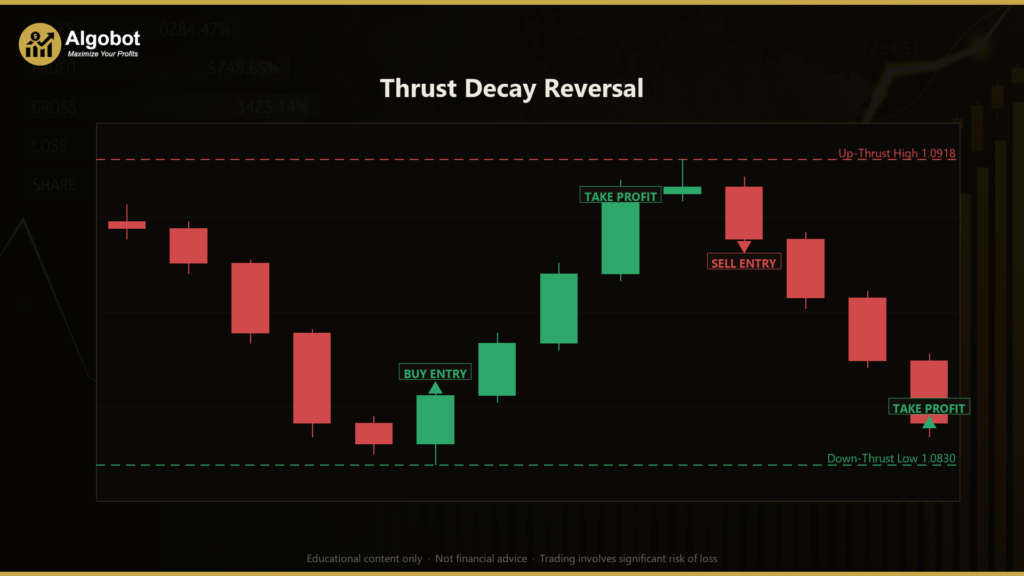
The Thrust Decay Reversal is a pure price-action momentum-exhaustion strategy — meaning it reads raw candle geometry (highs, lows, closes, and ranges) rather than relying on any technical indicator like a moving average or oscillator. Its trading style is counter-trend reversal: instead of chasing a move, it waits for an existing directional run to lose steam and then fades it. The core idea blends two classic concepts. The first is a "thrust" — a burst of momentum where price pushes hard in one direction. The second is "decay" — the observation that a healthy thrust expands its candle ranges, while a tiring thrust keeps making new highs (or lows) on progressively smaller candles. Shrinking ranges at fresh extremes suggest buyers or sellers are stepping in with less and less conviction at worse and worse prices.
This strategy is designed for markets that move in identifiable bursts followed by exhaustion — the kind of behaviour you often see after an extended directional run on intraday charts. It does not try to blindly pick tops and bottoms. Instead, it requires confirmation: a sequence of consecutive directional bars, evidence that the newest bar's range has decayed below the run's peak range, and then a clear reversal candle that closes back against the move. Only when all three align does the strategy signal a trade.
As a learning tool, the Thrust Decay Reversal is well suited to traders who want to study momentum exhaustion and reversal mechanics without the noise of lagging indicators. Because every condition is derived from price alone, you can see exactly why a signal fired by looking at the chart. That transparency makes it a useful study piece for understanding how range expansion and contraction relate to trend health — even if you never trade it with live capital.
How It Works
The strategy evaluates the chart once per newly closed bar. It looks at a window of recent candles, where shift 1 is the most recent closed bar (the "trigger" or reversal candle) and shifts 2 through RunLength + 1 form the "thrust run." Here is what it checks, in plain English:
- A consistent directional run. Each bar in the run is compared with its older neighbour. For an up-thrust, every run bar must print a higher high and a higher close than the one before it. For a down-thrust, every bar must print a lower low and a lower close. If the run is not cleanly directional, no signal forms.
- Decaying momentum. The strategy finds the largest candle range within the run (the "peak range"). The newest run bar's range must have shrunk below
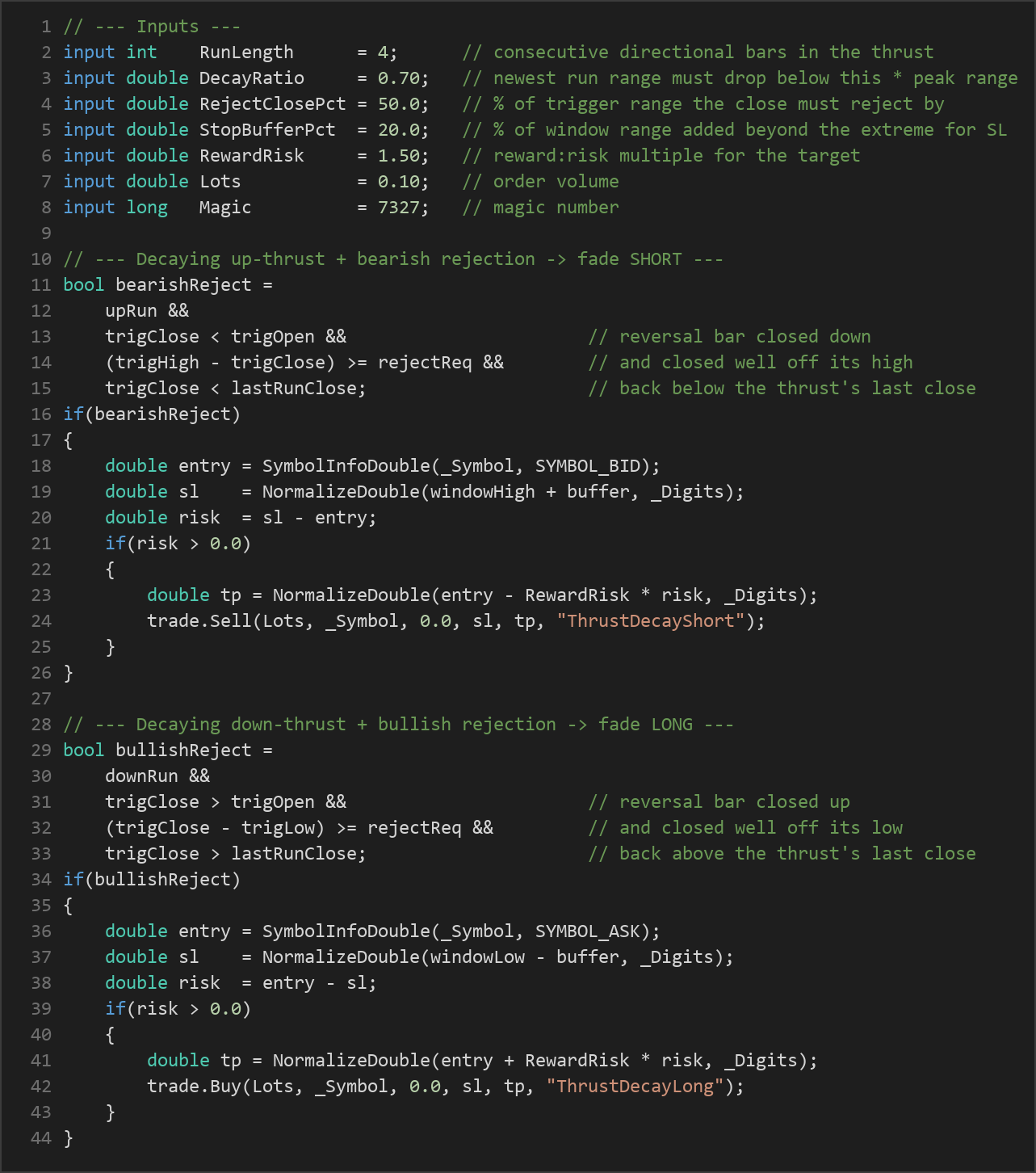
DecayRatio× that peak. This is the exhaustion tell — the move is still extending, but on weaker and weaker candles. - A rejection close (the trigger). The very next bar must close back against the run. For a fade-short setup, the trigger bar closes down, closes well off its high (by at least
RejectClosePctof its own range), and closes back below the thrust's last close. For a fade-long setup, the mirror conditions apply: closes up, closes well off its low, and back above the thrust's last close.
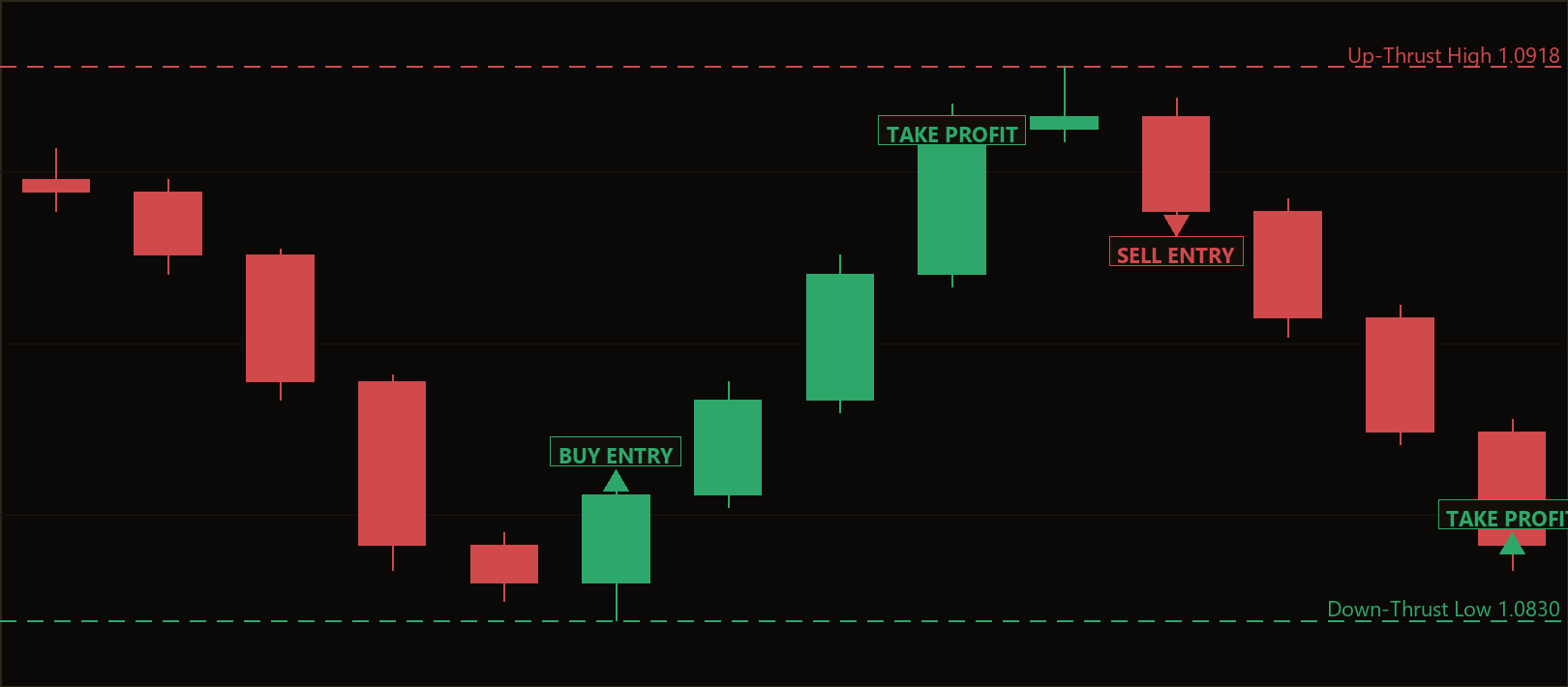
When an up-thrust decays and is followed by a bearish rejection, the strategy signals a sell. When a down-thrust decays and is followed by a bullish rejection, it signals a buy.
Exit logic is fully structural and price-derived:
- Stop-loss. The strategy measures the full window range (the highest high to the lowest low across the run and trigger). The stop sits just beyond the thrust's extreme — above the window high for shorts, below the window low for longs — padded by a buffer equal to
StopBufferPctof the window range. This places the stop beyond the structure that would invalidate the reversal idea. - Take-profit. The target is a fixed reward-to-risk multiple of the stop distance, set by
RewardRisk. If the measured risk is one unit of distance, the target is placedRewardRiskunits in the trade's favour.
Only one position per symbol is held at a time for this strategy's magic number; the stop-loss and take-profit manage the exit once a trade is open.
Strategy Parameters
| Parameter | Default | Min | Max | Description |
|---|---|---|---|---|
| RunLength | 4 | 3 | 8 | Number of consecutive directional bars that must form the thrust run before a reversal is considered. |
| DecayRatio | 0.70 | 0.40 | 0.95 | The newest run bar's range must fall below this fraction of the run's peak range to qualify as "decayed." Lower values demand more pronounced exhaustion. |
| RejectClosePct | 50.0 | 0.0 | 100.0 | How far (as a percent of the trigger bar's own range) the reversal candle must close back into its range to count as a valid rejection. |
| StopBufferPct | 20.0 | 5.0 | 60.0 | Extra distance, as a percent of the window range, added beyond the thrust extreme when placing the stop-loss. |
| RewardRisk | 1.50 | 0.50 | 4.0 | The reward-to-risk multiple used to set the take-profit relative to the stop distance. |
| Lots | 0.10 | 0.01 | 1.0 | Order volume (position size) in lots. |
Recommended Chart Settings
The Thrust Decay Reversal is designed to read momentum bursts and their exhaustion, which tend to show up most cleanly on liquid instruments and intraday timeframes such as the M15 or H1 charts of a major forex pair (for example, EUR/USD). On these timeframes there are enough bars to form a meaningful thrust run while each candle still carries directional information. That said, the logic is symbol-agnostic — it works from raw bar geometry — so you are encouraged to test it across the instruments and timeframes you actually follow. Keep in mind that range-expansion behaviour differs between trending sessions and quiet, low-volatility conditions, so results will vary considerably across different market environments. Always study the strategy's behaviour on a demo account before drawing conclusions.
How to Install on MetaTrader 5
- Download the .ex5 file from the link below
- Copy it to your MT5
MQL5\Expertsfolder - Restart MetaTrader 5 or refresh the Navigator panel
- Drag the EA onto a chart matching the recommended symbol and timeframe
- Configure the input parameters and enable Algo Trading
What to Consider Before Using This EA
Every reversal approach involves trade-offs, and being honest about them is part of trading well.
Strengths of this approach. Because the strategy is pure price action, it has no indicator lag — it reacts to the bars in front of it. Its entries are confirmation-based rather than predictive: it waits for both decay and a rejection close before acting, which filters out many false reversals. The stop placement is structural, sitting beyond the swing that would invalidate the idea, which keeps risk tied to actual price levels rather than an arbitrary fixed distance.
Known limitations. Counter-trend strategies face a fundamental challenge: a strong, persistent trend can keep "decaying" and reversing in appearance, then continue anyway. In a powerful one-directional run, fading the move can lead to a series of stop-outs. The strategy also requires a clean, consecutive directional run — choppy or overlapping candles will simply produce no signal, so it may sit idle for long stretches. Whipsaw-prone, low-volatility conditions can generate marginal rejection candles that historically may not lead anywhere.
Where it may underperform. Strongly trending markets, news-driven spikes, and very quiet ranging periods are all environments where momentum-exhaustion signals can be misleading. The strategy may also behave differently across instruments with different volatility profiles. Treat it as one lens on market behaviour, not a complete trading system — and combine your study of it with broader context such as session timing and higher-timeframe structure.
Risk Management Tips
Sound risk management matters more than any single entry rule. As you study this strategy, keep these general principles in mind:
- Risk a small, fixed fraction per trade. Many educational frameworks suggest risking no more than 1–2% of account equity on any single position, so that a string of losses does not threaten your account.
- Size positions from your stop, not your hopes. Because this strategy derives its stop from structure, you can calculate position size by dividing your per-trade risk budget by the stop distance — rather than picking a lot size arbitrarily.
- Use a demo account first. Run the EA on a demo or simulator across many market conditions before considering any live use. This helps you understand its signal frequency and behaviour without financial pressure.
- Understand drawdown. Every strategy experiences losing streaks. Knowing the depth and duration of historical drawdowns helps you set realistic expectations and avoid abandoning a plan at the worst moment.
- Account for costs. Spread, slippage, and commissions all affect outcomes, especially on shorter timeframes where the take-profit may be modest.
Education, patience, and disciplined risk control are the foundation of responsible trading — far more so than any individual signal.
Risk Warning
Trading foreign exchange, CFDs, and other leveraged financial instruments involves substantial risk of loss and is not suitable for all investors. The strategies and tools discussed on this page are provided for educational purposes only and do not constitute financial advice, investment recommendations, or solicitation to trade. Always consult a qualified financial adviser before making trading decisions. Past backtest performance is not indicative of future results.
Downloads
- Expert Advisor: ThrustDecayReversal.ex5 (58 downloads)
- Source Code: ThrustDecayReversal.mq5 (52 downloads)
- Documentation: ThrustDecayReversal.pdf (65 downloads)