Disclaimer: This article is for educational and informational purposes only. It does not constitute financial or investment advice. Trading forex and CFDs carries significant risk of loss. Past performance of any strategy — including backtests — does not guarantee future results. Never trade with money you cannot afford to lose.
What Is This Strategy?
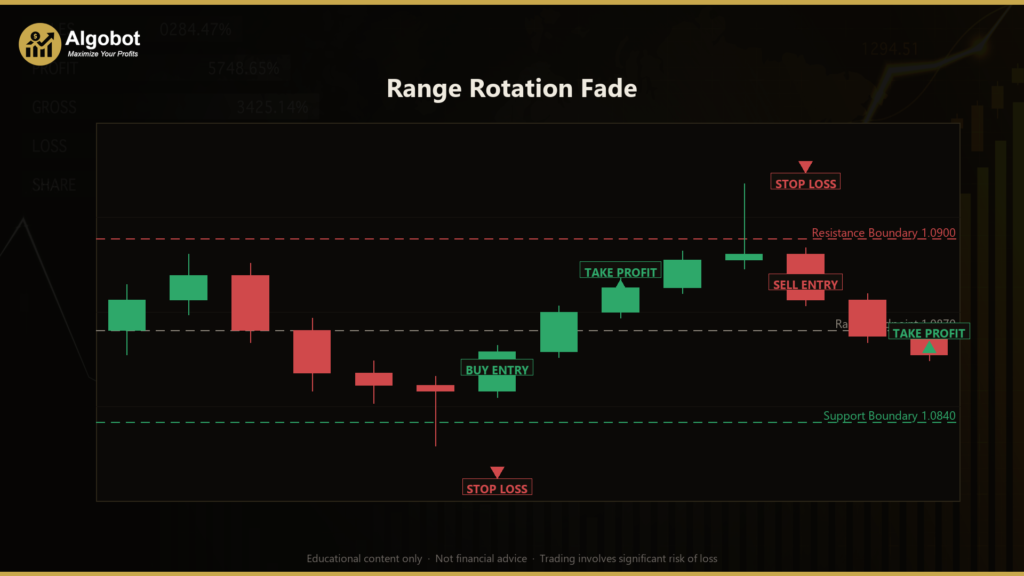
The Range Rotation Fade is a pure price-action, mean-reversion strategy that combines two classic building blocks: horizontal support/resistance levels and candlestick rejection (the "pin bar"). A mean-reversion approach assumes that when price stretches away from a balanced area, it tends to rotate back toward the middle rather than continue in a straight line. Instead of relying on a stacked panel of lagging oscillators, the Range Rotation Fade reads the raw structure of the most recent bars and asks a simple question: did price try to break out of the range, fail, and snap back inside?
The strategy is designed specifically for ranging or balanced markets — periods when a currency pair or instrument is oscillating sideways between a defined ceiling and floor rather than trending strongly in one direction. It builds a horizontal "balance zone" from the highest high and lowest low over a configurable lookback window, then waits for a single candle to sweep one of those boundaries and reject it with a long wick. When that happens, the strategy fades the failed breakout, aiming for a partial move back toward the midpoint of the range. A built-in "balance filter" measures the range width against the Average True Range (ATR), a volatility gauge that estimates how far price typically moves per bar, and refuses to trade when the range is too wide — a sign the market may be trending, where fading can be dangerous.
As a learning tool, the Range Rotation Fade is well suited to traders who want to understand liquidity sweeps, support and resistance defense, and candlestick rejection without the noise of dozens of indicators. It is a clean, single-timeframe example of how a fade (counter-trend) entry can be structured with objective, rule-based conditions. Treat it as a study in mechanical mean reversion rather than a finished, profit-producing system.
How It Works
The strategy evaluates conditions only once per completed bar — it never acts on a half-formed candle. On each new bar, it looks back at the most recently closed candle (the "signal" candle) and the range that came before it. Here is what the strategy checks, step by step:
- Define the balance range. Over the last
RangeLookbackclosed bars (excluding the signal candle), the strategy records the highest high as theupperboundary and the lowest low as thelowerboundary. The midpoint between them is the rotation target. - Confirm balance, not trend. It calculates ATR over
AtrPeriodbars. If the range width is greater thanMaxRangeAtrMult × ATR, the market is considered too directional, and the strategy stands aside. This is the balance filter that keeps it out of runaway trends. - Inspect the signal candle's anatomy. The strategy measures the candle body (open-to-close distance) and the upper and lower wicks (the rejection "tails"). A long wick relative to the body indicates that price was pushed to an extreme and then forcefully rejected — the hallmark of a pin bar.
From there, the strategy signals one of two trades:
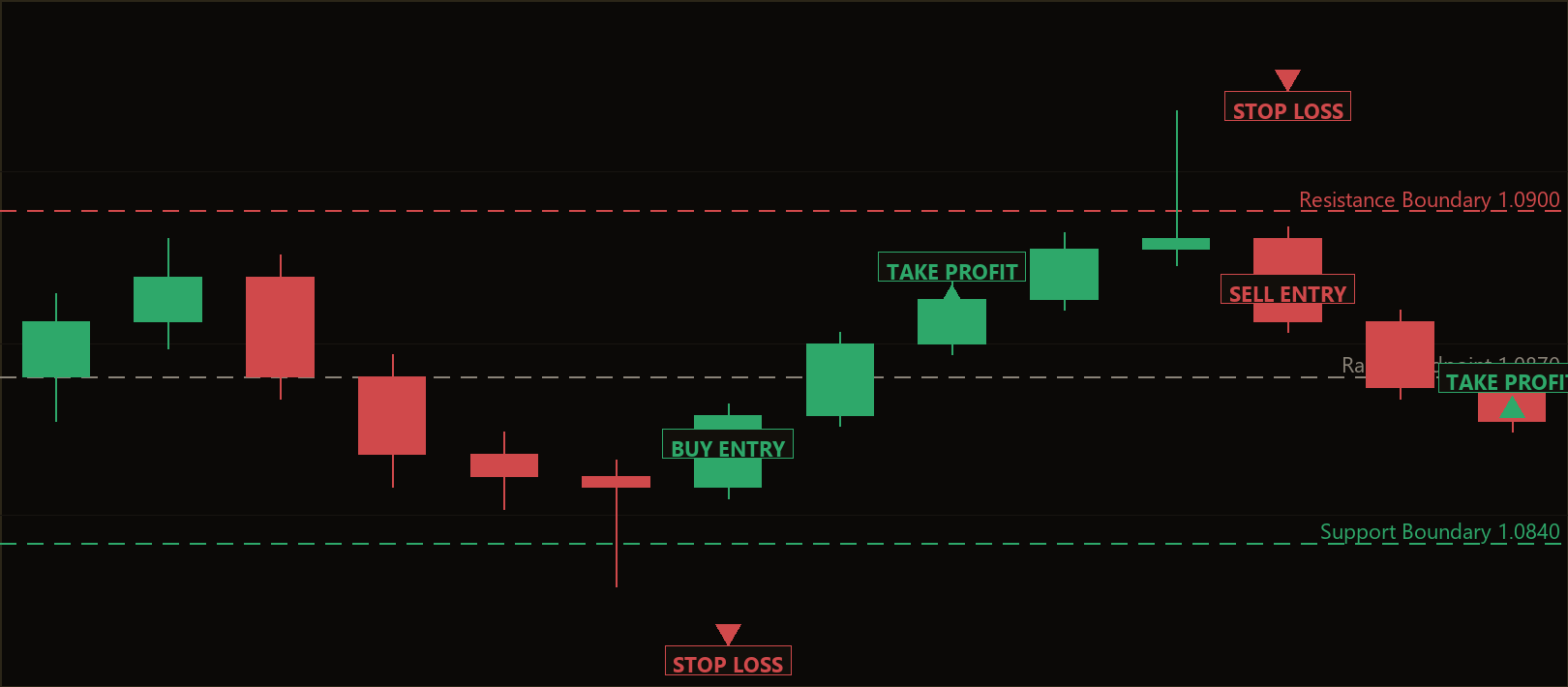
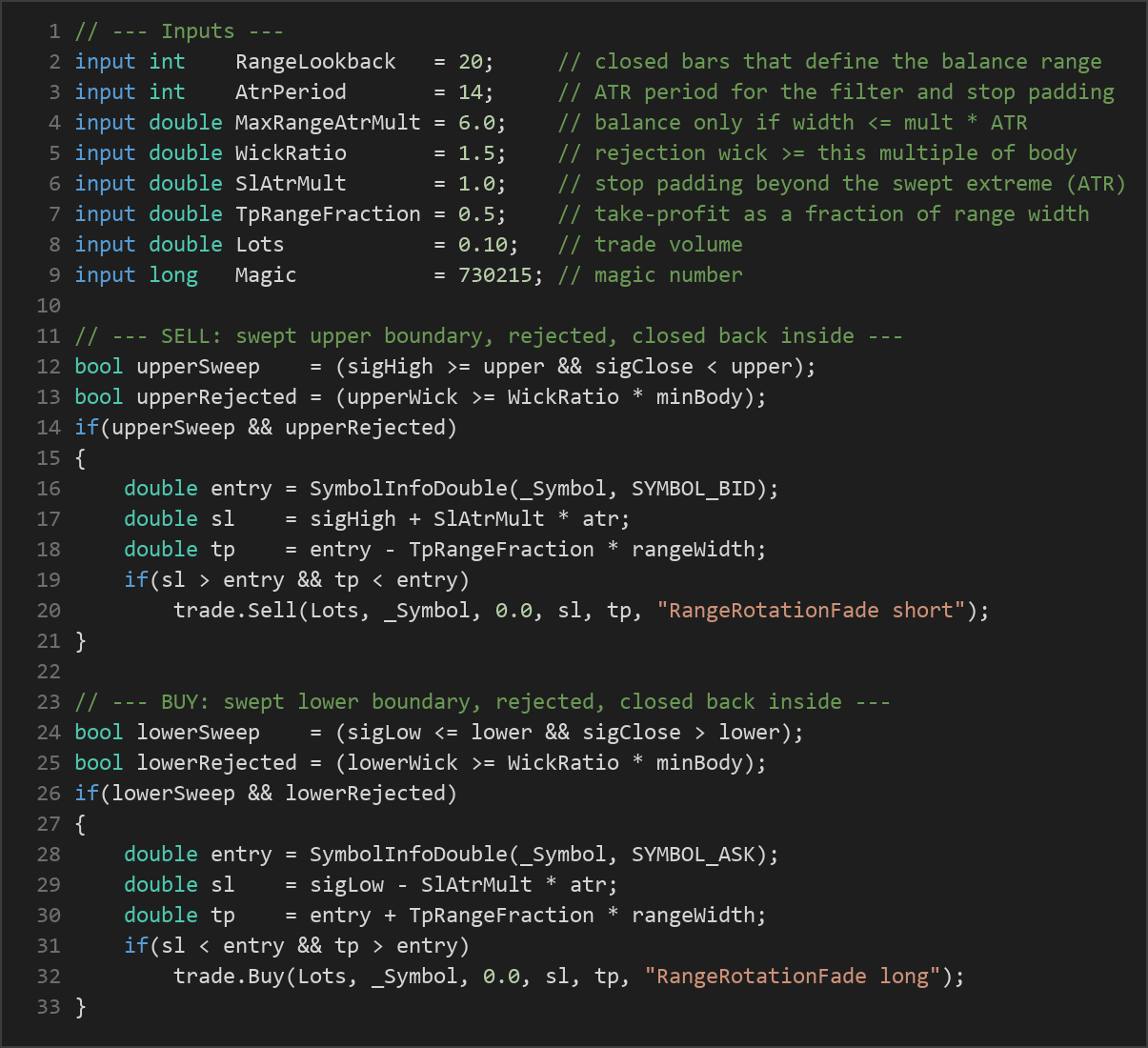
- Sell (fade an upper sweep). When the signal candle's high reaches or exceeds the
upperboundary but the candle closes back below it, and the upper wick is at leastWickRatiotimes the body, the resistance level is being defended. The strategy signals a short, expecting price to rotate back down toward the midpoint. - Buy (fade a lower sweep). When the signal candle's low reaches or breaks the
lowerboundary but the candle closes back above it, and the lower wick is at leastWickRatiotimes the body, the support level is holding. The strategy signals a long toward the midpoint.
Stop-loss logic. The stop is placed just beyond the swept extreme, padded by SlAtrMult × ATR. For a short, the stop sits above the signal candle's high; for a long, it sits below the signal candle's low. The idea is that if price closes decisively past the level after all, the fade thesis is invalid and the trade should be cut.
Take-profit logic. The target is set as a fraction of the range width, controlled by TpRangeFraction. At the default of 0.5, the strategy aims for roughly the midpoint of the range from a boundary entry — a conservative mean-reversion objective rather than a full traverse to the opposite side.
Only one position per magic number is allowed at a time, so the strategy never stacks multiple fades on the same setup.
Strategy Parameters
| Parameter | Default | Min | Max | Description |
|---|---|---|---|---|
| RangeLookback | 20 | 10 | 60 | Number of closed bars used to define the balance range (the support/resistance boundaries). |
| AtrPeriod | 14 | 7 | 30 | ATR period used for both the balance filter and the stop-loss padding. |
| MaxRangeAtrMult | 6.0 | 3.0 | 12.0 | The range qualifies as "balance" only if its width is at or below this multiple of ATR. Keeps the strategy out of trends. |
| WickRatio | 1.5 | 1.0 | 3.0 | The rejection wick must be at least this multiple of the candle body for a valid pin-bar signal. |
| SlAtrMult | 1.0 | 0.5 | 3.0 | Stop-loss padding beyond the swept extreme, measured in ATR multiples. |
| TpRangeFraction | 0.5 | 0.25 | 1.0 | Take-profit travel as a fraction of the range width (0.5 ≈ midpoint from a boundary entry). |
| Lots | 0.10 | 0.01 | 1.0 | Trade volume in lots. |
Recommended Chart Settings
The Range Rotation Fade is a single-timeframe strategy, meaning every calculation uses the chart's own period. It tends to make the most conceptual sense on intraday timeframes such as the M15, M30, or H1, where balanced ranges form regularly between sessions. Major forex pairs that frequently consolidate — for example EUR/USD or GBP/USD — are natural candidates for studying range rotation behavior.
Because the strategy depends on genuine sideways balance, its character changes dramatically across market conditions. The same settings that behave well in a quiet, range-bound session may struggle during high-impact news or strong trending phases. Always test the defaults on historical data for your chosen symbol and timeframe before drawing any conclusions, and expect results to vary.
How to Install on MetaTrader 5
- Download the .ex5 file from the link below.
- Copy it to your MT5
MQL5\Expertsfolder. - Restart MetaTrader 5 or refresh the Navigator panel.
- Drag the EA onto a chart matching the recommended symbol and timeframe.
- Configure the input parameters and enable Algo Trading.
What to Consider Before Using This EA
Strengths. The Range Rotation Fade is transparent and rule-based, which makes it an excellent teaching example. Its logic mirrors how discretionary traders think about liquidity sweeps and defended levels, and the ATR-based balance filter is a thoughtful attempt to avoid the single biggest danger for any fade strategy: trading against a strong trend. Stops anchored beyond the swept extreme are logically placed at the point where the trade idea would be invalidated.
Known limitations. Like all mean-reversion approaches, this strategy faces its hardest test when a range finally breaks. A genuine breakout will produce exactly the sweep-and-reject pattern the strategy looks for, right before price runs in the opposite direction — meaning false signals tend to cluster at the worst possible moments. Pin-bar quality also depends heavily on the WickRatio setting; too low and noise slips through, too high and valid setups are filtered out. The fixed TpRangeFraction target does not adapt to where price entered within the range, so reward-to-risk can vary trade to trade.
Where it may underperform. Strongly trending markets, low-liquidity periods, and news-driven volatility spikes can all defeat the balance filter or produce sweeps that never rotate back. This strategy is not a "set and forget" solution; it is a structured framework for studying counter-trend entries that requires ongoing observation and parameter tuning.
Risk Management Tips
Sound risk management matters more than any single entry rule. Consider these general principles as part of your education:
- Position sizing. Size each trade so that a stop-loss hit costs only a small, predefined share of your account — many educators suggest risking no more than 1–2% per trade.
- Use a demo account first. Run the strategy on a demo or paper account until you fully understand how it behaves across different sessions and market conditions.
- Understand drawdown. Even a well-designed mean-reversion strategy can experience losing streaks. Know the maximum drawdown you can tolerate, both financially and emotionally, before committing real capital.
- Account for costs. Spreads, commissions, and slippage all eat into mean-reversion targets, which are often modest. Factor them into any evaluation.
- Avoid over-leverage. Leverage magnifies both gains and losses; conservative leverage gives a strategy room to survive normal variance.
Risk Warning
Trading foreign exchange, CFDs, and other leveraged financial instruments involves substantial risk of loss and is not suitable for all investors. The strategies and tools discussed on this page are provided for educational purposes only and do not constitute financial advice, investment recommendations, or solicitation to trade. Always consult a qualified financial adviser before making trading decisions. Past backtest performance is not indicative of future results.
Downloads
- Expert Advisor: RangeRotationFade.ex5 (35 downloads)
- Source Code: RangeRotationFade.mq5 (39 downloads)
- Documentation: RangeRotationFade.pdf (38 downloads)