Disclaimer: This article is for educational and informational purposes only. It does not constitute financial or investment advice. Trading forex and CFDs carries significant risk of loss. Past performance of any strategy — including backtests — does not guarantee future results. Never trade with money you cannot afford to lose.
What Is This Strategy?
Range Sweep Reclaim is a pure price-action, support-and-resistance reversal strategy that uses candlestick wick analysis and the Average True Range (ATR) indicator to identify "liquidity grabs" near established swing highs and swing lows. Rather than relying on a stack of lagging moving averages or oscillators, it reads raw market structure: where price recently topped out, where it bottomed, and how a single candle reacted when it pushed beyond those edges. Its trading style is short-term mean-reversion — it fades failed breakouts back toward the middle of a range instead of chasing momentum.
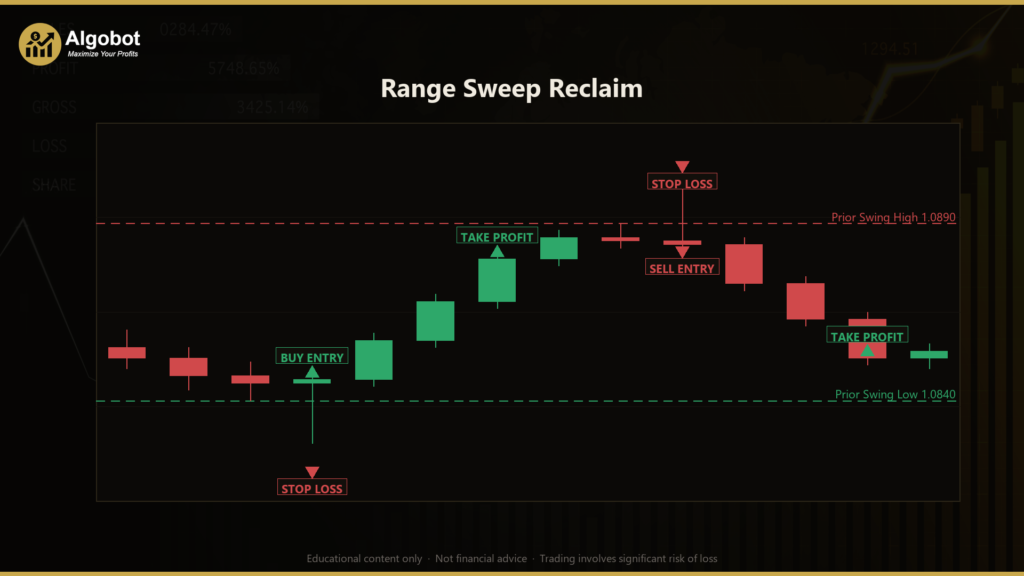
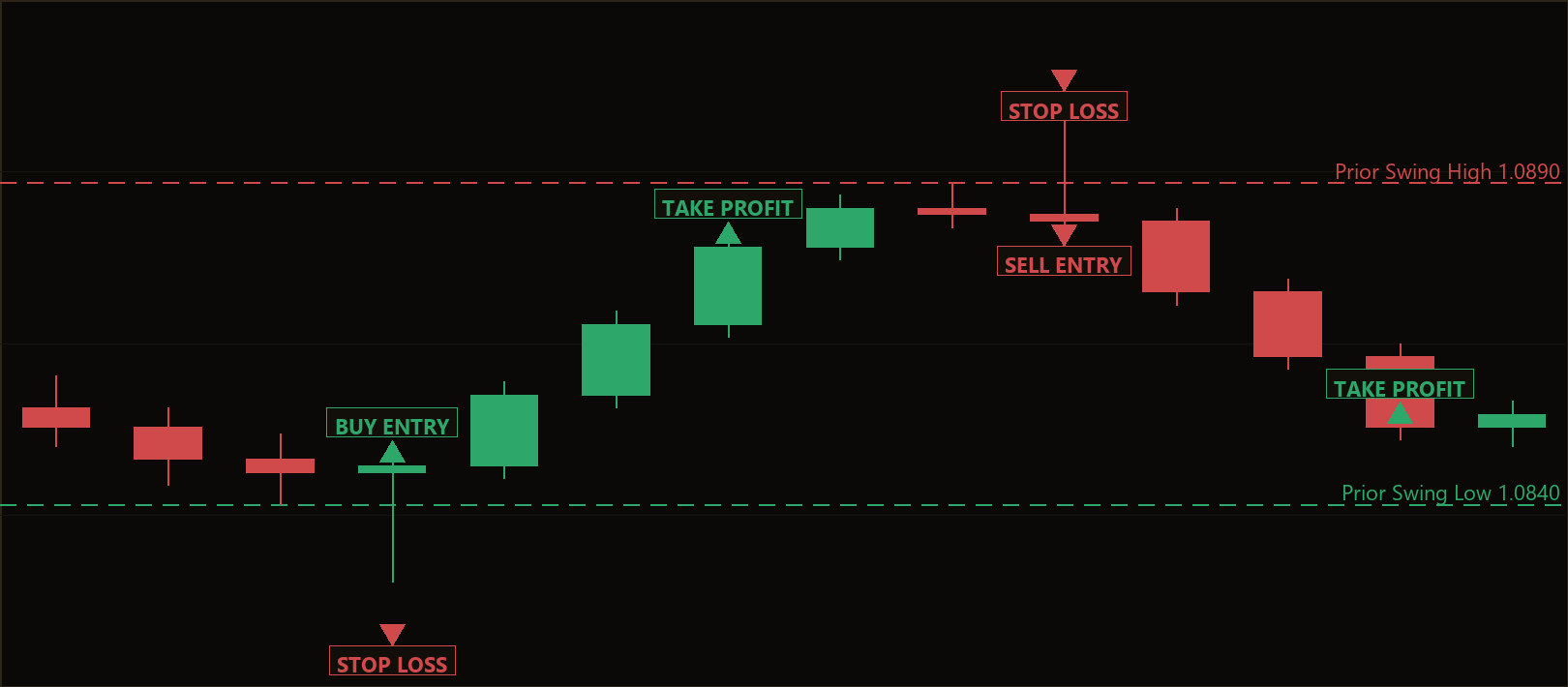
The core idea rests on a well-documented market behavior. Around an obvious swing high (resistance) or swing low (support), other traders place protective stop orders. A brief spike that pokes through one of these levels can trigger those resting stops, only for price to immediately snap back inside the range and close on the "correct" side of the level within the same bar. That failed breakout leaves a long rejection wick and a group of trapped breakout traders. Range Sweep Reclaim is designed to detect that exact footprint and position for the snap-back.
As a learning tool, this strategy suits traders who want to study price action, support and resistance, and the concept of liquidity sweeps without the noise of many indicators. It is best treated as a framework for understanding why false breakouts occur and how rule-based logic can define them objectively. It is not a shortcut to results, and like any reversal approach it carries real risk because it deliberately trades against the immediate move.
How It Works
The strategy evaluates the market once per closed bar on your chosen timeframe. It looks only at the most recently completed candle (the "signal bar") and compares it to the range that came before it. Here is the logic, step by step:
- Define the prior range. The strategy scans the
RangeLookbackbars before the signal bar and records the highest high (prior resistance) and the lowest low (prior support). This is the range the market has respected most recently. - Measure the signal bar. It calculates the candle's total range (high minus low), its body direction (bullish or bearish), and the size of its upper and lower rejection wicks.
- Calculate volatility. It computes the ATR over
AtrPeriodbars. ATR measures average price movement and is used here to pad the stop-loss so it sits a sensible distance beyond the sweep extreme rather than right on it.
Short setup — the strategy signals a sell when all of these are true:
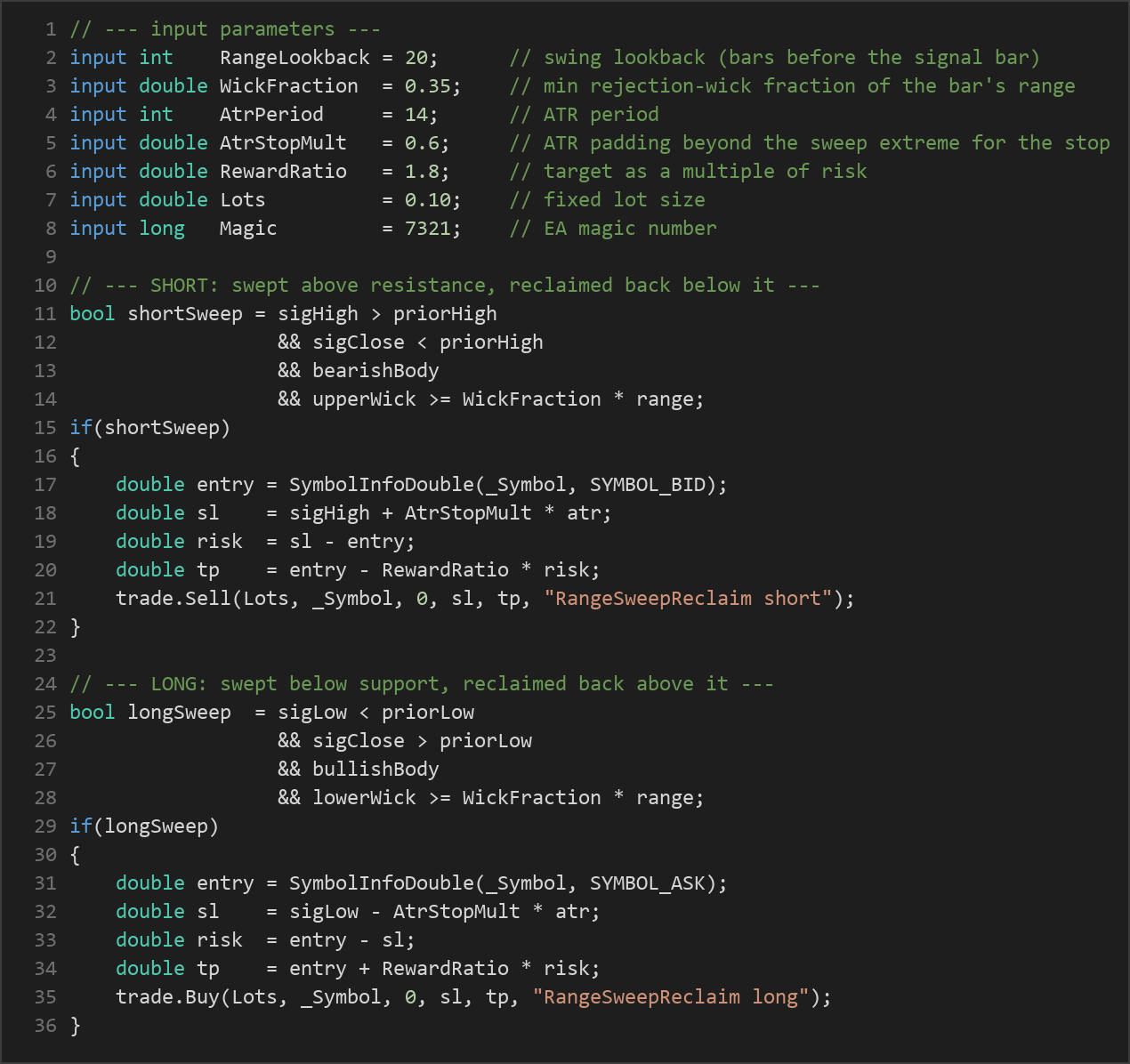
- The signal bar's high pushed above the prior resistance level (the sweep).
- The bar then closed back below that same resistance level (the reclaim).
- The candle has a bearish body (close below open).
- The upper wick is at least
WickFractionof the bar's total range, confirming a dominant rejection from above.
Long setup — the strategy signals a buy when all of these are true:
- The signal bar's low pushed below the prior support level (the sweep).
- The bar then closed back above that same support level (the reclaim).
- The candle has a bullish body (close above open).
- The lower wick is at least
WickFractionof the bar's total range, confirming a dominant rejection from below.
Stop-loss logic: For a short, the stop sits just above the signal bar's high plus AtrStopMult × ATR of padding. For a long, it sits just below the signal bar's low minus the same ATR padding. Placing the stop beyond the rejected extreme means that if the level truly breaks, the trade is closed before the loss grows.
Take-profit logic: The distance from entry to stop defines the risk. The target is set at RewardRatio multiplied by that risk, projected toward the middle of the range. With the default reward ratio of 1.8, the strategy aims for a target 1.8 times the size of the stop distance.
Position management: The strategy holds only one position at a time, identified by its Magic number, and acts just once per closed bar. It will not stack trades or react to every tick.
Strategy Parameters
| Parameter | Default | Min | Max | Description |
|---|---|---|---|---|
| RangeLookback | 20 | 8 | 60 | Number of bars before the signal bar used to define prior support and resistance. Larger values reference broader, more significant swing levels. |
| WickFraction | 0.35 | 0.10 | 0.60 | Minimum size of the rejection wick as a fraction of the candle's total range. Higher values demand a more pronounced rejection before a signal is valid. |
| AtrPeriod | 14 | 5 | 40 | Number of bars used to calculate the Average True Range, which gauges current volatility for stop padding. |
| AtrStopMult | 0.6 | 0.10 | 2.0 | Multiplier applied to ATR to pad the stop-loss beyond the sweep extreme. Larger values create wider, looser stops. |
| RewardRatio | 1.8 | 0.80 | 4.0 | Take-profit target expressed as a multiple of the risk (stop distance). A value of 1.8 targets 1.8 units of reward per unit of risk. |
| Lots | 0.10 | 0.01 | 1.0 | Fixed trade volume in lots. Should be sized appropriately for your account balance and risk tolerance. |
Recommended Chart Settings
Range Sweep Reclaim is a flexible price-action framework, but it tends to be studied most naturally on intraday timeframes such as the M15, M30, or H1 charts, where liquidity sweeps around swing levels are common and clearly visible. Liquid instruments with well-defined ranges — major forex pairs such as EUR/USD or GBP/USD — are a sensible starting point for analysis because their tight spreads reduce the cost of entering near a rejection.
Because the logic is volatility-aware through ATR and range-relative through WickFraction, it can adapt across symbols and timeframes. That said, every market behaves differently. Results will vary across instruments, sessions, and changing volatility conditions, so always test any configuration on the specific symbol and timeframe you intend to study before drawing conclusions.
How to Install on MetaTrader 5
- Download the .ex5 file from the link below
- Copy it to your MT5
MQL5\Expertsfolder - Restart MetaTrader 5 or refresh the Navigator panel
- Drag the EA onto a chart matching the recommended symbol and timeframe
- Configure the input parameters and enable Algo Trading
What to Consider Before Using This EA
Every strategy has strengths and weaknesses, and an honest understanding of both is essential before committing any capital — even on a demo account.
Strengths of this approach:
- It is built on a recognizable, logical market pattern — the failed breakout — rather than curve-fitted indicator combinations.
- The entry rules are strict and objective, requiring a sweep, a reclaim, a body in the right direction, and a dominant wick all at once. This filters out many weak setups.
- Risk is defined at entry: every trade has a stop placed beyond the rejected extreme and a target set as a multiple of that risk.
Known limitations:
- As a counter-trend reversal method, it deliberately trades against the immediate move. In a strong, sustained trend, what looks like a sweep can be the start of a genuine breakout, and the strategy may take losses fighting momentum.
- It only acts on closed bars, so it does not react intrabar. A sharp reversal that completes before the bar closes may be missed.
- Performance is sensitive to parameter choices. A
WickFractionset too low may produce noisy signals, while one set too high may rarely trigger. - Spread, slippage, and entering at the bid/ask near a volatile extreme can erode the theoretical edge, especially on lower-liquidity symbols or during news.
This strategy may underperform in trending markets, during high-impact news events, or on illiquid instruments with erratic wicks. It tends to suit ranging or balanced conditions where levels are respected and false breakouts are common. Treat it as one analytical lens, not a complete trading system.
Risk Management Tips
Sound risk management matters more than any single entry signal. Consider these general principles as part of your education:
- Risk a small, fixed percentage per trade. Many educational sources suggest never risking more than 1–2% of account equity on any single position. Size your
Lotsso that the distance to your stop-loss represents only that small fraction of your balance. - Always trade with a stop-loss. This strategy defines one automatically, but you should understand where it sits and why before going live.
- Test on a demo account first. Run the EA on a demo or in the MT5 Strategy Tester across different market conditions and timeframes before considering real funds. This builds familiarity with how often it trades and how it behaves in losing streaks.
- Understand drawdown. Every strategy experiences losing runs. Know how a sequence of losses would affect your account and whether you could tolerate it emotionally and financially.
- Avoid over-leverage. Leverage magnifies both gains and losses. Conservative position sizing is a key part of survival.
- Keep a trading journal. Recording why each trade triggered and how it resolved turns the strategy into a genuine learning exercise.
Risk Warning
Trading foreign exchange, CFDs, and other leveraged financial instruments involves substantial risk of loss and is not suitable for all investors. The strategies and tools discussed on this page are provided for educational purposes only and do not constitute financial advice, investment recommendations, or solicitation to trade. Always consult a qualified financial adviser before making trading decisions. Past backtest performance is not indicative of future results.
Downloads
- Expert Advisor: RangeSweepReclaim.ex5 (2 downloads)
- Source Code: RangeSweepReclaim.mq5 (3 downloads)
- Documentation: RangeSweepReclaim.pdf (2 downloads)