Disclaimer: This article is for educational and informational purposes only. It does not constitute financial or investment advice. Trading forex and CFDs carries significant risk of loss. Past performance of any strategy — including backtests — does not guarantee future results. Never trade with money you cannot afford to lose.
What Is This Strategy?
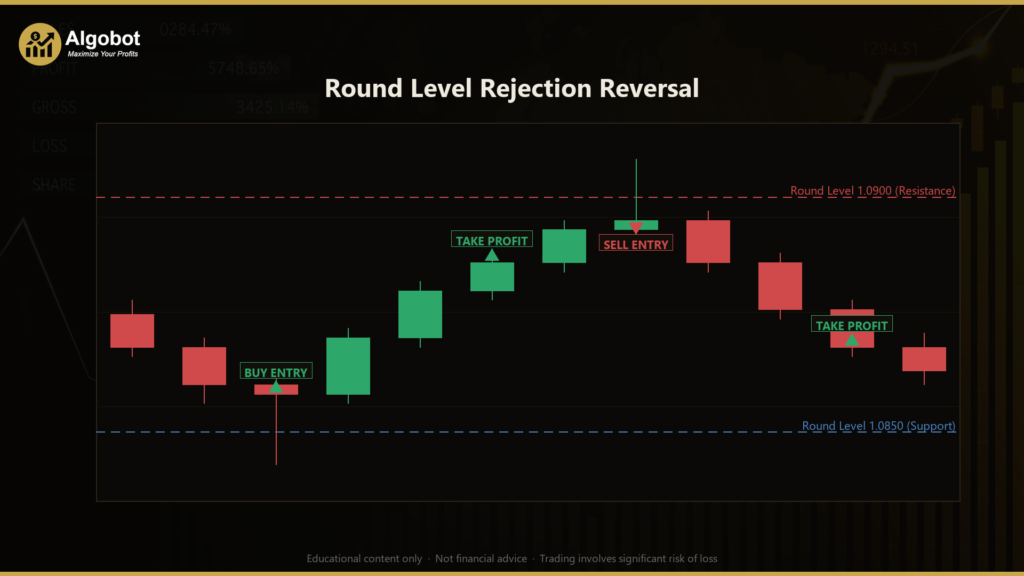
The Round Level Rejection Reversal is a pure price-action trading strategy for MetaTrader 5 that uses no technical indicators of any kind — no moving averages, no RSI, no ATR, no Bollinger Bands. Instead, it focuses on a single, time-tested concept: the pin-bar rejection of psychological round-number price levels. A pin bar is a candle with a small body and one long "wick" or "tail," showing that price tried to push in one direction but was firmly rejected and pushed back the other way.
The strategy is built around the idea that round numbers — the ".00" and ".50" "figure" levels such as 1.1000, 1.1050, and 1.1100 on EURUSD, or 1950.00 and 1950.50 on Gold — act as natural horizontal support and resistance. Because limit orders, stop-loss clusters, and option barriers tend to congregate at these obvious prices, the market frequently pokes through a figure and then snaps back. The Round Level Rejection Reversal is designed to identify that snap-back and trade in the direction of the rejection. These levels are non-repainting and known in advance, since they sit on a fixed grid that never moves.
This is a mean-reversion / reversal style system best suited to traders who want to study how support and resistance behave around obvious price zones. As a learning tool, it is valuable precisely because it strips away indicators and forces you to reason about raw candle structure and where the market is likely to react. This is a strategy analysis intended for education — not a promise of any particular outcome.
How It Works
The strategy acts once per newly-closed candle on the chart's timeframe and holds at most one position at a time. Before evaluating any signal, it checks that the current spread is not wider than your configured limit, so it avoids entering during costly, illiquid conditions.
When a candle closes, the strategy examines its structure relative to the nearest round-number level:
- The grid: Round levels are spaced
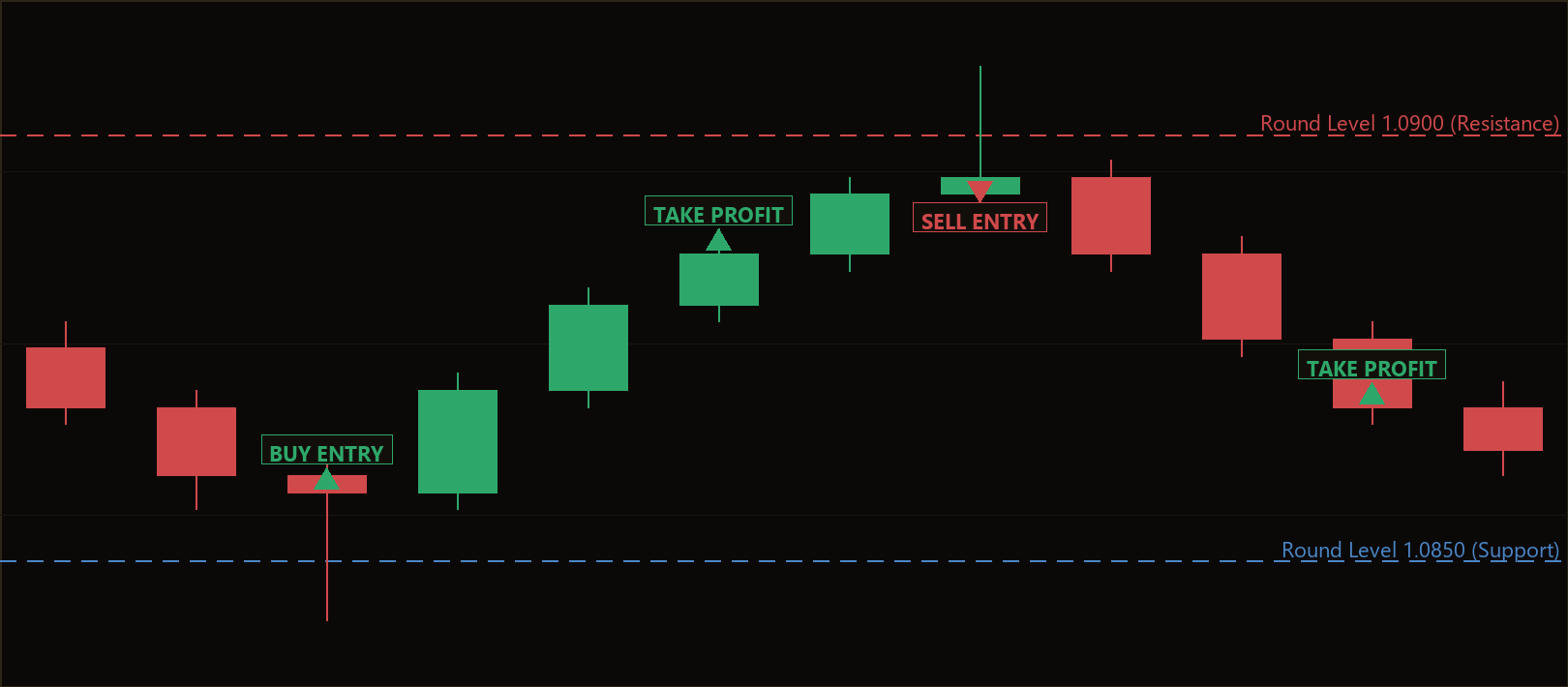
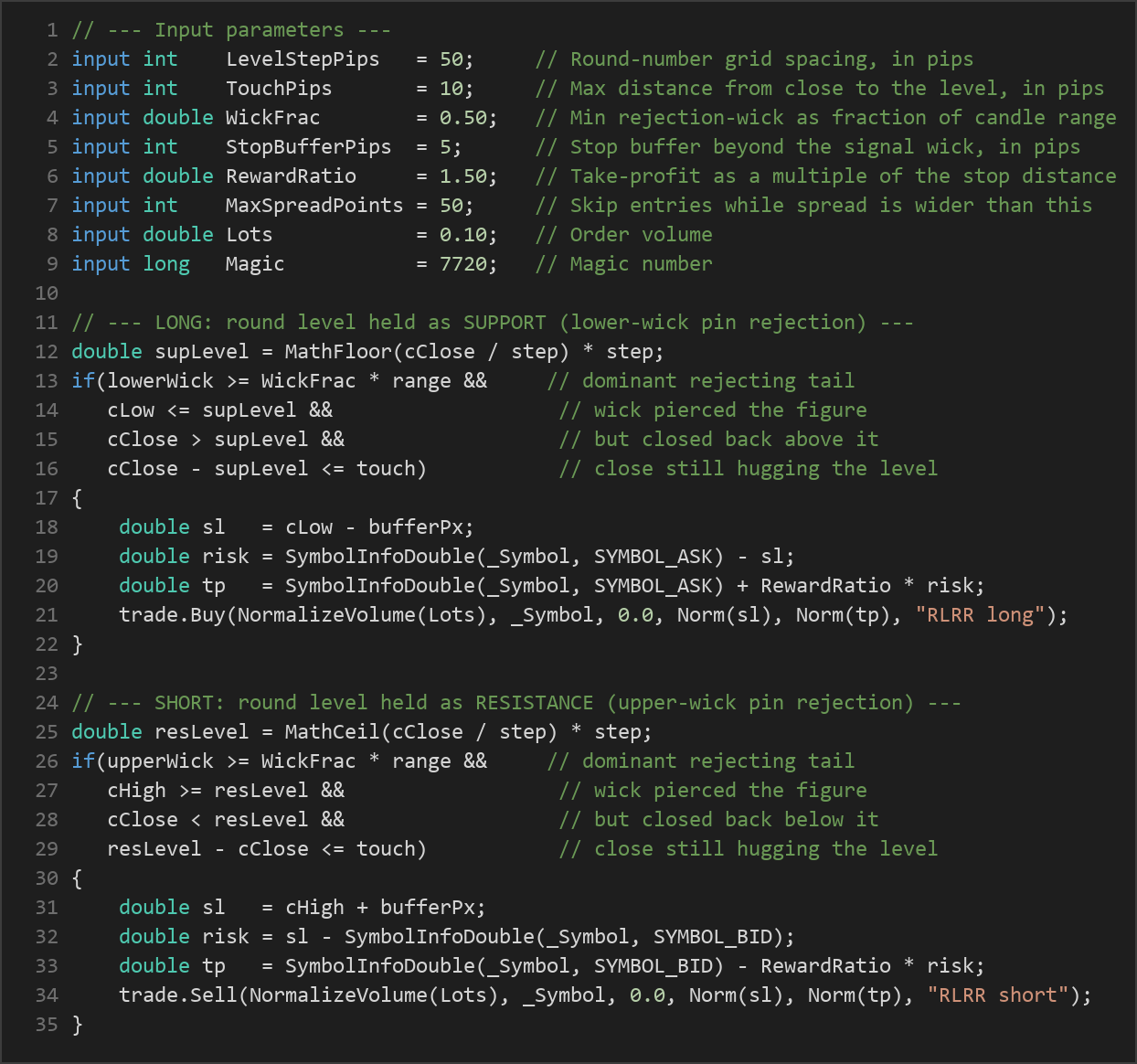
LevelStepPipsapart (50 pips by default, which produces the familiar ".00" and ".50" figures). Everything is measured in pips derived from the symbol's own specification, so the same logic adapts to FX pairs, metals, indices, or crypto without hard-coding price scales. - Long (support) signal: The strategy signals a potential buy when a candle's low pierces down to or through a round level, but the candle closes back above it, leaving a long lower wick. That lower wick must be at least
WickFracof the candle's full high-to-low range, and the close must sit withinTouchPipsof the level. This pattern suggests the figure acted as support. - Short (resistance) signal: The mirror image. The strategy signals a potential sell when a candle's high pierces up to or through a round level, but the candle closes back below it, leaving a long upper wick of at least
WickFracof the range, with the close withinTouchPipsof the level. This suggests the figure acted as resistance. - Stop-loss logic: The stop is placed just beyond the signal candle's rejecting wick — below the low for longs, above the high for shorts — plus a
StopBufferPipscushion. This ties the stop to actual market structure rather than an arbitrary fixed distance. - Take-profit logic: The take-profit is set at a fixed
RewardRatiomultiple of the stop distance. With the default 1.50 ratio, the target is 1.5 times the risk, giving each trade a controlled, known reward-to-risk profile before it is ever placed. - Exit management: Once a trade is open, the structural stop-loss and the fixed take-profit manage the exit. The strategy does not add to positions or open a second trade until the first one closes.
The strategy also validates that the calculated stop and target respect the broker's minimum stop distance; if a signal would produce a stop or target that is too tight, the trade is skipped.
Strategy Parameters
| Parameter | Default | Min | Max | Description |
|---|---|---|---|---|
| LevelStepPips | 50 | 10 | 200 | Spacing of the round-number grid, in pips. A value of 50 targets the ".00" and ".50" figure levels. |
| TouchPips | 10 | 1 | 50 | Maximum distance (in pips) the candle's close may sit from the level. Keeps entries tightly anchored to the figure. |
| WickFrac | 0.50 | 0.20 | 0.80 | Minimum length of the rejection wick as a fraction of the candle's full range. Higher values demand a more dominant rejection tail. |
| StopBufferPips | 5 | 1 | 50 | Extra buffer (in pips) placed beyond the signal candle's wick when setting the stop-loss. |
| RewardRatio | 1.50 | 0.50 | 5.00 | Take-profit distance expressed as a multiple of the stop distance (reward-to-risk ratio). |
| MaxSpreadPoints | 50 | 0 | 500 | Skip new entries while the spread (in points) is wider than this value. Set to 0 to disable the filter. |
| Lots | 0.10 | 0.01 | 1.00 | Order volume, in lots. Snapped to the symbol's allowed volume step and limits. |
| Magic | 7720 | 0 | 9,999,999 | Unique identifier so the EA only manages its own trades. |
Recommended Chart Settings
The Round Level Rejection Reversal was designed for intraday figure-level day-trading, where round numbers exert the most visible influence. Lower timeframes such as M5, M15, and M30 tend to suit this approach best, as they produce frequent, well-defined pin-bar rejections at the round-number grid. The default 50-pip grid is calibrated for typical FX pairs, but because all distances are derived from the symbol spec, the logic also applies to metals, indices, and crypto.
The strategy can run on any symbol, but it tends to be most coherent on liquid instruments with tight spreads where round numbers are widely watched, such as major FX pairs and Gold. Keep in mind that results will vary across different market conditions — the same settings can behave very differently in trending versus ranging environments.
How to Install on MetaTrader 5
- Download the .ex5 file from the link below
- Copy it to your MT5
MQL5\Expertsfolder - Restart MetaTrader 5 or refresh the Navigator panel
- Drag the EA onto a chart matching the recommended symbol and timeframe
- Configure the input parameters and enable Algo Trading
What to Consider Before Using This EA
Strengths. The clearest advantage of this approach is its simplicity and transparency. Because it uses no indicators, there is nothing to lag, repaint, or curve-fit to past data in hidden ways — round levels are fixed and known in advance. The structural stop and fixed reward-to-risk target give every trade a defined, pre-planned risk profile, which is excellent discipline for a developing trader to study. Requiring a confirmed pin-bar rejection, rather than trading a level on touch alone, helps filter out many weak setups.
Limitations. Round numbers are not magic; price often slices straight through a strong figure during high-momentum moves or major news. In a strong trend, repeated reversal attempts against the trend can produce a string of losing trades, since the strategy is fundamentally counter-trend at the moment of entry. The fixed reward-to-risk target may exit before a larger move completes, or may be too far away in quiet, choppy conditions. The TouchPips and WickFrac filters reduce false signals but also mean some genuine rejections are skipped.
Where it may underperform. Expect weaker behavior during strong trending phases, around scheduled high-impact news, and on illiquid symbols or sessions with wide spreads. The MaxSpreadPoints filter helps, but it cannot fully compensate for fast, gapping markets. Always test the strategy across multiple symbols and market regimes before drawing conclusions.
Risk Management Tips
Regardless of the strategy, sound risk management is what protects an account over time. Consider these general educational principles:
- Risk a small, fixed fraction per trade. Many educators suggest risking no more than 1–2% of account equity on any single trade. Size your
Lotsso that the distance to the structural stop represents that small fraction, rather than picking a lot size at random. - Always use a demo account first. Run the EA on a demo or a small test account until you understand how it behaves across different conditions and timeframes.
- Understand drawdown. Even a well-designed system experiences losing streaks. Knowing the historical depth of consecutive losses helps you size positions you can sit through emotionally.
- Account for costs. Spreads, commissions, and slippage all erode results, especially on lower timeframes. The spread filter helps, but real trading costs should be part of your evaluation.
- Never over-leverage. Leverage amplifies both gains and losses. Keep total exposure modest and avoid stacking correlated positions across symbols.
Treat this EA as a structured way to study price action around round numbers — a learning instrument, not a shortcut.
Risk Warning
Trading foreign exchange, CFDs, and other leveraged financial instruments involves substantial risk of loss and is not suitable for all investors. The strategies and tools discussed on this page are provided for educational purposes only and do not constitute financial advice, investment recommendations, or solicitation to trade. Always consult a qualified financial adviser before making trading decisions. Past backtest performance is not indicative of future results.
Downloads
- Expert Advisor: RoundLevelRejectionReversal.ex5 (61 downloads)
- Source Code: RoundLevelRejectionReversal.mq5 (58 downloads)
- Documentation: RoundLevelRejectionReversal.pdf (64 downloads)