Disclaimer: This article is for educational and informational purposes only. It does not constitute financial or investment advice. Trading forex and CFDs carries significant risk of loss. Past performance of any strategy — including backtests — does not guarantee future results. Never trade with money you cannot afford to lose.
What Is This Strategy?
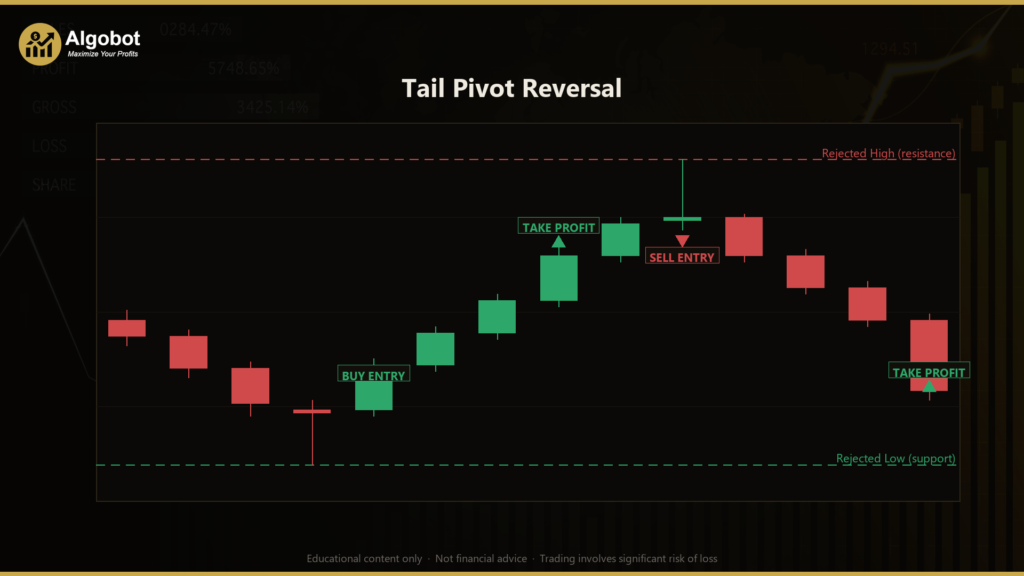
The Tail Pivot Reversal is a pure price-action reversal strategy for MetaTrader 5 that trades the classic pin bar (also called a rejection candle) without using a single technical indicator. There are no moving averages, no oscillators, no ATR — every decision is derived directly from raw candle geometry: the highs, lows, opens, closes, and the wicks (the thin "tails" that extend beyond a candle's body). A pin bar is a candle with a long tail on one side and a small body, and it represents an auction that pushed price to a new extreme and was immediately rejected.
This strategy is built for reversal trading at local turning points. It looks for the moment when price thrusts to a fresh short-term high or low, gets rejected, and then shows follow-through in the opposite direction. Because it relies on raw structure rather than smoothed indicators, it tends to be most relevant on markets and timeframes where individual candles carry meaningful information — for example, swing-trading timeframes where a single rejection bar reflects genuine supply or demand rather than random noise.
As a learning tool, the Tail Pivot Reversal is well suited to traders who want to understand how price action and candle anatomy work without the abstraction of indicators. It demonstrates several important concepts in one package: identifying rejection wicks, requiring confirmation before entering, placing structural stop-losses, and sizing targets with a reward-to-risk multiple. Treat it as a study of disciplined reversal mechanics rather than a profit opportunity.
How It Works
The strategy evaluates one signal at the open of each new candle. It inspects the candle that just closed (the "rejection bar") and the lookback window of candles behind it. Rather than entering immediately on a rejection, it arms a pending stop order and only enters if the market trades through it — demanding confirmation that the reversal has follow-through.
Entry conditions (the strategy signals a setup when):
- The just-closed candle has a small body — the distance between open and close must be no larger than
MaxBodyPctof the candle's full range. This filters out strong directional candles and keeps only those dominated by a tail. - For a bullish setup, the candle prints at a fresh local low (its low is lower than every low in the lookback window), the lower wick is at least
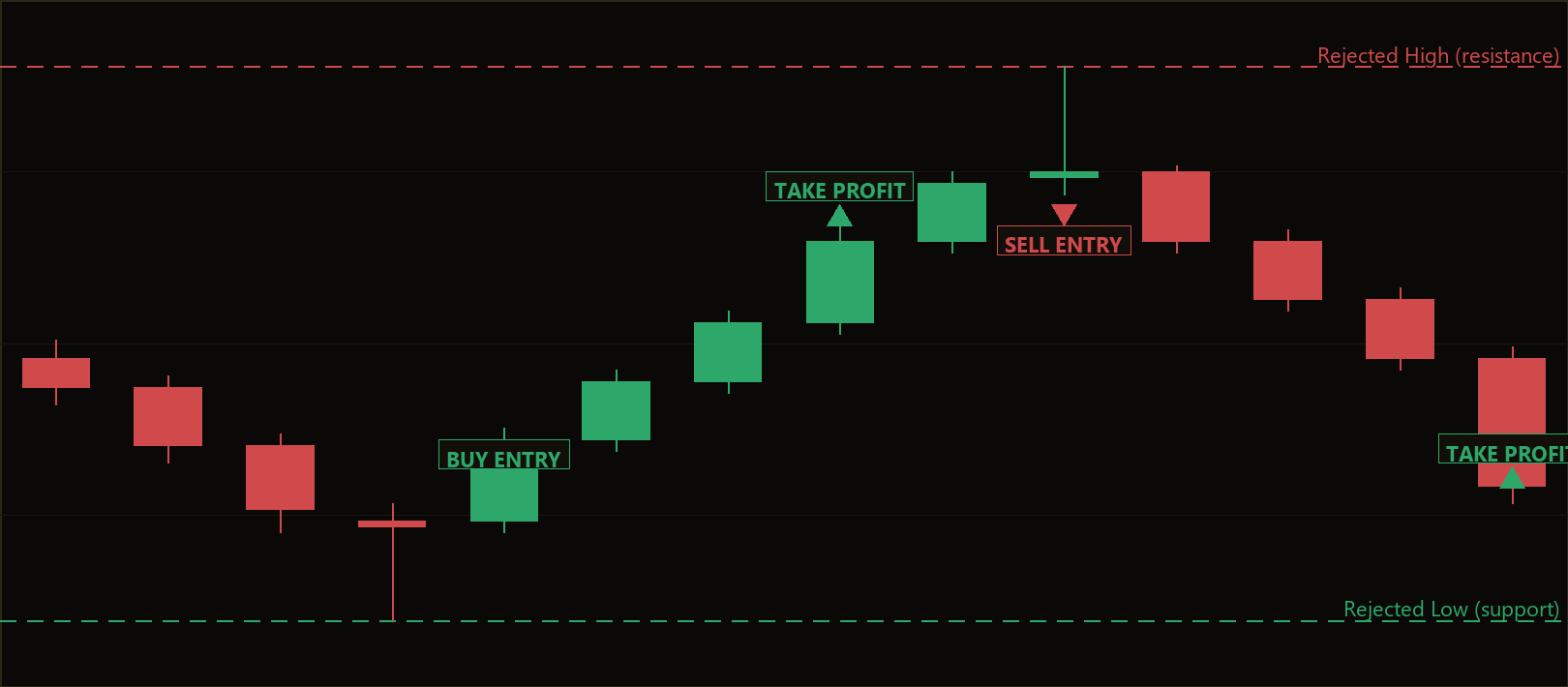
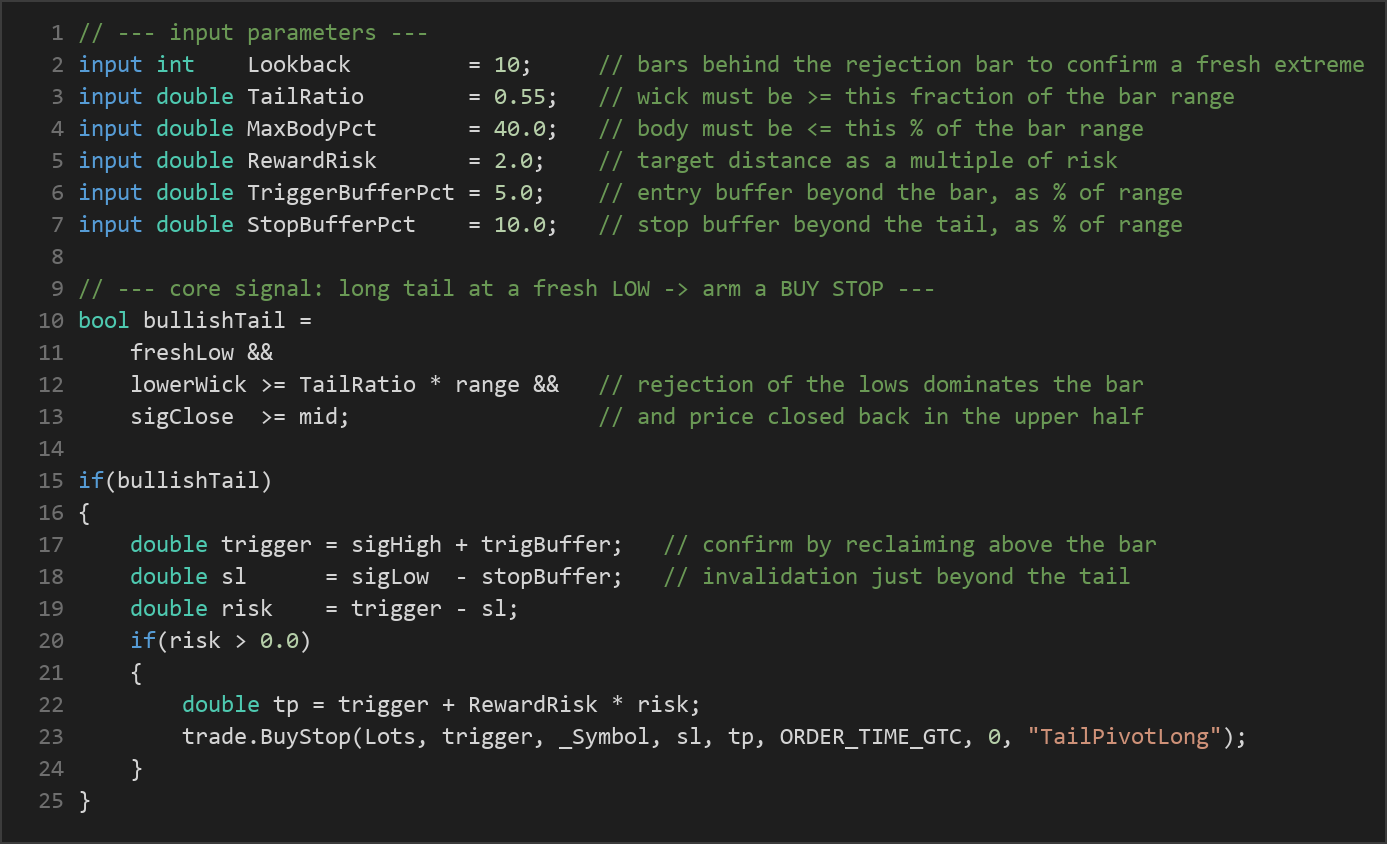
TailRatioof the range, and the candle closes back in the upper half of its range. This is the footprint of sellers running out of momentum at a low. - For a bearish setup, the candle prints at a fresh local high, the upper wick dominates the range, and the candle closes back in the lower half.
- When a bullish setup appears, the strategy arms a buy stop above the rejection bar's high (plus a small trigger buffer). When a bearish setup appears, it arms a sell stop below the rejection bar's low (minus the buffer).
Confirmation and order lifetime:
- The pending order is valid for exactly one bar. If the next candle does not trade through the trigger price, the order is cancelled at the next bar open so a stale signal never lingers.
- The strategy never stacks trades — if a position is already open on its magic number, no new orders are armed.
Stop-loss logic:
- The stop-loss sits just beyond the rejected tail extreme — below the rejection bar's low for longs, above its high for shorts — extended by
StopBufferPctof the range. This is a structural, price-derived invalidation point: if price returns through the tail, the reversal premise is wrong.
Take-profit logic:
- The target is placed at a configurable reward-to-risk multiple. The strategy measures the risk (distance from entry trigger to stop) and projects the take-profit at
RewardRisktimes that distance in the trade's direction. With the default of 2.0, the target sits twice as far from entry as the stop.
Strategy Parameters
| Parameter | Default | Min | Max | Description |
|---|---|---|---|---|
| Lookback | 10 | 4 | 40 | Number of bars behind the rejection candle that must be cleared for the extreme to count as "fresh." Larger values demand a more significant local high or low. |
| TailRatio | 0.55 | 0.35 | 0.80 | Minimum size of the rejection wick as a fraction of the candle's full range. Higher values require a more pronounced tail. |
| MaxBodyPct | 40.0 | 10.0 | 70.0 | Maximum body size as a percentage of the candle range. Lower values insist on a smaller body and a more tail-dominant candle. |
| RewardRisk | 2.0 | 0.5 | 5.0 | Take-profit distance expressed as a multiple of the risk (entry-to-stop distance). |
| TriggerBufferPct | 5.0 | 0.0 | 30.0 | Extra distance beyond the rejection bar, as a percentage of range, that price must reach to trigger the pending entry. |
| StopBufferPct | 10.0 | 0.0 | 50.0 | Extra distance beyond the tail extreme, as a percentage of range, where the stop-loss is placed. |
| Lots | 0.10 | 0.01 | 1.0 | Fixed order volume in lots for each trade. |
Recommended Chart Settings
The Tail Pivot Reversal is designed as a single-symbol, single-timeframe price-action study. Because it depends on each candle carrying meaningful structure, it is generally most coherent on higher timeframes such as H1, H4, or D1, where a rejection wick reflects a genuine shift in supply and demand rather than intrabar noise. It can be applied to liquid forex pairs, indices, or other instruments that produce clean candle structure.
There is no single "correct" symbol or timeframe — the parameters are deliberately exposed so you can study how the behavior changes. Results will vary substantially across different markets, sessions, and volatility regimes, and a setting that looks reasonable on one instrument may behave very differently on another. Always test on a demo account before drawing any conclusions.
How to Install on MetaTrader 5
- Download the
TailPivotReversal.ex5file from the link below. - Copy it to your MT5
MQL5\Expertsfolder (in MetaTrader 5, use File → Open Data Folder to locate it). - Restart MetaTrader 5 or right-click the Navigator panel and choose Refresh.
- Drag the EA onto a chart matching the recommended symbol and timeframe.
- Configure the input parameters and enable Algo Trading (the toolbar button must be green).
What to Consider Before Using This EA
The Tail Pivot Reversal has several genuine strengths as a learning model. Requiring confirmation through a pending stop order is more disciplined than blindly fading a rejection candle on its close — many false pin bars never see follow-through and are simply skipped. Its stops are structural rather than arbitrary, sitting just beyond the tail that defined the setup, and its one-bar order lifetime prevents stale signals from accumulating. The complete absence of indicators also makes its logic transparent and easy to reason about.
That said, every reversal approach has well-known limitations. Pin bars are common, and not every rejection marks a turning point — in a strong trend, fading fresh extremes can lead to repeated stops as price continues in the dominant direction. The strategy may underperform in choppy, low-volatility conditions where wicks form for noise reasons, and during fast news-driven moves where the confirmation entry can fill at a poor price. The fixed lot size means position risk varies with the stop distance, which changes from setup to setup. Because the take-profit is a fixed reward-to-risk multiple, the strategy makes no attempt to read where price is likely to stall — the target may sit beyond a level the market respects. None of this makes the approach invalid; it simply means the strategy should be studied, tested, and understood rather than trusted on faith.
Risk Management Tips
Sound risk management matters more than any single strategy. Consider these general principles as part of your education:
- Risk a small, fixed fraction per trade. Many educators suggest never risking more than 1–2% of account equity on any single position. Because this EA uses a fixed lot size, you may need to adjust the
Lotsinput to keep risk consistent as the stop distance changes. - Always demo first. Run the strategy on a demo account across many trades and varied market conditions before considering any live use.
- Understand drawdown. Even a well-designed approach experiences losing streaks. Know the maximum drawdown you are emotionally and financially prepared to tolerate.
- Keep position sizing deliberate. Match your lot size to your account size and risk tolerance, not to a desire for larger outcomes.
- Review and journal. Treat each trade as a data point for learning, not a verdict on the strategy.
Risk Warning
Trading foreign exchange, CFDs, and other leveraged financial instruments involves substantial risk of loss and is not suitable for all investors. The strategies and tools discussed on this page are provided for educational purposes only and do not constitute financial advice, investment recommendations, or solicitation to trade. Always consult a qualified financial adviser before making trading decisions. Past backtest performance is not indicative of future results.
Downloads
- Expert Advisor: TailPivotReversal.ex5 (57 downloads)
- Source Code: TailPivotReversal.mq5 (61 downloads)
- Documentation: TailPivotReversal.pdf (66 downloads)