Disclaimer: This article is for educational and informational purposes only. It does not constitute financial or investment advice. Trading forex and CFDs carries significant risk of loss. Past performance of any strategy — including backtests — does not guarantee future results. Never trade with money you cannot afford to lose.
What Is This Strategy?
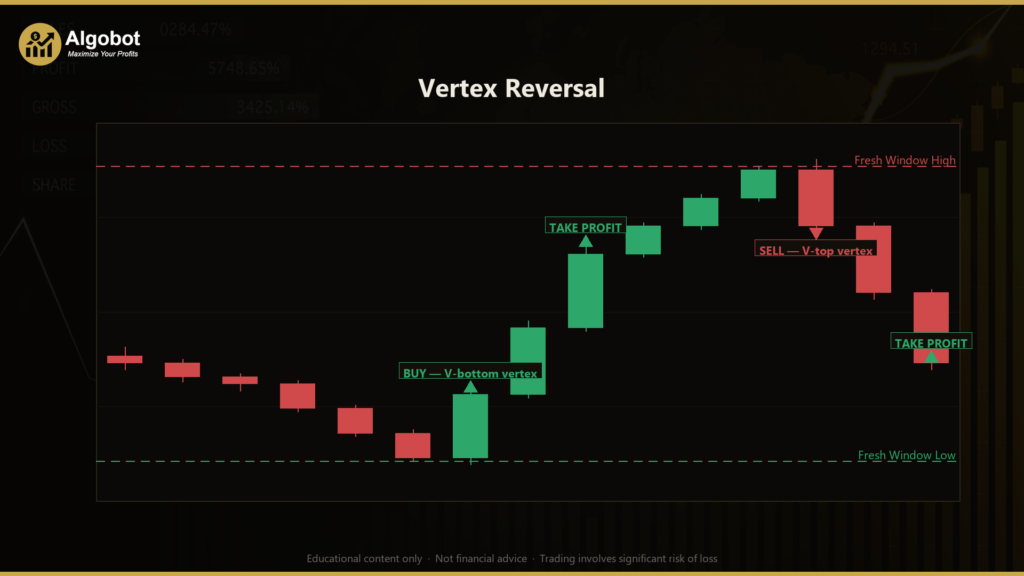
Vertex Reversal is a pure price-action trading strategy for MetaTrader 5 that hunts for sharp "V-shaped" turning points — moments when a short directional run is violently undone by a single dominant candle. Unlike most systems, it uses no indicators of any kind: there are no moving averages, no oscillators, and no Average True Range (ATR) anywhere in the logic. Every decision is made from raw candle geometry — the highs, lows, opens, closes, and ranges of recent bars. The trading style is counter-trend swing reversal with a mean-reversion flavour, meaning it looks to fade exhausted moves at the edges of a range rather than follow a trend.
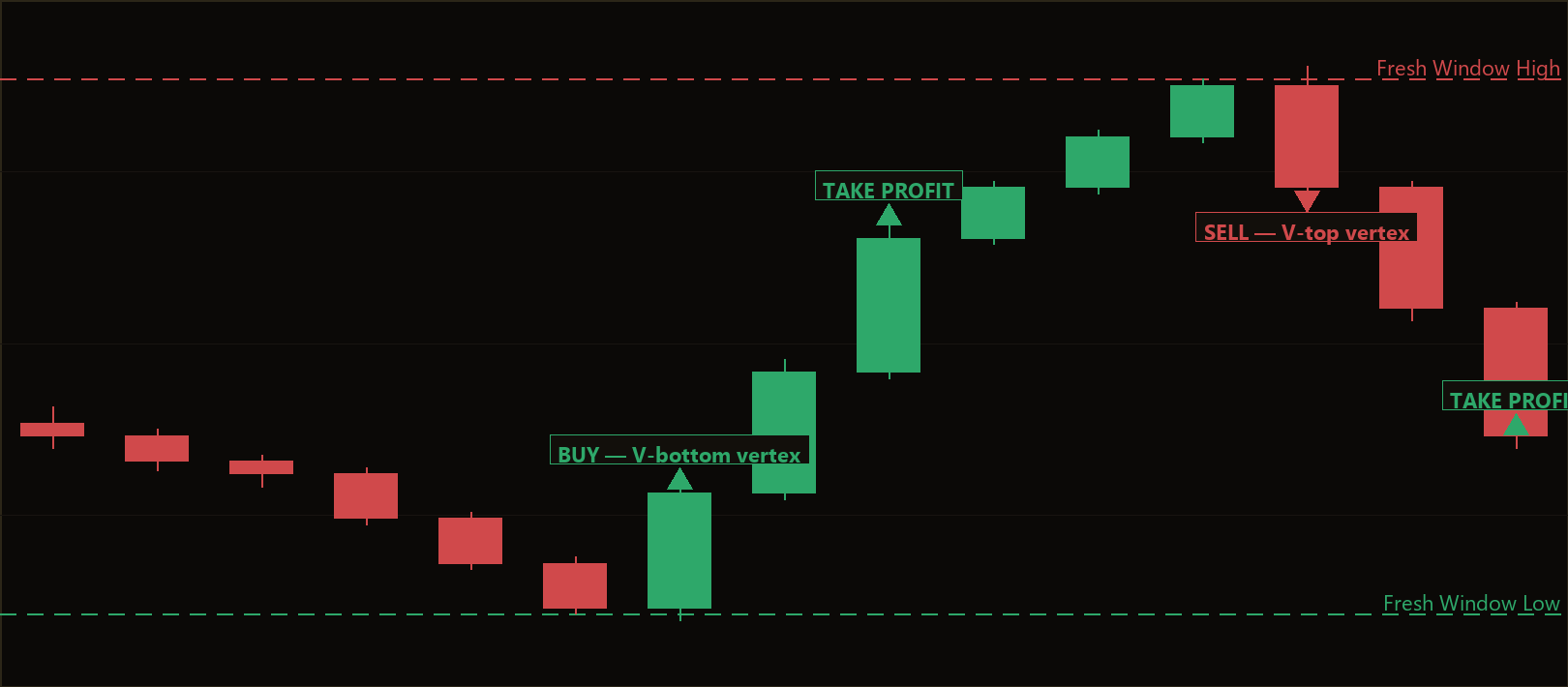
The core idea models the abrupt "snap-back" that frequently marks the end of a brief, over-extended leg. Most reversal patterns confirm slowly — a pin bar here, a climax bar followed by a separate rejection bar there. Vertex Reversal instead demands that one candle, which it calls the "vertex bar," single-handedly erases the move that preceded it. That candle must reach a fresh local extreme, engulf the bar before it, expand well beyond the average size of the leg it is reversing, and close strongly in the new direction. When all of those things line up at once, it is the market's clearest tell that the side previously in control was trapped and is being run over.
As a learning tool, this strategy is well suited to traders who want to study candlestick structure and price behaviour at extremes without leaning on lagging indicators. It was built with XAU/USD (gold) and GBP/USD in mind on intraday timeframes, but it locks to no symbol and runs on whatever chart you attach it to. Treat it as a framework for understanding how reversals form, not as a shortcut to results.
How It Works
The strategy evaluates once per freshly closed bar and only ever holds one position at a time. The most recently closed candle is the "vertex bar," the bars before it form the "leg," and a lookback window is scanned to confirm a fresh extreme. Here is what the strategy checks before it signals an entry.
Shared filters (both directions):
- Expansion check — The vertex bar's range (high minus low) must be larger than
ExpansionMulttimes the average range of the leg it is reversing. This filters out quiet, narrow candles and keeps only abnormally wide "snap" bars. - Fresh extreme — The strategy scans the lookback window that precedes the vertex bar and records the highest high and lowest low. The vertex bar must tag a brand-new extreme of that window.
- One position rule — If a position with the strategy's magic number already exists on the symbol, no new trade is opened. The stop-loss and take-profit manage every exit.
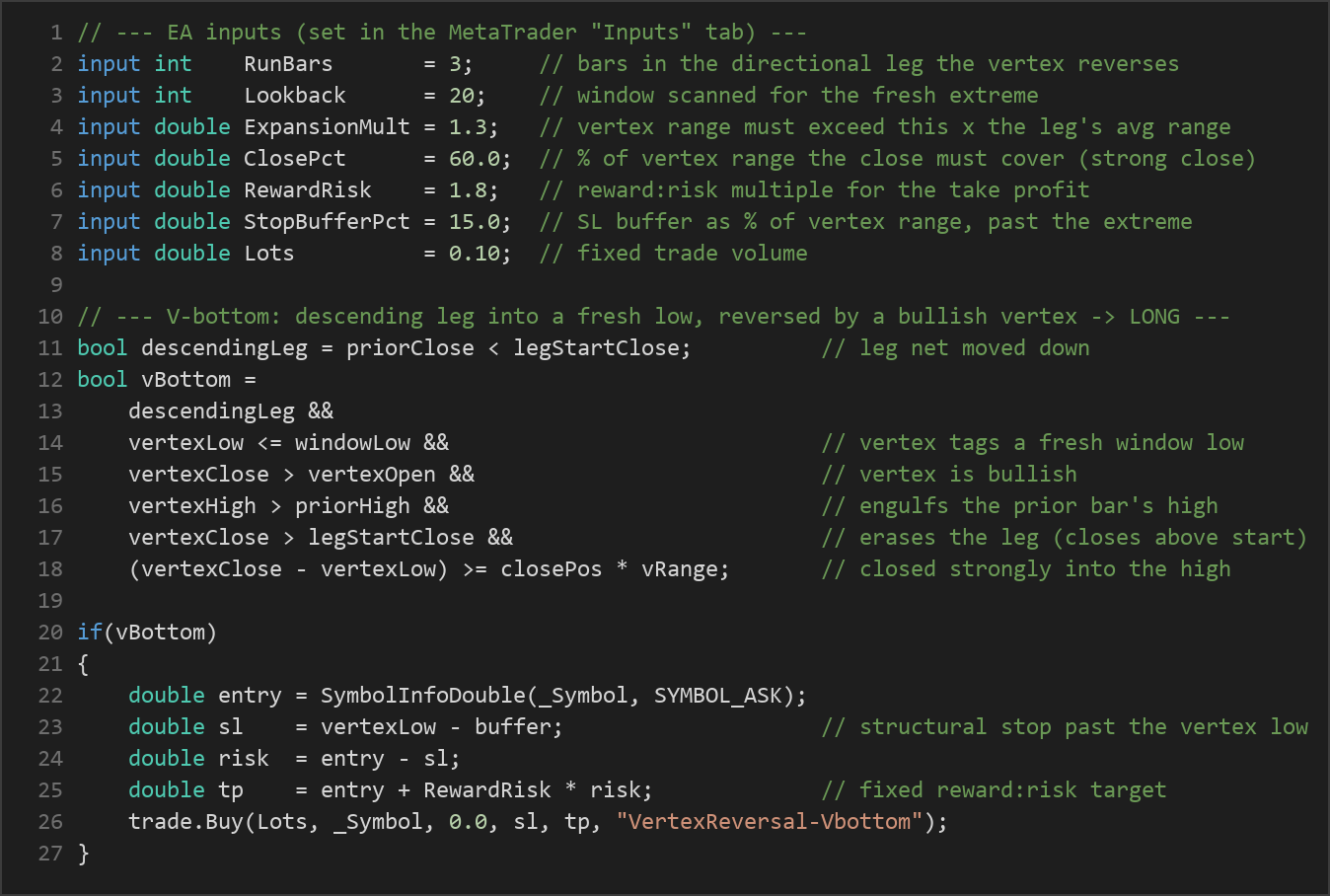
The strategy signals a LONG (V-bottom) when all of the following are true:
- The leg was descending — the close just before the vertex is lower than the close where the leg began.
- The vertex bar tags a fresh window low.
- The vertex bar is bullish (closes above its open).
- The vertex bar engulfs the prior bar's high.
- The vertex bar's close jumps back above the close where the leg started, erasing the entire move in one bar.
- The close lands strongly into the high — the distance from the low to the close covers at least
ClosePctpercent of the vertex range.
The strategy signals a SHORT (V-top) under the exact mirror image: an ascending leg drives into a fresh window high, then a wide bearish vertex bar engulfs the prior bar's low, closes back below where the leg began, and closes strongly into its low.
Stop-loss logic: The stop is structural, placed just past the vertex bar's extreme. For longs it sits below the vertex low; for shorts it sits above the vertex high. A small buffer — StopBufferPct percent of the vertex range — is added beyond that extreme to give the trade breathing room.
Take-profit logic: The target is a fixed reward:risk multiple. The strategy measures the distance from entry to the structural stop (the "risk"), multiplies it by RewardRisk, and projects that distance from the entry to set the take-profit. With the default of 1.8, the target sits 1.8 times further away than the stop.
Strategy Parameters
| Parameter | Default | Min | Max | Description |
|---|---|---|---|---|
| RunBars | 3 | 2 | 8 | Number of bars in the directional leg the vertex bar must reverse. |
| Lookback | 20 | 6 | 60 | Size of the window scanned for the fresh high/low extreme. |
| ExpansionMult | 1.3 | 1.0 | 3.0 | How much wider the vertex bar's range must be versus the leg's average range. |
| ClosePct | 60.0 | 40.0 | 90.0 | Percentage of the vertex range the close must cover, confirming a strong close. |
| RewardRisk | 1.8 | 0.5 | 5.0 | Reward-to-risk multiple used to place the take-profit relative to the stop. |
| StopBufferPct | 15.0 | 0.0 | 100.0 | Extra stop-loss buffer, as a percentage of the vertex range, beyond the extreme. |
| Lots | 0.10 | 0.01 | 1.0 | Fixed trade volume (lot size) per position. |
Recommended Chart Settings
Vertex Reversal was designed with XAU/USD (gold) and GBP/USD in mind on the M15 to H1 timeframes, where short, sharp legs and clean reversals tend to appear frequently. That said, the logic is symbol- and timeframe-agnostic and will run on whatever primary chart you attach it to. Because the strategy fades extremes, its behaviour can change dramatically between volatile and quiet sessions. Results will vary across different instruments, brokers, spreads, and market conditions, so always study how it behaves on your specific chart before drawing any conclusions.
How to Install on MetaTrader 5
- Download the .ex5 file from the link below
- Copy it to your MT5
MQL5\Expertsfolder - Restart MetaTrader 5 or refresh the Navigator panel
- Drag the EA onto a chart matching the recommended symbol and timeframe
- Configure the input parameters and enable Algo Trading
What to Consider Before Using This EA
Every approach has trade-offs, and an honest look at both sides will make you a better student of the markets.
Strengths of this approach:
- No indicators, no lag. Because it reads raw candles, the strategy reacts to structure as it forms rather than waiting for a smoothed indicator to catch up.
- Defined risk on every trade. The structural stop and fixed reward:risk target mean each position has a clear, pre-planned exit on both sides.
- Strict entry filter. Requiring a fresh extreme, an engulfing snap, an expansion bar, and a strong close together keeps the strategy selective and avoids many weak setups.
Known limitations:
- Counter-trend by nature. Fading a move means trading against momentum. In a strong, persistent trend, "fresh extremes" can keep printing in the same direction, and reversal signals may be run over.
- Trade frequency. The demanding filter set means qualifying setups can be rare on some symbols and timeframes, which can make evaluation slow.
- Sensitivity to volatility. The expansion and close filters depend on candle sizing, so abnormally wide spreads, gaps, or news spikes can distort what counts as a valid vertex bar.
- Fixed lot sizing. The
Lotsparameter does not scale with account equity, so position size must be set deliberately for your balance.
The strategy may historically underperform in choppy, low-volatility ranges where no clean leg develops, and in trending markets where reversals fail repeatedly. Use it as a lens for understanding reversal mechanics, not as a set-and-forget solution.
Risk Management Tips
Sound risk management matters far more than any single entry signal. Keep these general principles in mind as you study any strategy:
- Risk a small, fixed fraction per trade. Many educators suggest never risking more than 1–2% of your account on a single position, so a string of losing trades cannot threaten your capital.
- Size positions to your stop, not your hopes. Let the distance to your structural stop and your chosen risk percentage determine lot size, rather than the other way around.
- Always start on a demo account. Test the strategy in simulated conditions until you understand its behaviour, its drawdowns, and how it reacts to different sessions.
- Understand drawdown. Even a well-built reversal strategy will endure losing streaks. Know the maximum drawdown you are willing to tolerate before you commit real funds.
- Account for costs. Spreads, commissions, and slippage all eat into outcomes, especially on a strategy that trades volatile instruments like gold.
Risk Warning
Trading foreign exchange, CFDs, and other leveraged financial instruments involves substantial risk of loss and is not suitable for all investors. The strategies and tools discussed on this page are provided for educational purposes only and do not constitute financial advice, investment recommendations, or solicitation to trade. Always consult a qualified financial adviser before making trading decisions. Past backtest performance is not indicative of future results.
Downloads
- Expert Advisor: VertexReversal.ex5 (65 downloads)
- Source Code: VertexReversal.mq5 (56 downloads)
- Documentation: VertexReversal.pdf (61 downloads)